


What a multi-car pileup is, and how one impact becomes twenty
A multi car pileup, also called a chain reaction crash, is a collision of three or more vehicles where one impact pushes a car into the next and the wreck grows front to back. Anything from a ten car pile up to a hundred car scene works the same way, and that is what makes fault hard: instead of one at fault driver, a pileup can leave many drivers each carrying a share of blame for the specific cars they hit.
The chain is pure physics. One car cannot stop in time and strikes the car ahead; that car is shoved into the next; and the force runs forward from bumper to bumper faster than anyone behind can react. The bigger the speed and the worse the visibility, the longer the chain grows, which is how a single missed brake becomes a fifty car scene. Texas has produced some of the largest chains on record, from the 133 vehicle Fort Worth I 35W disaster to a 127 vehicle chain on I 35 near San Antonio, but the legal question is the same in a three car chain as in a hundred car one: who pays.
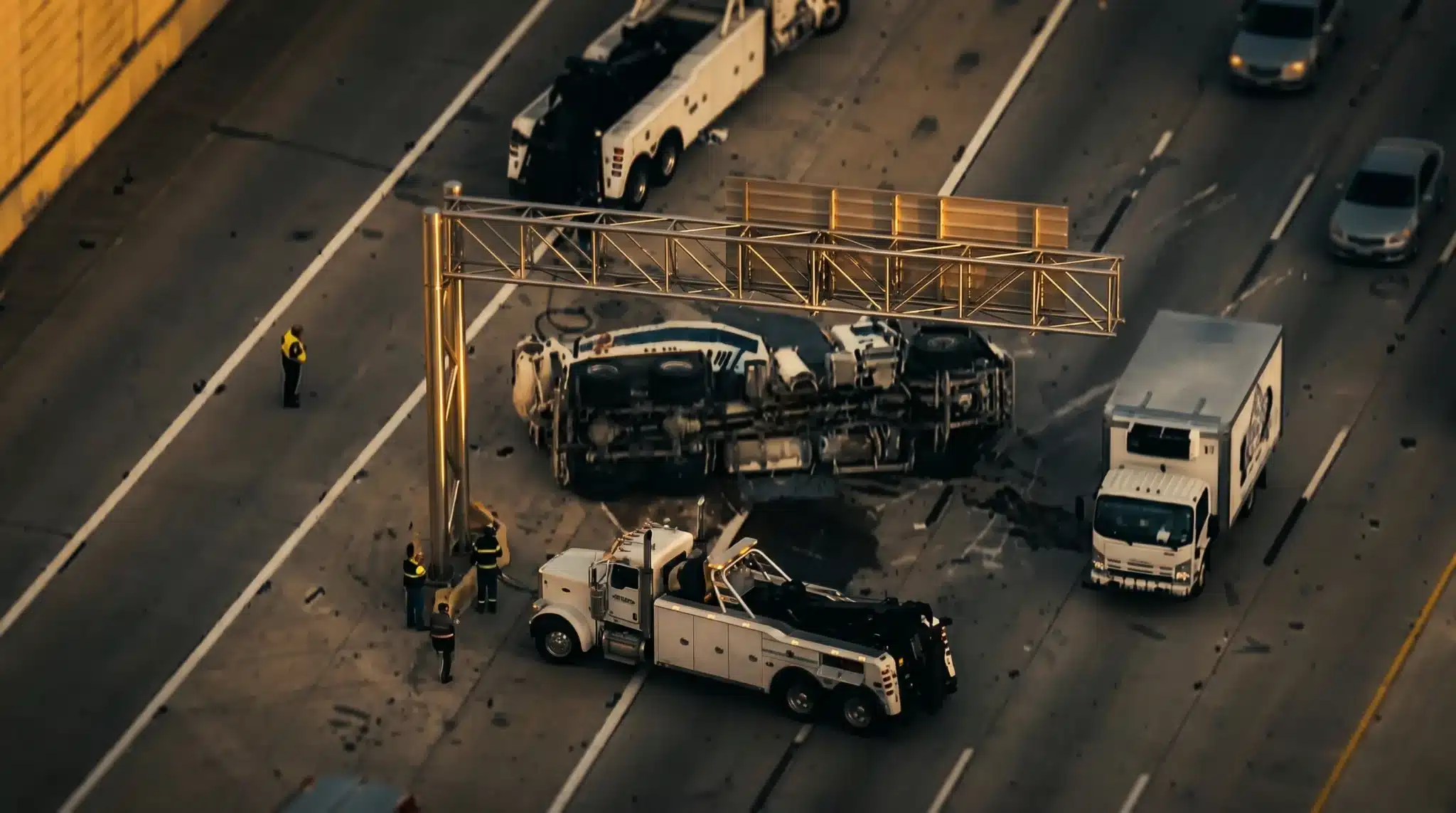
The chain reaction crash rule: who pays in a multi car pileup
Under Texas modified comparative fault, you can recover only if you are 50 percent or less at fault, your recovery is reduced by your own percentage, and at 51 percent or more you recover nothing. In a pileup, whether it is a three car chain or a multiple car accident stacking dozens, that rule is applied to each pair of cars, so the same driver can be under the bar against the car behind them and over it against the car ahead.
Whose fault is it in a 3 car pileup? Not automatically the middle driver’s: the rear driver is presumed at fault for the car directly ahead, but the middle car can be a victim of the strike from behind and at fault for the car it was pushed into, so each of the two impacts is judged on its own evidence. A driver’s share of fault is set by proving the four negligence elements against them, a duty of care, a breach, causation, and damages, then comparing that breach against every other driver’s negligence.
Fault gets untangled crash pair by crash pair, using the physical evidence of who hit whom, in what order, and how hard. Driving the posted limit on ice does not save a driver either, because Texas law requires adjusting speed to conditions, a duty our guide on bad weather car accidents in Texas covers in full.
When one driver can be made to pay everything
A defendant found more than 50 percent responsible can be held jointly and severally liable for the plaintiff’s full damages under Section 33.013 of the Texas Civil Practice and Remedies Code, which means the driver who started the chain can end up answering for the whole recovery, not just their slice. That is why identifying the chain starter matters as much as sorting the pairs.
What starts the chain: the driver behaviors that build a pileup
Most pileup accidents start with a driver who could not stop in time, and federal crash causation research attributes roughly nine in ten crashes to driver error rather than the road or the vehicle. A pileup chains because drivers follow too closely to stop when the car ahead brakes, so each impact pushes into the next vehicle, and four behaviors do most of the building:
- Following too closely, which removes the space a driver needs to react, so the rear car strikes and gets struck in turn.
- Driving too fast for the conditions, which lengthens stopping distance, and in mass pileups investigators routinely clock the lead vehicles well above a safe speed for the ice or fog.
- Distraction, which delays the brake input by the seconds the chain needs to grow.
- Impairment, which slows every reaction the other three depend on.
Each of these breaches the driver’s legal duty to keep a safe following distance and adjust speed to the road, and that breach is what earns a driver a fault percentage when the crash is untangled. That is how a two car tap grows into a car crash pile up.
When a mechanical failure, not a driver, starts the chain
Not every pileup traces back to driver error: when a tire blows, brakes fail, or a defective part locks a wheel and stalls a car in a live lane, the vehicle or parts manufacturer can become a defendant alongside the drivers. Federal research still ties about nine in ten crashes to driver error, but the small share caused by vehicle failure matters in a pileup, because a defect that stops a car in fast traffic can be the true chain starter. Proving it takes the failed component itself plus the maintenance and recall history, so the vehicle has to be preserved before it is repaired or scrapped.
Why do Texas pileups happen on winter mornings? Ice, fog, and commuter speed
The major mass pileups on record, in Texas and nationally, cluster in the early morning hours on ice or in fog, when road surfaces are coldest, visibility is lowest, and commuters are moving at full highway speed. the Fort Worth chain began at about 6 a.m. on ice; the San Antonio chain of 1994, widely reported at 127 vehicles on I 35, came from slick roads and morning sun glare; and the largest US pileups have been morning fog events. A 50 car pile up is not a freak event in those conditions, it is what happens when one blocked lane meets traffic that cannot see or stop in time. The legal point is the same one the fault rule makes: weather is never a legal excuse, because the duty to slow down for the conditions belongs to every driver on the road.
Can you sue the road operator after a pileup? Yes, and the government clock is short
Yes, the party responsible for the road can be a defendant when a maintenance contractor or a government entity failed to treat a known icing hazard, but a government defendant runs on a notice clock that can be as short as six months, far shorter than the two years drivers get, and our guide to Texas car accident filing deadlines lays out the full deadline stack. A private operator, like the company maintaining a tolled express segment, does not share the government’s immunity, which is exactly why the Fort Worth toll lanes produced claims a public highway might have blocked. And because a defendant more than 50 percent responsible is jointly and severally liable for the full damages under Section 33.013, a road operator found to carry the majority of the blame can be made to answer for the entire recovery, which is what makes the operator the deep pocket in a mass pileup. When a blown tire or failed brakes starts the chain instead, the maintenance shop or the manufacturer joins the defendant list alongside the drivers.
How do you prove your lane of the pileup? The diagram, the damage, and the witnesses
Your recovery in a pileup depends on proving which impacts you received and which you caused, and the evidence that settles it is the crash report diagram, the damage pattern on each vehicle, and the witness statements taken at the scene. The diagram and the damage pattern establish who hit whom in what order, which is exactly how fault gets untangled pair by pair. The report itself does not decide who pays, though: it documents the scene, and the fault percentages are assigned later by the insurers and, if the claim is litigated, by a jury, each weighing that diagram against the damage, the vehicle black box data, and the witnesses. A police officer can note a contributing factor or write a citation, but that is evidence an adjuster considers, not a final verdict on who pays. A multi vehicle crash report can run dozens of pages of units and codes, and our Texas crash report decoder shows how to read yours. When a semi is in the chain, the carrier’s records and the truck’s electronic data can add the carrier as another liable party beyond the drivers, and our guide on being rear ended by a semi truck in Texas walks through those trucking evidence rules.
How insurers try to pin the chain on you
In a chain reaction, an adjuster’s play is to push a larger fault share onto you pair by pair, so what not to tell your insurance company is anything that concedes it: do not guess your speed, your following distance, or the order of impacts, do not say you are fine before a doctor has checked you, and do not accept a share of blame on that first call. Our guide to dealing with insurance companies in Texas covers the full adjuster script, recorded statements included.
How does insurance work in a multi car pileup?
In a pileup your recovery can draw on several policies at once, because each at fault driver’s liability coverage answers only for the impacts that driver caused. If the drivers who hit you carry Texas minimum limits of 30,000 dollars per person, those limits exhaust fast in a serious injury, and your own uninsured and underinsured motorist coverage is what fills the gap an underinsured driver leaves. Stacking multiple at fault policies plus your UM/UIM is often the only way a major pileup injury gets fully covered. Before any of that fault is sorted, your own PIP or MedPay coverage pays the first medical bills, regardless of who caused the chain.
In a serious pileup the money comes in a set order, and knowing it is how you avoid settling with one insurer before the rest of the stack is counted:
- Your PIP or MedPay pays first These first party coverages pay your early medical bills right away, no matter who caused the chain, so treatment never waits on the fault fight.
- Each at fault driver’s liability Every driver who hit you owes their share from their own policy, up to that policy’s limit, which is why the number of at fault drivers matters as much as the size of any one policy.
- Your UM or UIM coverage When the at fault limits run out or one of the drivers was uninsured, your own underinsured motorist coverage fills the gap the chain left.
- A commercial policy, when a truck is in the chain A carrier’s policy is far larger than a car’s, and it opens up when a semi or work vehicle caused one of the impacts.
What should you do if you were in a pileup? Your first three moves
Your first three moves are to get to safety, to photograph every vehicle position before anything moves, and to get checked by a doctor even if you feel fine.
- Get to safety, then call 911 In mass pileups, some of the people killed are struck on the road after leaving their cars, so if the traffic is still live, staying belted inside can be safer than standing in a lane.
- Photograph every vehicle position before they move The order and angle of the cars is the fault evidence, and it disappears the moment tow trucks start pulling the chain apart.
- Get checked by a doctor today Chain reaction hits load the neck, back, and chest from two directions, and those injuries often surface a day later, so a same day exam ties them to the crash.

We at J. Alexander Law Firm handle Texas pileup claims on contingency, which means the case review is free and there is no fee unless we win.
Were you in a chain reaction crash?
Call 469-807-7480 or contact us online. Se habla español.