


Interactive Safety Tool
Truck Accident Injuries by Speed: What 80,000 Pounds Does to You
Choose a truck crash type and set the impact speed. The figure shows where truck accident injuries concentrate on the body of the car’s occupants; the panel shows the physics behind them. Hover or tap any body zone for detail.
Impact speed
40mph
10City street40Highway80
Injury zones on the body
ModerateSeriousCritical
Hover or tap a body zone for common injuries
0
Average deceleration during impact
0
Equivalent fall height
0
Distance a loaded semi needs to brake to a stop, dry road
0%
Modeled risk of fatal injury, car occupant
Crash geometry
Truck rear ends your car
Most common injuries in this crash type
How to use this tool
The science, in plain English
The physics, in more depth
Reading the Visualizer
The figure maps the body of a person riding in the passenger vehicle, because in a collision between a large truck and a car, the car’s occupants take nearly all of the harm. When you pick a truck crash type, the zones most often injured in that crash light up. Gold means moderate injury risk; orange means serious; red means critical. Slide the speed up and watch the colors shift.
A loaded rig outweighs your car by roughly twenty to one, so the deceleration your body experiences in a truck collision is far more violent than the same speed between two cars.
The four numbers under the figure translate the crash into terms you can feel, with that weight mismatch built into every one of them.
Why Weight Changes Everything in a Truck Crash
Two physics facts decide who gets hurt in a truck collision. The first is weight: a loaded tractor trailer can weigh 80,000 pounds, about twenty times a passenger car, and when a heavy vehicle and a light one collide, the light one absorbs nearly all of the speed change. The second is geometry: a trailer’s floor sits at roughly hood height, so a car can slide beneath it and the windshield and roof, not the crumple zone, take the impact. That is underride, and it is why truck crashes turn fatal at speeds two cars would walk away from.
When a heavy vehicle and a light one collide, the light one absorbs nearly all of the speed change. The physics never splits a truck crash evenly.
Is a pickup truck safer than a car in a crash? A heavier pickup does fare better against a car, but it still loses badly to an 80,000 pound rig. Mass only helps until something much heavier arrives.
Braking closes the loop. Counting driver reaction, a loaded semi at 65 mph can need around 525 feet to stop, nearly two football fields, so many truck crashes begin as ordinary slowdowns the big rig could not match. The same mass that needs all that room to stop is the mass that makes the crash so severe when it cannot.
The Deeper Physics of a Truck Crash
The physics of an 18 wheeler accident does not stop at the weight mismatch; here is what it does to a body, to a set of numbers, and to your odds of walking away.
What happens to your body after a truck crash?
Delta v, the change in speed at impact, tears soft tissue and breaks bone. Your body keeps moving at the speed the car was going until the belt, the airbag, or the interior stops it in under a tenth of a second. The bigger the delta v, the deeper the damage.
What happens to your body after a car crash follows the same rule, but a truck crash pushes the delta v far higher because the rig barely slows. The organs feel it too: even behind an intact seatbelt, the abdominal organs keep moving and can bleed internally, which is one reason internal bleeding hides at the scene.
What does a rear end truck hit do to your neck and spine?
At truck energies, whiplash becomes disc and ligament injury. A rear end hit from a rig drives your head and neck through a whip motion no car to car crash can match. The truck transfers nearly its full closing speed into your car, so the seat back and head restraint take energy they were never built to hold.
The seat back can fail rearward while your head snaps over the restraint, loading the cervical spine at its weakest point. What would bruise in a car crash instead tears the discs and ligaments of the neck, which is how a semi truck accident turns simple whiplash into a lasting injury.
The legal side of a semi rear end is covered in our guide on what to do after being rear ended by a semi in Texas.
A worked example: what 40 mph actually does to your body
Set the tool to a truck rear end at 40 mph and watch what it reports. Because a loaded rig outweighs your car about twenty to one, the model gives your car roughly 95 percent of the speed change. Your body goes from a standstill to about 38 mph in a heartbeat.
The tool converts that into the energy of a fall from a five story building, delivered through only about half a meter of crush. Spread over so little distance, that is why an 18 wheeler wreck at a speed you would survive between two cars can still be fatal here.
Impact speed versus delta v, and why the difference matters
Impact speed is how fast the vehicles were closing. Delta v is the change in speed your own body actually goes through, and it is what injury research ties outcomes to. The two numbers come apart in a truck crash.
Between two similar cars, each takes about half the closing speed as its delta v. In a truck crash the car takes nearly all of it, because the loaded rig barely slows. A 40 mph closing speed becomes a 38 mph delta v for you, not 20.
That gap is the hidden reason a 40 mph truck crash injures far worse than a 40 mph crash between two cars. The speedometer reads the same; the number your body feels does not. Because the car takes such a high delta v, the speed at which every crash type turns fatal drops right along with it.
The speeds where each truck crash turns fatal
Every crash type in this tool crosses the 50 percent fatality mark at a different modeled speed for a person in the car, and the order tells the whole story:
- Side underride: about 27 mph
- Truck t bones you: about 30 mph
- Rear underride: about 31 mph
- Head on: about 34 mph
- Truck rollover onto your car: about 38 mph
- Jackknife: about 42 mph
- Truck rear ends you: about 46 mph
- Lost cargo: about 48 mph
- Wide turn squeeze: about 50 mph
- Blind spot swipe: about 58 mph
That a side underride can be fatal at ordinary city speeds, lower than any other semi accident in the list, is the entire case for side guards. The same ordering carries into the crash by crash body map: the types that turn fatal at the lowest speeds are the ones that strike the head and neck first.
Why do truck crashes cause so many brain injuries?
Truck crashes cause so many brain injuries because the impact arrives at head height, so the head takes first contact. In an underride or a t bone, the striking structure enters at windshield and window height. The head meets solid steel first instead of last, after the bumper and airbags have done their work.
Even when nothing touches the skull, the deceleration itself throws the brain against the inside of the skull, bruising and tearing tissue. That double exposure, direct contact plus rapid deceleration, is why a truck wreck sends so many people to a trauma center with a brain injury.
When your seatbelt and airbags simply cannot save you
Belts and airbags rest on two assumptions: the cabin stays intact, and the crash pulse stays inside the range they were designed for. A truck crash breaks both. When the cabin caves in, intrusion moves the wall to where the belt was meant to restrain you, and that protective geometry is gone.
In an underride, the car slides under the trailer and never touches the sensors that fire the airbags. Above the design pulse, the belt still holds your frame while your organs keep moving inside you. That is why guards, following distance, and a truck’s No Zones prevent more harm than any device inside your car.
Past the design pulse, the chest strikes the belt itself, so the restraint becomes its own source of injury. Because the belt holds the body while the organs keep moving, internal bleeding can begin behind a seatbelt that never came undone.
What rain, worn brakes, and a heavy load do to the numbers
The 525 foot stopping figure that makes a tractor trailer accident so hard to avoid assumes dry pavement and good brakes. On wet pavement, braking distance can grow sharply, because the tires have much less grip to work with. Worn or out of adjustment brakes are among the most cited violations in roadside inspections, and they stretch that distance further.
A heavier or shifted load raises both the stopping distance and the chance the big rig rolls or ends up jackknifed. Every one of these factors is in play before the driver ever touches the brakes.
Every factor that stretches a truck’s stopping distance happens invisibly, before the crash.
What is the deadliest state to drive in?
By deaths per mile driven the rural southern states lead, and by raw count Texas leads. Its long high speed rural highways are where a big rig crash turns fatal most often, because speed drives the delta v your body takes.
The injuries and afterThe Injuries and the Long Road Back
The tool shows where a crash lands on the body. This is what those hits become: the injuries by name, why some pain comes late, and what getting better takes.
The 10 common injuries a truck crash leaves behind
These are the ten injuries a truck crash produces most, named plainly and grouped by the part of the body they strike. Which ones you get is set by the shape of the crash, not by chance.
- Traumatic brain injury and concussion
- Cervical spine and disc injury, from whiplash to a herniated disc
- Spinal cord injury and the paralysis it can cause
- Chest and rib fractures, with bruising of the lungs and heart
- Abdominal organ injury, most often to the spleen and liver
- Pelvic and hip fractures
- Crushed or trapped arms and legs
- Internal bleeding that is not visible at the scene
- Lacerations and degloving from the glass and metal of an underride
- Burns, a specific danger when a rig’s fuel tanks rupture
Which injuries you get is set by the shape of the crash, the striking height and the line of force, not by chance.
What is truckers syndrome?
Truckers syndrome is the delayed neck and back pain that shows up hours or days after a truck crash. At the scene, adrenaline masks the damage, so you feel fine. Once it fades, the soft tissue and disc injury from the violent deceleration finally registers.
It is why the person who felt fine at the scene wakes up the next morning unable to turn their head. The pain was there all along; the body just could not feel it yet.
Do crash victims feel pain at the moment of impact?
Crash victims often do not feel pain at the moment of impact, because adrenaline blunts it and the pain arrives later. Adrenaline blunts pain during the crash and in the minutes right after, so the ache of whiplash and soft tissue damage tends to arrive hours later. That delay is the same one behind truckers syndrome.
How long does your body stay in shock after a crash?
The adrenaline and acute stress response can mask pain for minutes to hours, and sometimes into the next day, which is why injuries surface late. The same adrenaline that delays pain also hides internal injury, so at the scene truckers syndrome and a hidden bleed can look alike.
What recovery from a truck crash injury looks like
Recovery from a truck crash injury follows an arc. In the first hours, adrenaline masks the pain and the injury hides. In the first weeks, imaging finds what the scene missed, a herniated disc, a small brain bleed, or a hairline fracture.
Then comes the long tail: surgery, physical therapy, and lasting injury. The timeline depends on the crash. An underride head injury and a rollover spinal injury start from different damage and heal on different schedules, months of therapy for the brain, a life of limited movement. A child hurt in a truck crash carries that impact furthest, since a young spine or brain injury shapes the decades ahead.
What is the number one cause of a truck crash?
Driver fatigue, distraction, and speed lead the causes of a semi truck accident, followed by brake and maintenance failures the inspection reports flag most. Nearly all of these trace back to the truck, not the car it hits. A tired driver who drifts, a rig that cannot stop in time, or a load that shifts is behind far more of these crashes than anything the other driver did.
Federal research ties the critical reason to driver error in about 94 percent of crashes. The top three driver behaviors are distraction, speeding, and impairment, and each is worse with a truck’s mass and long stopping distance behind it. Because those causes trace to the truck, so does the claim, reaching the carrier and the company that put the rig on the road.
Read the wording with care: the critical reason is not the same as the cause or the fault. It names the last failure in the chain, not who pays. A driver error in the truck also lands its harm on the other vehicle, the occupant split this tool already shows, where nearly everyone killed rides in the passenger car.
Questions that lead past the injury. Can you sue if a truck driver hits you? Yes. A truck claim reaches the carrier and the company behind the driver, not the driver alone, which is why a semi case is valued differently; see what a Texas truck accident claim is worth.
What should you not say after a truck crash? Never guess at your speed, never guess at fault, and never say you feel fine before a doctor has checked you. Stick to the facts you are sure of; here is how to handle the insurance adjuster after a truck crash. The hardest injury to prove is the soft tissue or brain injury that does not show on a scan, which is why delayed symptoms like truckers syndrome matter so much to a claim.
Collision guide
The rule that decides an underride crash
The Ten Truck Crash Types, Explained
A truck rear-ends your car
The signature crash of a fatigued or distracted trucker meeting slowed traffic. The rig transfers nearly its full closing speed into your car in a fraction of a second, overwhelming seat backs and head restraints. Because a truck’s bumper sits high, the impact often arrives above your car’s strongest structure and can override the trunk toward the rear seats. The braking gap is what sets up this crash type, the rig meeting traffic it cannot stop for in time.
Head on with a truck
Among the least survivable crashes on the road. The two vehicles’ speeds combine, and the twenty to one weight mismatch means the car does almost all of the stopping for both. Cabin intrusion consumes the crumple zone, driving severe chest, brain, and leg injuries even in modern vehicles with every airbag deployed.
Side underride
A trailer crosses the road at night or pulls out of a driveway, and a car strikes it broadside. The trailer floor sits at hood height, so the car can pass beneath it until the windshield and A pillars take the impact. Airbags and crumple zones never engage. This is the crash side underride guards are designed to prevent, and they are still not required in the United States.
Rear underride
Traffic stops, a car does not, and the trailer’s rear edge meets the windshield. Federal rules require a rear underride guard on most trailers precisely because of this crash, and a strong, well maintained guard can catch the car’s bumper and let its safety systems work. A weak, rusted, or damaged guard folds, and the outcome changes completely.
Jackknife and trailer sweep
Hard braking or lost traction lets the trailer swing out of line with the tractor, folding like a pocket knife. A jackknifing trailer can sweep across several lanes in seconds, striking vehicles broadside, forcing some beneath it, and setting up chain reaction pileups in the traffic behind. Injuries mix side impact and underride patterns.
A truck T-bones your car
An intersection crash with a rig is unlike a car to car T bone. A truck’s bumper and frame ride above a car’s door sill and side beam, so the impact arrives at seat and window height, where a car has the least structure. Head, chest, pelvic, and internal injuries dominate on the struck side, at speeds a frontal crash would forgive.
Wide turn squeeze
Truckers sometimes swing left before a tight right turn, and the trailer’s rear wheels track far inside the tractor’s path. A car that enters the gap can be caught between the turning trailer and the curb, crushed, or dragged. These crashes happen at low speed, which makes them survivable more often, but arm, chest, and head injuries on the trapped side are common. Together with the truck t bone, this is the crash that crushes the limbs and the pelvis.
Truck rollover onto your vehicle
Shifted cargo, a high curb, or a ramp taken too fast can tip a trailer over. When 80,000 pounds comes down on the car beside it, the roof takes a load it was never designed for. Head, neck, and spine injuries dominate, and the outcome depends heavily on which seats were beneath the trailer. This is the crash type that most often produces a spinal cord injury and the paralysis that can follow.
Blind spot sideswipe
A rig’s blind spots can hide an entire car down each side. When a truck merges into an occupied lane, the swipe itself is often minor; the loss of control that follows is not. Many of the serious injuries in these crashes come from the secondary impact with a barrier, a ditch, or other traffic.
Lost cargo and road debris
Federal cargo securement rules exist because loads come loose. A tire carcass, a strap-failed pallet, or shifting freight turns the lane behind a truck into an obstacle course, and a heavy object at highway speed behaves like a fixed barrier no crash test anticipated. Injuries split between the strike itself, often at windshield height, and the emergency swerve that follows.
The law on underride guards, and the gap that still kills
Underride guard regulation is the single rule that decides whether an underride crash is survivable, and it is only half written. Federal law treats the two ends of a trailer very differently.
- Rear guards are required. Federal rule 49 CFR 393.86 mandates a rear impact guard on most trailers, and a 2022 upgrade strengthened the standard to protect car occupants in a 35 mph rear underride. A strong, well maintained guard catches the bumper and lets the airbags fire.
- Side guards are not. No federal rule requires a side underride guard, so a trailer crossing the road broadside offers a car nothing to hit but open space until the windshield.
Congress has proposed a side guard mandate again and again, most recently as the Stop Underrides Act, and it has never passed. That open gap in the regulation is why side underride stays one of the deadliest crashes on the road.
The tool in plain text
Where a Truck Crash Strikes the Body, Crash by Crash
The visualizer lights up different body zones for each truck crash type. Here is that same mapping written out, so you can read where each crash lands without touching the tool.
- Truck rear ends you: neck, spine, and head.
- Head on: chest, head, legs, and pelvis.
- Side underride: head, neck, and chest, at window height.
- Rear underride: head, neck, and chest.
- Jackknife: the side of the body, the head, and the chest.
- Truck t bones you: head, chest, and pelvis on the struck side.
- Wide turn squeeze: arms, chest, and the trapped side.
- Rollover: head, neck, and spine.
- Blind spot swipe: it varies, since most harm comes from the secondary impact.
- Lost cargo: head and chest, at windshield height.
Why the seat you are in changes everything
Where you sit and which side the truck strikes decide how bad your injuries are, as much as the speed does. A side impact or side underride punishes the struck side occupant most.
The struck side takes the direct hit; the far side gets a fraction of a second and the width of the car as protection. A driver hit on the driver side and a passenger hit on the passenger side face far worse odds than the person on the opposite side of the same crash.
Front seat and rear seat differ too. The front takes the brunt of a head on or a rear underride, while a child in the back is safer from those but just as exposed in a side hit. The tool models a typical front seat adult, so read the struck side as your side.
Which truck crash causes which injury
Each named injury traces back to the crash geometry that most often produces it.
- Traumatic brain injury: underride, rollover, and lost cargo, the crashes that strike at window or windshield height.
- Cervical spine and disc injury: a rear end hit from the rig.
- Spinal cord injury and paralysis: rollover and severe underride.
- Chest and rib fractures: head on and t bone.
- Abdominal organ injury: t bone and side impact.
- Pelvic and hip fractures: t bone and head on.
- Crushed or trapped limbs: wide turn squeeze and t bone.
- Internal bleeding: any high delta v crash, and it is often masked at first.
What are the 7 types of injuries?
A truck crash produces seven categories of injury:
- Brain: concussion and traumatic brain injury.
- Spinal: the neck, the back, and the spinal cord.
- Chest and organ: rib fractures with bruising of the lungs and heart.
- Abdominal: the spleen, liver, and kidneys.
- Pelvic: the hip and pelvis.
- Limb and orthopedic: crushed or broken arms and legs.
- Soft tissue: the whiplash and strain that surface late.
These seven categories are the same regions the crash by crash body map lights up; a category is just the injury a struck zone produces. Which one you get traces back to where the truck hits and how much delta v the car takes.
Common questions
Truck Crash Injury Questions, Answered
Straight answers to the questions people search after a truck accident. Each one starts with the direct answer, then the research behind it.
Why are truck accidents so much worse than car accidents?
Weight. A loaded tractor trailer can weigh 80,000 pounds, roughly 20 times a passenger car, so in a collision the car absorbs nearly all of the speed change. Federal crash data shows that when a large truck and a passenger vehicle collide, the people killed are overwhelmingly in the passenger vehicle.
What is an underride accident?
An underride crash is one where a car slides beneath the body of a trailer, which sits at about hood height. The car’s bumper, crumple zone, and airbag sensors pass underneath untouched, and the first structure to take the impact is the windshield and roof. Underride crashes are the deadliest geometry in trucking.
At what speed can a truck crash kill you?
Lower than almost any other crash type. Because the passenger vehicle absorbs nearly all of the energy, fatal outcomes in truck collisions occur at speeds that would often be survivable between two cars, and underride crashes can be fatal at city street speeds. There is no safe speed to collide with an 80,000 pound vehicle.
How much longer does a semi take to stop than a car?
Counting driver reaction, a fully loaded semi at 65 mph can need around 525 feet to come to a stop, nearly the length of two football fields and roughly two thirds more than a passenger car. Worn brakes, wet roads, and heavier loads stretch that distance further, which is why following distance around trucks matters so much.
What is a jackknife accident?
A jackknife happens when the trailer swings out of line with the tractor, folding like a pocket knife, usually after hard braking or a loss of traction. The sliding trailer can sweep across several lanes, striking vehicles broadside and forcing some beneath it.
Do underride guards actually work?
Strong ones do. Federal rules require rear impact guards on most trailers, and the standard was upgraded in 2022 to protect car occupants in 35 mph rear underride crashes. Side underride guards are not required in the United States, though Congress has repeatedly proposed a mandate, which is why side underride remains a persistent cause of death.
Who usually gets hurt in a truck crash?
Occupants of the other vehicle. Federal crash data shows that 96 to 97 percent of vehicle occupants killed in recent years in two vehicle crashes between a large truck and a passenger vehicle were in the passenger vehicle. The truck driver, sitting high off the ground and surrounded by mass, usually survives.
How is the fatality risk in this tool calculated?
The risk figures are modeled estimates shaped from federal large truck crash research, adjusted for the geometry of each crash type and the weight mismatch between a loaded truck and a passenger car. They are educational estimates for a typical adult in the passenger vehicle, not predictions for any specific crash or person.
Keep exploring
Related Educational Resources
The visualizer shows what a truck collision does to the body. These free tools and guides cover what comes next, from the first hour after a crash to understanding what a claim is actually worth.
Free tools & guides
- Car Crash Injury Visualizer: the companion tool covering car-to-car collision physics
- Average truck accident lawsuit value in Texas: why truck cases are valued differently than car cases
- What to do after a crash in Texas: the step by step guide for the first hours and days
- Dealing with insurance companies in Texas: what adjusters look for and how to protect your claim
- Texas Settlement Offer Analyzer: check whether an offer accounts for everything it should
- Texas Crash Report Decoder: translate every code on your CR-3 crash report
- All free tools: every calculator, decoder and data study in one place
Truck accident help where you are
- Texas truck accident lawyers: how the firm handles 18-wheeler cases statewide
- Dallas truck accident lawyers: I-35E, I-635, and the I-30 corridor
- Fort Worth truck accident lawyers: I-20, I-35W, and the Alliance freight corridor
- Houston truck accident lawyers: port traffic and the I-10 and I-45 truck routes
- San Antonio truck accident lawyers: I-35 and Loop 410 commercial traffic
- Canton truck accident lawyers: I-20 wrecks and the Trade Days rush
- Texas traumatic brain injury lawyers: the injury this tool shows most often in truck crashes
- All practice areas
Transparency
Methodology and Sources
Peak deceleration and fall height come from the car’s speed change, weighted for the twenty to one truck-car mass mismatch. Underride types use very small crush distances, since the crumple zone is bypassed, and show the lower body spared because injury concentrates above the beltline. Semi braking assumes about 0.35 g on a dry road, excluding reaction time. Rollover risk reflects crushing load and stays elevated at low speed; blind spot risk includes the secondary collisions that follow. All figures are educational estimates for a typical adult in the car, not predictions.
Data sources
- Federal Motor Carrier Safety Administration; Large Truck and Bus Crash Facts
- National Highway Traffic Safety Administration; crash injury and occupant protection research
- Insurance Institute for Highway Safety; large truck crash and underride guard research
- National Transportation Safety Board; highway safety studies and underride investigations
Embed or Reference This Tool
Journalists, educators, and safety organizations are welcome to reference the figures above or embed the tool, free, with attribution and a link back to this page.
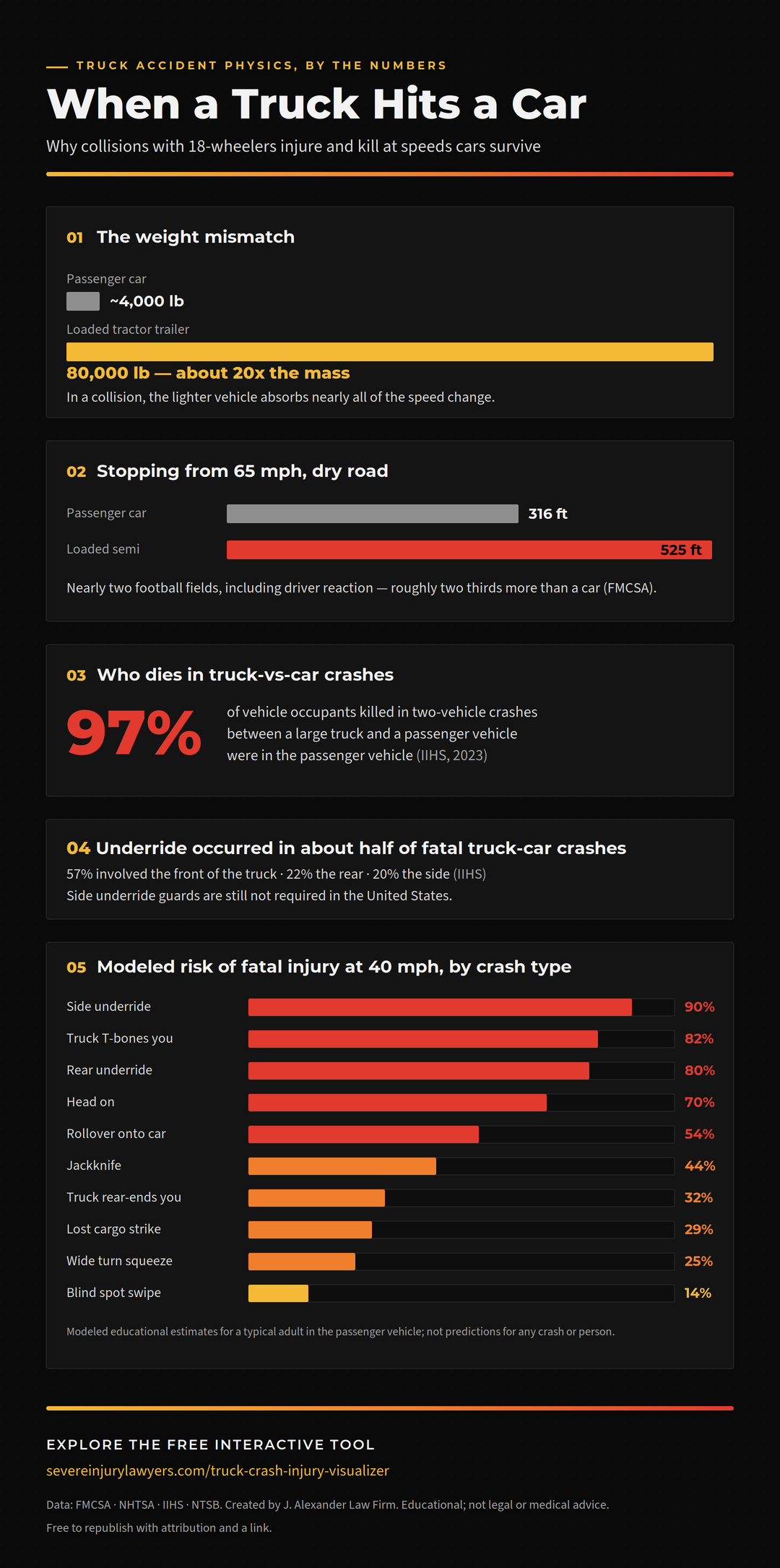
Download: full size PNG · print PDF: free to republish with attribution and a link to this page.
Created by J. Alexander Law Firm, a personal injury firm whose truck accident lawyers have spent years studying how these crashes injure people. This page is educational and is not legal or medical advice.