

Car accident lawyer in Dallas.
Reviewed by Josh Alexander, Founder & Managing Attorney · Updated July 2026
Hurt in a wreck and searching for a car accident lawyer in Dallas near you? Here is what your claim is worth, what you must prove, and what hiring us costs: nothing unless we recover.
Rated 4.9 from 568+ client reviewsRecovered for clients
Years of combined experience
Client reviews
Years Super Lawyers Rising Stars

Reflects total client recoveries across hundreds of resolved matters. Past results do not guarantee a similar outcome.
Injured in a car accident?
We can help.
If you were hurt in a car wreck in Dallas that another driver caused, Texas law lets you recover damages for your losses, whether you call it a car accident, a crash, or a wreck. The amount you can recover mostly depends on the insurance coverage of both you and the other driver. We break down exactly how that works further down this page; for now, know that yes, you can obtain compensation if you have suffered an injury.
Further Legal Reading: (Tex. Civ. Prac. & Rem. Code § 33.001) and (§ 16.003)
What can you recover after a car accident in Dallas?
Texas lets you recover two kinds of damages; insurers hope you only claim one. Their first offer usually covers the obvious receipts and quietly leaves out everything the injury took from your daily life.
Economic damages
Your real out of pocket losses. We collect every bill, invoice, and pay stub so nothing gets left off the demand.
Non-economic damages
The losses that never show up on a bill. There is no cap on these damages in an ordinary Texas car crash, and the strength of your medical records drives the multiplier applied to them, so we document how your life changed to justify the number.
“Pain and suffering is valued a few common ways in Texas. One method multiplies your medical bills by a number that usually runs from about 1.5 to 5 based on how severe and lasting the injury is; another assigns a daily dollar amount for every day you live with the pain. Neither is written into the law. They are starting points insurers use, and the final figure comes down to evidence.”
Josh AlexanderFounder & Managing AttorneyMarine Corps veteran
Being blamed doesn’t end your case.
You can still recover money in Texas even if you were partly at fault, as long as you were 50 percent or less responsible for the crash; this is called modified comparative fault, or proportionate responsibility, under Tex. Civ. Prac. & Rem. Code § 33.001. Your award is simply reduced by your share of the blame, which is why adjusters work so hard to pin extra fault on you. Pushing that percentage back down is one of the most valuable things we do.
Have us challenge your percentageAt 51 percent or more, you recover nothing. That cliff is exactly why adjusters try to inflate your share, and why we fight it.
If you were a passenger, you almost always have a claim
If you were a passenger, you almost never share fault for the crash, so your recovery is not reduced and you can pursue a claim against every driver involved, including the driver of the car you were riding in. That often means more than one insurance policy can pay you, since either driver’s coverage may be on the hook. If either driver was working at the time, their employer’s commercial policy becomes another source of recovery on top of the personal policies.
In Texas, you usually have just 2 years to file.
People often ask how long they have to file a car accident claim in Texas; usually just 2 years from the date of the crash. Evidence disappears and witnesses forget, and the deadline is closer than most people think. In narrow cases the clock starts when you reasonably discover the injury instead, called the discovery rule, but courts apply it rarely.
What if a government vehicle caused your crash?
If a city, county, or state vehicle caused your crash, your deadline is far shorter than the usual two years; you often must give the government formal written notice within about six months, and sometimes as little as 90 days, since some Dallas-area cities set shorter windows in their charters. Both limits come from the Texas Tort Claims Act: it shortens your deadline and caps what a government body must pay. Because a missed notice can end an otherwise strong case, talk to a lawyer right away, and see our Texas car accident filing deadlines page for the exact caps and statute.
Results that speak for themselves.
Recovered for a family after a fatal collision with a commercial truck.
Resolved for a client seriously hurt in a wreck with a tractor-trailer.
Recovered after a heavy truck caused a high-impact highway collision.
Settlement for injuries from a commercial truck collision.
Recovered for a driver injured by another motorist’s negligence.
Settlement for a client rear-ended in Texas traffic.
Sample results from real past cases. Past results do not guarantee a similar outcome; every case is different.
Why most Dallas car accidents happen
Driver error causes about 90 percent of car accidents, and federal crash studies put the figure as high as 94 percent. Get the cause right, and you have the driver whose insurance ends up owing you.
The leading causes we see
- Distracted driving, like texting behind the wheel
- Speeding and aggressive lane changes
- Drowsy or impaired driving
- Running red lights and stop signs
- Failing to yield or making unsafe lane changes
- Vehicle defects or poor road design
How we prove who’s responsible for your crash
Different causes point to different people who have to pay. If a texting driver hit you, their phone records and the car’s data recorder prove it. If a defective part caused the crash, the manufacturer is on the hook, not you. If a badly designed intersection played a role, the road authority can be liable too. Pinning down the real cause early is what sets who owes you and how much, so we move fast to lock down the proof before it disappears. In legal terms, that evidence exists to prove the other driver’s duty, breach, causation, and your damages, the four elements every negligence case turns on.
The four things you must prove to win your case
To win a Texas car accident claim you have to prove four things about the other driver: duty, breach, causation, and damages. Lawyers call these the four elements of negligence, and falling short on any one of them is where a case loses. It is also exactly what an adjuster attacks when trying to push your share of the blame higher under Texas comparative fault.
- Duty. The other driver owed you reasonable care behind the wheel, which every Texas driver does.
- Breach. They failed that duty, like texting, speeding, or running a light.
- Causation. That failure is what actually caused the crash and your injuries, which is where the crash report, phone records, and vehicle data recorder do the work.
- Damages. The crash cost you something real, from medical bills and lost wages to pain and suffering.
The car wrecks we handle most in Dallas.
From a minor collision to a serious crash, these are the wrecks we take on most.
View all practice areas →Rear-end
In most rear-end crashes the driver behind is at fault, though the defense may argue you stopped too suddenly. We use the investigation to shift that argument back where it belongs.
T-bone
Side impacts can be devastating. We subpoena the right parties to obtain traffic camera footage so we can understand exactly what happened.
Rollover
Rollover crashes, including SUV rollovers, often cause some of the most severe injuries. Sometimes the way the road was built or even a vehicle defect is what caused it; we make sure no detail is overlooked.
Head-on
Head-on crashes are among the deadliest. We move fast to preserve the evidence, and if the case goes to trial we reconstruct the collision with 3D modeling.
Hit and run
Leaving the scene of an accident carries both criminal and civil penalties in Texas. You can still be covered through your own uninsured motorist coverage, and we will assist you in any way we can.
Rideshare (Uber/Lyft)
More than one party can be liable, including the driver’s personal insurance and the rideshare company’s commercial policy, whether that is Uber or Lyft. Texas has specific laws for these accidents, and our rideshare accident page covers them in depth.
Company and work vehicles
If the driver who hit you was working at the time, you can often file against their employer, not just the driver. Texas law holds companies responsible for crashes their employees cause on the job, and commercial and fleet policies usually carry far higher limits, which can mean more than one source of recovery.
Company & truck crashes →Drunk driver crashes
Texas allows punitive damages when a collision was caused by gross negligence like drunk driving, and the bar that overserved the driver can share liability under the state’s dram shop law. That can mean a larger recovery from more than one source.
Suing a drunk driver →Fatal crashes
When a wreck takes a life, the claim becomes a wrongful death case with its own rules and deadlines. Our Dallas wrongful death lawyers guide families through every step of it.
Wrongful death claims →Hit by a company car or fleet vehicle in Dallas?
If a company car, fleet vehicle, or work van hit you in Dallas, you can often file against the business that owns it, not just the driver. As a Dallas company vehicle accident lawyer, we go after the employer’s commercial policy and its vehicle insurance across Dallas County, which usually carries far higher limits than a personal one; that can mean more money available for your injuries. Texas holds a company responsible when its employee causes a crash on the job, so a delivery van, a sales rep’s company vehicle, or a service truck on a route all point back to the business.
See who pays for your crashBecause available coverage usually caps your recovery, a high limit commercial fleet policy directly raises what you can actually collect.
For a big rig or semi, see our Dallas truck accident lawyers page. For an Uber or Lyft crash, see our rideshare accident page.
Some wreck injuries hide for days.
Car accidents in Dallas commonly cause whiplash and neck injuries, back and spinal damage, concussions and other head injuries, broken bones, and internal injuries. See a doctor even if you feel fine at the scene; getting checked early protects your health and creates the medical record that supports your claim.
Delayed symptoms to watch
Some of the most serious problems show up days later. If you are unsure whether your symptoms are connected to the crash, talk to us and we will point you in the right direction.
No insurance or hit and run?
You can still get paid. Your own uninsured and underinsured motorist coverage, called UM and UIM, is built for exactly these situations; in a hit and run it is often the main source of your recovery. We review your policy for free to find every coverage that can pay you.
Coverage for when the other driver can’t pay
UM coverage pays when the at-fault driver has no insurance or flees; UIM covers the gap when their limits fall short. Texas only requires 30/60/25 liability ($30,000 per person, $60,000 per crash, $25,000 property), and many drivers on Dallas County roads carry only that or nothing. So if your injuries cost $80,000 and the other driver has $30,000, your UIM can cover the $50,000 difference. Personal Injury Protection (PIP) also pays your own medical bills and lost wages regardless of fault. Insurers must offer all three, so unless you rejected them in writing, you likely have them. In a hit and run, your own UM coverage is usually the primary source of recovery because there is no at fault policy to reach.
When the other driver has no insurance
A driver with no insurance, or one who flees, does not end your claim; your own UM, UIM, or PIP coverage steps in to pay it.
The injuries insurers fight hardest to prove
The hardest car accident injuries to prove are soft tissue injuries like whiplash and a mild traumatic brain injury or concussion. They often do not show up on an X ray or MRI the way a broken bone does, so insurers argue the pain is exaggerated or unrelated to the crash. The way you overcome that is a complete and consistent medical record: an early diagnosis, steady treatment with no gaps, and notes that tie the symptoms directly to the collision. That paper trail is what turns an invisible injury into a claim an insurer has to pay.
How medical records set your claim value
Your medical records are what turn an injury into a dollar figure, so the more complete and consistent they are, the higher your claim is worth. Insurers read every gap in treatment as proof you were not really hurt, and they use it to shrink the offer. That is why we tell clients to see a doctor early, follow the treatment plan, and keep every bill, scan, and therapy note. Because the pain and suffering multiplier keys off how severe and lasting your injury is, complete and consistent records directly raise that part of your claim, not just your medical costs.
One thing to know: an injury that surfaces late usually does not reset your deadline, which generally still runs two years from the crash date, so if symptoms appear days or weeks later, get documented and talk to us early. The narrow discovery rule exception is explained on our Texas car accident filing deadlines page.
Where these crashes happen.
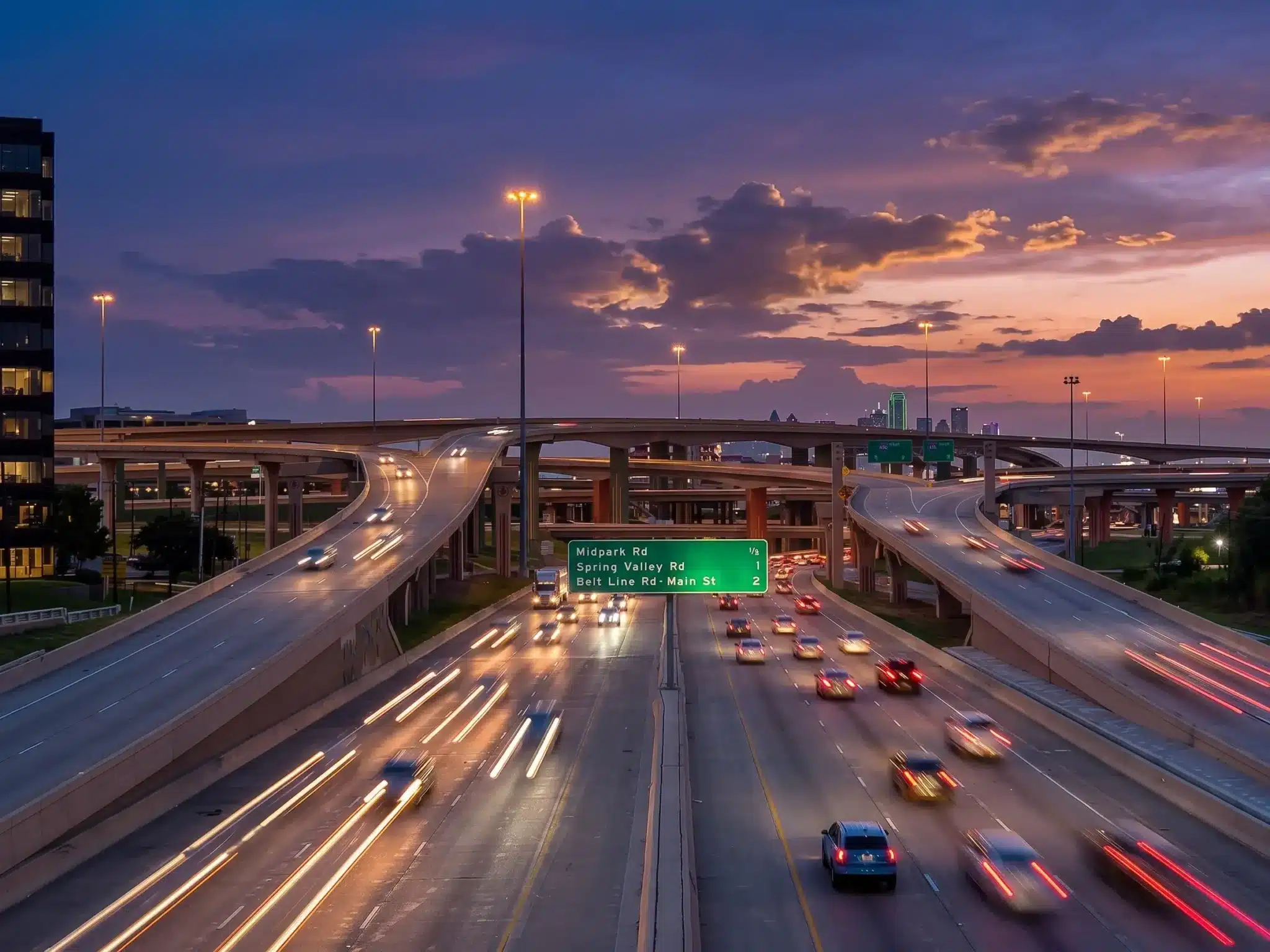
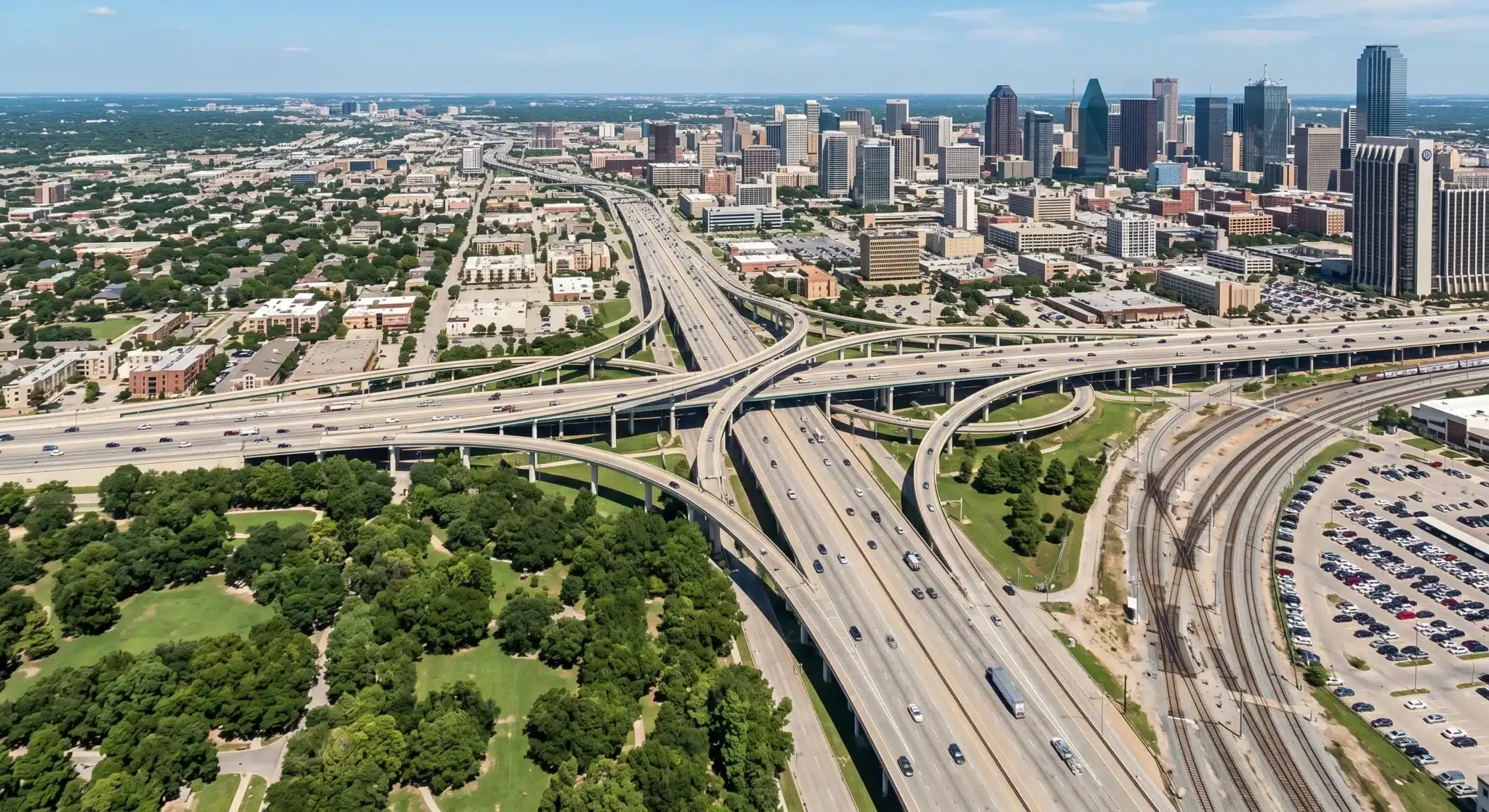
The Dallas roads and interchanges where we see the most serious car accidents.

US-75 / I-635; The High Five interchange
Five ramps connect the Central Expressway and the LBJ here. Drivers are in a hurry, so speeding and weaving are common, which makes this one of the city’s worst areas for crashes.

I-635 / Skillman; The LBJ Freeway corridor
Traffic here is constant, and the lane changes toward the Skillman and Greenville exits produce frequent multi-car wrecks.

US-75 Central; Central Expressway
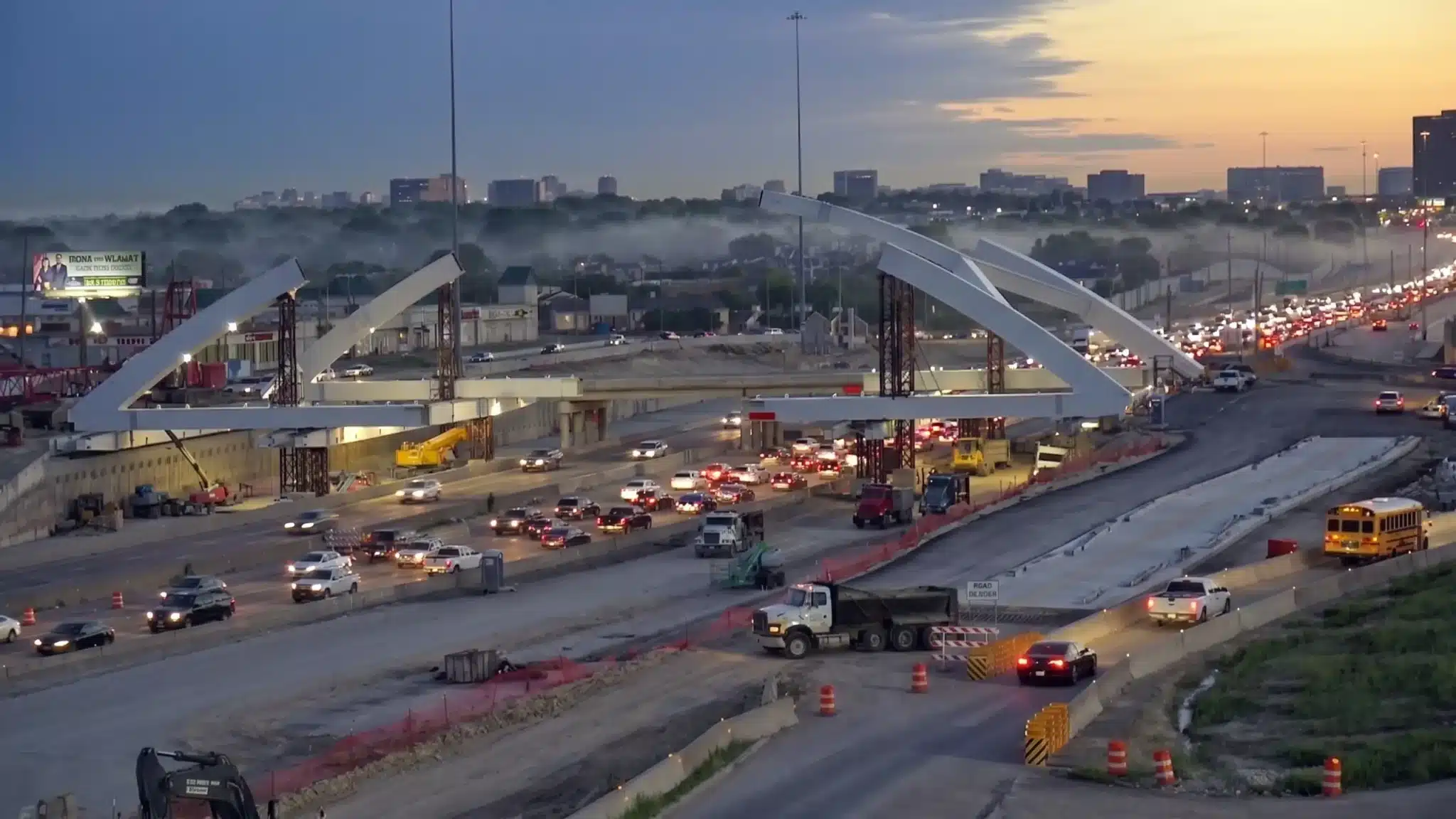
Ongoing construction means stop-and-go traffic and short lane merges, which often cause sideswipes and rear-end collisions.

I-35E Stemmons; The Stemmons Freeway
Crashes here more often involve commercial and company vehicles: cars colliding with 18 wheelers, semi trucks, dump trucks, and fleet vans. If a work vehicle hit you, see our company vehicle accident breakdown above.

I-30; The East West run
Suburban commuters pour into Dallas here at speed, and crashes climb during rain and rush hour.

Spur 366; Woodall Rodgers & downtown
Tight ramps and frequent exits feed onto surface streets, and the stop-and-go conditions are where most of these crashes happen.
Source: Current Dallas County crash data is public through the TxDOT Crash Records Information System (CRIS) at cris.txdot.gov; we pull the figures for the road in your case.
No fee unless we recover. Period.
You never pay out of pocket. We advance the costs of building your case, and our fee comes only from what we recover for you.
What to expect from the insurance company.
Insurers across Dallas tend to open low, and our job is to get you the full compensation Texas allows. Our managing litigation attorney, Matthew Graham, spent more than a decade on the insurance defense side; writing those first offers was part of the playbook he ran, and that knowledge now works for you. Adjusters will pressure you as if you were at fault, bring up a social media post or a recorded call, and twist your words. They are not on your side; we are, and every day you wait lets evidence disappear and witnesses forget.

Your first moves after a crash
- Call 911. Get police and medical help on the way; the crash report they create is key evidence later.
- Document the scene. If you are able, photograph the vehicles, the road, and your injuries, and get names and numbers from any witnesses.
- See a doctor. Get checked even if you feel fine, since some injuries surface days later and the record ties them to the crash; in a serious Dallas wreck that often means Parkland Memorial Hospital, the region’s Level I trauma center.
- Talk to a lawyer before you file the claim. The consult is free, and what you say to the insurer in that first call can set your fault share before you know what your claim is worth; do not give a recorded statement or sign anything first.
What not to say to an insurance adjuster
After a crash, do not tell the insurance company you are fine, do not guess about how the accident happened, and never say anything that sounds like admitting fault, even a polite “I’m sorry.” Avoid giving a recorded statement or accepting a quick number before you know how badly you are hurt, because adjusters use those words and that agreement against you later. Stick to the basic facts like the date, location, and the vehicles involved, and let everything else go through your lawyer. If you are unsure what is safe to say, call us first and we will handle the conversation for you.
Do insurance companies want you to get a lawyer?
No; insurers would rather you not hire a lawyer, because unrepresented people usually accept less and settle faster. Adjusters know a represented client is more likely to document the full value of the claim and take the case to trial if the offer is unfair, which is exactly what moves them to pay more. That is why the same first offer often rises once an attorney is involved. Talking to us costs nothing and there is no pressure to hire, so you lose nothing by finding out what your claim is really worth first.
To be honest, if no one was hurt and only sheet metal was damaged, you may not need a lawyer; a real injury flips that. Our guide on whether a car accident lawyer is worth it shows exactly where that line falls.
What your Dallas car accident claim is worth
Your Dallas car accident claim is worth the full cost of what the crash did to you: your medical bills, future care, lost income, and pain and suffering, added together. There is no set average; a minor injury might settle in the low five figures, while a serious or permanent injury can reach six or seven figures. As a Dallas car accident injury lawyer, we value your claim from the evidence, not a formula, so you know the real compensation on the table before you answer any offer. The number is usually capped only by the insurance available to pay it.
There is no Texas average that fits your case
Any page that hands you a single average figure is guessing; how injury type changes the range is covered in our breakdown of average car accident lawsuit value in Texas.
Why a fair settlement takes months, not weeks
Most straightforward Texas car accident claims settle within a few months to a year, while cases with serious injuries or disputed fault take longer, especially once a lawsuit is filed. The biggest reason a settlement takes so long is your own medical treatment; settling before you know the full cost of your injuries almost always means settling for less. We move your case as fast as the facts allow without leaving money behind. You can also run an offer through our settlement offer analyzer to see what you might actually keep.
What really caps your claim is the coverage, not the law
In an ordinary Texas car accident there is no state cap on what you can sue for, so your claim can be worth as much as your injuries, medical costs, lost income, and pain and suffering add up to. In practice the real ceiling is usually the insurance available to pay it: the at-fault driver’s policy limits plus your own uninsured or underinsured motorist coverage. That is why we review every policy that could pay you, not just the obvious one. The exception is a claim against a government entity, which does carry damage limits and much shorter deadlines.
Why a $50,000 settlement never lands as $50,000
On a $50,000 settlement with no fault against you, you typically keep about $18,500 to $31,000 after the fee, case costs, and liens. Your fault share comes off the gross settlement first, then the one third contingency fee (closer to 40 percent in litigation) applies to the reduced amount, and case costs and medical liens come out of your share last. With no fault, a one third fee is about $16,667, leaving roughly $33,333 before costs and liens. At 20 percent fault, Texas reduces the $50,000 to $40,000 before the fee applies, so you keep less; a $20,000 or $100,000 settlement scales the same way. We walk through the full math in our Texas $50,000 settlement breakdown.
| $50k, no fault | $50k, 20% fault | |
|---|---|---|
| Settlement amount | $50,000 | $50,000 |
| Less your fault share § 33.001, 20% | −$0 | −$10,000 |
| Less attorney fee one third contingency | −$16,667 | −$13,333 |
| You keep before case costs & liens | $33,333 | $26,667 |
Illustration only; your fee, costs, liens, and fault share change the figure. Past results do not guarantee a similar outcome.
“I spent over a decade on the insurance side, directing the litigation that decided how little they paid out. I know the number they open with, the number they will actually pay, and the gap between the two. That gap is where your case lives, and I use everything I learned over there to close it in your favor.”
Former insurance defense attorney
Why you can trust that advice.
As car accident attorneys in Dallas, Tex., we have recovered over $100 million from Texas insurers and put it into our clients’ hands. Josh is a USMC veteran with more than a decade of trial experience, and the firm has earned recognition from Super Lawyers and the Multi-Million Dollar Advocates Forum.
You reach an attorney, not a call center. Bilingual, available 24/7, and paid only if we recover. Laura Rivas serves Dallas clients in English and Spanish.

How we’d build your case.
We prepare every case as if it will be tried. Insurers know that, and it is often what moves them to settle fairly instead of gambling in court. Here is how we get there.
- Preserve the evidence. With only two years to file and footage that disappears fast, we send spoliation letters to lock down crash video and witness statements before they are lost.
- Prove fault and damages. We investigate who caused the crash and document the full cost of your injury, from bills to future care.
- Find every source of recovery. We pursue all liable parties and every policy that can pay you, not just the obvious one.

Real bilingual car accident lawyers in your corner.

Josh Alexander
A Marine Corps veteran and Texas trial lawyer who has recovered millions for hundreds of injured clients across Texas and Oklahoma.
Meet Josh →
Matthew Graham
Spent over a decade directing insurance defense litigation for a 10-state region of the country’s second-largest auto insurer. Now he works for the injured.
Meet Matthew →
Laura Rivas
Nine-plus years representing the injured in motor vehicle, 18-wheeler, catastrophic injury, and wrongful death claims. Bilingual, English and Spanish.
Meet Laura →Quinton, a Dallas client’s story.
“Hello, I am Quinton. I was involved in a car crash in Texas, it was raining and this lady next to me with children fell asleep behind the wheel, the car accelerated and crashed into the left side of my vehicle; my car ended up flying off into the side of the road into a ditch. I slid about 50 yards into the grass and mud, the car was totaled. I was in a lot of pain on my left shoulder, my hip; mostly on my left side. I ended up going to doctors in Denton; I soon called J. Alexander, they took care of me; the process was really smooth, less than a year later I got paid.”
Searching for the best car accident lawyer in Dallas? Read the reviews.
“They took the time to answer all of my questions and made me feel confident in them. The whole staff has been friendly and professional.”
“After speaking with them, we were put at ease right away. They made sure my physical therapy was covered and have been invaluable to us.”
“Excelente servicio al cliente, son muy atentos con sus clientes. La comunicacion es muy buena; te ayudan a cualquier hora.”
Reviews from actual clients. Past results do not guarantee a similar outcome.
Free tools and helpful resources.
Settlement offer analyzer
Enter an offer and see how your fault share, fees, and liens affect what you would actually keep.
Analyze my offer →What to do after a crash
The steps to take right after a Texas car accident to protect your health and your claim.
Read the guide →Do you need a lawyer?
When hiring a lawyer actually adds value after a Texas crash, and when it may not.
Read the breakdown →Settlement breakdown
See how a Texas car accident settlement is calculated, from fault to fees to your net check.
See the breakdown →Dealing with insurers
How Texas adjusters work, what to avoid saying, and how to protect the value of your claim.
Read the guide →Filing deadlines
The Texas deadlines that can end your claim, and why acting early protects your evidence.
Check the deadlines →Common questions.
What do Dallas drivers ask us most?
Still have questions?
The fastest answers come from a quick, free call with an attorney who can hear your specific situation.
Call (469) 807-7480Should I take the insurance company’s first settlement offer after a car accident?
How can I tell if my car accident settlement offer is a fair one?
Why shouldn’t I admit fault after a car accident?
How long do I have to file a car accident claim in Texas?
How much does it cost to hire a car accident lawyer in Dallas?
Will my insurance rates go up if I sue the other driver after a crash?
Can a hospital lien take money out of my car accident settlement?
Do I have to pay taxes on a car accident settlement in Texas?
How long does it take to get my settlement check after a car accident?
Can I get money for my car’s lost value even after it’s been repaired?
What shouldn’t I say to my own injury lawyer?
Free consultation with a Dallas car accident lawyer. No fee unless we recover.
12801 N. Central Expressway, Suite 1100
Dallas, TX 75243
You pay nothing unless we win. Tell us what happened and we’ll tell you, honestly, whether you have a case.
Attorney advertising. Josh Alexander is responsible for the content of this page; principal office 12801 N. Central Expressway, Suite 1100, Dallas, TX 75243. Prior results do not guarantee or predict a similar outcome in any future case. The information on this page is for general purposes only and is not legal advice; contacting the firm or submitting a form does not create an attorney-client relationship. Se habla español.