


Learning how to choose a personal injury lawyer in Texas usually happens at the worst time, in the days after a crash while you are hurting and the bills are arriving. Most people who reach us called someone else first, signed fast, and only later realized they could not get a straight answer about their own case. We wrote this guide because we would rather help you choose well the first time than fix a bad choice later, even if the firm you choose is not ours.
How to choose a personal injury lawyer in Texas, before the wrong call costs you
The one thing we want you to get right is whether your lawyer prepares the case to be tried or runs it through a settlement mill: a high volume practice that signs as many cases as it can, then pushes each toward a quick, low settlement. Your file becomes one of thousands on a shelf, and the offer reflects that.
A file built by a lawyer ready to put it in front of a jury draws a higher offer than one from a firm that has never tried a case and needs to clear yours by Friday.
This holds whether you were hit by a distracted driver, handled by our Dallas car accident lawyers, or a rig on I-35, where our truck accident lawyers deal with commercial policies and multiple insurers. The stakes change; the choice does not.
Common question
How do I choose a personal injury lawyer in Texas?
Start by checking that the lawyer is licensed and in good standing through the State Bar of Texas, then ask exactly who will handle your case, how often you will get updates, and what the contingency fee is. The right fit is a firm that prepares your case as if it will go to trial, not one that settles fast to clear its shelf.
Choosing the right personal injury lawyer is hard. Here is what working with J. Alexander Law Firm sounds like
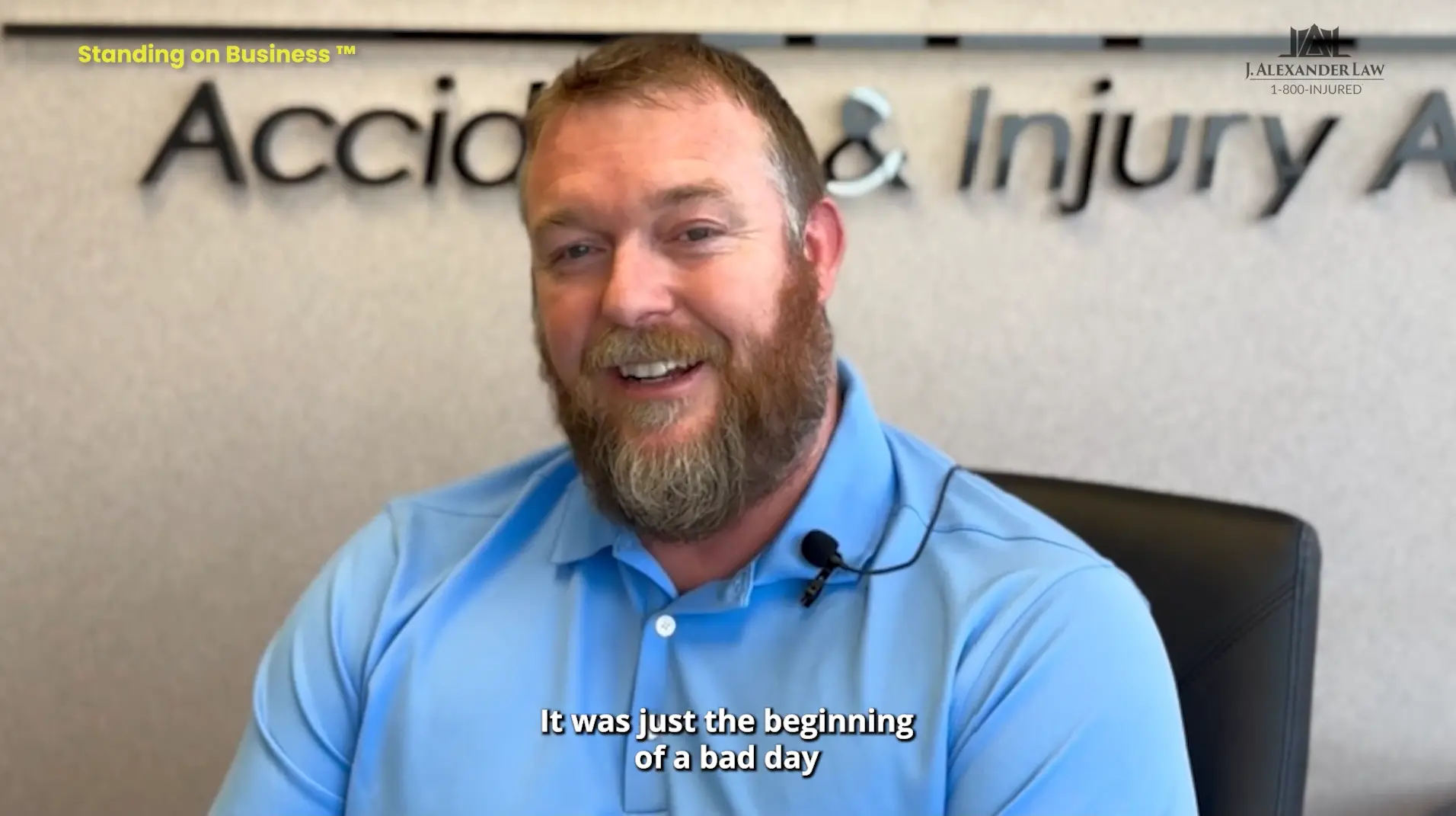
Chris came to us after hiring a different firm first; his story is the pattern we see most, sign fast somewhere, then find you cannot get a straight answer about your own case.
“I was in an accident before and I used another firm, and it is a night and day difference with their firm and this firm. There has not been a situation where I could not get a hold of somebody. It has been a totally different experience for me.”
Chris · Verified client · Watch Chris’s story ▶
This review reflects one client’s individual experience. Past results do not guarantee a similar outcome.
The throughline is access, and it is the one thing you can test before you sign: call the firm, and notice who answers, how fast, and whether they already know your name.
What clients consistently say
Across a 5.0 Google rating and 675 reviews, the same themes repeat: you reach a real person who knows your file, someone explains each step before it happens, and the case comes off your plate.
Chris asked us these questions when he called after his crash
When Chris called us, all he wanted was to reach a human being who knew his case. These are the four questions we tell people to ask on the first call, whether they call us or another firm. Listen for a clear answer, not a comforting one. One test runs underneath all four: can the lawyer explain your own case back to you in plain language? If you hang up more confused than you called, that is an answer too.
Ask before you sign
What is the fee, exactly?
Ask for the exact percentage and whether case costs come out on top of it. What you are testing is whether the firm states its own number plainly and can explain anything above the Texas norm in a single sentence. A firm that gets vague about its fee will not get clearer about your money later.
Who actually handles my case?
You want a name, not a department. At this firm your attorney sets the demand and approves every offer, our negotiator handles the back and forth with the adjuster, and your case manager keeps your treatment and updates on track. If a firm cannot tell you who your day-to-day contact is before you sign, that is your answer.
How often will I hear from you?
Ask for a rhythm, not a promise to call sometime. Clients describe texts almost every other day around appointments and demands. A clear cadence, whether weekly or tied to case events, tells you the firm runs on a system instead of hoping you do not check in.
How fast do you return calls?
Ask what happens when you call and no one picks up. The honest answer is a return call, no later than one business day, from someone familiar with your file. Chris switched firms largely because he could finally reach a human being. That is the baseline you should expect, not a perk you should be grateful for.
What questions should I ask before hiring a personal injury lawyer?
Ask what the contingency fee is and whether case costs come out on top; ask who your day-to-day contact will be and how quickly they return calls; and ask whether the firm tries cases or only settles them. Clear answers to those three questions tell you most of what you need.
How we at J. Alexander Law Firm suggest verifying any Texas lawyer
We would rather you verify us than take our word for anything, so here are the three checks we point people to. They take about ten minutes and cost nothing.
- Search the State Bar of Texas. Look the lawyer up in the State Bar of Texas Find a Lawyer directory to confirm an active license and read any public grievance history. Every licensed Texas attorney appears here by name and bar number.
- Check board certification. Use the Texas Board of Legal Specialization to see whether the lawyer is board certified in personal injury trial law, a specialty credential that requires substantial trial involvement, peer references, and a passed exam. Fewer than 10 percent of Texas attorneys hold any board certification, so it is proof of the courtroom experience that separates a trial attorney from a settlement mill, not a badge a firm can simply buy.
- Read the recent reviews. Read the newest reviews, not just the star average, and look for specifics about communication and results rather than vague praise. A pattern of “I could never reach anyone” tells you more than a five star headline.
Check us the same way Here is how to check us: Josh Alexander, Texas Bar No. 24086984, licensed in Texas since 2017. Run the same two searches on that number before you call anyone, including us.
Common question
How do I check if a Texas lawyer is legitimate?
Search the lawyer on the State Bar of Texas Find a Lawyer directory to confirm an active license and see any public grievance history, and check the Texas Board of Legal Specialization to see if they are board certified in personal injury trial law. You can verify J. Alexander Law Firm the same way; Josh Alexander is Texas Bar No. 24086984.
Fairness is one of our core values. Here is what a fair fee looks like
$0
Upfront to start
33%
Standard in pre litigation
40%
Standard in litigation
No fee
Unless we win
Fairness starts with a fee you can see. The fee is a written percentage of what the case brings in, and case costs like records and expert fees are separate, so both belong in the same written agreement. If the arrangement is not in writing, slow down. Ours is in writing: 33% in pre litigation or 40% in litigation, with a $300 administrative fee on top. None of it, including any case costs we advance, is owed without a recovery.
A third deduction is the one clients rarely see coming. If a health insurer, Medicare, or Medicaid paid your accident bills, it can claim that money back out of your settlement through a lien or a subrogation right, and hospitals can file their own liens on top. Part of a good lawyer’s job is negotiating those balances down before you see your net, so ask on the first call how the firm handles liens and who does the negotiating.
Sanity check an offer Before you sign, run an offer through our Texas Settlement Offer Analyzer to see whether it covers your medical bills and lost wages or just closes your file cheaply.
Common question
How much does a personal injury lawyer cost in Texas?
You pay nothing upfront and nothing at all if there is no recovery. On contingency the fee is a written percentage of what is recovered, most often 33% for a claim resolved in pre litigation and 40% for one resolved in litigation; a fee higher than that is worth questioning.
If a Texas lawyer quotes you an average settlement, do not believe them
People search for an average settlement figure, but it does not exist in any useful form. What a claim is worth is set by facts specific to you: your total medical treatment, whether you needed surgery, the income you lost, the lasting effect on your body, and your share of fault. Two crashes identical on paper can settle years and dollars apart.
That is why an early offer and a headline average are both traps: an insurer quotes a low number before your treatment is finished, and an online average lumps a sprained wrist and a spinal fusion into one misleading middle. A lawyer who respects that will not hand you a figure on day one; a lawyer chasing your signature will.
Fault carries its own rule. Under the Texas modified comparative fault system your recovery is reduced by your share of the blame, and if you are 51 percent or more at fault you recover nothing (Civil Practice and Remedies Code chapter 33). It sits alongside the four things you must prove and comes off every dollar an insurer offers, so a 30 percent fault finding takes almost a third off the check before your injury is even debated. That is why proving the other side’s fault is central to the work, not a formality.
Common questions
What should I not say to an insurance adjuster?
Do not give a recorded statement, do not guess about how the crash happened, and do not say you are fine or not hurt, since soft tissue and head injuries often surface days later. A casual guess about how it happened can hand the adjuster a bigger share of fault to pin on you, which directly cuts what you recover. Stick to the basic facts and let your lawyer handle the rest. Be completely honest with your own lawyer, though; the caution that protects you with an adjuster works against you if you hold anything back from the person building your case.
How much do I keep from a $50,000 settlement?
You do not pocket the full amount. The contingency fee comes out first, most often 33% when the claim settles in pre litigation or 40% if it resolves in litigation, then case costs like records and expert fees, then any medical liens or unpaid bills your providers are owed. What is left is your net, and the exact split depends on your written fee agreement and your medical balances. Ask for an itemized settlement statement so every deduction is visible, and model the offer against your own bills with our Texas Settlement Offer Analyzer.
At J. Alexander Law Firm we go up against the settlement mills, and win
We build every case from day one as if a jury will decide it. Most cases still settle; the difference is that the file is documented and the demand is backed by evidence that would hold up in court. Insurers track which firms are ready for trial and price offers accordingly, so readiness raises the number even when no one sees a judge.
A settlement mill runs the opposite play: sign a high volume of cases, spend as little as possible on each, and rely on fast, low settlements. That math works for the firm, not for you.
The simple test is to ask when the firm last took a case to verdict. A trial attorney answers with a year.
Common question
What is a trial attorney and do I need one?
A trial attorney is a lawyer who builds every case as if it will be tried in front of a jury, which changes what an insurer is willing to pay. You do not need to go to trial to benefit; the readiness itself moves the offer, because the insurer knows the file can survive a courtroom.
Proving your injury supports your Texas claim. Here is what to look for
Any Texas injury claim, from a car crash to a store fall, comes down to proving four things. Before you sign with us, we will show you how your case meets each one, because we would rather you understand your claim than simply hand it over.
- Duty The other person owed you a duty of care, such as a driver’s duty to follow the road rules or a store’s duty to keep its floor safe.
- Breach They broke that duty by running the light, texting, speeding, or ignoring a hazard they knew about.
- Causation That breach is what actually caused your injury, not something that happened before or after the crash.
- Damages You suffered real, measurable harm: medical bills, lost income, and the pain that comes with both.
Most claims are won or lost on the last two, causation and damages, where documentation decides the outcome; that is why a lawyer who prepares the file matters more than one who just signs you up.
Common question
What is the hardest injury to prove?
The injuries that do not show on a standard scan are hardest: soft tissue damage, concussions and other traumatic brain injuries, and psychological harm like post traumatic stress. They still win when the medical record is built carefully, with consistent treatment, the right specialists, and notes that tie each symptom back to the crash. The difficulty is a reason to hire a lawyer who handles these injuries, not a reason to assume your claim is weak.
A big name in Texas does not mean the firm is the right fit for you
The firm with the most billboards is not automatically yours. A big advertising budget tells you what a firm spends to get your call, not how it handles your file after you sign. Three things matter more than name recognition:
- Experience with your exact case. A firm that works truck wrecks every month reads a commercial insurance policy differently than one that mostly does slip and falls, so match the lawyer to the crash. Our car accident, truck accident, and motorcycle accident teams each work the injuries and insurers specific to those wrecks.
- Whether you can reach them after you sign. This is where a big name that runs like a settlement mill tends to fall down.
- Willingness to be compared. Line up two or three firms and ask each the same short list: when did you last try a case, who is my contact, and what is the fee. A confident firm expects the comparison; the one that pressures you to skip it has just told you something.
Common question
Should I switch lawyers if I already hired one?
Yes, you can change lawyers at any point, and it usually costs you nothing extra because the two firms split the one contingency fee rather than doubling it. If your current firm will not return your calls or cannot tell you who is handling your case, that is reason enough to get a second opinion.
Red flags to walk away from
If you hear any of these in a first meeting, treat it as a reason to keep looking.
Red flags and what they mean
Red flag
A promised dollar amount before anyone has read your file.
Why walkNo one can value a claim they have not reviewed. A number that early is a sales pitch, not an estimate.
Red flag
Pressure to sign on the spot.
Why walkA firm confident in its own work gives you time to read the agreement and get a second opinion.
Red flag
Being discouraged from getting a second opinion.
Why walkThe only reason to fear a second look is work that would not survive one.
Red flag
A fee above the 40 percent litigation norm with no explanation.
Why walkFees can vary, but an unexplained higher percentage means you are paying for something you were never told about.
Red flag
No clear answer on who handles your case.
Why walkIf they cannot name your contact before you sign, you will spend the whole case chasing one.
Do not wait too long to decide
You have two years to file in Texas (Civil Practice and Remedies Code section 16.003), but the evidence disappears far sooner; video is often overwritten within days or weeks. There is no three year rule for Texas injury claims, so assuming you have an extra year is how valid cases get thrown out. Choose a lawyer early, while the proof still exists. More in our guide to Texas filing deadlines.
Who you are hiring at J. Alexander Law Firm


I founded J. Alexander Law Firm in 2017 (Texas Bar No. 24086984). I am a Marine Corps veteran who deployed during Operation Iraqi Freedom, and I run the firm on one habit: we prepare every file as if a jury will read it, because insurers pay a demand built to try differently than one built to settle quietly. Matthew Graham, our Managing Litigation Attorney, holds every case to that standard.
The firm behind this guide
Josh Alexander has been named a Super Lawyers Rising Star every year from 2022 through 2026. Verify any of it yourself using the two searches above.
Results in motor vehicle casesAnonymized · J. Alexander Law Firm
| Client | Case type | Recovery |
|---|---|---|
| Dannet B. | Motor vehicle accident | $925,000 |
| Brian F. | Motor vehicle accident | $350,000 |
| Eduardo V. | Motor vehicle accident | $305,025 |
Every case is different, and past results do not guarantee a similar outcome.
Not sure yet? Start with a free case review
A free case review is a conversation: you tell us what happened, and we tell you honestly whether you have a claim and who would handle it. Browse our practice areas to see how we handle cases like yours. No fee unless we win.
Common questions
Is it worth suing for a personal injury?
It is worth pursuing a claim when someone else caused real, documented harm: medical bills you did not choose, income you lost, or an injury that changed how you live. Most claims settle without a filed lawsuit, so pursuing one rarely means a courtroom. A free case review is the low cost way to find out where you stand, because a lawyer will tell you honestly when a claim is not worth your time.
What should I bring to a free case review?
Bring whatever you already have; you do not need a complete file. The crash or incident report, any photos, the names of doctors you have seen, your insurance information, and a note of missed work are enough to start. If you are missing some of it, the firm can request records for you, because the point of the review is to find out where you stand, not to test your paperwork.
24/7 · Free consultation · No fee unless we win
Talk to a Dallas personal injury lawyer today.
Call 469-807-7480 or contact us online. Se habla español.