


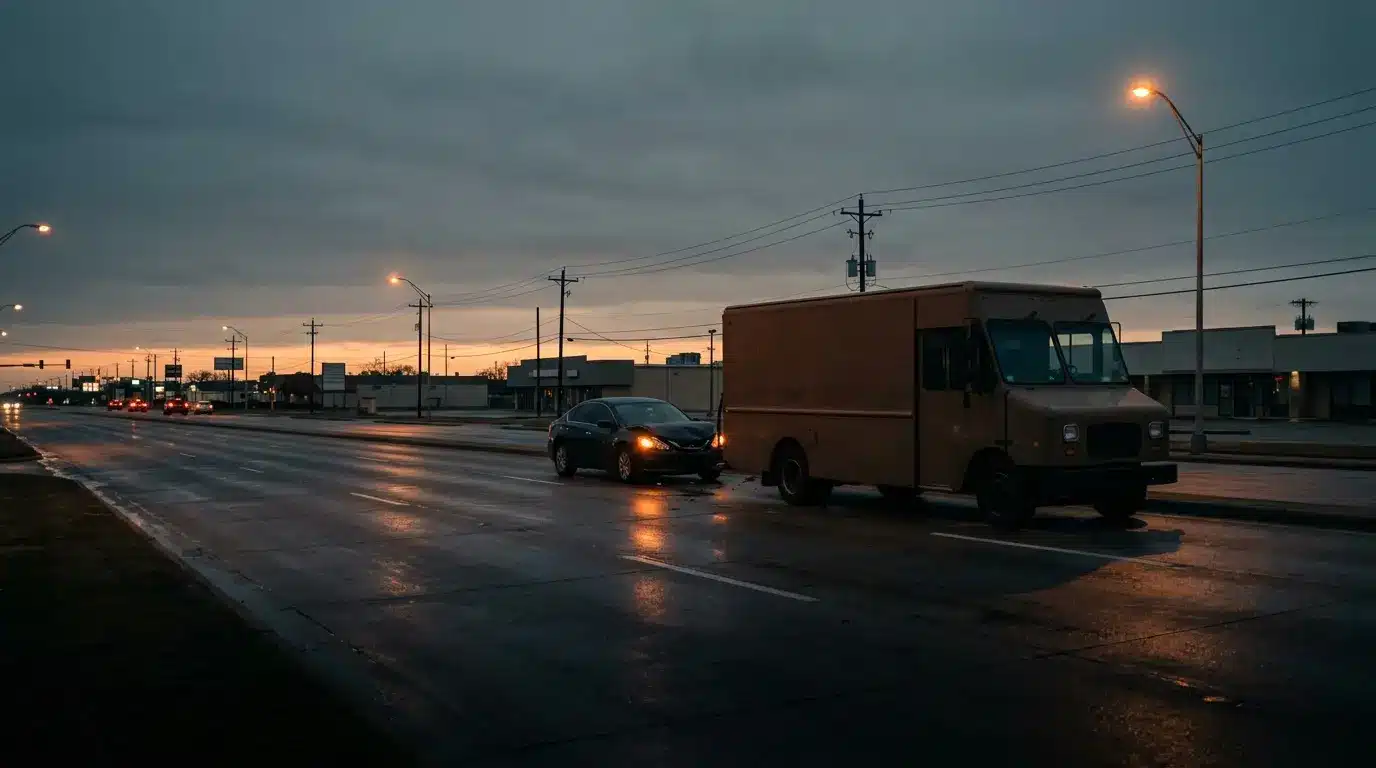
UPS truck accident lawyers in Texas.
Reviewed by Josh Alexander, Founder & Managing Attorney | Updated
UPS package drivers are UPS employees. So when one of them hits you, the company answers for the driver, and you know who the defendant is on the first day. What happens next is a question of proving fault and getting the records UPS already has.
Rated 4.9 from 568+ client reviews- $100M
Recovered for clients
- 4.9
Average client rating
- 568+
Client reviews
- 5
Years Super Lawyers Rising Stars
 Dallas Stars
 SMU Athletics
- Sporting United
- Super Lawyers Rising Stars
- Multi-Million Dollar Advocates Forum
- Million Dollar Advocates Forum
- Texas Trial Lawyers Association







Reflects total client recoveries across hundreds of resolved matters. Past results do not guarantee a similar outcome.
A UPS truck crash is not built like an Amazon or FedEx crash.
When a delivery van hits a driver or a pedestrian, the first question is usually which company the driver works for. With Amazon and FedEx delivery work, a separate contractor company often sits between the driver and the brand on the side of the van, and answering that one question can take months.
UPS package drivers are employees of UPS. They are represented by the Teamsters under the largest private sector collective bargaining agreement in North America. In the usual UPS van crash there is no contractor company in between, which means most UPS truck accidents start with the defendant already identified.
That does not make the claim small. It moves the argument to who caused the collision, what the records show, and how much the injury is worth.
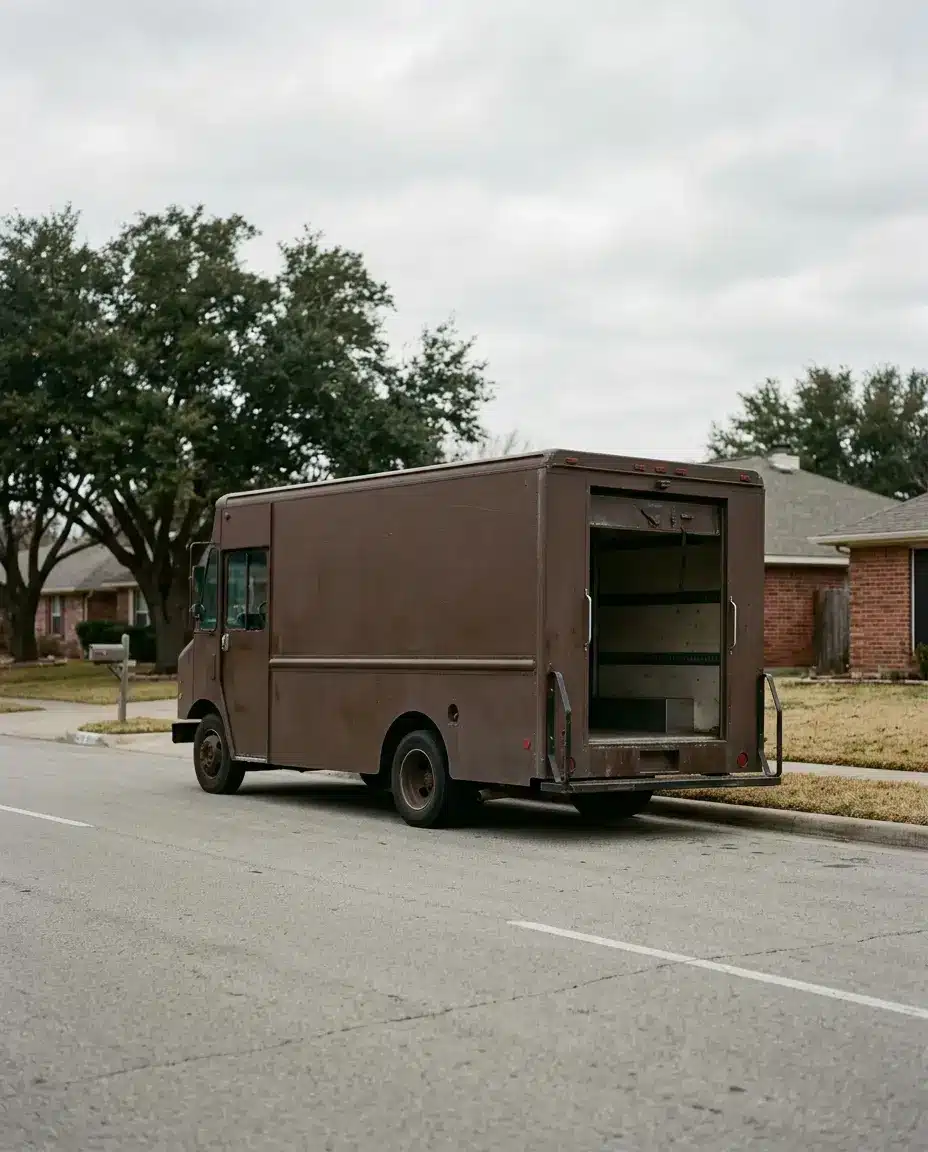
Why UPS answers for what its driver did.
A UPS driver accident is rarely a claim against one person. Because the driver was a UPS employee working a route, the company is on the claim alongside the driver, and you are dealing with a national carrier rather than an individual with a personal auto policy. The doctrine behind that, vicarious liability, is set out in full on our company vehicle accident guide.
Driver negligence and corporate negligence are separate claims. The driver may have made the mistake, and UPS may have made its own: a driver kept on a route with a known history, training that was never given, a van with a repair request the company never acted on. Each of those is a failure by the company itself.
Both matter because they rest on different proof. Driver negligence is proven from the collision itself. Corporate negligence is proven from employment and maintenance records that only UPS holds, which is why we ask for them in the first week rather than the first year.

A UPS truck accident in Texas carries a two-year deadline to file suit.
Texas Civil Practice and Remedies Code Section 16.003 gives most injury claims two years from the date of the crash. Exceptions exist and they are narrow, so confirm your date rather than assuming one applies to you.
Shared fault is the second number that decides what you keep. Under Section 33.001, your recovery drops by your percentage of responsibility, and you recover nothing if a jury puts you above 50 percent. Every point an insurer assigns to you is money it does not pay, which is why the percentage gets argued as hard as the injury does.
Who you are up against.
A UPS accident is not a claim against a driver with a personal auto policy. UPS accidents are answered by people who do this work full time: claims professionals, in-house counsel, and outside defense firms who have handled thousands of delivery collisions and know exactly what a case like yours usually settles for.
One of the first things we establish is how the loss is covered, because that determines who has authority to pay and how the claim gets evaluated. Texas discovery rules require a defendant to produce its insurance and indemnity agreements, so we request them rather than guessing at the structure from the outside.
Until that is answered, an early call is an opening position from an adjuster paid to close your claim for less than it is worth. You are not required to give a recorded statement to the other side, or to accept an offer made before your treatment is finished.
“I have worked on both sides of the desk, the most common thing I see with insurance companies is their initial offer, 99% of the time it is not the correct amount; I would know it was a tactic we would use and know I can share that knowledge with you.”

Matthew Graham spent over a decade directing insurance defense litigation for a 10-state region before joining the plaintiff’s side.
Three versions of the same crash, three different defendants.
A UPS driver in a UPS package car.
This is the standard case. The driver is a UPS employee working a route, the vehicle belongs to the company, and UPS answers for the collision. The claim turns on fault and on damages rather than on identifying the right defendant, and the records that prove both sit with the company.
A seasonal driver in a personal vehicle.
UPS has used seasonal drivers in personal vehicles during peak delivery periods. Whether that arrangement applied to any particular crash is not something we assume. A seasonal driver in a personal car can change who the defendant is, which is one of the first things we check when the vehicle described does not match a standard package car.
A hired, staffing, or non-employee driver.
Where a driver was placed through a staffing arrangement rather than hired directly, more than one company can be answerable for the same crash. This is uncommon in UPS package delivery. Whether it applies to your crash is a question of fact, so we establish the driver’s actual employment before naming a defendant. Naming the wrong one costs time you do not have under the two-year deadline.
What we do in the first week.
A car accident with a UPS truck is a claim against a national company from the minute it happens. The first week is spent making sure the record of it exists before anyone needs to argue about what the record says.
- 1
Identify the driver and confirm the employer
We pull the police crash report, identify the driver by name and unit number, and confirm in writing that the driver was a UPS employee working a route at the time. The defendant gets verified, not assumed.
- 2
Send the preservation letter
We write to UPS and put the company on notice of its duty to preserve the records tied to your crash, including route data, vehicle data, and the driver’s file. The letter creates a documented demand, dated and delivered.
- 3
Fix the crash time and the scene
We establish the exact timestamp and location, then request the footage that exists near it: business cameras, doorbell cameras, and traffic cameras. A timestamp is what lets two recordings be matched to one collision. Private footage is often overwritten quickly, so this is asked for in days rather than months.
- 4
Open the claim and take the calls
We notify the carrier, open the file, and become the contact point. Adjusters call us instead of you, and you stop giving statements to a company whose job is to reduce what it pays.
How people get hit by UPS trucks.
UPS truck crashes fall into a handful of recurring patterns, and in most of them the brown truck was doing something entirely routine when it happened. Whatever version yours was, what you do in the first hours after a UPS truck wreck decides how much of it you can still prove months later.
Rear-ended by a delivery truck
A loaded package car that slammed into stopped traffic leaves damage showing how fast it was moving. Photograph both vehicles before either is moved or repaired.
Backed into at a stop
A step van has limited rear visibility, so a van that ran into you may never have seen you. Note whether a spotter was present and whether the backup alarm worked.
Sideswiped in traffic
Wide vehicles drift when a driver is watching an address instead of the lane. Damage running the length of one side shows the point of first contact, so photograph your whole car.
Struck while walking
Pedestrians are hit near the curb, in driveways, and in parking areas where a van is pulling in or out. Get the names of anyone who saw it before they leave.
Hit by an opening door or a double-parked van
A van stopped in a live lane forces other drivers around it. Photograph where the truck was parked; that position is the evidence and it disappears in minutes.
Crashed into at an intersection
A driver behind schedule takes a light that has already changed and collided with cross traffic. The timing is provable from camera footage and from the vehicle’s own data if it is requested before it is gone.
Whatever you do next, get medical attention and keep the records. A gap between the crash date and the first visit is the argument an insurer makes to say the injury came from something else. See our guide on what to do after a crash in Texas.
The evidence only UPS holds.
Route and delivery records
Stop times, delivery scans, and where the vehicle was through the day. These place the truck at your location at a specific minute, which is often the difference between two versions of the same collision.
Vehicle telematics
Modern delivery vehicles record operating data. What was captured, and what remains available, is established through a formal request rather than assumed from the outside.
The driver’s employment file
The file holds hiring records, training, prior incidents and any discipline. That is what supports a claim that the company itself was careless, separate from what the driver did that day.
The company’s own report of the crash
Large carriers document collisions internally. Maintenance and repair history for that vehicle sits alongside it, and both are requested by name in discovery.
What a preservation letter does
It is a written notice to UPS that identifies your crash and states the company’s duty to preserve the material connected to it, creating a dated record of what was asked for and when.
A preservation letter does not physically stop a record from being lost. What it does is remove any argument that no request was ever made, and if evidence connected to your crash later turns out to be unavailable, that failure to preserve has a legal name: spoliation.
This is why the timing is the point. The letter goes out in the first week, before we know which record will end up mattering most.
Start your case reviewWhat you can recover.
Texas allows recovery in four broad categories. What any single claim is worth depends on the injury, the medical record, and the proof of fault.
Medical expenses
Treatment already received and care your doctors expect you to need. Future care is proven with medical opinion, not with an estimate written after the fact.
Lost income
Wages missed while you were unable to work, and lost earning capacity where an injury changes the work you are able to do going forward.
Property damage
Repair or replacement of a wrecked vehicle and the personal property damaged inside it, including a rental for the time yours is unavailable.
Non-economic harm
Physical pain, mental anguish, disfigurement, and physical impairment. Texas treats these as real losses even though no invoice exists for them.
For how these categories are valued in Texas claims, see our guide on what a Texas accident case is worth. Past results do not guarantee a similar outcome.
Results from Texas vehicle claims.
- $716KMotor vehicle accident
Recovered for a driver injured by another motorist’s negligence.
- $350KMotor vehicle accident
Settlement for a client rear-ended in Texas traffic.
- $15M18-wheeler, wrongful death
Recovered for a family after a fatal collision with a commercial truck.
- $2.55M18-wheeler crash
Resolved for a client seriously hurt in a wreck with a tractor-trailer.
- $1M18-wheeler crash
Recovered after a heavy truck caused a high-impact highway collision.
- $750K18-wheeler crash
Settlement for injuries from a commercial truck collision.
Sample results from real past cases, none of which involved UPS. Past results do not guarantee a similar outcome.
Who handles these claims
You reach an attorney, not a call center.

Josh Alexander
Founder & Managing AttorneyA Marine Corps veteran and Texas trial lawyer who founded the firm and has recovered millions for hundreds of injured clients. On a UPS file he owns the fault question, naming what the driver did and what the company failed to do.
Meet Josh AlexanderMatthew Graham
Managing Litigation AttorneySpent over a decade directing insurance defense litigation for a 10-state region of the country’s second-largest auto insurer. He gets the preservation letter out in week one and sits with you before any recorded statement.
Meet Matthew GrahamLaura Rivas
Senior Associate AttorneyNine years representing injured people in motor vehicle, catastrophic injury, and wrongful death claims, in English and Spanish. She keeps the medical record moving so every symptom ties to treatment. Texas Bar No. 24096510.
Meet Laura Rivas


Questions people ask after a UPS accident.
If yours is not here, call and ask it. The answer is free either way.
Talk to an attorney today
Tell us what happened and we will tell you whether you have a claim worth bringing.
Call (469) 807-7480Who is liable for a UPS truck accident?
Are UPS drivers employees or independent contractors?
How long do I have to file after a UPS truck accident in Texas?
What if I was partly at fault for the crash?
What evidence does UPS have after a crash?
Do I have to talk to the insurance company?
What does it cost to hire you?
Six Texas offices. The same file, worked the same way.
A UPS route runs through every one of these counties. Find the office nearest you, or call the Dallas number and we will route it. If you cannot travel while you are treating, we come to you.
- Headquarters12801 N Central Expy, Suite 1100
Dallas
TX
Dallas, TX 75243 (469) 807-7480Explore services in Dallas
- 1023 S. Trade Days Blvd., Ste 113
Canton
TX
Canton, TX 75103 (903) 385-8500Explore services in Canton
- 801 W Road to Six Flags St, Ste 141J
Arlington, TX 76012 (817) 856-0580Explore services in Arlington
Hit by a UPS truck anywhere in Texas? The preservation letter goes out the same week, whichever office opens the file.
View all locationsRelated reading.
-
Different vehicle
UPS tractor trailers, the feeder trucks, are handled on our truck accident page
Those crashes fall under FMCSA federal trucking regulations, and the driver’s hours of service and electronic logging data become evidence that package car cases do not involve.
Go to truck accidents -
Employer responsibility
When a company answers for its driver
The full rule on employer responsibility for employee drivers, across every kind of company vehicle.
Read the employer rule -
First steps
What to do in the hours after a Texas crash
See the first steps -
Deadlines
The two-year deadline on Texas accident claims
See the deadlines -
Case value
What a Texas accident case is worth
See what drives value -
Hiring a lawyer
Is it worth getting a lawyer after a Texas crash?
See what the numbers say
Hit by a UPS truck? No fee unless we recover.
Tell us what happened and we will tell you whether you have a claim worth bringing. You pay nothing up front, we advance the case costs, and our fee comes only out of what we recover for you.
Free consultation, 24/7 · Se habla español · Serving all of Texas
Attorney advertising. Josh Alexander is responsible for the content of this page; principal office 12801 N. Central Expressway, Suite 1100, Dallas, TX 75243. Prior results do not guarantee or predict a similar outcome in any future case. The information on this page is for general purposes only and is not legal advice; contacting the firm or submitting a form does not create an attorney-client relationship. UPS is a registered trademark of its owner and is named here only to describe the type of claim this firm handles; this firm is not affiliated with, endorsed by, or acting on behalf of that company. Se habla español.