



Rollover accident lawyer in Texas.
Reviewed by Josh Alexander, Founder & Managing Attorney · Updated August 2026
Your vehicle went over on a Texas road, probably with no other car in sight, and the insurer is already treating that as your fault. Here’s what your claim needs before the wreck is scrapped, and what hiring us costs: nothing unless we recover.
Rated 4.9 from 568+ client reviewsRecovered for clients
Years of combined experience
Client reviews
Years Super Lawyers Rising Stars
Reflects total client recoveries across hundreds of resolved matters. Past results do not guarantee a similar outcome.
Rolled over in Texas? Your claim turns on the cause and the wreck.
Did you roll on a rural two lane, a farm to market road, or a Texas highway? Did the adjuster’s first call already use the words “loss of control”? A rollover claim turns on two questions, and nothing else in your case works without them.
Both questions have answers. Both sit on clocks the insurer knows far better than most families do. And the two questions are one investigation, because the cause names the defendant while the wreck holds the proof of the cause.
In week one, our attorneys send written demands to preserve the wreck. We photograph the scene while its marks are still there. We start working out what caused the roll, because the cause points at the right defendant. We handle these cases across Texas from our Dallas office. Get a free case evaluation before the insurer, not you, decides what happens to the vehicle.
Further Legal Reading: (Tex. Civ. Prac. & Rem. Code § 33.001) and (§ 16.003)
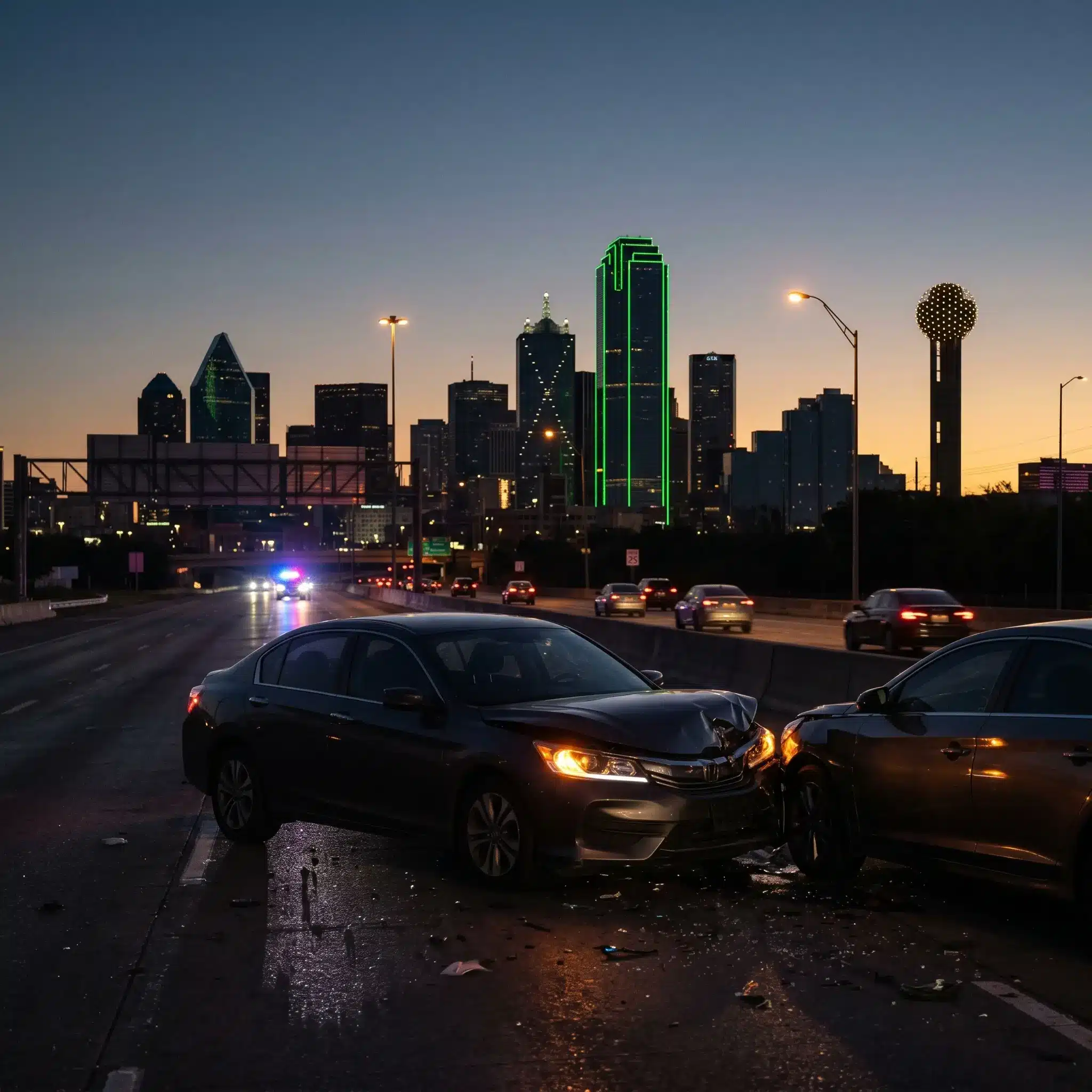
What can you recover after a rollover accident in Texas?
If you were injured
Medical care past and future, the income you couldn’t earn, and the impairment a roll leaves behind all belong in one demand. Our crash injury visualizer maps how those injuries behave inside the body.
If the rollover was fatal
Texas gives the family wrongful death and survival claims. The clock on the wrongful death claim starts when the injured person dies, and both claims carry a two year deadline (Tex. Civ. Prac. & Rem. Code § 16.003(b)).
After a fatal rolloverThe family’s claims and their clocksTwo claims in one case, and why the family’s clock can end later
A fatal rollover accident becomes two claims in one case. The wrongful death claim belongs to the family and answers for their loss; the survival claim carries what the person who died could have pursued. Because accrual waits for the death, the family’s two years can end months after the deadline that would have governed an injury suit, and the two dates in one file are easy to confuse (Tex. Civ. Prac. & Rem. Code § 16.003(b)).
Limitations also pauses for legal disability: a claimant younger than 18 when the claim accrues is protected while a minor (Tex. Civ. Prac. & Rem. Code § 16.001), which matters when children lose a parent. Evidence pauses for nothing. The wreck that shows why the vehicle went over moves toward salvage on the insurer’s schedule either way, so a grieving family’s first call should still be about keeping the vehicle. Ask us to handle that step so you don’t have to.
If a commercial truck caused the roll, the trucking company and its policy come into the case. Those claims run through our truck accident practice.
“We value rollover cases as structural injury claims. The roof and pillars moved toward the people inside, so the medical record and the impairment evidence carry the number, not the sheet metal. Write down every cost the roll has caused you, including the ones still arriving, and bring that list to your free case evaluation.”
 Josh AlexanderFounder & Managing Attorney
Marine Corps veteran
A single vehicle accident is not automatically your fault
One vehicle left the road, so the adjuster’s file already says driver error. Texas law has no such presumption: “The mere happening of an accident is no evidence of negligence” (Wells, quoted in Porterfield v. Brinegar, 719 S.W.2d 558 (Tex. 1986)). Porterfield itself was a one vehicle rollover on a Texas highway. No Texas rule converts a one car crash into a verdict against the driver; the blame is a position, and evidence answers it: the trip point, the tire, the driver who forced the swerve, the road.
You lose the right to recover only above 50 percent, in the statute’s words “greater than 50 percent” (Tex. Civ. Prac. & Rem. Code § 33.001); at exactly 50 you still recover, just reduced (§ 33.012(a)).
Passengers in a rolled vehicle have their own claim
If you were the passenger, you recover from whoever bears the fault, and that includes the driver of the car you rode in. Your claim runs on its own track. Whoever held the wheel, say nothing to any adjuster about speed, drowsiness or “losing control”. Route the fault conversation through us first.
The labelWhat counts as a single vehicle accident, and how the carrier treats oneWhy the label changes which policy pays and where the blame lands
A single vehicle accident is a crash in which only one vehicle is involved in the impact: no second car, just your vehicle, the road and whatever caught it. Most rollovers are single vehicle accidents, because the usual sequence is a vehicle leaving the pavement alone and tripping on something low. The label changes how the carrier treats the claim. With no other driver in the file, no second insurer exists to pay, so the claim runs on your own coverage while the fault question lands entirely on you.
Expect the seat belt argument in the same breath. Nonuse is admissible in Texas, but only to apportion responsibility under Chapter 33; it reduces a recovery by percentage and never forfeits one (Nabors Well Services v. Romero, 456 S.W.3d 553 (Tex. 2015)). Those belt percentages join the same Chapter 33 pool that decides whether your share crosses the bar. Because no second driver exists to absorb percentages, every point the adjuster assigns pushes you toward the greater than 50 percent bar, which is why cause evidence naming another defendant is also the evidence protecting your recovery. Have us test the single vehicle label before you accept it; a phantom driver or a road defect takes your crash out of that category.
You have two years to sue. The wreck has only weeks.
You have two years from the day of the crash to file a rollover lawsuit in Texas (Tex. Civ. Prac. & Rem. Code § 16.003(a)). The wreck itself can be gone in weeks. Those are the two clocks, and only the first belongs to you. The vehicle’s clock is set by the total loss process, not the courthouse, so the preservation demand cannot wait for the suit. Every deadline that can end a Texas claim is mapped in our filing deadlines guide.
A driver who never touched you can still be liable
One vehicle in the crash doesn’t mean one driver in the story. A car that swung into your lane and kept going is still a cause. Texas law says an operator “shall drive as nearly as practical entirely within a single lane” (Tex. Transp. Code § 545.060(a)) and must follow at a safe and prudent distance (§ 545.062(a)). If that driver is never identified, your claim ordinarily runs through your own uninsured motorist coverage; how that works lives in our guide to crashes with uninsured drivers. So today, write down everything you remember about the other vehicle, the color, the shape, the direction it went. Do it even though that car never touched you.
Results that speak for themselves.
Recovered for a family after a fatal collision with a commercial truck.
Resolved for a client seriously hurt in a wreck with a tractor trailer.
Recovered after a heavy truck caused a high impact highway collision.
Settlement for injuries from a commercial truck collision.
Recovered for a driver injured by another motorist’s negligence.
Settlement for a client rear ended in Texas traffic.
Sample results from actual past cases. Past results do not guarantee a similar outcome; every case is different.
How does a rollover accident happen? Most start with a trip.
About 95 percent of single vehicle rollovers are tripped, per NHTSA. The vehicle leaves its path and hits something low, a curb, a soft shoulder, a ditch, a slope, and that tips it over. Untripped rolls, the kind caused by steering and speed alone, are the rare exception. Which trigger was yours decides everything that follows.
The four triggers behind most Texas rollovers
- A trip at the pavement edge, where a soft shoulder or drop off catches a tire
- Tire failure at highway speed, a blowout or tread separation
- A swerve forced by another driver who never stopped
- Speed into a curve, the rare untripped kind
The mechanicsHow does a car flip over in an accident? The trip and the pivotWhat arrests the tires, and why a taller vehicle needs less force
A car flips when its tires stop moving sideways and its body does not. The vehicle slides off its travel path, something low arrests the tires, a curb, soft soil, the edge of a ditch, and momentum above that pivot point carries the body up and over. Crash investigators call the catch a trip, and NHTSA’s education materials trace nearly all single vehicle rolls to one.
The higher a vehicle carries its weight, the less force the trip needs, so an SUV or pickup can go over where a sedan slides to a stop. The same physics that flipped the car frames the inspection: find the trip, measure the roll, and the mechanics become evidence. Walk us through the seconds before the tip and we can usually tell you which piece of ground did it.

Rural roads, routine driving: where Texas rollovers actually happen
A rollover collision is not one event but two, the trip and the roll. Roll over crashes concentrate on rural Texas roads, and a single vehicle crash on a farm to market road is the pattern we see most. Among vehicles in single vehicle fatal crashes in 2023, 47 percent of those in rural areas rolled over, compared with 17 percent in urban areas, per NHTSA. The same research found over 90 percent of vehicles in fatal single vehicle rollover crashes were doing ordinary driving, going straight or taking a curve. That cuts against the assumption that a roll means reckless driving. Tell us what the road felt like in those last seconds, the pull, the drop, the bang. Those feelings point to a cause, and the cause points to who answers for it.
How we answer the theory that you lost control
“You lost control” is a theory, not a finding. An insurer reads a one car file to confirm it. An investigator reads it to find the cause. Four facts can outvote the theory, and each one names a different party to answer for the crash. That’s why we check all four before we accept any version of the story.
- The trip point. Gouges and furrows where the pavement edge or the shoulder gave way show what pulled the vehicle off its path.
- The tire. The tire itself shows whether it failed before the roll or in it, and a failure at highway speed points away from driver error.
- The other driver. If someone forced the swerve and never stopped, that driver stays in the case even without contact.
- The road. A drop off or washout with no warning brings whoever was responsible for maintaining the road into the claim.
Before you accept any version of driver error, have all four checked. The first consultation is free, and we run these checks for you.
What caused your rollover decides who owes you: trip, tire blowout, the vehicle itself, or speed
Trip: curb, shoulder, ditch
The most common cause of a rollover accident is a trip: the vehicle leaves the road and something low catches it. NHTSA puts that trigger far ahead of every other one. An unrepaired drop off or washout at that spot can put the road authority, a contractor, or the driver who forced you off the pavement on the hook.
Tire failure at highway speed
A tire that lets go at highway speed pulls the vehicle off course faster than any driver can correct, and that points the cause away from the driver. The failed tire is evidence, so it has to survive. Whether it supports a separate claim is a question we answer during our review.
Vehicle behavior
Some vehicles go over at a speed and a steering move that shouldn’t roll a car. NHTSA names vehicle type as a significant factor: SUVs, pickups and vans sit taller than a sedan, so less force at the tyres is needed to start them over. An inspection answers that question, and only while the vehicle still exists.
Speed and the curve
A small share of rolls involve no trip at all, only speed carried into a curve. Insurers read that story into every single vehicle claim, and they have it backwards. Even then, Texas divides responsibility by percentage rather than ending the claim.
Why the trip point gets checked first
Order matters in a cause investigation. The trip point comes first because rain and traffic erase it first. The tires, the roof line and the recorder module last only as long as the vehicle does. Don’t let anyone, not the insurer, not the storage yard, not a family member, get rid of the tires or the vehicle before the cause question is answered.
Checked in this order
Keep the vehicle: your rollover case can be scrapped with it
A rollover claim can die in a salvage auction. Once the insurer pays a total loss claim, it usually owns the rollover wreck (Tex. Transp. Code § 501.0925). From there the vehicle moves toward auction. Storage yards also have their own legal right to get rid of vehicles nobody claims, so an unclaimed wreck can lawfully be auctioned or scrapped within weeks. You don’t control either clock. The payment that closes the property claim is the same event that feeds the salvage pipeline, so the settlement check and the evidence loss can share a date. The shape of the crushed roof, the tires, the trip marks in the sheet metal and the recorder module all go with it.
Our preservation letter is notice, not a court order. The duty to preserve starts when a party “knows or reasonably should know that there is a substantial chance that a claim will be filed” and that the evidence it holds matters to that claim (Wal-Mart Stores v. Johnson, quoted in Brookshire Bros. v. Aldridge). So tell your insurer in writing today that the vehicle must not be moved, sold or destroyed. Then let us take over.
One letter to the insurer, whoever is storing the wreck, and the operator who towed it, sent the day we take the case.
If it is destroyed anywayWhat a Texas judge can do about a lost wreckThe two step spoliation test, and why it is worth less than the vehicle
If the wreck is destroyed after notice, the fight moves into court, and the rules there are exact. The trial judge decides spoliation, never the jury, and does it in two steps.
- Duty and breach. The court decides, as a question of law, whether a party with a duty to preserve the evidence breached it intentionally or negligently.
- The remedy. Only then does the court weigh how much the offending party was to blame and how much the loss hurt the other side, with options running from an award of attorney fees to dismissal.
That framework is why the notice letter matters (Brookshire Bros. v. Aldridge; Tex. R. Civ. P. 215.2). The spoliation jury instruction is saved for a finding that evidence was destroyed with the specific intent of concealing it, plus a narrow exception where a negligent loss leaves the other party no meaningful way to present its case. You can’t sue anyone separately for destroying evidence; spoliation is not an independent tort in Texas (Trevino v. Ortega). Every remedy on that list is worth less to you than a wreck that still exists. That’s why the hold letters go out before the question ever comes up.
What proves a rollover crash: yaw marks, roof crush, the recorder
On the road: yaw marks, the trip point, transfer
Yaw marks are the curved, striped prints a sliding tire leaves. They record how fast the vehicle was going and how it was steered before the roll. The trip point is the gouge where a tire dug in. It marks the exact spot where sliding became rolling. Dirt and crushed grass on the body panels tie the vehicle to that spot.
On the vehicle: roof height, tires, module
Measuring how far the roof crushed down from its original height tells a reconstructionist how violent the roll was and how many times the vehicle turned. The tires show whether one failed before the roll or during it. And the module, if your vehicle has one, holds the final seconds in numbers.
On the roadWhat a reconstructionist reads in yaw marksSpeed, steering and the trip, measured from marks that fade
The arc and spacing of yaw marks give an estimate of the vehicle’s speed. They also show how the wheel was turned before the vehicle left its path. That’s a measured answer to an adjuster’s theory that the driver simply lost control. The direction of the gouging at the trip point shows what caught the vehicle. And a documented drop off or crumbling shoulder at that spot moves the cause outside the driver altogether. These are measurements, and they can only be taken from marks that still exist. Traffic wears them away, and bent grass stands back up within days.
The moduleThe recorder, stated plainly: five seconds, twice a second, if equippedWhat the federal rule actually requires, and what it does not
Not every vehicle has one. The federal rule covers vehicles equipped with an event data recorder and does not require the device (49 C.F.R. § 563.3). Where a module exists, a vehicle on the road today captures about five seconds before impact, sampled twice a second. That includes vehicle speed, throttle position and service brake status (49 C.F.R. § 563.7). Vehicles built late this decade start carrying a longer window. Five seconds sounds thin until you set it against a rollover, where the swerve, the braking and the trip all happen inside that span. And when no module exists at all, the roof crush measurement and the marks on the road have to do the recorder’s work, which makes the wreck’s survival the case itself.
None of this evidence waits for your claim to be ready. Photograph the road marks and the flattened grass this week, before the weather takes them. Photograph the vehicle from every side, wherever it sits. Send us the photos with the date.
When the road tripped your vehicle: government liability and the six month notice
In a rollover motor vehicle accident the trip point is sometimes the road itself, a drop off or a washout, and when it is, the same defect that tripped the vehicle is what brings a governmental unit into the case as the defendant. For an ordinary premise defect the unit owes only the duty owed a licensee; for special defects “such as excavations or obstructions” the duty rises to that owed an invitee (Tex. Civ. Prac. & Rem. Code § 101.022). Texas courts built that doctrine on a hole that flipped a car (County of Harris v. Eaton (Tex. 1978)).
Which class the defect falls into sets the duty the unit owed you, so the photographs of that drop off decide the legal standard as well as the facts. Design decisions keep their immunity (§ 101.056), so the claim is built on maintenance failures and missing warnings, not on blueprints. A private contractor that left the edge has no immunity; a claim against it proceeds as ordinary negligence.
| Notice to the governmental unit a condition on the claim, § 101.101(a) | 6 months |
| City charter notice windows can be tighter than six months | check now |
| Deadline to file suit § 16.003 | 2 years |
Only § 16.003 is the deadline to sue; the notice is a condition, not a limitations period.
If the road gave way under you, the notice work starts now. Call before the first month is gone.

No fee unless we recover. Period.
You never pay out of pocket. We advance the costs of building your case, and our fee comes only from what we recover for you.
Expect two moves from the insurer: the recorded call and a fast total loss
A single vehicle claim lands on the adjuster’s desk with the theory already drafted: driver error. The recorded call exists to confirm it. That’s why you’re invited to talk through the crash until the words “I lost control” appear. Expect the total loss to move fast too, because getting rid of the wreck helps the carrier twice: it closes the file and it takes the evidence with it. Matthew Graham, our managing litigation attorney, spent more than a decade directing insurance defense litigation. He’s watched this sequence from the other side. Now he reads a single vehicle file the way the carrier does, and he answers it.

CoverageIs a rollover accident considered a collision?Why your own collision coverage applies with no other car
Usually, yes. The standard Texas personal auto policy defines collision to include “upset” of the covered vehicle. That’s why a rollover is ordinarily a collision claim under your own collision coverage, even when no other car was involved. Your policy’s own definition controls. Read it before the adjuster reads it to you, and send us the declarations page along with your questions.
The recorded callWhat not to say on the recorded callThe words adjusters wait for, and the safer script to follow
Give the date, the place and the vehicles involved, then stop. No speed estimates. No guesses about how tired you were. No agreeing that one vehicle means one fault. A polite estimate offered in the first call has a way of becoming the file’s centerpiece by the time an offer arrives. Anything beyond the basics waits until you’ve prepared it with us.
The claim pathA single vehicle accident insurance claim, from first filing to the fault fightThe sequence your file will follow, and where it turns
Filing starts with your own carrier. A single vehicle accident insurance claim usually has no other policy to file against, so the property side runs through your own collision coverage while the injury side waits on the fault fight. Your own policy may carry coverage that answers before the fault question is settled, so ask your carrier what yours includes while the argument is still running. Report the crash, identify the storage yard holding the wreck, and get the total loss valuation in writing before agreeing to anything.
The fault fight is the claim’s second act. The adjuster opens with driver error, asks for a recorded statement to support it, and moves the total loss quickly; the recorded call and the fast total loss serve the same file closing goal, which is why both tend to arrive in the same week. Chapter 33 percentages then decide what the injury claim pays, and the cause evidence decides the percentages. Because a single vehicle collision leaves the claim riding entirely on your own coverage, there is no second insurer to absorb blame, which is the part a single vehicle accident lawyer works hardest, and every percentage the adjuster assigns lands on you and pushes your share nearer the recovery bar of § 33.001.
If the driver who forced the swerve is never identified, the claim ordinarily proceeds through the uninsured motorist side of your own policy, the phantom driver problem covered earlier on this page. Send us the adjuster’s first letter before you answer it.
The safest recorded statement is one we prepare with you. The next safest is one that never happens. Call before you return the adjuster’s message.
Read the black box before you sign the total loss paperwork
If your vehicle carried a data recorder, that data belongs to you. Texas law bars anyone else from retrieving it without your consent or a court order, apart from a few narrow exceptions in the statute (Tex. Transp. Code § 547.615(c)). Your consent stops meaning anything once the module is gone. When an insurer takes ownership of a wreck by paying a total loss claim, it applies for the salvage title no earlier than the 30th day after paying (Tex. Transp. Code § 501.0925). After that the vehicle moves toward auction. So the window to read the module is measured in weeks. The total loss decision and the evidence decision are the same decision, no matter how routine the adjuster makes the paperwork sound.
A total loss settlement can transfer the vehicle, and everything inside it, with one signature. Get each of these in writing first.
Assumption against recordWhat the module answers against what the adjuster assumesThree assumptions replaced by numbers, if the module survives
An adjuster’s theory of a single vehicle rollover is built from assumptions. A surviving module replaces three of them with numbers recorded in the seconds before the trip (49 C.F.R. § 563.7).
| The adjuster assumes | The module recorded |
|---|---|
| “You were speeding” | Vehicle speed across the five seconds before impact |
| “You never braked” | Service brake status, sampled twice a second |
| “You panicked and floored it” | Throttle position through the swerve |
Reading the module takes three things: your consent, a module that survived and a vehicle that still exists. Two of those three are yours to protect. Remember that title follows the total loss payment and the retrieval right follows the title (Tex. Transp. Code § 547.615(a)(1)), so the payment that hands the carrier the wreck also ends your power to consent to a module read, passing the data along with the metal.
Total lossIs a car totaled if it rolls over?The Texas test is repair cost against value, with no set percentage
Usually, and the reason is structural. A roll damages the roof rails, pillars, windshield frame, doors, glass and suspension all at once. Repair costs on that much damage pass the vehicle’s value fast. Texas sets no percentage threshold; the total loss call is the insurer’s economic decision. What the statute defines is salvage: a vehicle whose cost of repairs “exceeds the actual cash value of the motor vehicle immediately before the damage” (Tex. Transp. Code § 501.091(15)). Actual cash value means the market value of the vehicle (§ 501.091(1)). Salvage value doesn’t enter either side of that comparison, whatever the adjuster’s worksheet suggests.
Because a roll moves the vehicle’s structure toward the people inside it, a rollover claim is valued on the medical and impairment record rather than the sheet metal, a question we cover in our breakdown of average car accident lawsuit value in Texas. Until then, get the total loss offer and the actual cash value figure in writing. And sign nothing that transfers the vehicle before the module and tires are documented.
Why you can trust that advice.
As Texas injury attorneys handling rollover cases statewide from our Dallas base, we have recovered over $100 million from Texas insurers and put it into our clients’ hands. Josh is a USMC veteran with more than a decade of trial experience, and the firm has earned recognition from Super Lawyers.
Bilingual, available around the clock, and paid only if we recover. Laura Rivas serves clients across Texas in English and Spanish. Call and you reach an attorney, not a call center; the number rings through 24/7.


How we’d build your rollover case: preserve, document, determine.
We prepare every rollover case as if it will be tried, and insurers can tell. The work has to happen in a fixed order, because the evidence disappears faster than the claim can come together. Each step exists for the next one: the hold letters keep what the photographs will record, and the photographs supply what the cause determination will read. Here’s what week one looks like.
- Preserve. We send written hold demands to your insurer, the storage yard and any tow operator before anything else, so the vehicle, its tires and its recorder module are still there when the claim decisions get made.
- Document. We photograph and measure the scene while it still exists, from the marks on the pavement to the spot where the ground first caught the vehicle.
- Determine. We test each possible cause in the order the evidence points, because the cause tells us who has to answer: another driver, a road authority, or a fight over your own percentage.
Bring the crash report number and the storage yard’s name to the first call; all three steps can start the same day.
The bilingual attorneys on your rollover case.
Josh Alexander
A Marine Corps veteran and Texas trial lawyer who has recovered millions for hundreds of injured clients across Texas.
Meet Josh Alexander
Matthew Graham
Spent over a decade directing insurance defense litigation for a 10-state region of the country’s second largest auto insurer. Now he works for the injured.
Meet Matthew Graham
Laura Rivas
Nine plus years representing the injured in motor vehicle, 18-wheeler, catastrophic injury, and wrongful death claims. Bilingual, English and Spanish.
Meet Laura RivasAsk for the attorney you see here when you call; the name on the page is the name on your case.
Searching for a rollover accident lawyer in Texas? Read the reviews.
“They took the time to answer all of my questions and made me feel confident in them. The whole staff has been friendly and professional.”
“After speaking with them, we were put at ease right away. They made sure my physical therapy was covered and have been invaluable to us.”
“Excelente servicio al cliente, son muy atentos con sus clientes. La comunicacion es muy buena; te ayudan a cualquier hora.”
Reviews from actual clients. Past results do not guarantee a similar outcome.
Free tools and helpful resources.
Crash injury visualizer
See how each wreck type injures the body, rollovers included, and which symptoms tend to show up late.
Open the visualizerTexas filing deadlines
Every clock that can end a Texas injury claim, and the narrow exceptions that can move one.
Check the deadlinesFirst steps after a crash
What to do in the first hours so your health and your claim both survive the week.
Read the stepsDo you need a lawyer?
Where the line falls between a claim you can settle alone and one that needs a lawyer.
Read the breakdownCrash report decoder
How to pull your statewide crash report from TxDOT and read it code by code.
Decode my reportWhat claims resolve for
What Texas car accident claims have resolved for and what moves the number.
See the numbersOpen whichever guide matches your next decision. If the crash happened this week, start with the first steps guide.
Common questions after a rollover.
Who pays my medical bills if they blame me for the rollover? Two coverages pay before fault is ever decided.
What is the most common cause of a rollover accident? Tripping, and the trip point decides who answers for it.
What is the most critical factor in causing a rollover accident? Not one factor; vehicle height, speed and the trip interact.
What percent of rollover accidents are fatal? A small share of crashes carries an outsized share of deaths.
How likely is it to survive a rollover accident? Most people do, and two choices drive the outcome heavily.
What car is most likely to roll over? Taller, narrower vehicles: SUVs, pickups and vans lead.
What should you not say to an injury lawyer? Nothing is off limits; your own lawyer needs the bad facts.
What are red flags when hiring a lawyer? Promised outcomes, pressure to sign, silence after signup.
Who is at fault when only one vehicle rolls over? Texas presumes nothing; four facts can answer the blame.
What does hiring a rollover accident lawyer cost? Nothing upfront, and nothing at all if there is no recovery.
Still have questions? The fastest answers come from a quick, free call with an attorney who can hear your specific situation.
Call 469-807-7480Six offices. The same standard of care.
From DFW to the Gulf Coast to South Texas, an attorney is never far. Find your nearest office and the services we handle there. And if you cannot come to us, we come to you.
Canton
TXCanton, TX 75103 (903) 385-8500
Explore services in Canton
Arlington, TX 76012 (817) 856-0580
Explore services in Arlington
Rolled over anywhere in Texas? Every office sends the same preservation letter and works the same cause investigation.
View all locationsTalk to a rollover accident lawyer in Texas. No fee unless we recover.
Tell us what happened and we will tell you what your rollover claim needs, at no cost. The wreck that proves the cause can be sold or scrapped within weeks, so the first call is about keeping it.
Free consultation, 24/7 · Se habla español · Serving all of Texas
Attorney advertising. Josh Alexander is responsible for the content of this page; principal office 12801 N. Central Expressway, Suite 1100, Dallas, TX 75243. Prior results do not guarantee or predict a similar outcome in any future case. The information on this page is for general purposes only and is not legal advice; contacting the firm or submitting a form does not create an attorney-client relationship. Se habla español.