


T bone accident lawyer in Texas.
Reviewed by Josh Alexander, Founder & Managing Attorney · Updated August 2026
Broadsided at a Texas intersection, and both drivers say the light was green? Cameras, recorders, and the way the two vehicles hit can settle that question. Here’s who holds the video, how we request it before it’s erased, and what hiring us costs: nothing unless we recover.
Rated 4.9 from 568+ client reviewsRecovered for clients
Years of combined experience
Client reviews
Years Super Lawyers Rising Stars
Reflects total client recoveries across hundreds of resolved matters. Past results do not guarantee a similar outcome.
What is a T bone accident? A side impact with no crumple zone to protect you.
A T bone accident happens when the front of one vehicle hits the side of another at a right angle, almost always at an intersection. The name comes from the T shape the two vehicles make when they hit. If you are asking what is a T boned accident, or searching what is at bone accident because autocorrect got there first, this is the crash you mean. T bone collisions go by four names, and they all mean the same wreck:
One fact drives everything else on this page: the side of a car has no crumple zone. A struck door sits inches from the person behind it, so a speed that would dent bumpers in a rear end crash can total a vehicle here. That’s why proving who had the light, and finding the camera that saw it, matters more in a broadside than in any other kind of crash. TxDOT crash data shows where these crashes happen most often, and our most dangerous intersections in Texas tool ranks every one of them.
Hurt in one of these? Tell us what happened and have an attorney review your crash free, before the nearest camera records over what it saw.
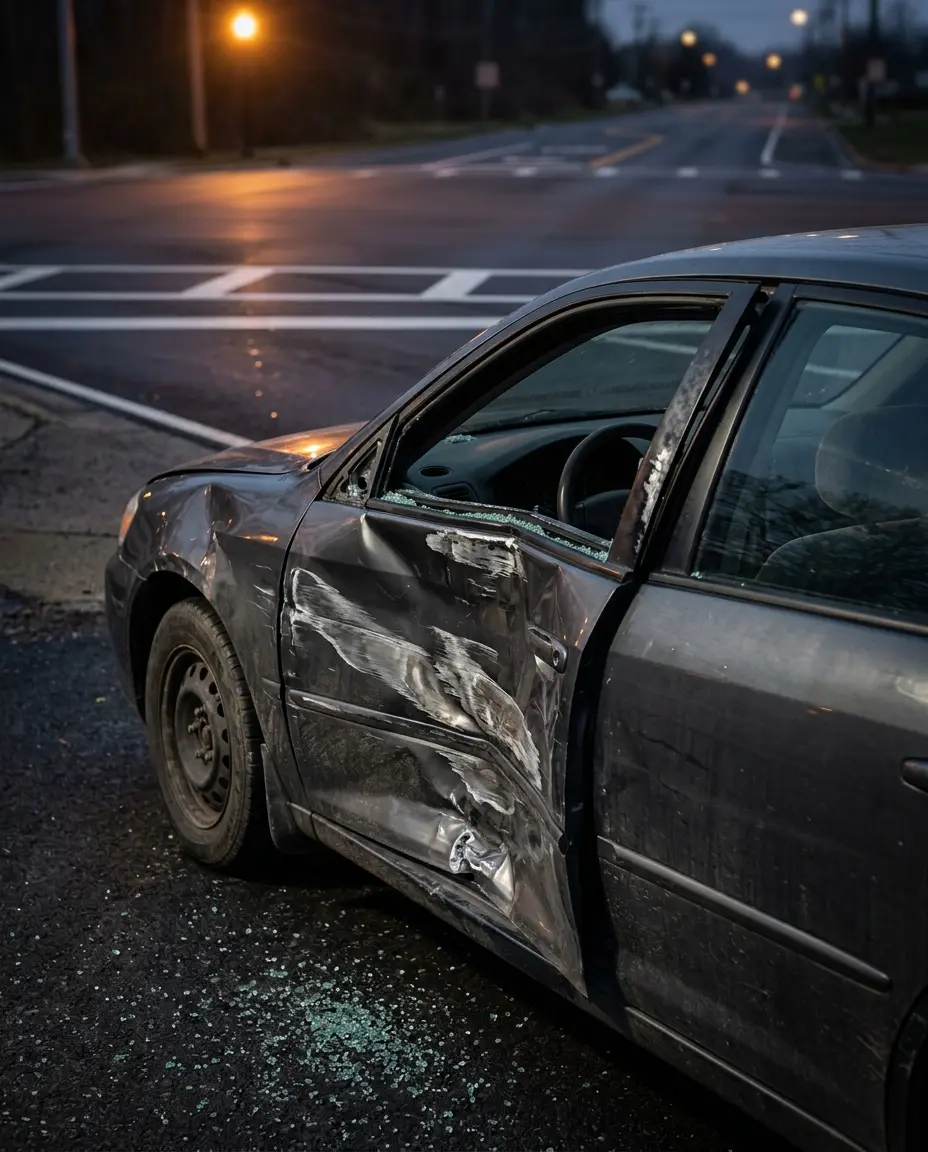
How hard did the broadside hit? Your crushed door holds the number.
In a front end crash, several feet of metal fold up and absorb the force. In a broadside, only inches stand between the other car and you: the door skin, an inner panel, and the pillars around them. With so little metal to work with, these cases turn on measurements. The first one is how far your door moved in.
Near side hit
In a near side hit, the other car’s bumper strikes the door you sat behind. Only the door skin and the B pillar stood in its way. Intrusion distance is the inches between where your door line started and where the metal ended up. That number records how much force reached your seat.
Far side hit
Where you sat decides which injuries the medical record has to prove, which is why the seating position goes in the file on day one. A far side hit lands across the cabin from where you sat, and the wreck still tells the story. Where the crush starts, how deep it goes, and which way the panels folded show where each car was at the moment of impact. They also show the closing speed, how fast the two cars came together.
“Photograph the door line straight on, with a tape measure in the frame, before the car gets towed or repaired. Crush depth converts to closing speed, and that number holds up no matter how hard an adjuster pushes on it. Send me the photos before the yard releases the car. The review costs nothing.”
 Josh AlexanderFounder & Managing Attorney
Marine Corps veteran
Both drivers say the light was green. Here is what breaks the tie.
A broadside dispute usually comes down to your word against theirs, with no referee. The other driver swears the light was green. So do you. Cross traffic clears in seconds, and the officer often records both stories without choosing one. Texas raises the stakes on that stalemate: you recover nothing if your share of responsibility is greater than 50 percent, and any award is cut by your percentage of blame (Tex. Civ. Prac. & Rem. Code secs. 33.001, 33.012(a)). Every point pinned on you has a dollar value, so a tied story never stays tied.
Once your share passes 50 percent, you collect nothing; at exactly 50 you still collect half. Every added point comes out of this line.
The four tiebreakers, in the order we chase them
Signal timing records show what the light was showing and when it changed. The camera above the crossing, covered below, shows the cars themselves. If a car carries a recorder, it holds about five seconds of speed and brake data (49 C.F.R. Part 563), and the crush on your door tells a crash reconstruction expert how fast the other car was going when it hit you. A court order is what reaches the other car’s module, and a court order needs a filed suit, so the two year clock and the day that wreck goes to salvage are the same deadline seen from two directions. Write down your memory of the light today; we’ll collect the versions that can’t forget.
Get the video requested before the cameras record over your crash.
Video is the first evidence a broadside loses. Camera systems loop quickly and record over older footage. No Texas law sets one statewide deadline for how long that video must be kept; each camera owner keeps it on its own schedule. A written request works only while the footage exists. The two year deadline to file suit (Tex. Civ. Prac. & Rem. Code sec. 16.003(a)) runs from the crash date no matter what happens to the video.
Government signal or vehicle in your crash? Notice is due within six months.
When a governmental unit owns the signal or the vehicle in your crash, it’s entitled to written notice of the claim within six months of the incident, and some city charters set tighter windows (Tex. Civ. Prac. & Rem. Code sec. 101.101). That notice is a condition on suing the unit, not your deadline to sue. The separate two year clock keeps running from the day of the crash. The notice is jurisdictional; if it’s missed, that alone can end the case. The exact windows live on our Texas car accident filing deadlines page. If a government signal or vehicle was part of your T bone, call today, while both clocks still have room.
What the firm has recovered, from $350,000 to $15 million
Recovered for a family after a fatal collision with a commercial truck.
Resolved for a client seriously hurt in a wreck with a tractor trailer.
Recovered after a heavy truck caused a high impact highway collision.
Settlement for injuries from a commercial truck collision.
Recovered for a driver injured by another motorist’s negligence.
Settlement for a client rear ended in Texas traffic.
Sample results from past cases. Past results do not guarantee a similar outcome; every case is different.
How Texas broadsides happen: left turns, run signals, and driveway pull outs
A T bone crash needs a crossing path; Texas intersections, driveways, and alleys supply it. One driver had the right of way; the other had to yield and crossed anyway. Which pattern yours followed decides what proof to chase.
The three patterns behind most Texas broadsides
- A left turn across oncoming traffic closer than it looked
- A driver running a red light or stop sign
- A pull out from a driveway, alley, or parking lot exit
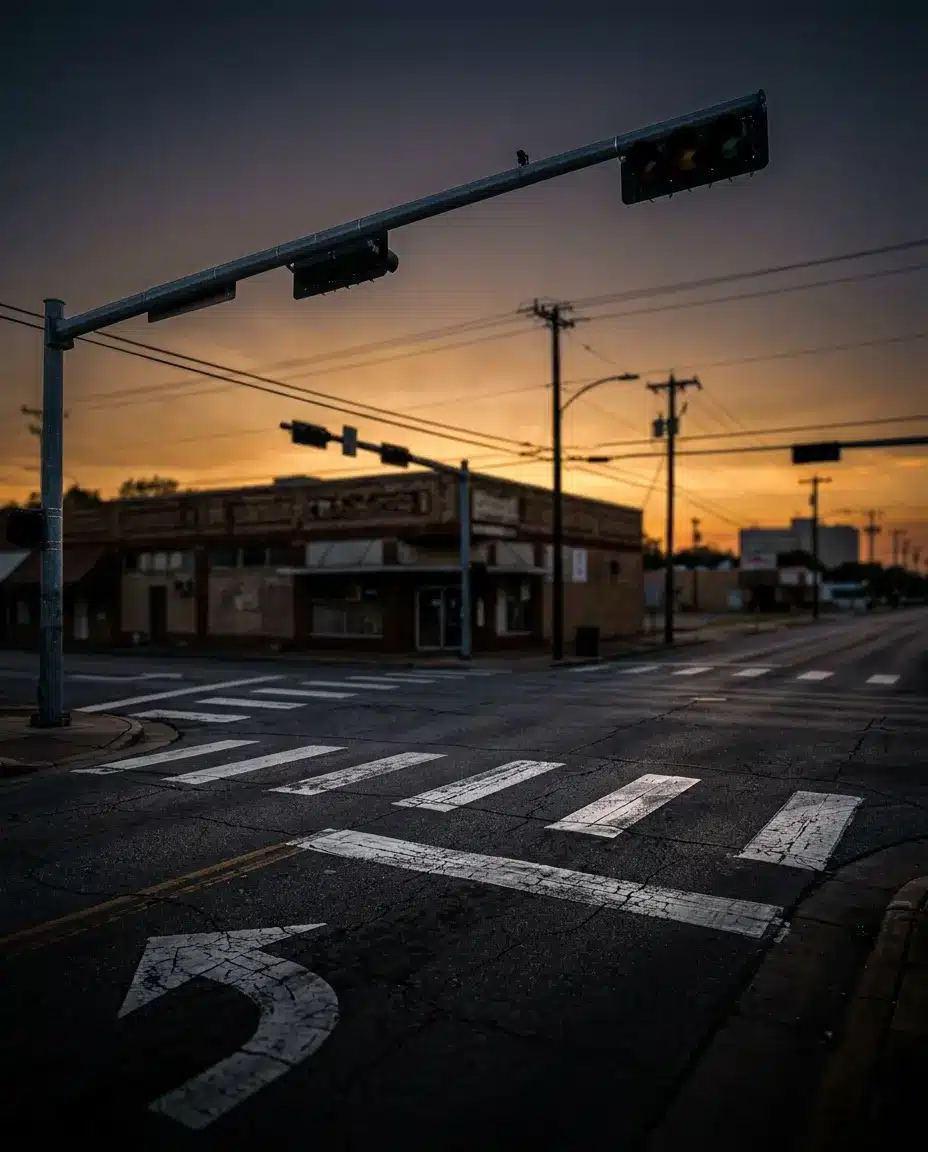
Each pattern names its proof, and Texas law hands you a head start
Each pattern carries its own proof. A left turn case asks whether your car was an immediate hazard the turning driver had to yield to (Tex. Transp. Code sec. 545.152); camera angle and speed answer it. A run signal case comes down to timing, so the controller’s data decides it. A driveway case is simpler: sec. 545.155 makes the driver coming off a private drive the one who must yield. Texas hands you a head start: a driver required to stop and yield who collides with the vehicle entitled to the right of way “is presumed not to have yielded the right-of-way” (Tex. Transp. Code sec. 545.151(f)). The rules themselves, and what a citation does to a claim, live on our failure to yield in Texas page.
Not sure which one is yours? Tell us what happened and we’ll name the proof it needs.
Who has video of your crash: the city, TxDOT, a bus, or the corner store
Video of a Texas intersection crash rarely sits in one place. The signal usually belongs to a city or county traffic department. If the corner is on a state highway, a TxDOT camera may cover it. Those cameras generally stream live rather than record, so we ask in writing but never count on a recording. A bus or train on the block carries its own cameras, and the store or doorbell facing the corner may hold the only clear angle.
The 2019 law changed less than most drivers think. Texas ended photographic traffic signal enforcement, meaning the systems that mailed tickets (Tex. Transp. Code § 707.020, effective June 2, 2019), and it let contracts signed before May 7, 2019 run until they expired. Monitoring cameras were never banned. So a recording of your crash may still exist.
- The city or county. It runs the signal and its traffic management center.
- TxDOT. Its highway cameras generally stream live only.
- The transit agency. Buses and trains record as they pass.
- The private corner. Store cameras and doorbells aimed at the street.
Tell us the cross streets and we’ll start the holder list the same day.
The side impact cases we take across Texas, and what each one turns on
Every broadside is the same crash shape with a different driver behind it. Here are the versions we handle, and the fact that decides each one.
Left turn broadside
An oncoming driver turns across your straight path. The turn itself usually puts the fault on the other driver; the fight then moves to your speed and your light, and that’s where the camera earns its keep.
Red light runner
Two greens can’t both be true. The controller kept its own log of the cycle, and we pair it with any camera on the corner to show who entered on red.
Stop sign run
These happen most on rural highways and neighborhood streets. Where the cars came to rest, the skid marks, and the crash report diagram usually show who never stopped, even with no camera in sight.
Driveway pull out
A driver leaves a parking lot, alley, or private drive into your lane. Texas puts the duty to yield on that driver (sec. 545.155), which makes these the cleanest fault cases we handle.
When you sat where it landed
The striking car lands on your door. How far it pushed into the cabin can be measured, and that number shows how fast it was going, so we photograph and measure the damage before the car is moved or sold.
When the hit came from across the cabin
The hit lands on the passenger side while you’re driving. The same door and pillar measurements show how hard the impact was, and where you sat is a fact we record early, not an afterthought.
Truck broadside
When a commercial truck hits you at an intersection, federal rules, a trucking company, and far higher policy limits all come into the case. Our truck team takes these from day one.
Truck crash claimsDrunk driver broadside
A drunk driver changes who else may answer for the crash, and that question can share liability under the dram shop law. More responsible parties can mean a larger recovery.
Suing a drunk driverFatal side impact
When a broadside takes a life, the claim becomes a wrongful death case with its own parties and deadlines. Our wrongful death attorneys walk families through every step.
Wrongful death claimsFive seconds of black box data can settle whose light was green.
When two drivers each swear the light was green, about five seconds of data can end the argument. If a vehicle has an event data recorder, it captures roughly five seconds before impact, including speed, brake application, and throttle position (49 C.F.R. § 563.7). That window shows who was moving, how fast, and whether anyone ever touched the brake pedal. Not every car carries one; the federal rule sets what an equipped recorder captures, and it doesn’t require any vehicle to have one (49 C.F.R. Part 563).
Texas leaves that data under the owner’s control. No one else may retrieve it without the owner’s consent, a court order, or one of the statute’s narrow exceptions (Tex. Transp. Code § 547.615(c), (d)). So the other driver’s recorder is reached through their consent or through a court order, and that’s one reason we file suit while both vehicles still exist.
Don’t release or repair the car before the download. Call us before the tow yard decides for you.
Are T boned cars usually totaled? Often, and you can check the math.
Often, yes. A broadside lands where a car has the least metal to give, so repair costs climb past what the car is worth sooner than they would in a frontal hit. Texas sets the salvage line where repair cost “exceeds the actual cash value of the motor vehicle immediately before the damage” under Tex. Transp. Code sec. 501.091(15). Nothing gets added to either side.
Declared a total loss
Insurers often declare a total loss below that line, because paying you out costs them less than a slow structural repair. That’s a business decision, not a rule. You can check the number behind it.
Repaired instead
A repair keeps your car. But a structural side repair shows up on every vehicle history report from then on. Buyers pay less once they see that record. That loss is called diminished value.
ValueWhat actual cash value meansThe market figure the payout keys off, and how to test it
Actual cash value is what your exact car, with its trim, mileage, options, and condition, would have sold for the moment before the crash. It isn’t the replacement cost. It isn’t your loan balance either. Ask the adjuster for the valuation report behind the offer, then read the comparable vehicles it lists. A comp two trim levels below yours, or one carrying double your miles, drags the figure below what your car was worth. Recent tires, a rebuilt transmission with paperwork, or a rare package all belong in the number, and each one you document pushes it back up. Send us the report and your service records. Flagging what the comparison missed is part of the free review.
LoansWhen the loan tops the payoutWho gets paid first, and where gap coverage picks up the rest
Your lender gets paid before you do. The lender collects from the actual cash value first, and anything left comes to you. If you owe more than the payout, the difference stays your debt unless gap coverage picks it up. That’s why the value figure is worth testing before you accept. Every dollar you can document goes toward the loan before the shortfall lands on you. Bring your payoff statement to the case review so the advice covers the whole picture, not just the check.
EvidenceKeep the car until the crush is measuredWhy the wreck must be photographed before the auction takes it
In a disputed intersection crash, the totaled car is itself evidence. The day the title transfers, the crush depth, the point of impact, and the door line all leave with it for the salvage auction. So photograph the struck side straight on and at an angle, and hold a tape measure against the deepest point the metal pushed in. Shoot the interior too, wherever the panels came in. Then tell the adjuster in writing that the car must be held for inspection before it goes anywhere. Once that request is on record, a car that disappears anyway becomes something the court can weigh inside your case. Call before you release anything, and the hold letter goes out the same day.
A total loss offer is the insurer’s number, not the last word. Before the title changes hands, send us the offer for a free actual cash value check.

No fee unless we recover. Period.
You never pay out of pocket. We advance the costs of building your case, and our fee comes only from what we recover for you.
What the insurer does with two green light stories, and the call to decline
An adjuster treats two conflicting stories as a discount. If neither driver can prove the light, the file gets marked disputed and the offer drops by whatever share they can park on you. The first tool for that is a recorded statement, taken early, before anyone knows what the cameras hold. Our managing litigation attorney, Matthew Graham, spent more than a decade on the insurance defense side in Texas; he’s read the internal notes adjusters write on disputed light claims, and that inside view now works for you.

The first callThe recorded statement trap: what that first call is forThe estimates they ask for, and why a guess becomes your story
The call sounds like paperwork. It’s not. It’s the insurer gathering evidence. The adjuster will ask you to estimate your speed, the other car’s distance, and the exact color sequence of the light. Any guess becomes your locked story before the video or the timing data exists. Decline politely, in writing if you can, and let the facts arrive first. You don’t have to give the other driver’s insurer a statement at all.
First movesFirst moves after a T bone crash: the step this page ownsThe camera step that cannot wait for the insurance process
Most of the checklist after any crash is the same, and our guide on what to do after a car accident in Texas walks through all of it. The one step a broadside adds is the camera. Note every business, doorbell, transit route, and signal facing the intersection before you leave the area, or send us the cross streets and we’ll track down who might hold video. Recording systems loop quickly, so this step can’t wait for the insurance process.
If the crossing driver had no insurance, the proof stays the same; our guide to being hit by an uninsured driver in Texas explains who pays instead. Either way, before the insurer hears your account of the light, give it to us free.
How we get intersection video before it is erased: hold letters, records requests, then subpoenas
The route to Texas intersection video runs on paper: a hold letter to every holder in the first week, a Public Information Act request to each governmental one, and a subpoena when a private holder refuses once suit is filed. The records request works against any Texas city, county, transit agency, or state agency. The agency must produce the video promptly, and if that will take more than 10 business days, it must certify a date in writing (Tex. Gov’t Code § 552.221). A subpoena is not a court order. A subpoena can issue once a case exists; a court order comes from the judge.
| Who holds it | The route | The clock |
|---|---|---|
| City or county signal | Written request under ch. 552 | Prompt production under § 552.221 |
| TxDOT highway camera | The same request, sent early | Generally streams live, not stored |
| Transit agency onboard camera | ch. 552 reaches it, hold letter first | Its own records schedule, no statewide number |
| Private business or doorbell | Hold letter, then a subpoena on 10 days notice (Tex. R. Civ. P. 205.2) | Loops overwrite quickly, so ask first |
The letterWhat the preservation letter does, and the one thing it cannotWhy notice matters even though it binds nobody on arrival
The letter doesn’t force anyone to do anything by itself; nothing about it binds the holder the day it arrives. Its job is knowledge. Texas places a duty to preserve on a party who knows or reasonably should know there is a substantial chance a claim will be filed and that evidence it holds will be material to it (Brookshire Bros., Ltd. v. Aldridge, restating the settled Texas standard). Once the letter lands, the holder can no longer say it had no idea the video mattered. A later loss becomes something a court can sanction, not just bad luck. That’s why we send one to each holder right away, naming the intersection, the date and time, and the cameras we mean.
If it is erasedIf the video is erased after notice, what a Texas court doesThe two step test, and why it is worth less than the footage
You can’t file a separate lawsuit over the erased video, because spoliation is not an independent tort in Texas.
A remedy inside your case is different. It can move the fault percentages themselves, and those percentages are the number your recovery is calculated from (Trevino v. Ortega). The fight happens inside the injury suit itself. The trial court works in two steps.
- Duty and breach. Did a duty to preserve exist, and did the holder breach it intentionally or negligently.
- The remedy. The court picks one matching the culpability and the prejudice the loss caused the other side. Prejudice belongs here, in the remedy, never in step one (Brookshire Bros. v. Aldridge).
One remedy lets jurors presume the lost video was unfavorable. Courts save that instruction for intentional destruction, or for a negligent loss that leaves no meaningful way to present the case. Every remedy on that list is worth less than footage that still exists. That’s why the paper moves first.
“My defense files split two ways: crashes with video settled on facts, crashes without it settled on stories. Send the requests while there’s still something left to find.”
Former insurance defense attorney
Why you can trust this advice: $100 million recovered from Texas insurers
The advice on this page comes from a firm that has recovered over $100 million from Texas insurers and put it into clients’ hands. Josh Alexander is a USMC veteran with more than a decade of trial experience, and the firm has earned recognition from Super Lawyers and the Multi Million Dollar Advocates Forum.
You reach an attorney, not a call center, in English or Spanish, at any hour. Based in Dallas, the firm takes side impact cases from every part of Texas. Call 469-807-7480 whenever you’re ready to talk it through.
How we build a T bone case: preserve, prove the light, document the loss
We build a T bone case in three moves. The order matters more here than in any other kind of crash, because the first move protects the evidence the other two depend on.
- Preserve. We send letters to every video holder at the intersection, and we keep both vehicles out of the salvage pipeline until their recorders are read.
- Prove the light. Camera angles, recorder data, signal timing records, and crush measurements stack up until two stories become one answer.
- Document the loss. Every number the insurer must answer goes in writing, from the measured door line to the actual cash value math.
Step one runs on other people’s clocks, and none of them pause for your recovery.
Meet the attorneys who would work your side impact case, in English or Spanish.
Josh Alexander
A Marine Corps veteran and Texas trial lawyer who has recovered millions for hundreds of injured clients across Texas.
Meet Josh Alexander
Matthew Graham
Spent over a decade directing insurance defense litigation for a ten state region of the country’s second largest auto insurer. Now he works for the injured.
Meet Matthew Graham
Laura Rivas
Nine plus years representing the injured in motor vehicle, 18-wheeler, catastrophic injury, and wrongful death claims. Bilingual, English and Spanish.
Meet Laura RivasSearching for the best T bone accident lawyer in Texas? Read the reviews.
“They took the time to answer all of my questions and made me feel confident in them. The whole staff has been friendly and professional.”
“After speaking with them, we were put at ease right away. They made sure my physical therapy was covered and have been invaluable to us.”
“Excelente servicio al cliente, son muy atentos con sus clientes. La comunicacion es muy buena; te ayudan a cualquier hora.”
Reviews from actual clients. Past results do not guarantee a similar outcome.
Free tools for your claim: check your intersection, your deadlines, and your offer
Most dangerous intersections in Texas
The ranked Texas crossings where side impact crashes happen most, so you can see how yours compares.
Check your intersectionWhat to do after a crash
The first moves that protect your health and your claim in the days after a Texas wreck.
See the stepsTexas filing deadlines
Every clock that can end a Texas injury claim, and the date that starts each one.
Check your datesSettlement offer analyzer
Enter an offer and watch how fault share, fees, and liens change what you’d keep.
Analyze my offerDo you need a lawyer?
When hiring one is worth the fee after a crash, and when handling it yourself makes more sense.
Weigh it upDealing with insurance companies
How adjusters build a fault file, and what to keep out of your first phone calls.
Know what to sayYour T bone accident questions, answered.
Who is liable in a T bone accident?
How do insurance companies decide who is at fault?
What should you do after a T bone accident?
What is a T bone accident worth?
Can you get whiplash from a T bone accident?
What are the typical injuries from a T bone car accident?
Where do broadside collisions most commonly occur?
Are T boned cars usually totaled?
Can I still recover if the crash was partly my fault?
Does a T bone case fail if neither car had a black box?
Still have questions? The fastest answers come from a quick, free call with an attorney who can hear your specific situation.
Call 469-807-7480Six offices. The same standard of care.
From DFW to the Gulf Coast to South Texas, an attorney is never far. Find your nearest office and the services we handle there. And if you cannot come to us, we come to you.
Canton
TXCanton, TX 75103 (903) 385-8500
Explore services in Canton
Arlington, TX 76012 (817) 856-0580
Explore services in Arlington
Broadsided anywhere in Texas? Every office sends the same hold letters and chases the same intersection video.
View all locationsFree consultation with a Texas T bone accident lawyer. No fee unless we recover.
Describe your crash and you will know what your case needs next, at no cost. The camera that saw your intersection is on its own clock, so the first call is about reaching it while the footage still exists.
Free consultation, 24/7 · Se habla español · Serving all of Texas
Attorney advertising. Josh Alexander is responsible for the content of this page. Principal office 12801 N. Central Expressway, Suite 1100, Dallas, TX 75243. Past results do not guarantee or predict a similar outcome in any future case. The information on this page is general information and is not legal advice, and contacting the firm or submitting a form does not create an attorney client relationship. Spanish speaking staff available.