


Texas company vehicle accident lawyer.
Reviewed by Josh Alexander, Founder & Managing Attorney · Updated August 2026
Hit by a delivery van, company car or fleet truck in Texas? You may be able to recover from two parties, not one: the driver, and the business behind them. Find out below whether the employer is on the hook for your crash. Asking costs you nothing, and so does hiring us unless we recover.
Rated 4.9 from 568+ client reviewsFirm results, ratings and recognition
- $100M+
Recovered for clients
- 75+
Years of combined experience
- 568+
Client reviews
- 5
Years Super Lawyers Rising Stars
 Dallas Stars
 Sporting United
 Super Lawyers Rising Stars
 Multi-Million Dollar Advocates Forum
 Million Dollar Advocates Forum
 Texas Trial Lawyers Association
Reflects total client recoveries across hundreds of resolved matters. Past results do not guarantee a similar outcome.
Struck by a company vehicle? You may have two claims, not one.
If a company vehicle hit you in Texas, you can recover from the driver who was careless. You may be able to reach the business behind that driver too. Delivery van, fleet pickup or company sedan, the vehicle type doesn’t decide it. If the person at the wheel was doing their job, Texas law may let you pursue the employer for what you lost.
That matters to you because a business usually carries a commercial policy, and that policy raises what your recovery can reach. Below, you will see when the employer answers for your crash and when only the driver does.
Further Legal Reading: Tex. Civ. Prac. & Rem. Code Sec. 16.003
Free Case Evaluation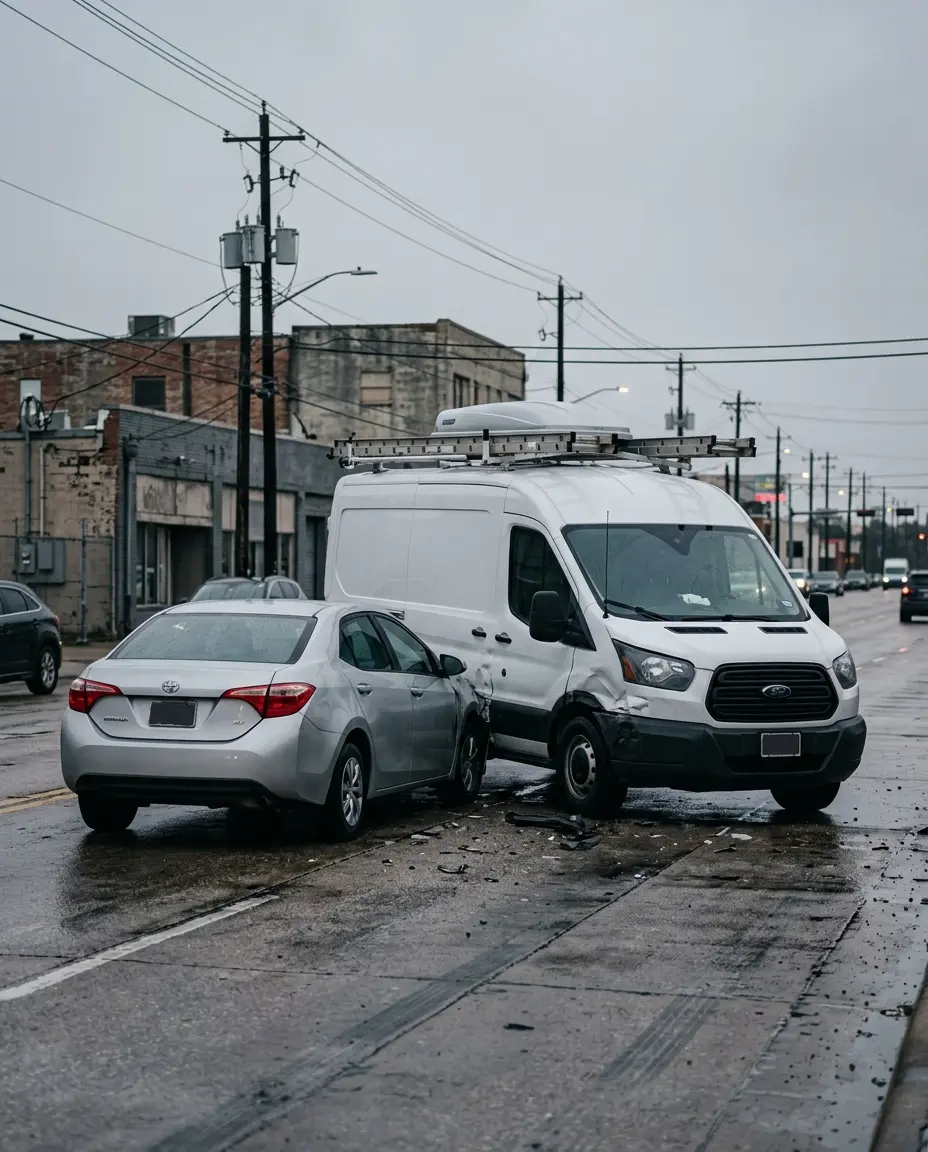
What can you recover after a company vehicle crash?
You can claim two kinds of damages after a company vehicle crash, and the first offer you get usually covers only one. Your receipts are easy to count. What the injury took from your daily life is where you get short changed.
What counts as economic damages?
These are the losses you can count: every bill, invoice and pay stub the crash produced. Keep them as they arrive so nothing’s missing when your demand letter goes out.
Medical billsFuture treatmentLost wagesLost earning capacityWhat counts as noneconomic damages?
These are the losses no receipt can show: pain, physical limits, the parts of daily life the injury took away. Medical records carry the weight here, so every visit you make and every symptom you report becomes support for this part of the claim.
Pain and sufferingPhysical limitationLoss of daily life
“List every loss since the crash, including the ones without receipts, before any adjuster asks you to summarize. The missed shifts, the ride to every appointment, the chores you now pay someone else to do. If it never gets written down, it never gets paid.”
 Josh AlexanderFounder & Managing Attorney
Marine Corps veteran
Blamed for the crash? You can still recover at 50 percent or less.
Being blamed doesn’t end your claim. Texas uses proportionate responsibility. You can still recover as long as your share of the blame is 50 percent or below, and your award is reduced by that share, under Tex. Civ. Prac. & Rem. Code Sec. 33.001. If you’re found more than 50 percent responsible, you recover nothing. That is exactly why the company’s commercial insurer works so hard to push your percentage up.
How the reduction works
Your damages$100,000
Your share of fault20%
Recoverable amount before fees and liens$80,000
Percentages are assigned in whole numbers, and every point the adjuster adds to your column comes straight out of your recovery. Above 50 percent, the claim is gone.
Within hours, the driver who hit you gives the employer’s insurer their version, and your fault percentage gets built from that story. Get your own account written down today, and don’t accept blame on a recorded call.
Company dashcam and telematics erase on a schedule. One letter stops that.
Telematics, the tracking data the vehicle records on its own, overwrites in a loop, and dashcam cards get reused. Driver logs and dispatch records are kept only as long as company policy requires, often days or weeks. Those same records are what win the course and scope fight later, the argument over whether the driver was working at the time. One letter from us puts the business on notice, in writing, to keep all of it for you.
Your first step: find the employer and the owner on your CR 3 report
Before anything else, pin down two names: the driver’s employer and the vehicle’s owner. At the scene, that means the door decal, the fleet number, the paperwork the driver hands over. Afterward, the CR 3 report from your crash lists the registered owner and the insurance carrier. Those fields often name a business nobody mentioned at the roadside.
If the owner field shows a city, county or state unit, move quickly: a claim against a governmental unit can require written notice within six months. For the rest of the first week checklist, our guide on what to do after a car accident in Texas walks through it.
Door decalFleet numberCR 3 owner fieldCR 3 carrier field
Results that speak for themselves.
- $15M18 wheeler, wrongful death
Recovered for a family after a fatal collision with a commercial truck.
- $2.55M18 wheeler crash
Resolved for a client seriously hurt in a wreck with a tractor trailer.
- $1M18 wheeler crash
Recovered after a heavy truck caused a high impact highway collision.
- $750K18 wheeler crash
Settlement for injuries from a commercial truck collision.
- $716KMotor vehicle accident
Recovered for a driver injured by another motorist’s negligence.
- $350KMotor vehicle accident
Settlement for a client rear ended in Texas traffic.
Sample results from actual past cases. Past results do not guarantee a similar outcome; every case is different.
Why company vehicle crashes happen, and why the cause is also your proof
Company vehicle crashes usually start with the job: quotas, delivery windows, dispatch, fatigue, unfamiliar equipment. Each cause is also evidence. It can show the driver was doing the employer’s work at the moment of impact, and your claim against the company turns on exactly that.
What pushes a work driver into a crash?
- Route quotas that reward pace over care
- Delivery windows too tight to hit lawfully
- Dispatch calls and app pings answered while driving
- Double shifts that put a tired driver on the road
- A borrowed or newly assigned vehicle the driver barely knows
- Fleet maintenance that quietly fell behind
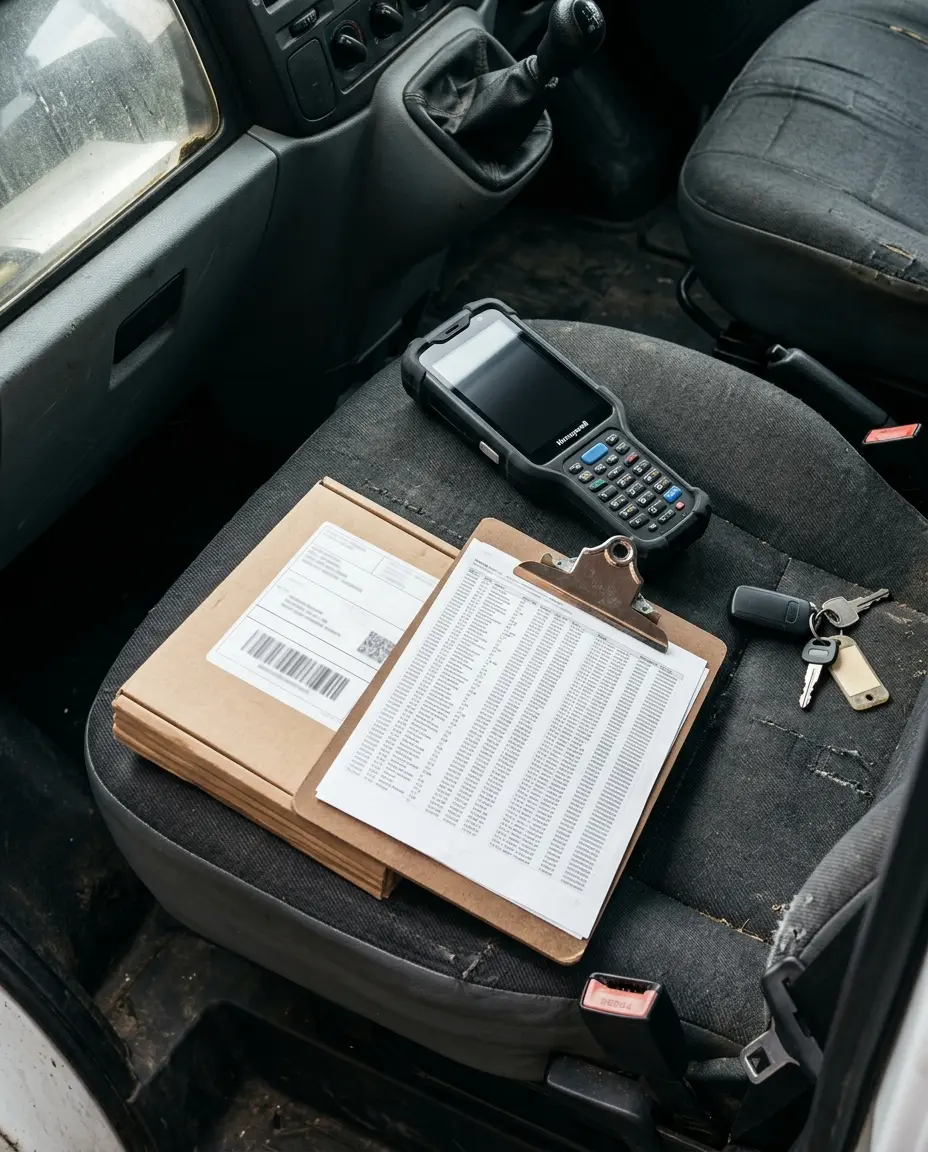
Where the proof lives: the manifest, the schedule, the dispatch log
When a business owns the vehicle, a cause is never only a cause. The route was assigned, the stop was scheduled, the call came from dispatch. Facts like these can help show the driver was doing the company’s work when the crash happened. That is exactly the fight the course and scope section below takes up. Most of that proof sits in the company’s own records: a manifest, a schedule, an assignment log. So what you noticed about the driver’s task matters early on.
Delivery manifestRoute assignmentShift scheduleDispatch logPhone records
What do you have to prove against the driver first?
Your claim rests on four things about the driver: duty, breach, causation, and damages. Lawyers call these the elements of negligence. Reaching the employer adds one question on top of them, because the business answers for those four only if the driver was doing its work when you were hit. Miss even one against the driver and you have nothing to pin on the company. Your claim against the employer borrows entirely from your claim against the driver.
The elements proved against the driver
- Duty. The driver owed you reasonable care, which every driver on a Texas road does.
- Breach. The driver broke that duty, like running a light, holding a phone, or pushing too hard to make a delivery window.
- Causation. That failure is what caused the crash and your injuries, and the crash report and the vehicle’s own data do the proving here.
- Damages. The wreck cost you something: medical bills, lost wages, pain that follows you home.
Match your facts against the four elements and mark which ones you can already prove with what you have.
Which work vehicles cause these crashes most often?
A business vehicle is any vehicle doing a company’s work when it hits you. These are the ones we see most across Texas, plus the two that belong with a different team.
Delivery vans
Package routes run on quotas and delivery windows. The route log and scanner data show where the driver was and why, and both tie the trip to the job.
Company cars
An employer provided sedan the driver also takes home raises the sharpest question on this page: was this trip for the business or for the driver?
Fleet pickups
Trade crews move between jobsites with tools in the bed. Work orders and supervisor texts usually settle whose errand the drive was.
Service and utility trucks
A technician driving between dispatched calls sits near the center of any job connection fight. Dispatch records name the call, the address, and the time.
Box trucks
Local movers, furniture deliveries, and rental trucks with a crew stay on this page under the same employer rules. The line is the tractor trailer.
Sales fleet sedans
Pooled cars checked out for the day leave a paper trail: who signed the vehicle out, for which meeting, on whose calendar.
-
Tractor trailers
A tractor trailer or 18 wheeler crash runs under its own federal rules and belongs with our Texas truck accident team.
Truck accident lawyers -
Rideshare cars
An Uber or Lyft crash comes with its own tiers of coverage, and our rideshare accident lawyers page handles those claims.
Rideshare accident lawyers
Find your vehicle type in this list, and follow the link out if yours was a tractor trailer or a rideshare car.
Who pays after a company vehicle accident?
When the driver who hit you was doing a job for a business, Texas law may let you pursue that business, not just the person behind the wheel. The rule has a Latin name, respondeat superior, and a plainer one, vicarious liability. Both mean the same thing for you: an employer answers for what its employee did on the job.
You have two questions to answer. Was the driver the company’s employee or agent at the time? And was the driving in the course and scope of that employment, meaning part of the job? Companies commonly accept the first and contest the second; that fight has its own section below.
Your claim against the company rides on your claim against the driver, so you still prove the driver was careless underneath it. A name on the door starts that question for you; it never settles it.
What puts an employer on the hook
Prove the driver was careless, then prove the job connection, and a business auto policy usually stands behind your claim. Commercial limits run higher than a personal driver’s, which raises what you can reach, never what you are promised.
Employee or agentDriving for the jobDerivative claimBusiness auto policy
Ask the employer, in writing, whether their driver was working at the time of the crash, and keep the reply.
Course and scope: the employer’s whole defense, and the Texas test that decides it
Employers commonly concede very little at this stage. Its defense, case after case, is that its driver was outside the course and scope of employment when you were hit. In plain words: not doing the job. Texas asks three things: whether the act fell within the driver’s general authority, furthered the employer’s business, and served the purpose the driver was hired for (Painter v. Amerimex Drilling I, Ltd., 561 S.W.3d 125 (Tex. 2018)).
CommutingDoes the drive to and from work count?Why an ordinary drive to work falls outside, and what changes it
An ordinary commute generally sits outside the scope, because the drive to and from work usually serves the driver’s own purposes (Painter, 561 S.W.3d 125). Texas recognizes exceptions, and each one turns on evidence, not labels. A special errand run at the employer’s direction can bring a commute inside the scope. So can driving that is itself part of the job. In Painter, a driller was paid a bonus to haul his crew between the rig and their housing, and that created a jury question on exactly that. And where the employer controls the trip, the route, the timing, a task performed along the way, the drive can move inside the scope as well. None of these applies automatically; whether one fits your crash is a fact question a lawyer builds from records, not a box anyone checks.
Special errandDriving as the jobEmployer controlled trip
ErrandsWhat if the driver stopped for something personal?The Mayes snack run, and what a detour does to the claim
A personal errand takes the driver out of the scope, even in the employer’s vehicle. In Goodyear Tire & Rubber Co. v. Mayes, 236 S.W.3d 754 (Tex. 2007), an on call employee took his employer’s truck to get snacks with friends, crashed, and the employer wasn’t liable. The rule reaches further than most people expect. Once a driver turns aside for a personal purpose, that detour puts the driver outside the scope. Texas has held that even the drive back from a personal errand fell outside it (Southwest Dairy Products Co. v. De Frates, 125 S.W.2d 282 (Tex. 1939)). Whether a small stop made along a work trip stays inside is fact specific; courts weigh how far the driver strayed from the business purpose.
An errand defense hurts the claim that holds the company responsible for its driver. It doesn’t always end the case against the company, because the theories in the next section aim at the employer’s own conduct instead. If the errand defense wins, the question changes. It stops being what the driver was doing for the company, and becomes what the company did wrong by putting that driver on the road at all.
PresumptionDoes the company owning the truck settle it?When owning the truck counts against the employer, and when not
Proof that the employer owned the vehicle and employed the driver raises a presumption that the driver was acting within the scope of employment (Robertson Tank Lines, Inc. v. Van Cleave, 468 S.W.2d 354 (Tex. 1971)). That presumption is a starting point, not a finding. It disappears once the employer produces evidence the driver was on a personal errand or otherwise off the company’s business. The burden then returns to you to come forward with other proof of course and scope.
An employer provided vehicle doesn’t by itself turn commuting or personal use into company business. Permission to drive the truck is not the same as furthering the employer’s business (Mayes, 236 S.W.3d at 757 to 758). The name on the door proves even less. At most it helps show ownership and employment, the two facts behind this same vanishing presumption. Treat the logo as a lead to follow, never as the case itself.
After hoursWhat if your crash happened at 7pm?What the clock proves about course and scope on its own: nothing
A crash at 7pm, or on a weekend, doesn’t end your claim, and a crash during working hours doesn’t make it. Time of day cuts neither way by itself. Texas holds that an act during working hours is not automatically within the scope. Conduct unrelated to the job falls outside it even on the clock (Minyard Food Stores, Inc. v. Goodman, 80 S.W.3d 573 (Tex. 2002)). On call status settles nothing by itself either. The Mayes driver was on call around the clock and was still outside the scope on a snack trip. What decides the fight is the task the driver was on and for whose benefit, never the time printed on the crash report.
None of the following proves the employer’s responsibility on its own, and none of it defeats your claim on its own:
Logo on the doorCompany ownershipEmployment aloneThe commuteOn call statusWorking hours
Write down the road and county where the crash happened; crashes cluster along delivery routes, and the location helps tie the trip to the job.
How else can you reach the employer besides course and scope?
Course and scope is not your only road to the employer. Five other theories, entrustment and hiring among them, put the company’s own conduct on trial rather than the driver’s: what it knew about the person it put behind that wheel, and when it knew it.
Who handed this driver the keys, and what did they know?
The company handed the vehicle to a driver it knew, or should have known, was unlicensed, incompetent, or reckless. Texas asks what the company knew at the handover, not what it learned later. Handing over the keys isn’t enough on its own. You still have to prove the driver drove negligently that day, and that the negligence caused your crash (Mayes, 236 S.W.3d at 758).
Should this driver have been hired at all?
A company has to use reasonable care in deciding who gets a driving job. If a routine check would have caught a suspended license, the hire itself is in question.
Was the driver ever trained on this vehicle?
Putting someone in a work vehicle without teaching them the equipment, the route, or the rules can be its own failure. That is separate from anything the driver did.
Who was supposed to be watching this driver?
Complaints went nowhere. Nobody read the alerts from the vehicle’s tracking system. Nobody counted the hours behind the wheel. The oversight the company skipped becomes part of the case against it.
Why was this driver still on the road?
Keeping a driver on the payroll after the warning signs show up is a decision. Proof that the company saw the risk and kept them driving anyway is what carries this theory.
The limitWhen the employer’s admission narrows these five theoriesWhy an admission changes which claims are worth bringing
Texas law limits which employer theories reach a jury once the employer admits the driver was working; we plead what the facts support. Several Texas appeals courts treat these direct claims as covering the same ground after that admission, because the employer already stands behind the driver’s negligence. Those courts let the claims go forward mainly where the facts point to gross negligence. A 2021 statute, Texas Civil Practice and Remedies Code chapter 72, adds a procedure that splits the trial into two phases for collisions involving commercial motor vehicles. It runs in the same direction. None of this erases the theories. It decides which ones are worth bringing on your facts, and that call gets made case by case, never by formula.
Which road you take depends on what the company admits:
- The company admits its driver was working, and the direct theories narrow.
- The company denies it, and those theories become the road that is left.
We usually know which way it went within the first few letters, and it changes what we file.
Ask in writing for the company’s driver file: the hiring date, the record check, the training log. An answer tells your lawyer something useful. So does a refusal.
Employee or contractor? Texas asks who controlled the work, not the contract.
You reach the employer through respondeat superior only when the driver was its employee. Companies know this, which is why the independent contractor label lands on your file so fast. Texas will not settle it by job title, and neither should you. Your test is the right to control: could the company direct not just the finished job but the means and details of the work?
The control factors Texas weighs
- Independence. Whether the worker runs a separate business of their own.
- Tools. Who provides the vehicle, the equipment, and the supplies.
- Progress. Who directs how the work gets done along the way.
- Duration. How long the worker is kept on, a day or a standing job.
- Payment. By the hour on a schedule, or by the completed job.
The labelWhy a contract calling the driver a contractor cannot settle itWhat day to day practice shows that the paperwork does not
A signed agreement naming the driver an independent contractor is evidence, not an answer. Texas courts look past the label when the company’s day to day practice shows control that doesn’t fit it. Look for assigned routes and schedules, or dispatch that runs the day. Required uniforms, branded vehicles, mandatory apps and vehicle tracking all point the same way, as do set methods for doing the work. A driver can be a contractor on paper and an employee in the courtroom, or the reverse. What decides it is proof of who controlled the details. That proof lives in the company’s own records, and pulling those records out is exactly what discovery is for.
Check one thing tonight: compare the name on the vehicle’s door with the owner and employer fields on your CR 3 crash report. If the two don’t match, bring both names to your consultation; a mismatch is often where the control question begins.
Some injuries hide for days. Get examined before the carrier calls.
A delivery van or fleet truck leaves you with the same injuries as any wreck: whiplash, spinal damage, concussion, broken bones, internal bleeding. Several of them can surface days after impact. See a doctor even if you feel fine tonight. The visit protects your health and starts the medical trail your claim will stand on.
What if symptoms show up days later?
Delayed headaches, numbness down an arm, and abdominal pain can appear long after the adrenaline fades. Note the day each symptom starts. Tell the doctor at every visit, so the record ties it to the crash.
Delayed headachesNumbness or tinglingAbdominal painWhat does a commercial carrier look for in your records?
Business insurers hunt for gaps in your treatment. They use them to argue the injury came from somewhere else. An early diagnosis, steady appointments, and every bill kept in one folder close that argument before it starts.
ER notesImaging scansTherapy records
Hard to see injuriesThe treatment trail that makes an invisible injury payWhy consistency beats imaging on a soft tissue claim
Whiplash and mild concussions rarely show on an X ray, so the commercial adjuster argues the pain is exaggerated or unrelated. What beats that is consistency: a diagnosis close to the crash date, treatment without gaps, and notes that connect each symptom to the crash. Bring the same list of symptoms to every doctor you see; a record that repeats itself is a record an insurer can’t pick apart.
A late symptomWhat a delayed diagnosis changes, and what it does notWhy the filing window usually still runs from the crash date
An injury that shows up late doesn’t usually move your filing window, which generally still runs two years from the crash. Seeing a doctor the week symptoms appear matters twice. It protects your health, and it keeps the gap between crash and diagnosis from becoming the defense’s favorite exhibit.
Anatomy, symptoms, and typical treatment paths for each of these injuries live in our crash injury visualizer. Use it after the appointment, not instead of one: see a doctor today, and keep every record from the visit.
What to expect from the commercial carrier
Expect the business’s insurer to reach you fast. Commercial policies come with claims teams, so an adjuster may call within days, sometimes before you have seen a doctor, asking you for a recorded statement and floating an early number. Matthew Graham spent more than a decade running that side, so you get someone who knows the opening moves before they land. Their goal is to close your claim small and soon. Yours is to say less than they hope.
Fast adjuster callRecorded statement requestEarly numberSocial media check
The recorded statementWhy it comes first and what it locks in for the carrierYou can decline it, and here is how to do that politely
A recorded statement locks in your version of events before your injuries have fully shown themselves, and anything you guess at follows the claim from then on. You don’t have to give one to the other side’s carrier before you talk to a lawyer. Say no politely, take the adjuster’s name and number, and let your lawyer return the call. The adjuster is not just gathering facts. Every percent of blame you take comes off your recovery, and a guess on the phone is the cheapest way for them to move that number.
The early offerPriced off the bills so far, silent on the treatment aheadWhat accepting it closes off for good
An offer that arrives in the first weeks is built on the bills that exist so far. It says nothing about the care still coming. Accepting it closes the claim for good, including everything diagnosed afterward. Let the medical picture finish forming before anyone talks settlement.
One move covers most of it: decline the commercial carrier’s recorded statement until you’ve spoken with a lawyer. A fuller list of what not to say sits in our guide to dealing with insurance companies in Texas.
What shapes a company vehicle settlement: coverage, treatment, and your share of fault
A settlement after a company vehicle hits you in Texas turns on three things. The policy standing behind that vehicle. The treatment you follow through on. The share of fault an adjuster assigns you. Texas requires any driver to carry only 30/60/25 coverage, that is $30,000 per injured person, $60,000 per crash, and $25,000 for property damage, under Tex. Transp. Code Sec. 601.072. Business auto policies often carry more than those minimums, sometimes with excess or umbrella coverage layered on top. No policy pays beyond what its own language allows.
Your treatment and your fault share shape what a claim is worth; the coverage sets what can actually be paid. Your fault share comes off the gross figure first, then the fee and any liens come out of what is left. So every percent argued off your share is a percent that stays in the recovery.
What moves a company vehicle claim
Coverage behind the vehicleTreatment without gapsFault assigned to youProof the driver was working
Free Case Evaluation
CoverageLimits set the ceiling, never the floorWhy we demand the policy before anyone talks numbers
Policy limits are a ceiling on what an insurer must pay; they never set a floor under what a claim recovers. A commercial policy behind the driver changes what’s possible, not what’s promised, and the policy’s own language decides whether it covers a given crash. That’s why we demand a copy of the policy early in a company vehicle case. Until you know the limits, any number an adjuster offers is a number offered in the dark.
Fault shareHow your percentage cuts the numberWhat the adjuster is fishing for on a recorded call
Texas reduces a recovery by the injured person’s share of responsibility, and bars it entirely once that share climbs past 50 percent. The commercial carrier’s adjuster knows both rules, which is why a recorded call fishes for anything that pushes your percentage up. The fault section earlier on this page walks through the math of that reduction, with the statute that sets it.
DirectionWhat raises a company vehicle claim and what lowers itFour factors, and which way each one pushes
The same four factors move every claim; the table shows which way each one pushes.
| Factor | Pushes the value up | Pulls the value down |
|---|---|---|
| Coverage what stands behind the driver | Commercial policy, excess layers a higher ceiling, never a higher promise | Personal minimum limits only |
| Medical course | Steady, documented treatment | Gaps the adjuster can point to |
| Fault share | Clear liability on the driver | Blame shifted onto you |
| Job connection | Driver on a route or a dispatched call | A personal errand at the wheel |
These show direction only, never amounts; the facts in your file decide the figure.
“I spent over a decade on the insurance side, directing the litigation that decided how little they paid out. I know the number they open with, the number they will actually pay, and the gap between the two. That gap is where your case lives, and I use everything I learned over there to close it in your favor.”

Former insurance defense attorney
Read the Texas average value guide before you accept any number the carrier floats.
How long does a company vehicle claim take, and what sets the pace
Nobody can quote you a date, and any figure you are given is an estimate rather than a promise. What you can know is what the clock is waiting on, because three of the four things below are knowable early. Your claim against a business usually runs longer than a two car case, for one reason: more parties, more policies, and more lawyers have to sign off before anything moves.
Treatment firstRecords and proofDemand and responseSuit if needed
What the clock waits on
- Your treatment finishing. No number is worth taking while the medical picture is still forming, so this stage sets the floor on everything after it.
- Records and the company’s own proof. Bills, imaging and wage loss on your side; the driver file, dispatch logs and telematics on theirs. A business that stalls here is the single most common reason a claim sits.
- The demand and the answer. A commercial carrier takes its own time reviewing a demand package, and the first answer is rarely the last one.
- Suit, only if the answer stays wrong. Filing restarts the pace on a court’s schedule rather than an adjuster’s, and most cases still resolve without a trial.
Stages, not dates. A straightforward claim can close in months; one where course and scope is genuinely fought runs longer, and the two year filing deadline runs the whole time regardless.
The stage you are in is the one thing that tells you what happens next. Tell us where yours sits and hear what the next step actually is, at no cost.
What if a city, county or state vehicle hit you?
It is still a work vehicle, but your claim runs under different rules and a far shorter clock. A public works truck, a county pickup, a city van: the driver was doing a job, same as any employee. What changes for you is that the employer is a governmental unit, so Texas puts your claim under the Tort Claims Act, the law that sets out when you can sue a public body at all.
Six month noticeCharters can be shorterOwner field on the CR 3
Months to give notice, not to sue
The Tort Claims Act requires notice of the claim within six months of the incident under Sec. 101.101, and some city charters set a tighter period than that.
Read that as notice, not as your filing deadline. They are two separate clocks. The two year limitations period still runs the whole time, and giving notice does not extend it.
Miss the notice window and the claim can be lost before the two year deadline is anywhere close. This is the one deadline on the page that can end a case in months.
This is why the owner field on your CR 3 matters so much. It is the field that tells you which clock you are on, and it is worth checking tonight rather than next month. If it names a city, county or state unit, call 469-807-7480 today and we will get the notice moving.
Why this advice holds: $100 million recovered and a record you can verify
The advice on this page comes from a Texas firm that has recovered more than $100 million for injured clients. The firm holds Super Lawyers recognition and membership in the Multi Million Dollar Advocates Forum. Josh Alexander is a Marine Corps veteran with over a decade of trial work. The team answers around the clock in English and Spanish, so a call at any hour reaches a person who can start the case.
Don’t take any of it on faith: look up any attorney named here on the State Bar of Texas site and check the record yourself.

How we build your case against the employer, from preservation letter to policy demand
Commercial carriers weigh a claim against the risk of losing at trial, so we prepare every file as though it will be tried. When a company is on the other side, your file gets built in this order.
- Preserve the company’s evidence. A preservation letter goes out first, locking down telematics, dashcam footage, driver logs, and dispatch records before the company’s routine deletion schedules erase them.
- Pull the CR 3 crash report. Its owner and carrier fields tie the vehicle to the business and its insurer.
- Pin down the driver’s status. Discovery goes after the personnel file, the contract, and the evidence of who controlled the work. That last piece decides whether the driver was an employee or a contractor.
- Demand every policy. The primary commercial policy plus any excess or umbrella coverage above it; which ones apply depends on their terms, so we read every one.
Bring three documents to the first meeting, the crash report, your photos, and your medical records, and that meeting counts.
The Texas lawyers who would work your file, in English or Spanish.
Josh Alexander
Founder & Managing Attorney
A Marine Corps veteran and Texas trial lawyer who has recovered millions for hundreds of injured clients across the state.
Meet Josh AlexanderMatthew Graham
Managing Litigation Attorney
Directed insurance defense litigation for more than a decade at the country’s second largest auto insurer. Now he works for the injured.
Meet Matthew Graham
Laura Rivas
Senior Associate Attorney
More than nine years representing the injured in motor vehicle, 18 wheeler, catastrophic injury, and wrongful death claims. Bilingual, English and Spanish.
Meet Laura RivasCall and ask by name for the attorney who would handle your case; you reach that person, not a call center.
Client stories.
-
Hit in a work truck
An SUV ran a red light into Michael’s dump truck
Watch how his claim was handled -
Commercial sideswipe
An 18-wheeler took the whole side of Alondra’s car
See what her sideswipe case was worth -
Struck by a semi
A semi hit Edith at a red light and kept rolling her car
See how we proved her disc injury -
Rear ended by a semi
A trailer threw Elvira’s car 300 feet in stopped traffic
See how her chest injury resolved in 7 months -
No coverage
Morgan was hit by a driver with no insurance
See who actually paid for her crash -
Your case
Been in a crash like one of these?
Free Case Evaluation
Picking a firm for a company vehicle claim? Start with the reviews.
- ★★★★★
“They took the time to answer all of my questions and made me feel confident in them. The whole staff has been friendly and professional.”
Cecilia G.Google review - ★★★★★
“After speaking with them, we were put at ease right away. They made sure my physical therapy was covered and have been invaluable to us.”
Kelly H.Google review - ★★★★★
“Excelente servicio al cliente, son muy atentos con sus clientes. La comunicacion es muy buena; te ayudan a cualquier hora.”
Salvador T.Google review
Reviews from actual clients. Past results do not guarantee a similar outcome.
Resource & education hub.
-
Deadlines
The two year clock and the shorter windows a few claims carry
Check the deadlines -
Case value
What a Texas car accident case is actually worth
Read the value guide -
Insurance
The tactics adjusters use after a Texas crash
Know what to say -
Legal fees
How contingency fees work; $0 up front, no fee unless we win
See where every dollar goes -
First steps
What to do in the first hours after a Texas crash
Walk the first steps -
Free tool
What each kind of impact does to the body
Open the crash injury visualizer -
Free tool
What a settlement offer actually leaves you
Open the settlement offer analyzer -
Free tool
How to pull and read your CR 3 crash report
Open the crash report decoder -
Hiring a lawyer
Is it worth getting a lawyer after a Texas crash?
See what the numbers say
Common questions about suing a company after a crash.
Direct answers to the questions Texans send us most after a crash with a business vehicle. If yours isn’t here, a licensed Texas attorney will answer it on a free call rather than guess at it.
Do I sue the driver or the insurance company?
Neither a policy nor an adjuster gets sued; people and companies do. A Texas suit names the driver, the employer where course and scope holds, or both in one lawsuit. Course and scope means the driving was part of the job. The insurer answers behind the defendant it covers, on the policy’s own terms. Which defendants to name depends on the facts, usually after the CR 3 report identifies the owner and the carrier.
How much does it cost to hire a lawyer to sue a company?
Nothing upfront, and nothing at all unless there’s a recovery. The fee is a percentage of what’s recovered, and our guide to how contingency fees work in Texas shows the exact math. The fee and any medical bills owed come out of the total, so what lands in your account is less than the number you hear quoted.
What type of lawyer is best for suing a company?
A personal injury trial lawyer who works employer liability cases. That means someone who fights course and scope, digs into entrustment and hiring records, and reads commercial policies. Whatever firm you interview, ask how it would handle the employer side of your claim, not just the driver side.
Is it worth hiring a lawyer if a work vehicle hit you?
Usually yes when you were injured, because a company on the other side multiplies the moving parts. Our guide on whether a car accident lawyer is worth it draws the line case by case.
What if the driver who hit you carried no insurance at all?
Businesses commonly insure their vehicles, but when it turns out no coverage applies, your own policy may step in. Your uninsured motorist coverage is the usual fallback, with personal injury protection covering early medical bills regardless of blame. Your policy has limits too, so ask your agent what yours are before you count on them. Our guide on who pays after an uninsured driver crash walks through it.
Do insurance companies prefer to settle out of court?
Usually yes, and a commercial carrier has sharper reasons than a personal one. A trial puts the company’s own conduct in front of a jury: who it hired, how it trained, what its records show. Settling keeps all of that private and the cost predictable. That preference works for you only when the file is built, though. A carrier settles well against proof and settles cheap against a claimant in a hurry. Filing suit isn’t the opposite of settling; it’s often what makes a serious offer appear.
What are signs of a good settlement offer?
Look at what the offer is built from, not the size of it. A serious offer arrives after your treatment is documented rather than before, it accounts for care your doctors say is still coming, and it reflects a fault split someone can actually explain to you. The warning signs run the other way: an offer inside the first weeks, pressure to decide by a date, or a number with no breakdown behind it. Bring the offer and the letter to us before you sign; reading it costs nothing.
Can I be sued for an accident in a company vehicle?
If the business thinks you carried part of the blame, its insurer can push that share back at you, and in a filed case that can arrive as a counterclaim. Texas splits responsibility by percentage, so this is really a fight over your number rather than a separate case. It matters because your share reduces what you recover, and above 50 percent it ends the recovery entirely. Don’t argue the percentage with an adjuster on the phone. Let us look at what the proof actually supports first.
Will an accident in a company vehicle affect personal insurance?
When someone else’s work vehicle hits you, the claim runs against the business’s liability coverage, not yours. Your own liability policy isn’t the one being asked to pay for a crash you didn’t cause. Your policy can still come into it in two situations: if you carry personal injury protection or medical payments coverage, that can pay early bills whoever was at fault, and if no business coverage turns out to apply, your uninsured motorist coverage may step in. What any of that does to your premium is your carrier’s call, not a promise anyone can make for it. Ask us before you open a claim on your own policy, because the order you make claims in matters.
What if you were the employee driving the company vehicle?
You have a claim, and it runs a different route. If your employer carries Texas workers comp, that system is generally your exclusive remedy against the employer, so comp benefits take the place of suing your own company. It does not close the door on the driver who hit you. That is a separate third party claim against their liability policy, and you can pursue it alongside comp. Michael, whose story is at the top of this page, was driving his work truck when another driver ran a red light into him, and his recovery came from that driver rather than from his employer. If your employer is a nonsubscriber, one that carries no comp at all, the picture changes again and you may have a claim against the company directly.
What happens if I get in an accident with a company vehicle?
Two claims can exist at once when a business’s vehicle hits you. One runs against the driver for negligent driving. The other runs against the employer through respondeat superior, which puts the crash on the business when its driver was working at the time. A commercial policy commonly stands behind the vehicle, and its limits often run higher than a personal policy’s. The sections above walk through each piece; the starting point is identifying the employer and the vehicle’s owner from the CR 3 crash report.
How much is a company vehicle claim worth in compensation?
No formula sets it. What the claim is worth depends on your damages, your share of fault, and the coverage actually available. The settlement section of this page walks through the same factors.
Is it worth suing a big company?
Size doesn’t decide worth; damages and proof do. A business on the other side changes two things. The defense you’ll meet, usually a course and scope fight over whether the driver was working. And the policy that may sit behind the driver. Limits cap what an insurer must pay; they never promise what a claim recovers. The question is what your losses are and what the evidence supports.
How long do I have to file after a company vehicle crash in Texas?
Two years from the day of the crash is the general Texas window for an injury suit, and it runs even if you’re still in treatment. A government owned vehicle can carry a much shorter notice window, which is covered above. Every clock, with its exceptions, is on our Texas filing deadlines page.
The crash happened at 7pm. Does that end my claim?
No. Time of day decides nothing on its own. Working hours alone don’t put a driver inside the course and scope of a job, and an evening crash doesn’t put one outside it. What decides it is what the driver was doing and for whom. A 7pm delivery run can sit squarely inside the scope. A lunchtime personal errand falls outside it. Note the time, then focus on what ties the trip to the work.
Before anything else tonight, find the filing deadline that applies to you and count it from your crash date. A missed deadline doesn’t reduce what a claim is worth; it takes the whole thing to zero.
Call 469-807-7480Six offices. The same standard of care.
From DFW to the Gulf Coast to South Texas, an attorney is never far. Find your nearest office and the services we handle there. And if you cannot come to us, we come to you.
- Headquarters12801 N Central Expy, Suite 1100
Dallas
TX
Dallas, TX 75243 (469) 807-7480Explore services in Dallas
- 1023 S. Trade Days Blvd., Ste 113
Canton
TX
Canton, TX 75103 (903) 385-8500Explore services in Canton
- 801 W Road to Six Flags St, Ste 141J
Arlington, TX 76012 (817) 856-0580Explore services in Arlington
Hit by a work vehicle anywhere in Texas? Every office sends the same preservation letter and chases the same company records.
View all locationsFree consultation with a Texas company vehicle accident lawyer. No fee unless we recover.
Tell us what happened and an attorney will tell you where your case stands. Telematics and dashcam footage overwrite on the company’s own schedule, so the first call is about reaching those records while they still exist.
Free consultation, 24/7 · Se habla español · Serving all of Texas
Attorney advertising. Josh Alexander is responsible for the content of this page; principal office 12801 N. Central Expressway, Suite 1100, Dallas, TX 75243. This page is written for people injured in a crash involving a vehicle driven for a business, whether they were hit by that vehicle or driving it. Past results do not guarantee or predict a similar outcome in any future case. The information on this page is general information about Texas law and is not legal advice; contacting the firm or sending a form does not create an attorney client relationship. Spanish speaking staff available.