







Fort Worth rear end collision lawyer.
Reviewed by Josh Alexander, Founder & Managing Attorney Updated
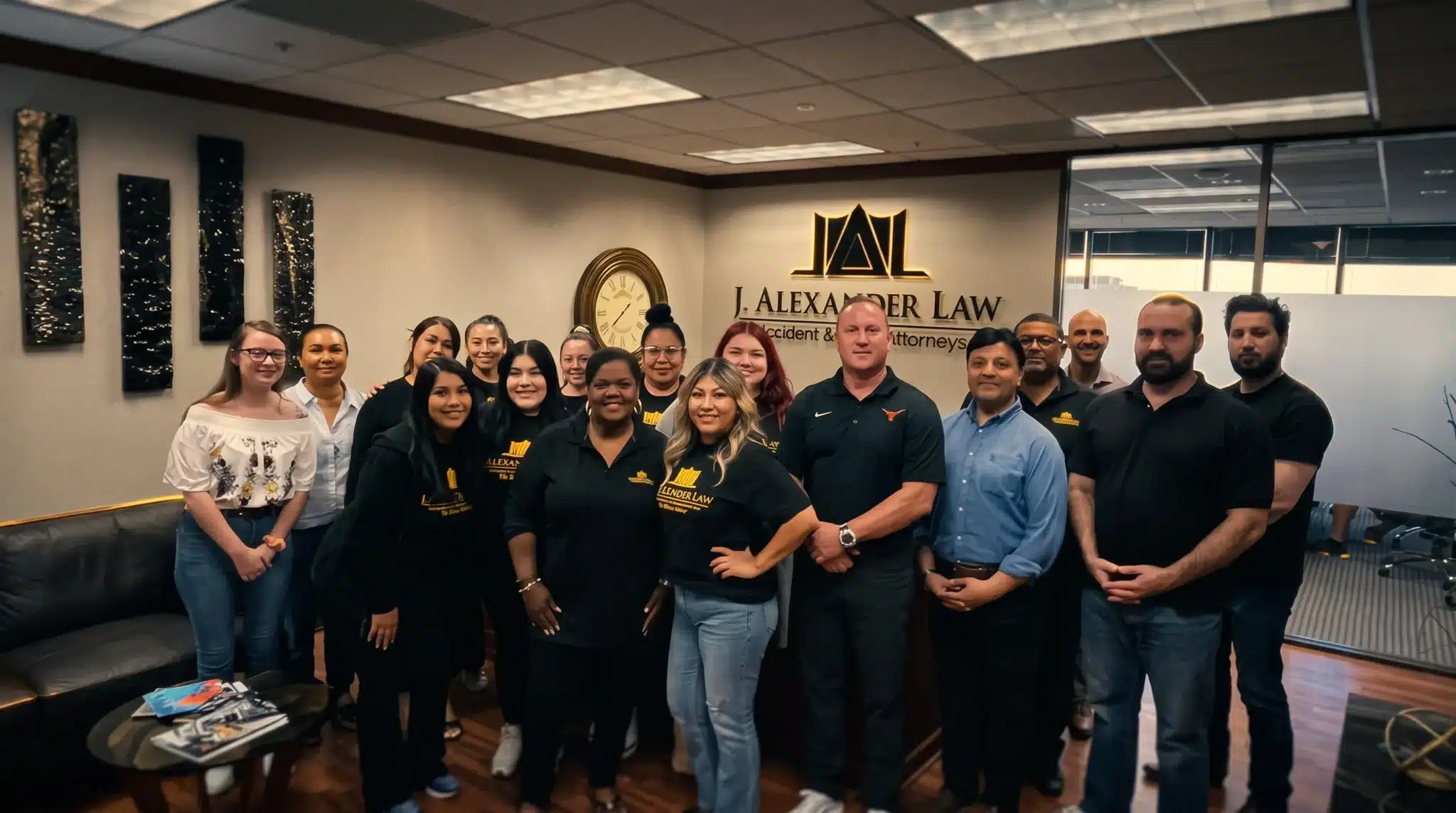
Our Fort Worth rear end collision lawyers work the claim from the crash report forward, so you can focus on your health. J. Alexander Law Firm keeps an office on North Main Street in Fort Worth, and across the firm our attorneys bring more than 75 years of combined experience to serious injury claims.
Rated 4.9 from 568+ client reviews across the firm (opens in a new window)Recovered for clients
Years of combined experience
Client reviews across the firm
Years Super Lawyers Rising Stars
Super Lawyers Rising Stars
Multi-Million Dollar Advocates Forum
Million Dollar Advocates Forum
Texas Trial Lawyers AssociationReflects total recoveries across hundreds of resolved matters. Past results do not guarantee a similar outcome.
When no officer came
Rear ended by a drunk driver with no police report
If you’re caught in a rear end accident the fault must be supported by the available evidence, including photographs, witness statements, vehicle damage, and statements the other driver made after the crash. Depending on the severity of the crash outcome, police may not go the full extent for investigation meaning they may not complete a state crash report.
And If the driver had been drinking, that may strengthen the evidence against them, but if no officer arrives, your claim is not over. It means other evidence becomes even more important to preserve ASAP.
Fort Worth police policy says every reported crash gets an officer. The city’s own audit is why one may still not have arrived.
What We Do First
1 Step one
Obtain the crash report
Crash reports are now obtained through the Texas Department of Transportation’s CRIS portal.Read moreRead lessA report may take up to 14 days to appear in CRIS. We request it as soon as it becomes available and begin the evidence gathering process.
2 Step two
Preserve evidence before it disappears
Evidence can disappear quickly after a rear end crash. Especially vehicle damages and any potential footage that recorded the accident.Read moreRead lessWe work to preserve: vehicle damage evidence; witness names and contact information; nearby surveillance or traffic camera footage; 911 recordings and dispatch records; medical documentation; statements made by the other driver; and bar, restaurant, or receipt records when alcohol may be involved. If you were part of a conversation, Texas law may allow you to record it. Statements made by the other driver at the scene may also be important evidence in a personal injury claim.
3 Step three
Investigate possible drunk driving evidence
A driver’s alcohol consumption can affect both liability and damages.Read moreRead lessEvidence may include: police observations; field sobriety testing; breath or blood test results; arrest records; and receipts or surveillance from a bar, restaurant, or other alcohol provider. In severe cases, intoxication may support a claim for exemplary damages. Texas law generally requires clear and convincing evidence of gross negligence for exemplary damages.
4 Step four
Evaluate whether a bar may be responsible
In some cases, the drunk driver is not the only potential defendant.Read moreRead lessUnder the Texas Dram Shop Act, a bar, restaurant, or other alcohol provider may be liable if it served alcohol to a person who was obviously intoxicated to the extent that they presented to be a clear danger to themselves and others. One crash can potentially involve two claims: a claim against the intoxicated driver, and a claim against the bar or business that overserved the driver.
Call (817) 330-2744 for a free case evaluation.
Call (817) 330-2744The Fort Worth file
How We Build a Fort Worth Claim
- 1
Open the file immediately
We begin gathering evidence as soon as you contact us.
Why the first days decide it
The first days after a crash are where the opportunity lies to best preserve photos, locate witnesses, find footage, and document injuries.
- 2
Request the crash report
Once the report becomes available through TxDOT CRIS, we obtain and review it.
What we read it for
We review it for officer observations, driver information, insurance details, witness information, and any indication of intoxication or traffic violations.
- 3
Determine whether a report should have been filed
Texas Transportation Code § 550.062(a) places the duty to prepare a crash report on the investigating officer.
What the statute requires
The duty applies when a crash involves injury, death, or apparent property damage of at least $1,000 to one person’s property. If no report exists, we evaluate what happened and identify other available records.
- 4
Preserve vehicles and records
We send preservation letters when necessary to help prevent key evidence from being destroyed.
What a preservation letter reaches
This may include the at fault vehicle, event data recorders, bar surveillance footage, receipts, cell phone evidence, company records, and other relevant materials.
- 5
File suit in Tarrant County when necessary
If an insurance company refuses to fairly resolve a claim, a lawsuit may be necessary.
When a lawsuit becomes the route
We go to trial generally in Tarrant County, depending on the facts of the case and where you may be located.
Your car, right now
Why waiting on car repairs benefits you.
One car, no money, and a lawyer telling you to leave it the way it is. This advice puts you in a position that deserves a straight answer rather than a form letter.
The car is evidence. The time you spend without transportation is a financial loss. Your own insurance policy can often pay for repairs before the other driver’s insurance company makes a decision.
1 The hold
Why you should wait before speaking to insurance adjusters
The damaged vehicle is physical evidence that an insurance adjuster cannot recreate from a photograph.Read moreRead lessTexas law requires a party to preserve evidence if they know, or should reasonably know, that a claim will be filed and the evidence is important to that claim. A preservation letter does not create this duty; it confirms a duty that already exists under the law. If a party intentionally conceals evidence, a judge may issue a spoliation instruction, which tells the jury to assume the evidence would have been unfavorable to that party. This remedy requires a finding of specific intent to hide information. Losing or repairing an item only triggers this penalty if the loss prevents the other side from defending the case. Repairing your car does not result in an automatic penalty. We make that decision together.
2 The rental
You lose the use of your vehicle while it sits in a repair shop or an impound lot.
You can demand compensation for the cost of a rental vehicle or other transportation while your car is unavailable.Read moreRead lessYou do not have to rent a car or spend money on transportation to recover loss of use. Texas law measures these damages by the reasonable rental value of the vehicle you cannot use. You can prove this value through lost profits or the cost of a substitute. Until 2016, Texas courts applied different rules for repairable cars versus total losses, but the Supreme Court removed that distinction. Now, the ability to fix the car does not change your right to these damages. Because these are consequential damages, you must prove they were foreseeable and not speculative. One limit exists: the Court has not ruled on cases where a person leaves a repairable car unrepaired to preserve its value, so lawyers must argue those specific facts in court.
3 Your policy
Your own insurance policy may pay for these costs before the other driver’s insurance company does.
You can choose to wait for the other driver’s insurance carrier, or you can seek coverage through your own policy.Read moreRead lessThe Department of Insurance states that if you have collision coverage, you can file a claim with your own insurer while the other carrier disputes fault or delays payment. Your insurer then pursues reimbursement for what it paid. You pay a deductible on your own claim, but you do not pay a deductible on a payment made directly by the at-fault driver’s insurer. Your insurer only returns the deductible if they recover the funds. A Texas auto policy also includes personal injury protection (PIP) unless a named insured rejected it in writing. This coverage pays $2,500 regardless of who caused the crash. Your PIP carrier generally cannot seek reimbursement from the at-fault driver unless that driver was uninsured on the day of the accident.
4 The title
What the title packet is
The insurance company decides if your car is a total loss. No Texas state agency or specific percentage determines this.Read moreRead lessThe Department of Insurance confirms the total loss call belongs to the insurer, made by comparing repair cost against current value. The statutory line for a salvage title is narrower and separate: a major component part damaged or missing, and repair cost, excluding repainting and sales tax, above the car’s actual cash value just before the damage. If you keep the car after they pay for it, Texas bars you from selling or transferring it until a salvage or nonrepairable title issues in your name. Read what is in the packet before the keys go back.
5 The value
A repair does not restore your financial position to what it was before the accident.
Texas law allows you to recover vehicle damages in two ways, and the method used can change the amount you receive.Read moreRead lessThe default is the difference in market value immediately before and immediately after, and this method changes to repair costs whenever repair is economical and reasonable. The Fort Worth court defines a total loss as a vehicle where repair is not economically feasible, even if a mechanic can physically fix it. Two things get overstated elsewhere and are worth knowing straight. The Supreme Court of Texas has not yet decided whether an owner may pick whichever measure pays more, so nobody should promise you both. And against your own carrier under ordinary collision coverage, the standard Texas policy does not owe lost value once the car has been completely and adequately repaired.
The car and the injury are separate claims. How slowly the car moves says nothing about what the injury claim is worth.
Call (817) 330-2744. We can tell you whether the car still has to sit.
Call (817) 330-2744Texas Motor Vehicle Case Results
Recovered for a client injured by another driver’s negligence
Resolved for a client injured in a Texas motor vehicle collision
Settlement for a client rear-ended in Texas traffic
Past results do not guarantee a similar outcome. Recoveries are shown before attorney fees, case expenses, and medical liens. Each case is different.
The corridors
Where traffic jams cause rear ends wrecks
Rear end crashes often happen in heavy traffic, especially where vehicles tend to slow down due to construction zones, exits or congestion.
Fort Worth has several heavily traveled corridors where congestion and abrupt traffic changes happen often.
Where they cluster

SH 121 / Airport Freeway
The SH 183 to NE Loop 820 segment ranked No. 15 in the 2024 Texas congestion report, with 579,470 person-hours of delay per mile.

I-35W
The SH 183 to I-30 segment ranked No. 8 statewide in the 2025 congestion report and No. 2 for truck congestion.

NE Loop 820
The I-35W to Baker Boulevard segment ranked No. 20 in the 2024 congestion report, with 476,623 person-hours of delay per mile.
How we build your claim to demand full compensation
The limit
Texas law does not allow you to sue an insurance company directly for delaying a claim. The penalties and deadlines in Insurance Code protect you from your own insurance carrier, but they do not apply to the driver’s insurance company.
The lever
The insurance company responds to the evidence in your file, the specific language in your demand letter, and the legal requirement to produce documents once you file a lawsuit.
1 The demand
Written to their policy limits
An insurance company does not use its own money when you submit a demand for an amount higher than the policy limits.Read moreRead lessUnder Stowers doctrine, an insurer that controls its insured’s defense owes that insured ordinary care in deciding whether to accept a settlement demand. This duty belongs to the insurer’s own policyholder, not to the person who sent the demand. A demand above policy limits does not trigger this duty even when the number is reasonable. You must send demands at or inside the limits with the release terms and the deadline that trigger the duty. Refusing then puts the carrier’s own money at risk beside the driver’s.
2 The file
Filing a lawsuit triggers the insurer’s obligation to respond to your claim.
No Texas rule makes a liability insurer tell you its limits before you file suit.Read moreRead lessTexas Rule of Civil Procedure 194.2 requires the insurer to disclose the policy limits. This obligation begins when the defendant files an answer or makes a general appearance in court. Until that filing occurs, the insurance company is not required to provide that number. Filing a lawsuit turns a coverage question into a legal disclosure obligation and subjects the adjuster to sworn testimony.
3 The coverage
Insurance policy limits do not always determine the total amount you can recover.
Texas law requires a minimum of $30,000 for each injured person, and a serious injury often exceeds that amount.Read moreRead lessTransportation Code 601.072 sets the floor at $30,000 for one injured person, $60,000 per crash and $25,000 for property damage. Underinsured motorist coverage on your own policy pays what is legally recoverable from the at fault driver up to your own limit, less what their carrier pays. Under Brainard, a UIM carrier owes nothing until a judgment establishes both that the other driver is liable and that they were underinsured, so that claim gets built from the first week rather than raised at the end.
4 The blame
The percentage is the case
A Texas jury assigns a share of responsibility to everyone, including drivers nobody sued.Read moreRead lessChapter 33 bars recovery altogether if your own share is more than 50 percent, and each defendant ordinarily pays only its own percentage. Defendants name responsible third parties to move percentage away from themselves, and after adequate time for discovery a court must strike that designation unless the defendant produces evidence raising a genuine fact issue. Texas also does not presume the rear driver was negligent. A court of appeals rejected that framing and left fault to the jury on the evidence, which is why the evidence gets gathered before anyone argues about it.
What the insurance company will not provide you
The prompt payment deadlines and the 18 percent penalty in Insurance Code Chapter 542 are written for a first party claim, meaning one you make to your own insurer. They do not reach a demand you send to the at fault driver’s carrier.
The Texas Supreme Court held in Allstate v. Watson that you cannot sue the other driver’s insurance company directly for unfair settlement practices. The Department of Insurance says the same about its own complaint process, which generally cannot resolve a dispute against the other party’s insurance company.
Your own policy works differently. When you file a claim for underinsured motorist or personal injury protection coverage, you are making a first party claim, which means the insurance company must follow the specific deadlines and penalties listed in your contract.
Prejudgment interest runs on a personal injury judgment at the postjudgment rate, tied to prime with a floor of 5 percent and a ceiling of 15. A defendant’s settlement offer stops that clock only on the amount offered. Interest keeps running on whatever the judgment exceeds it by.
Common Questions
What if pain starts days after the crash?
It is common for some injuries to become noticeable after the initial shock of a crash fades. Seek medical care promptly, follow your provider’s recommendations, and document symptoms as they develop. Delays in treatment can make both your recovery and your insurance claim more complicated.
How do I get my Fort Worth crash report?
Fort Worth Police Department no longer issues crash reports directly. Reports are obtained through TxDOT’s CRIS portal, and they may take up to 14 days to appear. We can help obtain and review the report once it is available.
No officer came to my crash. What now?
A missing police report does not end your claim. Preserve photos, vehicle damage, witness information, video footage, medical records, and any statements made by the other driver. Contact an attorney promptly if you were injured or if you believe the other driver was intoxicated.
Does a drunk driver change my rear-end claim?
It can. Intoxication may provide important evidence of negligence and may support additional claims or damages in certain cases. If a bar or restaurant overserved the driver, there may also be a potential dram shop claim.
How long do I have to file, and where is the case filed?
Texas generally has a two-year deadline for personal injury lawsuits, but exceptions may apply. A Fort Worth crash lawsuit may be filed in Tarrant County when venue is proper.
Is the driver who rear-ended me automatically at fault?
No. Rear-end collisions often point to the following driver’s failure to maintain a safe distance or pay attention, but fault is determined by the evidence. Road conditions, sudden stops, multiple-vehicle impacts, vehicle defects, and other facts can affect responsibility.
Your Fort Worth Legal Team

Josh Alexander
Josh Alexander is a Marine Corps veteran and Texas trial lawyer who has recovered millions for injured clients in Texas and Oklahoma. He reviews rear-end injury claims and focuses on building the evidence needed to prove liability and damages.
Meet Josh Alexander
Matthew Graham
Matthew Graham spent more than 10 years directing insurance defense litigation across a 10-state region for one of the country’s largest auto insurers. He uses that background to anticipate insurer tactics, preserve vehicle evidence, prepare clients for recorded statements, and develop cases for litigation when necessary.
Meet Matthew Graham
Laura Rivas
Laura Rivas has nine years of experience representing people injured in motor vehicle, commercial truck, catastrophic injury, and wrongful death cases. She represents clients in English and Spanish, and she works to make medical records document injuries, symptoms, treatment, and limitations accurately.
Meet Laura RivasReviews and Recognition
“They took the time to answer all of my questions and made me feel confident in them. The whole staff has been friendly and professional.”
“After speaking with them, we were put at ease right away. They made sure my physical therapy was covered and have been invaluable to us.”
“Excelente servicio al cliente, son muy atentos con sus clientes. La comunicación es muy buena; te ayudan a cualquier hora.”Reviews are from public Google reviews across the firm. Past results do not guarantee a similar outcome.
Talk With a Fort Worth Lawyer
The Fort Worth office is located at J. Alexander Law Firm, 2100 N Main St., Suite 222, Fort Worth, TX 76164.
The firm also has an Arlington office serving Tarrant County. For broader information about vehicle-injury claims, visit the Fort Worth car accident lawyers page.
There are no upfront attorney fees. Attorney fees are a percentage of any recovery and are explained in writing before representation begins. The firm advances case costs, and clients owe no attorney fee unless the firm recovers compensation.