


Dallas parking lot accident lawyer.
Reviewed by Josh Alexander, Founder & Managing Attorney · Updated August 2026
Were you injured in a crash in a Dallas parking lot or parking garage? J. Alexander Law Firm represents people hurt in collisions on private property, including shopping centers, apartment complexes, garages, medical offices, and retail lots.
Our team has a combined 60+ years of experience handling Texas personal injury claims. Parking lot accidents often do not result in a police report or traffic citation, but that does not mean you do not have a case. It simply means the available evidence becomes especially important.
Photos, surveillance video, vehicle damage, witness statements, lighting conditions, lane markings, and driver admissions can all help establish fault.
Rated 5.0 from 675+ client reviewsInside the lot, and at its exit
Parking lot accidents are different.
Crashes inside the lot
No citation to settle it
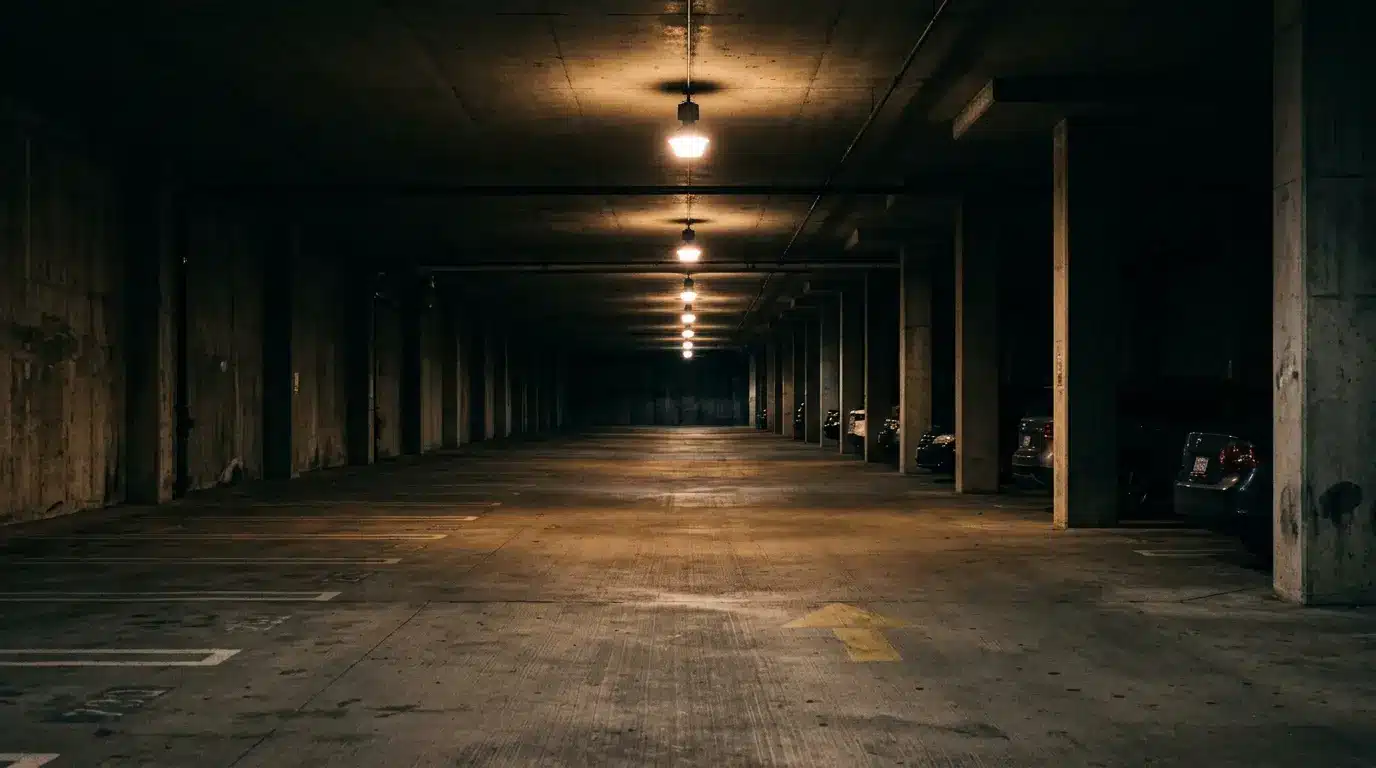
Parking lot and parking garage crashes are often more difficult to investigate than crashes on public roads. Many happen on private property, where officers may not issue citations or prepare detailed reports.
That does not prevent an injured person from pursuing compensation. It means fault must often be established through evidence rather than a citation, and it may depend on questions such as these.
- Which driver was backing up?
- Which driver had a clear view of the travel lane?
- Did a driver pull out of a space without checking for traffic?
- Was either driver moving too fast for the conditions?
- Did a driver cut across rows or ignore marked traffic flow?
- Is there surveillance video showing what happened?
Even without a police report or ticket, you may have a valid injury claim if another driver acted carelessly.
Crashes at the exit
The rules get clearer
The rules are often clearer when a driver leaves a parking lot, garage, driveway, or private road and enters a public street.
Under Texas Transportation Code Section 545.155, drivers entering a roadway from private property must yield to vehicles already traveling on that roadway. If a driver exits a Dallas shopping center, apartment complex, medical office, or parking garage and pulls into your path, that driver may be responsible for the collision.
The duty, in one line
§545.155
A driver entering a roadway from private property yields to traffic already on that roadway. Inside the lot there is no equivalent rule, which is why the two halves of this page are proved so differently.
Inside a parking lot, fault is usually proven through the evidence. At the exit, the law may clearly identify which driver had the duty to yield.
The first few days
After a parking lot crash.
The first few days after a parking lot crash can be critical. Security footage may be erased quickly, witnesses may leave without providing their contact information, and vehicle repairs may destroy valuable evidence.
1
Report the collision
Exchange details before anyone leaves the scene.
If nobody is there, or someone is hurt
Exchange names, contact details, driver’s license information, insurance information, and vehicle information before anyone leaves the scene.
Texas law requires drivers involved in a crash to provide identifying and insurance information under Texas Transportation Code Section 550.023.
If the other vehicle is unattended, Texas law generally requires you to leave your name, address, and vehicle information where the owner can find it; see Section 550.024.
If someone is injured or a vehicle cannot be safely driven away, notify law enforcement. Section 550.026 may require immediate notice to law enforcement.
2
Take photos and video
The scene matters as much as the damage.
What to photograph
- Damage to both vehicles
- The vehicles’ final positions, if it is safe to do so
- Parking spaces, travel lanes, ramps, curbs, signs, mirrors, and lane markings
- Skid marks, debris, barriers, broken lights, and obstructed views
- Lighting conditions, especially if the crash happened at night
- The exact location, including the garage level, row, entrance, or exit
3
Get witness information
Witnesses in parking lots leave within minutes.
Who they usually are
They may include shoppers, store employees, apartment residents, delivery drivers, pedestrians, or other motorists. Ask witnesses for their names, phone numbers, and email addresses before they leave. An independent witness can be especially valuable when the drivers disagree about what happened.
4
Request the footage
Many systems record over old video within days.
What a preservation request should cover
Many businesses and property owners overwrite security footage within days. Send a written request as soon as possible asking the property owner or manager to preserve all available video.
Your request should identify the date and approximate time of the collision, the exact location, the garage level, parking row, entrance, exit, or nearby business, and any cameras that may have captured the crash or the vehicles involved.
Potential sources of footage include:
- Parking garage or property-management cameras
- Store or restaurant cameras
- Apartment-complex security cameras
- Cameras at nearby businesses
- Delivery vehicles
- Dash cameras
5
Insurer last, in writing
No recorded statement before you know more.
Why it matters more here
You should report the crash to your insurance company. Consider speaking with an attorney before giving a detailed recorded statement, especially if fault is unclear or there is no police report.
When there is no officer’s diagram, citation, or written assessment of fault, early statements can carry significant weight. Understand what evidence exists before you give a detailed account to an insurance adjuster.
Private property, public duty
Will Dallas police respond?
Sometimes. Many parking lot crashes happen on private property, and Dallas police may not respond to minor accidents without injuries or significant vehicle damage.
If an officer responds and prepares a report, it may be available through the Dallas Police Department or the Texas Department of Transportation’s CRIS system. A police report may be helpful, but it is not required to pursue a personal injury claim.
Many valid parking lot injury claims are built using
- Security-camera footage
- Photos and video of the scene
- Vehicle damage patterns
- Witness statements
- Driver admissions
- Medical records
- Property maintenance records
- Accident reconstruction, when necessary
No police report on your crash? That is where most of these claims start.
Call 469-807-7480When the property is part of it
When the property owner may be responsible.
In some cases, the other driver is not the only party who may be responsible. A parking lot or garage owner may have contributed to the crash if the property was unsafe.
Poor lighting, blocked sightlines, missing traffic controls, or unsafe traffic flow may make a collision more likely.
Why it is worth asking
A code violation is evidence, not liability
A building-code or development-code violation does not automatically make a property owner liable. It may still serve as evidence that the owner knew, or reasonably should have known, about a dangerous condition.
If poor lighting may have contributed to the crash, photograph the area as soon as possible, and at roughly the same time of day or night as the collision.
A burned-out bulb or a changed condition may be repaired before it can be documented.
Conditions that may contribute
Burned-out, missing or inadequate lighting
The condition most often photographed too late.
Faded or missing lane markings
Required spaces are meant to be permanently identified.
Blind corners and blocked views
Corners a driver cannot see around until the car is already in the lane.
Landscaping that blocks a view
A hedge at the wrong height turns a sightline into a guess.
Poorly placed signs and cart corrals
Signage and corrals set down where they hide a moving car.
Missing mirrors at ramps and turns
A blind garage turn with no mirror warns neither driver.
Unsafe walkways, curbs and wheel stops
Barriers that do not keep a car off the path they mark.
Poorly designed traffic flow
Narrow lanes, and exits that give no view of the road.
Property conditions get repaired before anyone photographs them.
Call 469-807-7480Layout, not speed
Common Dallas parking lot crash patterns.
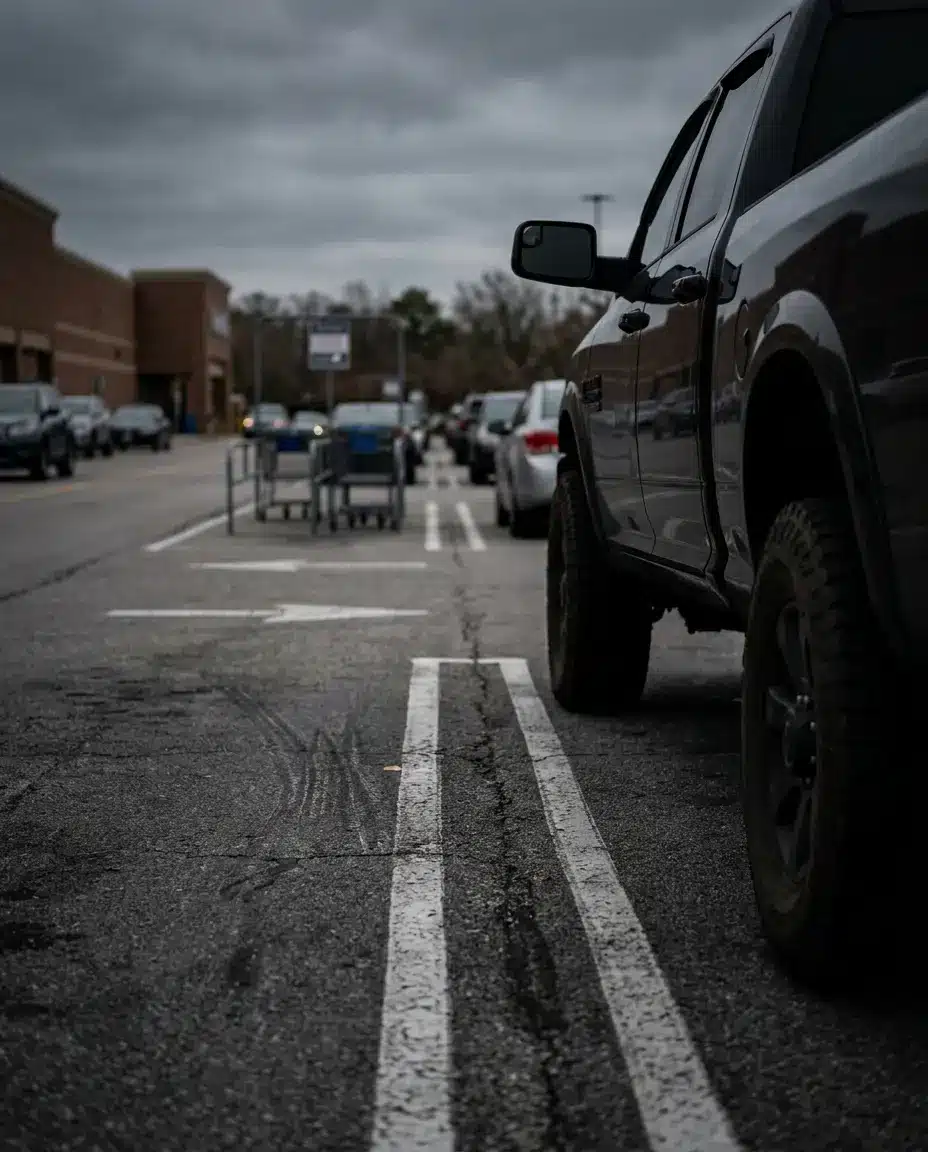
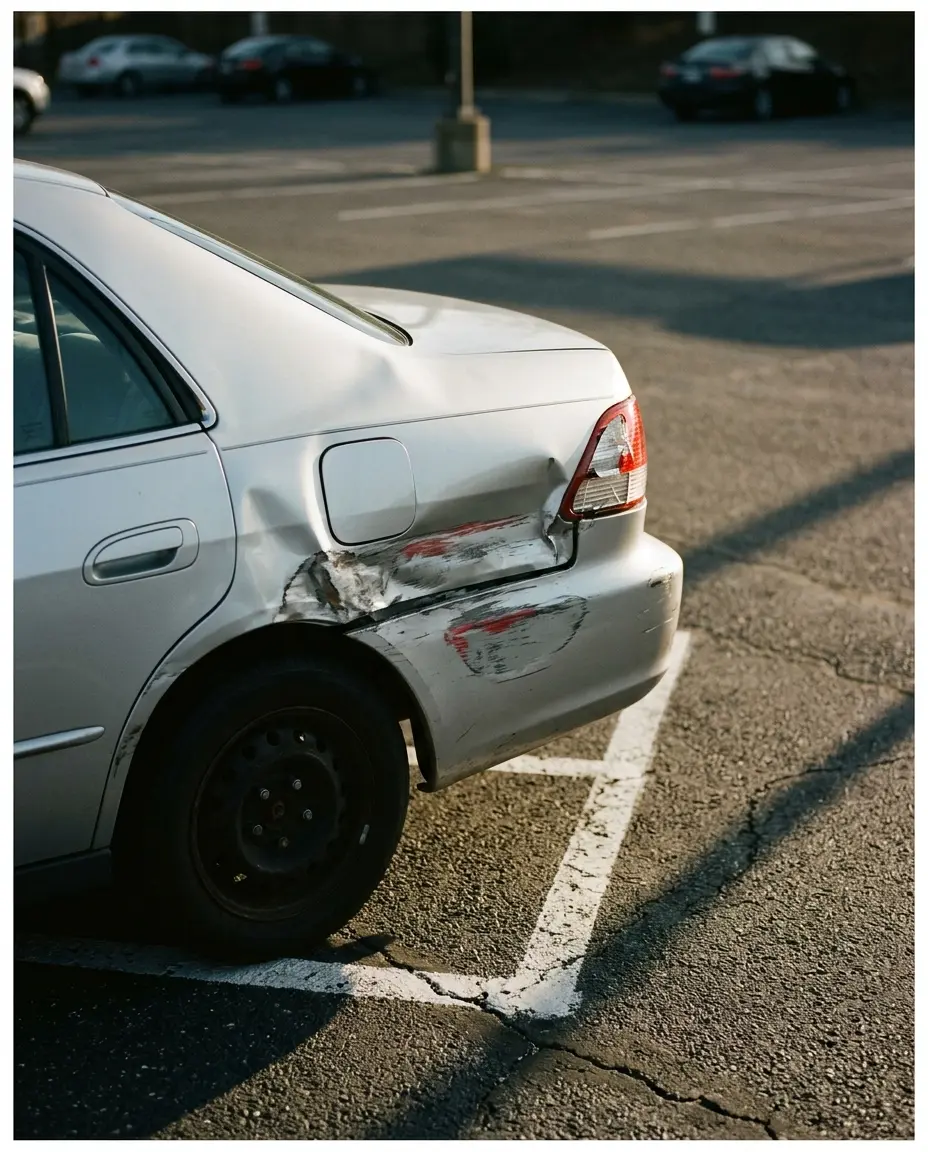
Parking lot accidents often happen because of layout, visibility, and limited space, not high speed. Parked vehicles, pillars, ramps, narrow lanes, and blind exits can leave drivers with little room to react.
Common crash patterns
Two vehicles backing out
Both drivers reverse at the same time, often with limited visibility.
A driver leaving a space
A driver pulls out without checking for vehicles already in the lane.
A driver exiting the property
A vehicle enters a public road without yielding to oncoming traffic.
Garage or parking-deck collision
A pillar, blind turn or ramp stops either driver from seeing the other.
Hit-and-run collision
A driver leaves before exchanging information or reporting the crash.
When a driver leaves the scene, report the collision promptly and request any available security footage the same day.
When both drivers contributed
Shared fault in Texas.
51%
When both drivers may have contributed to a crash, Texas law allows fault to be divided between them. Under Texas’s modified comparative responsibility system, your financial recovery is reduced by your percentage of fault under Section 33.012(a). Under Section 33.001, you generally cannot recover damages if you are found more than 50 percent responsible.
The worked example, on a $10,000 claim
40%
at fault
You recover $6,000, reduced by your 40 percent share.
51%
at fault
You recover nothing from the other party.
This is one reason early evidence matters. Video, witness statements, vehicle-damage patterns, and photos may help show which driver entered the lane first, had the better view, failed to stop, or had the greater opportunity to avoid the crash.
Your share of fault is the part early evidence can still move.
Call 469-807-7480Which policy responds
Insurance coverage that may apply.
More than one insurance policy may be available after a parking lot crash. For example, another driver may have failed to yield while a property owner also failed to maintain safe lighting, traffic markings, or sightlines.
The other driver’s liability insurance
Often the first source of payment when another driver caused the crash.
Uninsured or underinsured motorist
May apply if the at-fault driver has no insurance, too little, or leaves the scene.
Collision coverage
May cover vehicle damage regardless of fault, subject to your terms and deductible.
Medical payments coverage
May help pay certain medical bills under your own policy, regardless of fault.
Commercial insurance
May apply if the at-fault driver was working, making deliveries, or driving for a rideshare company.
Property-owner insurance
May apply when unsafe property conditions contributed to the crash.
What a claim can include
Compensation after a parking lot accident.
A parking lot collision can support the same types of damages as other Texas personal injury claims. Depending on the facts of the case, compensation may include the following.
Emergency medical care and bills
The care you have already had, and the bills that came with it.
Future medical treatment
Treatment still ahead, including anything a doctor expects will be needed.
Physical therapy and rehabilitation
Often the longest part of a low speed injury, and the part insurers question hardest.
Lost wages and earning capacity
Time off, and any lasting reduction in what you are able to earn.
Vehicle repair or replacement
Repair or value, plus what it cost you to get around without the car.
Transportation expenses
What getting to treatment and back has cost you since the crash.
Pain, suffering and limitation
The part no repair invoice shows, and the reason a low speed crash is worth more than its estimate.
Scarring, disfigurement or impairment
Where an injury leaves something behind, that is valued separately from the treatment it took.
What decides the value
No two of these are worth the same
The value of a claim depends on the severity of the injuries, the available insurance coverage, the evidence of fault, the medical treatment, and the effect of the crash on your daily life.
Past results do not guarantee a similar outcome. Every case is different.
Every claim turns on its own facts, and the consultation is free.
Call 469-807-7480Parking lot accident recoveries.
- $15M18-wheeler, wrongful death
Recovered for a family after a fatal collision with a commercial truck.
- $1M18-wheeler crash
Recovered after a heavy truck caused a violent crash on the highway.
- $750K18-wheeler crash
Settlement for injuries from a commercial truck collision.
- $716KMotor vehicle accident
Recovered for a driver injured by another driver’s negligence.
- $350KMotor vehicle accident
Settlement for a client rear ended in Texas traffic.
Sample results from actual past cases. Past results do not guarantee a similar outcome; every case is different. Ask where your facts sit; the consultation is free.
How long you have to file.
In most Texas personal injury cases, you have two years from the date of the crash to file a lawsuit under Section 16.003 of the Civil Practice and Remedies Code.
The deadline to preserve evidence runs much shorter. Video can be overwritten within days, witnesses may become difficult to locate, vehicle damage may be repaired, and property owners may fix lighting, repaint markings, or alter the scene.
Do not wait until the two-year deadline if a parking garage, apartment complex, retail center, hospital, or other business may have video evidence.
Frequently asked questions.
These are the questions that come up most often after a parking lot crash. Nearly all of them turn on the same two things: what evidence still exists, and how quickly somebody asks for it.
Who has the camera footage after a Dallas parking garage crash?
Usually, the company that operates or manages the garage has the footage, and that may not be the business you visited. Downtown Dallas garages, hospital garages, apartment complexes, and retail lots may all be managed by different companies.
Ask in writing for the operator to preserve footage, and include the date, time, location, garage level, parking row, entrance, or exit. A preservation request matters because it creates a record showing when the owner was notified that the evidence might be needed.
My crash happened in an apartment complex parking lot. Does that change my claim?
It may change the evidence available, but it does not prevent you from bringing a claim. Apartment complexes are private property, so a citation may not be issued and fault may depend more heavily on the available evidence.
The property manager may have camera footage, incident reports, gate-entry records, or other documentation showing when vehicles entered or left the property. Those records may not be retained for long, so request them quickly.
The other driver and I were both backing out. Who is at fault?
Both drivers may share fault. Texas allows responsibility to be divided between the parties, and the final percentage of fault can affect whether and how much you recover.
These cases often turn on which driver entered the lane first, which driver had a clearer view, whether either driver stopped, and whether video or vehicle damage supports one account over the other.
I was walking through a parking lot when a car hit me. Do I have a claim?
You may. A pedestrian claim generally depends on whether the driver failed to use reasonable care, whether that failure caused the collision, and whether you were injured as a result.
Evidence may include surveillance footage, witness statements, vehicle damage, the layout of the parking lot, and medical records.
The lot had a blind corner and a burned-out light. Is the property owner responsible?
Possibly. A claim against the property owner is separate from the claim against the driver, although both may arise from the same collision.
These claims often focus on the condition of the property, including lighting, sightlines, lane markings, signage, maintenance history, and traffic design. Document the condition quickly, before repairs or changes are made.
How long do I have to bring a Dallas parking lot accident claim?
In most cases, you have two years from the crash date to file a lawsuit. But you should act much sooner to preserve camera footage, witness information, photos, vehicle damage, and evidence of unsafe property conditions.
The question this page didn’t answer fits in a two minute call. Your exact crash decides every answer above.
Call 469-807-7480Meet our legal team.
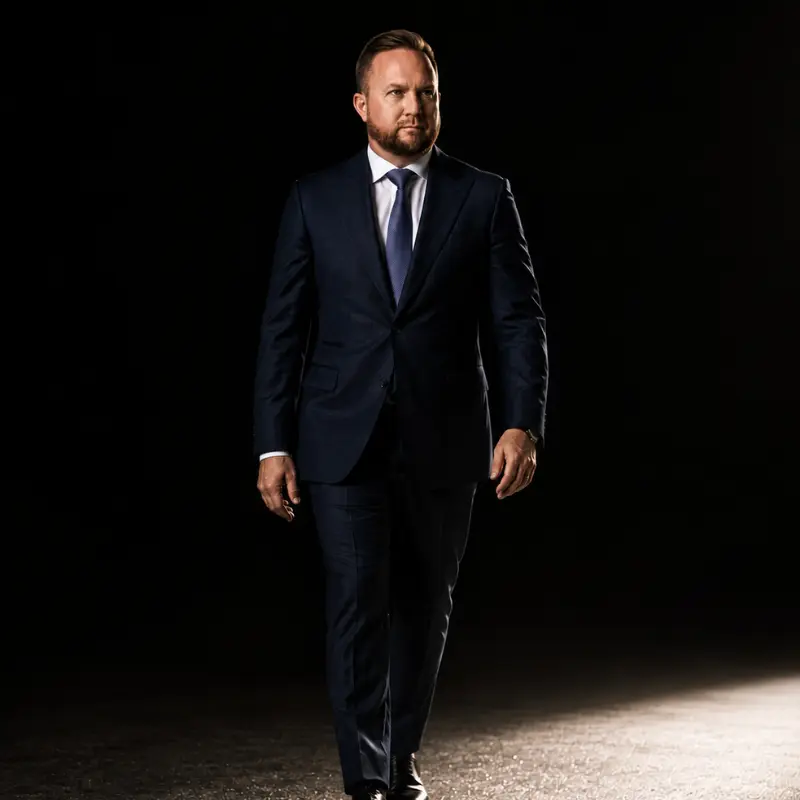
Josh Alexander
Founder & Managing Attorney
A Marine Corps veteran and Texas trial lawyer who has recovered millions for hundreds of injured clients across Texas.
Meet Josh Alexander
Matthew Graham
Managing Litigation Attorney
Spent more than a decade representing insurance companies, including directing subrogation litigation for the country’s second largest auto insurer. Now he works for the injured.
Get to know Matthew
Laura Rivas
Senior Associate Attorney
Nine plus years representing the injured in motor vehicle, 18-wheeler, catastrophic injury, and wrongful death claims. She works in English and Spanish.
More about LauraChoose the attorney you want to hear back from and name them when you call.
What our clients say.
- ★★★★★
“They took the time to answer all of my questions and made me feel confident in them. The whole staff has been friendly and professional.”
Cecilia G.Google review - ★★★★★
“After speaking with them, we were put at ease right away. They made sure my physical therapy was covered and have been invaluable to us.”
Kelly H.Google review - ★★★★★
“Excelente servicio al cliente, son muy atentos con sus clientes. La comunicacion es muy buena; te ayudan a cualquier hora.”
Salvador T.Google review
Reviews from actual clients. Past results do not guarantee a similar outcome. The quotes say what the firm can’t say about itself; call and form your own view.
Dallas headquarters
Talk with a Dallas parking lot lawyer.
Every parking lot crash is different. A short conversation can help determine what evidence should be preserved, whether another driver or property owner may be responsible, and what insurance coverage may be available. A parking lot accident is one type of car accident claim, and our Dallas car accident lawyers page covers the wider picture.
We charge no upfront fee. Attorney fees are a percentage of the recovery and are explained in writing before representation begins. We advance case costs, and you owe no attorney fee unless we recover compensation for you.
Attorney advertising. Josh Alexander is responsible for the content of this page; principal office 12801 N. Central Expressway, Suite 1100, Dallas, TX 75243. Past results do not guarantee or predict a similar outcome in any future case. The information on this page is general information about Texas law and is not legal advice; contacting the firm or sending a form does not create an attorney client relationship. Spanish speaking staff available.