


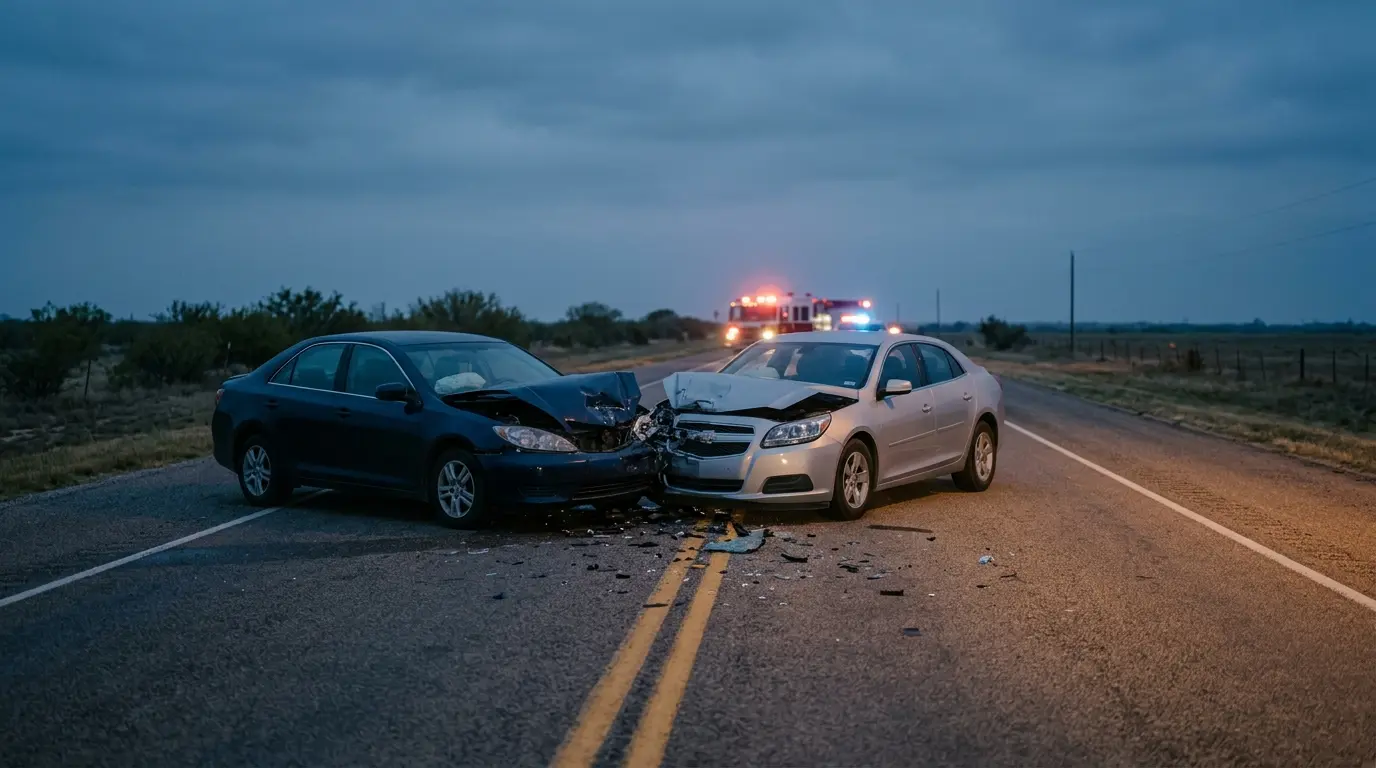
Head on collision lawyers in Texas.
Reviewed by Josh Alexander, Founder & Managing Attorney | Updated
A head on collision happens when two vehicles traveling in opposite directions strike front to front. These crashes can cause life changing injuries because both vehicles are moving into the impact.
In many Texas head on collision cases the key question is whether the other driver crossed into oncoming traffic. We preserve evidence, deal with the insurance company, and pursue compensation for your losses. You may have up to two years to file a lawsuit, but critical evidence can disappear much sooner.
No attorney’s fee unless we recover compensation for you.
Rated 4.9 from 568+ Google reviews- $100M
Recovered across resolved client matters
- 4.9
Google rating
- 568+
Google reviews
- 5
Years named to Super Lawyers Rising Stars
 Dallas Stars
 Sporting United
 Super Lawyers Rising Stars
 Multi Million Dollar Advocates Forum
 Million Dollar Advocates Forum
 Texas Trial Lawyers Association
Past results do not guarantee a similar outcome. Attorney recognitions and ratings are not a guarantee of future results.
What to do after a head on collision
Get medical care first and follow your doctor’s recommendations. Prompt medical care protects your health and creates documentation connecting your injuries to the collision.
Then protect the evidence, because vehicles get repaired or scrapped and camera recordings are overwritten within days. The immediate aftermath is covered in our first 48 hours guide.
No attorney’s fee unless we recover compensation for you.
Your first four steps
- Get medical care. Follow the treatment your doctor recommends, and tell your providers about all symptoms and activity limits so your records reflect how the injury affects your daily life.
- Be careful with recorded statements. Before giving one to the other driver’s insurer, consider speaking with a lawyer. You may have duties under your own insurance policy.
- Save what you have. Photos, video, the crash report information, and contact details for witnesses. Photograph the road itself, not only the cars, while the marks are still on it.
- Contact a lawyer quickly. Do not let the wrecked vehicle be scrapped or sold before its data is requested, and write down which businesses and houses face the scene, since their cameras overwrite in days.
What is a head on collision?
A head on collision occurs when two vehicles traveling in opposite directions strike front to front. You may also hear it called a head on car accident, a head on car crash, a frontal collision, or a wrong way crash.
These crashes are especially dangerous because each vehicle is moving toward the other at the moment of impact. A vehicle traveling 50 miles an hour and another vehicle traveling 50 miles an hour have a combined closing speed of 100 miles an hour.
That does not mean either vehicle experienced a 100 mile an hour wall impact. In a roughly equal head on crash, each vehicle’s impact is more comparable to striking a rigid barrier at its own speed.
The legal investigation usually begins with one question: where was each vehicle when the collision occurred? Our crash injury visualizer shows how those forces travel through the body at different speeds.

Who is at fault in a head on collision in Texas?
In many Texas head on collision cases, the driver who crossed into oncoming traffic is at fault. Texas law generally requires drivers to stay on the right half of the roadway when there is enough room to do so, under Section 545.051 of the Texas Transportation Code.
That rule has limited exceptions. For example, a driver may sometimes move left to pass another vehicle or avoid an obstruction. But an exception does not automatically excuse the crash. The driver still must have had a legal reason to enter the opposing lane, and must have done so safely.
If the other driver claims they were passing, we examine the road layout, sight distance, markings, vehicle data, debris, damage patterns, and available video to determine whether passing was lawful and could have been completed safely.
So we do not stop at which vehicle was on the wrong side. We look at whether an exception was available at all, and whether the driver met the conditions required for that exception. The facts of the crash can change the analysis.
When Texas law may allow a driver to move left of center
These exceptions are fact specific and do not automatically eliminate fault. Section 545.051 lists four.
- The driver was passing another vehicle.
- An obstruction made moving left necessary, and the driver yielded to oncoming traffic that was an immediate hazard.
- The roadway was divided into three marked lanes.
- The roadway was restricted to one way traffic.
On roads with four or more lanes of two way traffic, Section 545.051(c) generally prohibits driving left of the center line except in limited situations, including an authorized lane, avoiding an obstruction when it is safe, or turning into or out of an alley, private road, or driveway.
How do you prove which car crossed the line?
We do not rely only on what the drivers remember. A head on crash can happen in seconds, and one driver may be badly injured or unable to give a complete account.
We look for physical and digital evidence that shows where each vehicle was before impact, where the collision occurred, and what each driver did in the seconds beforehand. Physical evidence often provides a more reliable account than either driver’s memory.
That can include vehicle “black box” data, crash scene measurements, damage patterns, surveillance video, dash camera footage, and witness statements.
Because some evidence can disappear quickly, we may send preservation letters early to request that vehicles, electronic data, and relevant recordings are not destroyed or overwritten. A wrecked vehicle can be sold for salvage while a claim is still being opened.
Where the physical evidence and the crash report disagree, we retain a reconstruction engineer, whose calculations of speed and position are drawn from the evidence at the scene. The Texas crash report decoder explains what the officer’s fields do and do not settle.
What the road and the vehicles record
- Tire marks and gouges, which can help identify the impact area.
- Debris fields, which can help reconstruct the point and angle of impact.
- Crush damage, which can help show how the vehicles came together.
- Vehicle event data, including available information about speed, braking, steering, and seat belt use.
- Video from nearby homes, businesses, traffic cameras, or other drivers’ dash cameras.
That evidence also affects shared responsibility
Under Texas law, an injured person may generally recover damages if their share of responsibility is 50 percent or less. Their recovery is reduced by their percentage of responsibility, and recovery is barred only if they are more than 50 percent responsible, under Section 33.001 of the Texas Civil Practice and Remedies Code.
That percentage can reduce the compensation available in a claim or a lawsuit, which is why we build it from measurements. Physical evidence makes it harder for an insurer to shift blame based only on competing recollections. More on shared fault below.
Why does a car end up on the wrong side of the road?
A car can cross into oncoming traffic for many reasons. The cause matters because it can affect the evidence we seek and whether parties besides the driver may be responsible. Common causes include the following.
Wrong way driving
A driver enters a divided road, exit ramp, or one way roadway against traffic. Learn more about wrong way crashes.
Drunk or drug impaired driving
Alcohol or drug impairment can affect liability and may raise questions about other responsible parties in limited circumstances. Learn more about drunk driving crashes.
Drowsy driving
A driver falls asleep or loses focus after prolonged driving, shift work, or inadequate rest. Learn more about drowsy driving crashes.
Distracted driving
Phone use, navigation systems, or other distractions can cause a driver to drift across the center line.
Unsafe passing
A driver attempts to pass without enough time, distance, or visibility to return safely to their lane.
A commercial truck crossing over
Where the vehicle is a commercial truck, the carrier can be responsible as well as the driver. Our truck accident lawyers handle those.
Whichever it was, the duty in Section 545.051 did not change. The reason a driver crossed decides who else can be made to pay, not whether crossing breached the rule. Tell us what you know and we identify which of these your crash is. You do not have to arrive with the answer.
What injuries follow a head on collision, and why does treatment matter?
Because both vehicles are moving into the impact, injuries at these speeds tend to need months of care rather than weeks, and some of what they leave behind never fully resolves. The card beside this text lists the injuries we see most often on these files.
Get medical care early and follow the treatment your doctor recommends. Prompt medical care protects your health and creates documentation connecting your injuries to the collision.
Tell your medical providers about all symptoms and activity limits so your records accurately reflect how the injury affects your daily life. Your records are also where a written figure for future care has to come from, since a cost added later as a guess does not carry the same weight.
Common head on collision injuries
- Head and brain injuries. Including concussion and the memory and concentration problems that can follow.
- Neck and back injuries. Herniated discs and spinal injuries are common where the body is thrown forward against a belt.
- Chest, leg, and foot injuries. Frontal impacts load the belt, the wheel, and the footwell all at once.
- Lasting impairment and scarring. These leave no receipt, so the medical notes have to carry them.
Every injury is different, and only your treating doctor can say what your recovery involves. What we do is make sure the record reflects it.
What can you claim after a head on collision?
Texas generally allows four broad categories, and the same scene and medical records that prove fault also prove most of what you can claim.
Medical care
Treatment already billed, and future care your own doctor commits to a written figure.
Lost income
Wages the collision has already taken from you, and the earning capacity it removes going forward.
Property
The vehicle itself, whatever was destroyed inside it, and transport while yours is gone.
Losses with no invoice
What the injury costs you outside money: pain, mental anguish, scarring, and lasting impairment.
Why medical records carry so much of this
Your treatment record shapes the claim in three ways. Future care has to be costed in writing rather than guessed. Impairment leaves no receipt, so the medical notes have to carry it. And any gap in the record becomes the argument that something else caused the injury.
That last category, pain and impairment, arrives as no invoice at all, which is why it has to be recorded in your medical chart to be claimable.
Where a head on kills someone
The claim changes and different people bring it. Head on car crashes are among the types most likely to produce one, whatever the reason the driver crossed.
Texas generally restricts that claim to a surviving spouse, the children, or the parents, and it dates from the death. The percentage rule in Section 33.001 still applies there, so blame is argued in a death claim as it is in an injury claim. Our wrongful death lawyers page explains how a family brings one.
What if the other driver had too little insurance, or none?
Texas sets the legal minimum low, and it has not moved since 2011. The card beside this text lists what a driver has to carry.
Those minimum amounts come from Section 601.072 of the Texas Transportation Code, and they are only what a driver has to carry. They were never set against what a frontal impact costs to put right, and that mismatch is what a head on collision exposes.
So the at fault policy is often used up before your treatment is finished. That is when your own uninsured and underinsured motorist cover matters, because it pays when the other driver carried too little cover, or none at all.
The Texas legal minimum
- 30,000 dollars for injury to or death of one person.
- 60,000 dollars in total for one collision, however many people were hurt.
- 25,000 dollars for damage to property.
We check three things on every head on file
- Whether anything sits above the at fault driver’s first policy.
- Whether an employer’s cover applies, if the driver was working at the time.
- What your own uninsured and underinsured motorist cover will pay, including where the crash was fatal.
What does the other side do with a head on claim?
The insurer moves quickly, because the injuries are usually serious and it can see what the claim is worth. An adjuster may call within days, before anyone knows what your treatment will involve. That speed is why our preservation letters go out the same week, not after the first offer.
A head on collision also uses up the at fault policy more often than other crashes, so we check the coverage early.
Before giving a recorded statement to the other driver’s insurer, consider speaking with a lawyer, because you may have duties under your own insurance policy. We answer those requests for you, and since we are paid only from a result, that work is underway well ahead of any payment.
Once we open your file we handle those calls. Our guide on dealing with insurance companies in Texas sets out the rest.
Two arguments come up again and again
- Their driver was passing lawfully, so an exception in the statute applied to them.
- You could have avoided it, by braking sooner or steering somewhere you did not steer.
Both arguments are aimed at your percentage of the blame rather than at the impact.
Why the first offer arrives so fast
“I have seen insurance claims from both sides. First offers often fall short, and I use that experience to protect your case.”

Matthew Graham spent over a decade directing insurance defense litigation for a 10 state region before joining the plaintiff’s side.
How long do you have to file in Texas? Two years
Most Texas personal injury lawsuits must be filed within two years of the crash, under Section 16.003 of the Texas Civil Practice and Remedies Code. Exceptions exist, and they are narrower than most people assume. They are set out in Section 16.001 and turn on legal disability rather than circumstance.
The exceptions turn on legal disability
- A claimant under 18 when the crash happened, because the two years generally do not count against a child.
- A claimant of unsound mind when the claim arose.
Two limits come with that. A disability beginning after the two years have started does not pause them, and one disability cannot be added to another to stretch the period.
So we confirm your date against the statute rather than assume you have longer. The facts of the crash can change the analysis.

The two years govern the lawsuit. They do not govern the evidence, and the physical proof runs out long before the deadline does.
Do not wait for the deadline. Vehicles get repaired or scrapped, and camera footage is overwritten within days.
How is the number worked out?
We build the figure from documents rather than estimates. The bills already issued form the base. Your treating doctor’s written projection for future care sits on top of that. Your employment records show what the absence has taken.
Against that total we set the percentage the other side intends to pin on you, because that percentage comes straight off the figure. We match every line back to your medical chart before the demand leaves this office.
We will not present a demand, the written claim that opens negotiation, while your medical picture is still moving. Put a number forward too soon and every negotiation afterwards is pulled back toward it. For how these categories translate into figures, read our note on what a Texas accident case is worth. Past results do not guarantee a similar outcome.

What have we recovered in Texas vehicle claims?
- $716KMotor vehicle accident
Recovered for a driver injured by another motorist’s negligence.
- $350KMotor vehicle accident
Settlement for a client rear ended in Texas traffic.
- $15M18 wheeler, wrongful death
Recovered for a family after a fatal collision with a commercial truck.
- $2.55M18 wheeler crash
Resolved for a client seriously hurt in a wreck with a tractor trailer.
- $1M18 wheeler crash
Recovered after a heavy truck caused a high impact highway collision.
- $750K18 wheeler crash
Settlement for injuries from a commercial truck collision.
Sample results from actual past cases, none of which is a guarantee of any future result. More recoveries are on our full results page. Past results do not guarantee a similar outcome.
Who handles these claims
You reach an attorney, not a call center. Calls are answered in English and in Spanish.

Josh Alexander
Founder & Managing AttorneyA Texas trial lawyer and Marine Corps veteran, with over ten years in the courtroom and millions recovered for clients across the state. On a head on file he proves where each vehicle was when they met.
Meet Josh Alexander
Matthew Graham
Managing Litigation AttorneyRan insurance defense litigation for over ten years at the country’s second largest auto insurer, so he knows how the other side prices a file. He gets the preservation letter out in week one.
Meet Matthew Graham
Laura Rivas
Senior Associate AttorneyNine years representing injured Texans in vehicle, truck, catastrophic injury, and wrongful death claims, and she takes calls in English and in Spanish.
Meet Laura Rivas

From Josh Alexander
“Head on collisions are often devastating, and the questions that follow matter: what caused the crash, and who is responsible? I fight to get those answers and hold the negligent driver, company, or insurer accountable. You pay nothing unless we win.”
Josh Alexander
Founder & Managing Attorney
Marine Corps veteran, Texas trial lawyer
What does it cost to hire us?
Your consultation is free. We charge a fee only if we recover compensation for you, and we explain the fee agreement and the case expenses before you hire us.
Head on crashes are won on the road surface, not in the argument about it. Give us the report and the location, and we start the scene work from there. We get to the scene and the vehicles while both still hold the answer.
If the other side raises the passing exception, that is a question of proof rather than a defeat. We measure what was possible from where their vehicle actually was.
Questions people ask after a head on collision
These are the questions that come up on first calls. Each answer links back to the section that covers it in full.
Talk to an attorney today
Bring us the crash report and the location of the collision. Your filing deadline gets calendared before anything else.
(469) 807-7480No attorney’s fee unless we recover compensation for you.
What is a head on collision?
Two vehicles traveling in opposite directions strike front to front. The danger comes from closing speed, because both vehicles are moving into the impact. More on how these crashes happen.
Who is at fault in a Texas head on collision?
Usually it is the driver who crossed into oncoming traffic. But Texas law allows limited exceptions, so the crash evidence matters. More on fault and the exceptions.
What if the other driver says they were passing?
Passing is the first exception in the statute, and it is the argument insurers reach for. It only helps them if passing was permitted there and was carried out safely, which the physical evidence at the scene usually settles.
How do you prove who crossed the center line?
From tire marks, debris fields, and crush damage, from vehicle data, and from nearby video. Where those conflict with the crash report, a reconstruction engineer resolves it. More on the evidence we gather.
How long do I have to file after a head on collision in Texas?
Most Texas personal injury lawsuits must be filed within two years, though exceptions can apply. Do not wait for the deadline, because video and vehicle evidence may disappear much earlier. More on deadlines, and see our guide to Texas filing deadlines.
What if I was partly at fault?
You may still recover damages if you are 50 percent or less responsible. Your compensation is reduced by your share of fault, and you cannot recover if you are more than 50 percent responsible. More on shared fault.
What does it cost to hire a lawyer?
Your consultation is free. We charge a fee only if we recover compensation for you, and we explain the fee agreement and case expenses before you hire us. See how contingency fees work.
Hit head on in Texas? There is no fee unless we recover.
Describe the collision and when it took place. You will speak with a head on collision attorney rather than an intake screener.
There is nothing to pay at the outset and we fund the case as it runs. The first thing entered on your file is the date your claim expires.
No attorney’s fee unless we recover compensation for you. Free consultation, 24/7 · Se habla español · Serving all of Texas
Attorney advertising. Josh Alexander is responsible for the content of this page; principal office 12801 N. Central Expressway, Suite 1100, Dallas, TX 75243. Prior results do not guarantee or predict a similar outcome in any future case.
The information on this page is for general purposes only and is not legal advice; contacting the firm or submitting a form does not create an attorney-client relationship. This page describes head on collisions between private vehicles in Texas. Crashes involving commercial trucks are handled by our truck accident team.