
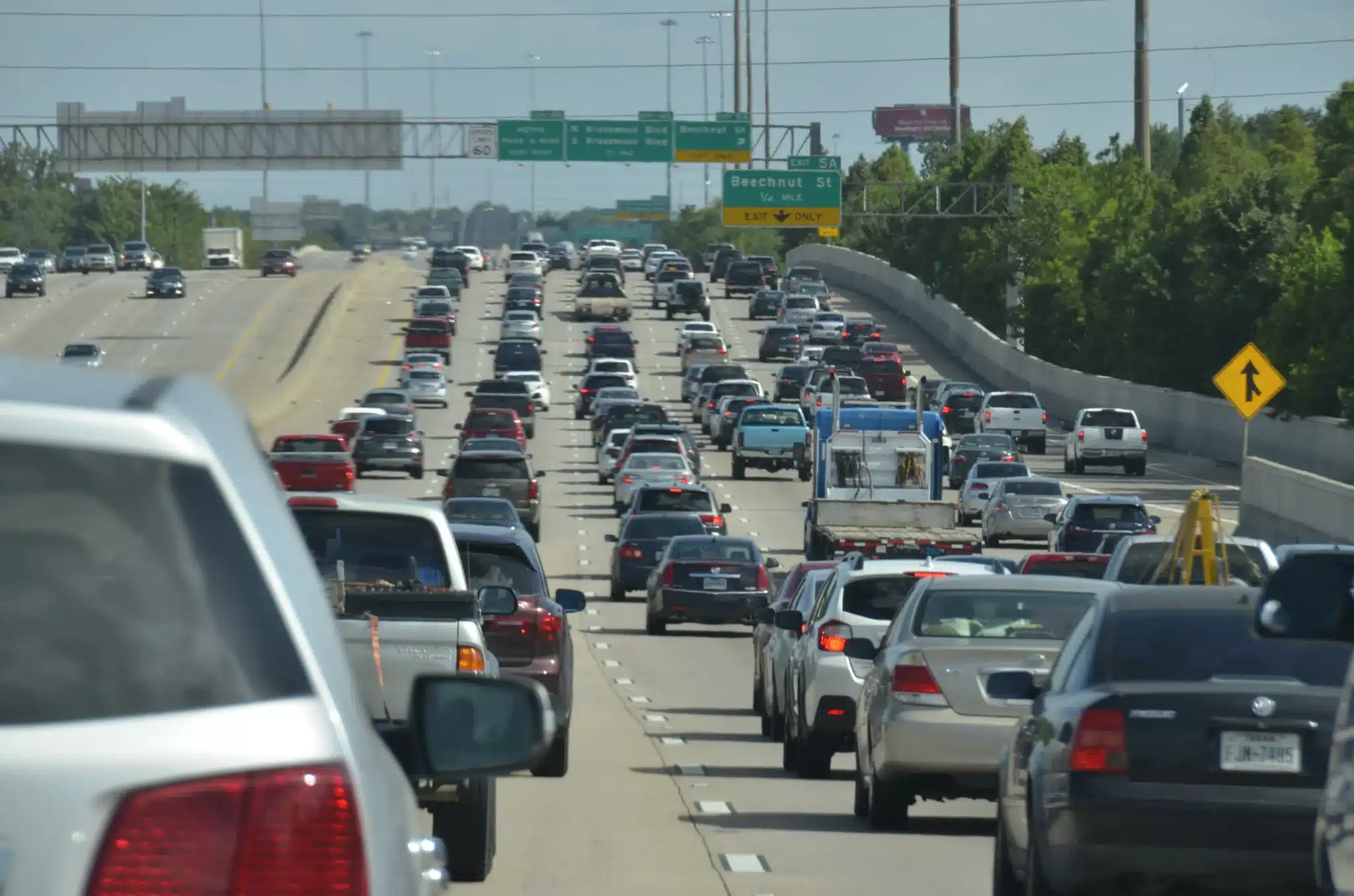
According to the Dallas Police Department, as reported by Fox 4, multiple vehicles crashed on the northbound lanes of North Central Expressway near Royal Lane at 8:14 a.m. on Sunday, July 12, 2026. One person died from their injuries, Dallas Fire-Rescue treated several people at the scene, and multiple people were taken to a local hospital. The cause is still under investigation.
We are writing this because our Dallas office sits on this same stretch of Central Expressway, north of the Royal Lane interchange, so we drive this road the way our clients do, every day. And where do most multi-vehicle crashes occur? On congested expressway corridors like this one.
29%
of U.S. crashes are rear-end collisions (NHTSA data, 2021)
4,161
people killed on Texas roads in 2024 (TxDOT)
1 in 5
traffic incidents are secondary incidents set off by an earlier crash (FHWA estimate)
2 yrs
Texas deadline to file most injury claims after a crash
What a multi-vehicle accident is, and why this stretch of Central Expressway breeds them
Definition
What a multi-vehicle accident is, and what a multiple car crash is called
A single wreck involving three or more vehicles. Usually a chain of separate impacts, often called a chain reaction accident or a pileup, set off when one vehicle cannot stop in time behind slowed traffic.
A multi-vehicle accident is not one collision but several, linked together. One vehicle strikes another, that vehicle is pushed into a third, and it is that transferred force, set off by a driver following too close, that propagates a chain from one bumper to the next. The word for a multiple car crash is a pileup; police and insurers also call it a chain reaction accident or a multi-vehicle collision. Of the four types of accidents insurers classify, rear-end, sideswipe, angle, and head-on, a chain crash strings several together in seconds. And because one wreck can injure people in several cars at once, more claimants end up sharing the same limited insurance policies, which is where the money fight described below begins.
How a chain reaction crash propagates Impact sequence
Car 3 · Starts it
Following too close
Broke the rule: leave enough room to stop
➔
Car 2 · Middle
Hit and pushed forward
Victim and defendant at once; both bumpers tell the story
➔
Car 1 · Front
Stopped in traffic
Never saw it coming; Luc’s position
Force transfers forward; fault points backward
People ask what 90 percent of car accidents are caused by: human error, and in a chain crash that error is plural, which is why Texas assigns fault in percentages instead of naming one culprit. The leading cause of multicar accidents is following too close into slowed traffic, which breaks a simple Texas rule: leave enough room to stop. The wrecks cluster where traffic stacks up: our analysis of TxDOT crash records ranks the Central Expressway at University Drive in McKinney the second most dangerous intersection in Texas, and roughly one in five incidents is a secondary crash bred by the one before it (FHWA estimate). The extreme: the 2021 Fort Worth pileup on I-35W, 133 vehicles and six people killed (NTSB), in the state that counted 4,161 road deaths in 2024, regularly the nation’s most (TxDOT).
What a common cause of multi-vehicle crashes looks like: how we helped Luc after a three-car chain crash
Luc told his story on camera. A three-car accident, the same pattern as Sunday’s news: he was the car out in front, sitting in traffic, when the back of his car was suddenly caved in by a car that had itself been hit. Whiplash, back trauma, a knee into the steering wheel, weeks unable to work. He called us right after the crash; we handled the insurers, checked in with him every week through his therapy, and his settlement, in his own words, was way more than he was expecting. Watch the rest of Luc’s story.
Who is responsible for a chain reaction accident in Texas: the fault points backward but is never automatic
Liability
Who is at fault in a multi-car collision
Usually the driver who could not stop in time. In a chain reaction accident, fault points backward through the chain, but Texas decides each case on its own facts and has no automatic rear-end rule.
Who is at fault in a multi-car collision: usually the driver who could not stop in time. Because Texas requires every driver to leave enough room to stop, the driver in back usually starts with the biggest share of the blame, but there is no automatic rear-end rule, and the middle car can be victim and defendant at once. Am I at fault if I hit a car in front of me because he slammed on his brakes? Maybe partly, maybe not at all; your speed, your distance, and the drivers around you decide. In court, fault comes down to four plain questions: did a driver owe you care, did they break that duty, did the break cause your injury, and what did it cost you. The cost is your medical bills, lost wages, and pain and suffering, each cut by your own share of the blame.
The 50 percent rule Texas law
50%the bar
Your fault at 50 percent or less: you recover, reduced by your share
Your fault above 50 percent: you recover nothing
Every point of blame an adjuster shifts onto you moves you toward zero
So how do insurers determine who was at fault, and do police officers determine who is at fault in a car accident? Police document and cite; insurers and courts assign fault. They rebuild the crash from the police report, photos, damage patterns, camera footage, each car’s black box, and witnesses. In a chain, the order of impacts is written on the middle car’s two bumpers: the depth of the damage and the black box timestamps tell whether it was one continuous shove or two separate hits, and that sequence pins each driver’s share. What you say to the officer ends up in that same file, so it matters too.
How insurance works in a multi-car accident: every policy in the chain pays its share
Insurance
How insurance works with multiple cars in one crash
Each at-fault driver’s insurer pays that driver’s share. Your own uninsured and underinsured motorist coverage fills the gap when those payouts fall short or a driver is never found.
How insurance works with multiple cars in one wreck is simple in principle: a chain crash stacks several insurance policies on top of one another, each at-fault driver’s insurer pays that driver’s share, and each share caps how much of your medical bills, lost wages, and pain and suffering that insurer will ever pay. That sounds reassuring until you see the limits. The Texas minimum coverage amounts in the chart below run out fast when several people are hurt, as they were in Sunday’s crash. One wrinkle in those percentages: a driver found more than half responsible can be made to pay the whole judgment, not just their share, which matters when the other drivers’ policies are small. This is where your own policy matters too. Uninsured and underinsured motorist coverage, UM and UIM, sits in every Texas policy unless you rejected it in writing, and it fills the gap when the at-fault drivers cannot cover what they caused. It also protects you when you are hit by an uninsured or hit-and-run driver. And yes, police do actually investigate hit and runs, and camera footage often helps, but that uninsured motorist coverage is your safety net when the driver is never found.
Who pays after a multi-car accident In the order we check
1
Each at-fault driver’s liability policy
Pays that driver’s share; the Texas minimum is $30,000 per person / $60,000 per crash
2
Your PIP coverage
At least $2,500; pays your medical bills and lost wages first, regardless of fault
3
Your UM and UIM coverage
Fills the share of any uninsured, underinsured, or never-identified driver in the chain
4
Responsible third parties
A commercial carrier, a government road defect, or a vehicle manufacturer when a component failed
Several people hurt in one chain drain shared limits fast
Two notes on that stack. Like your UM and UIM coverage, PIP stays in every Texas policy unless rejected in writing. And a vehicle defect matters because it can explain an inability to stop that was never the driver’s error, adding the manufacturer as a separate defendant. Settling a crash like this means negotiating with several insurers at once, and here is the dynamic that stalls it: each insurer’s cheapest move is to wait for the others to commit to a percentage first, so the claim freezes not because the facts are unclear but because every carrier benefits from going last. Pushing against that stall is the work. Dealing with these overlapping insurers is hard, and you do not have to do it alone.
One more thing about that settlement check: it is not all yours until the liens on it are cleared.
A hospital that treated you within 72 hours of the crash can put a claim on your settlement under Texas’ hospital lien law, capped at its bill or half your recovery, whichever is less, and your health plan may ask to be paid back out of the same money. Negotiating those numbers down is part of our work. At disbursement, our clients see the line for what their medical bills totaled and what we got them reduced to, the way LaToya did at hers.
How insurers determine who was at fault starts with the scene: five steps to take after a multi-car crash
What you do in the first minutes after a multi-car crash shapes how fault gets decided later. Here is what we tell people to do.
- Move to safety and turn on your hazards so the chain does not grow behind you.
- Call 911 so a police crash report exists.
- Video the whole chain with one continuous pan of every vehicle and plate before anyone moves or leaves.
- Get the name and insurance information of every driver and every witness.
- See a doctor the same day because adrenaline hides injuries and that same-day record is what your claim relies on.
Treat your words at the scene as a sixth step: what you do not say matters as much as what you do, as the next section shows.
These steps mirror our full guide on what to do after a car accident in Texas, written for exactly this situation. They matter early because the evidence and the law run on the same clock: camera footage overwrites itself within days, and Texas’ two-year filing deadline arrives faster than treatment ends, which is why we start this work in the first week, not the last one.
What not to tell your insurance company after a multi-vehicle crash
Insurance companies tell you not to admit fault because your words at the scene can be used to reduce or deny your claim. A recorded admission is the raw material of blame shifting: it is what an adjuster quotes back when arguing the crash was partly yours, and every percentage point shifted onto you cuts your recovery under the 50 percent rule in the gauge above, where one point past half means the insurer owes nothing at all. Do notify your own insurer promptly, that is a policy duty, but keep that first report to the plain facts of time, place, and vehicles, because how you notify your insurer runs into the same trap as what you say at the scene. Here is where people get hurt, and what to do instead.
Words that cost people their claims
Do not
Admit fault or say you are sorry at the scene.
Instead
Stick to exchanging information and checking on the people around you.
Do not
Guess at speeds, distances, or the order of impacts to any adjuster. A wrong estimate corrupts the fault investigation and becomes a data point against you.
Instead
Say only what you know for certain, and tell them the rest is under investigation.
Do not
Give a recorded statement before you talk to a lawyer.
Instead
Wait. You are not required to be recorded, and an adjuster can use that recording later.
Do not
Wait on medical care to see whether you feel better.
Instead
Get checked the same day, so your injuries are documented from the start.
Who is at fault in a multi-car collision when the insurer blames the survivor: how we fought for Lauren
Lauren also told her story on camera. Stopped in traffic, she saw a truck in her mirror and never heard brakes: the hit pushed her into the car ahead and threw her into oncoming traffic, where a third vehicle struck her. She was cut out of the car with a shattered ankle, broken leg and elbow, and back fractures, and the insurer still made her feel like the crash was her fault. Our team fought that blame with the evidence, the vehicle positions, the damage, her medical file, and that is exactly the fight we take over for you. Watch the rest of Lauren’s story.
When a multi-vehicle accident turns fatal in Texas: who the law allows to recover
One person died in Sunday’s crash. Our condolences are with that family, and nothing on this page is meant to speak for them or their loss. For families who face this, Texas law provides a path. Texas reserves a wrongful death claim for the closest family: the surviving spouse, children, and parents. If none of them files within three months of the death, the estate’s executor brings the claim unless the family says otherwise. A separate survival claim carries forward the injured person’s own claim for the estate. Both run on the same two-year deadline, and for a death that clock starts on the date of death. Coverage matters here too: when the at-fault drivers’ limits are exhausted, the family’s own uninsured and underinsured motorist coverage can help fund the recovery. There is no rush to decide anything today; when a family is ready, we are here to explain the options gently.
How we determine who was at fault across every driver in a chain crash
We map fault across every driver in the chain, because missing one can quietly cost you part of your recovery, and we move fast on the evidence before camera footage overwrites itself. That work is what decides whether it is worth getting a lawyer, and it costs you nothing up front: we are paid only if we recover for you.
One honest word about time: chain-crash claims settle slower, because no insurer pays until the percentage fight ends. Our answer is the weekly check-in Luc described, so you are never left in silence.
How a chain-crash claim actually moves The road from crash to check
Day 1
Crash, 911, same-day doctor
Week 1
Evidence hold: footage, EDR, witnesses
Months
Treatment while the percentage fight runs
Then
Settlement, liens negotiated down
Last
Disbursement: your check, explained line by line
Two years to file, but the evidence work starts in week one
J. Alexander Law Firm handles motor vehicle and serious injury cases across Texas from six offices, with headquarters on North Central Expressway in Dallas. Founding attorney Josh Alexander has been named a Super Lawyers Rising Star every year from 2022 through 2026.
If Sunday’s crash reached your family, talk to our Dallas team
You do not pay us unless we win
Talk to our Dallas team about the Central Expressway crash
We know how these chain crashes unfold. Call J. Alexander Law Firm at 469-807-7480 for a free case review.