


San Antonio Rotator Cuff Tear Settlement
$30,000 Rotator Cuff Tear Settlement After a Car Accident on FM 78 en San Antonio
An unlicensed teenager driving a Jeep Wrangler rear ended our client’s Toyota RAV4 on FM 78 as she sat stopped behind a stalled pickup, and the impact pushed her into it.
An MRI three months later found a tear in her right shoulder’s rotator cuff. We settled her claim for $30,000, the full policy limit, with no lawsuit filed.
En esta página
The Case in Brief
| Detalles del caso | Información |
|---|---|
| Resultado | $30,000, the limit of the liability coverage on the Jeep, paid without a lawsuit |
| Fecha y hora | |
| Ubicación | 8100 block of FM 78, northbound, San Antonio, Bexar County |
| Vehículos | 2010 Jeep Wrangler; 2016 Toyota RAV4, driven by our client; 2011 Ford F-250 recogida |
| Personas involucradas | Three drivers, each one alone in a vehicle |
| Informe de accidente | Condado de Bexar CR-3 written the same day, with a no driver’s license charge for the Jeep’s driver |
| Lesiones | A full thickness tear of the right rotator cuff, plus neck and lower back disc protrusions, all seen on MRI |
| Atención médica | No emergency room; chiropractic care from 12 days after the crash, MRIs that November, pain management in February 2024 |
A Stalled Truck, a Stopped SUV and a Jeep That Could Not Stop
It was 5:27 on a clear, dry Thursday evening in August, and traffic was moving north on FM 78, a two way road with no median and a posted limit of 45 mph. A white Ford F-250 came to a halt in the middle of the road; its driver later told the officer that a diesel line had come off. Our client was behind the truck in her red RAV4. She saw it stop and braked in time. The blue Jeep Wrangler behind her did not, and the hit sent her SUV into the back of the pickup.
The narrative box on page 2 records each driver’s account, quoted here exactly:
Driver of unit 3 stated that his diesel line came off causing his vehicle to stall in the middle of the roadway. Unit 2 stated that she observed unit 3 come to stop and was able to stop before crashing into unit 3. Unit 2 stated that she was rear ended by unit 1 which caused her to impact unit 3 causing damage to all three vehicles. Driver of unit 1 stated that he was not able to stop in time to prevent the crash.
Unit 1 is the Jeep, unit 2 is our client’s RAV4 and unit 3 is the pickup. Two lines stand out. Our client had already stopped short of the stalled truck on her own, and the Jeep’s driver told the officer he could not stop in time.
- Jeep Wrangler. Northbound behind the RAV4; its driver could not stop and struck the SUV’s rear.
- Toyota RAV4, our client. Stopped safely behind the stalled pickup, then shoved into it by the Jeep.
- Ford F-250. Stalled in the northbound lane after a diesel line came loose.
The officer also checked Yes in the report’s Secondary Crash box. TxDOT’s CR-3 instructions for officers say the box marks a crash that “occurs as a result of another traffic incident or crash,” and they ask the officer to explain the cause in the narrative. On FM 78, the earlier incident was the breakdown.
The box is a recent addition. CRIS, TxDOT’s crash records database, carries it only for crashes after March 31, 2023, when the April 2023 version of the form used for this report took effect. In 2025, the latest full year we checked, San Antonio had 393 reportable crashes marked secondary, about 1% of the city’s 37,304. In 41 of them a vehicle going straight ran into a stopped one, the pattern on FM 78. For April through December 2023, the city’s count was 256. Each crash counts once in these figures. When one wreck sets off another, more than one driver can share the blame, and our page on crashes with three or more vehicles explains how Texas divides it.
A Driver With No License
The Jeep’s driver was 17. His license block on the report shows type 5, the CR-3 code for unlicensed, and the same 5 fills the class, endorsement and restriction boxes beside it. Page 2 lists one charge against him: NO DL, short for no driver’s license.
Texas law leaves no room on that point. Transportation Code § 521.021 bars anyone the chapter does not exempt from driving on a Texas highway “unless the person holds a driver’s license issued under this chapter.”
Families call us about crashes like this one. A parent who phoned in August 2026 about a daughter’s accident described the other driver as “a 17 year old kid that didn’t even have a driver’s license.”
San Antonio crash records show how often the license box reads unlicensed. In 2025, officers coded at least one driver unlicensed in 2,542 of the city’s 37,304 reportable crashes, about 7%, and in 626 of its 10,058 rear end crashes, about 6%. In 2023 the shares were higher, about 9% of all crashes and 8% of rear end crashes. Rear end here means the two CRIS collision types for same direction impacts: both vehicles going straight, or one going straight and the other stopped. The figures show only what officers entered in the license type box. They do not show which driver caused any crash.
The Bexar County Report, Box by Box
Most of the four page form is numbered codes. These entries shaped this claim; the CR-3 decoder on our site covers the rest of the boxes.
| Campo | What the report shows, then what it means |
|---|---|
| Road and lane | FM78 RD, roadway part 1, direction NFM 78, main travel lane, northbound |
| Road type and limit | Roadway type 1, speed limit 45Two way, undivided; posted at 45 mph |
| Punto de referencia | 0.5 MI S of 6700 Beech Trail DrAway from any intersection, half a mile south of the 6700 block of Beech Trail Drive |
| Secondary crash | SíSet off by an earlier incident, which the narrative describes |
| Factors, Jeep | 19 and 22Distraction in vehicle; failed to control speed |
| Factors, RAV4 | NingunoNo contributing factor listed for our client |
| Defect, pickup | 98Other vehicle defect, explained in the narrative: the diesel line |
| License, Jeep driver | DL/ID type 5Unlicensed |
| Condiciones | Weather 1, light 1, surface 1Clear sky, daylight, dry pavement |
| Airbags | 1 for all three driversNot deployed |
| Gravedad de la lesión | N for all three driversNot injured, in the officer’s assessment at the scene |
| Towing | N/A for every vehicleNothing towed |
| Response | Notified 17:30, arrived 17:37, scene cleared 18:15Officer on scene 10 minutes after the crash; scene clear at 6:15 p.m. |
The officer picked both Jeep factors: 19, distraction in vehicle, and 22, failed to control speed. The report does not say what the distraction was. Our client’s RAV4 carries no factor at all, and the pickup’s only entry is the defect code, 98, which points back to the diesel line in the narrative.
Open the redacted Bexar County crash report (PDF)Small Numbers on the Form, Real Dents on the Cars
Every vehicle on a CR-3 gets a three part damage rating. A clock number gives the direction of the impact, two letters name the damaged area, and a final digit from 0 to 7 grades how bad it is. Nothing in this crash rated higher than 3.
| Vehículo | Rating, in plain words |
|---|---|
| Jeep Wrangler, Unit 1 | 12-FC-1Front center, hit from the 12 o’clock direction, severity 1 |
| Toyota RAV4 (our client), Unit 2 | 6-BC-3 y 12-FC-1Back center from 6 o’clock at severity 3, the highest rating in the crash; front center from 12 o’clock at severity 1 |
| Ford F-250, Unit 3 | 6-BC-1Back center, hit from the 6 o’clock direction, severity 1 |
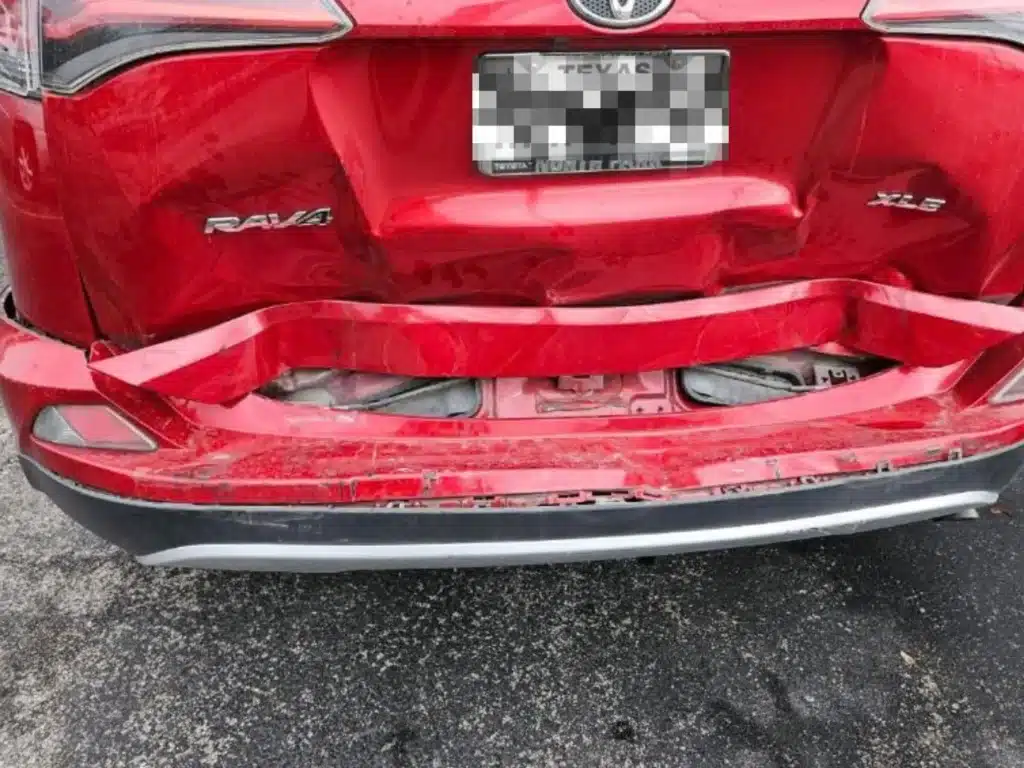
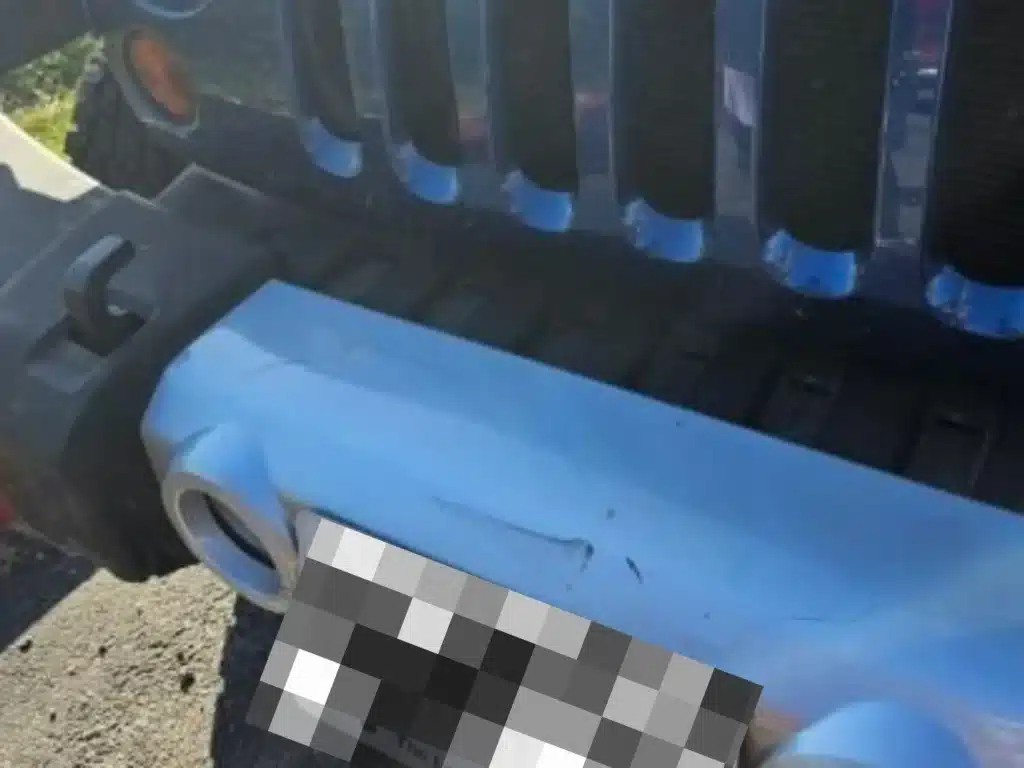
A 3 sounds minor. The opening photo of the RAV4 shows what it meant in metal: the rear bumper cover folded in on itself and the liftgate dented below the license plate. The Jeep’s front bumper came away with a crease and scuff marks. No airbag deployed in any of the three vehicles, and none of them left on a tow truck.
A damage rating grades sheet metal, not people. The N beside each driver’s name is the officer’s judgment at the roadside, made before any doctor had examined anyone. Our client’s injuries were documented later: at a chiropractic exam 12 days after the crash, and on MRIs that November.
What She Went Through Después de FM 78
No ambulance took her from FM 78, and she did not go to an emergency room. When she reached a chiropractor on August 22, 12 days after the crash, she reported that she had been relying on over the counter medicine.
Her complaints at that first exam:
- Cuello
- Parte baja de la espalda
- Right shoulder
- Cabeza
The chiropractor found swelling, muscle spasm, tender knots called trigger points and limited motion in each of those areas, along with grinding in the right shoulder as it moved. Orthopedic tests came back positive: Spurling’s and Soto Hall for the neck, and the straight leg raise for the lower back. Her neurological exam was normal and she walked normally. The chiropractor diagnosed sprains in her neck, lower back and right shoulder, plus a lumbar and pelvic sprain. Imaging was ordered at that visit, along with a referral to pain management.
Her care through the fall and winter paired guided exercise with electrical stimulation and heat or ice. At re exams on November 11 and December 4, the chiropractor described her as “slightly better.”
The MRIs
MRIs on November 14 and 20 found the shoulder injury. The supraspinatus, the rotator cuff tendon that runs across the top of the shoulder, had a small tear near the spot where it attaches, and the tear went through the full thickness of the tendon. In her neck, a disc protrusion touched the thecal sac, the membrane that surrounds the spinal cord, while the cord itself looked normal. In her lower back, one disc protrusion touched the thecal sac and another touched the nerve roots on both sides.
On a July 2026 call, a Richardson driver hit from behind while waiting at a red light put it this way: “I have a rotator cuff injury and I don’t know if that is considered to be serious.” Doctors describe a tendon tear by its size and its depth. A partial thickness tear leaves some of the tendon intact; a full thickness tear, like the one on our client’s MRI, goes all the way through. On December 4, her chiropractor added rotator cuff tear and disc displacement to her diagnoses and referred her to an orthopedic specialist.
Pain management
On February 12, 2024, about six months after the crash, she went to a pain management physician. She described neck pain running down into her arms, low back pain running down into her legs, and pain in her right shoulder. The physician diagnosed irritated nerve roots at both the neck and the lower back (cervical radiculopathy and lumbar radiculitis), low back pain and the right rotator cuff tear. The plan: gabapentin for nerve pain, the muscle relaxant cyclobenzaprine, the anti inflammatory meloxicam and acetaminophen with codeine, plus a recommendation for epidural steroid injections, both cervical and lumbar.
On February 24, 2024, her chiropractor recorded her as “significantly better” and released her at maximum therapeutic benefit, the point at which more of the same care was not expected to bring further gains.
From August 2023 to February 2024
- August 10, 2023: At 5:27 p.m. the Jeep strikes the RAV4 on FM 78. The officer arrives at 5:37, and the scene is clear by 6:15.
- August 22, 2023: First chiropractic exam; sprain diagnoses, imaging ordered, pain management referral.
- Fall 2023: Ongoing chiropractic therapy.
- November 11, 2023: Re exam; noted as slightly better.
- November 14 and 20, 2023: MRIs of her shoulder, neck and lower back; the shoulder study shows the full thickness rotator cuff tear.
- December 4, 2023: The tear and the disc findings become formal diagnoses; orthopedic referral.
- February 12, 2024: Pain management consultation: nerve root diagnoses, new prescriptions, injections recommended.
- February 24, 2024: Released from chiropractic care, significantly better.
- Antes de iniciar cualquier demanda: The claim settles for $30,000, the policy limit.
No License, but the Jeep Had Coverage
Whether a driver holds a license and whether a vehicle carries insurance are separate questions. The Jeep was owned by someone other than the teenager driving it, and the report marks Yes in its proof of financial responsibility box; the insurer’s name is blacked out in the public copy. Under Transportation Code § 601.076, an owner’s liability policy in Texas has to cover the named insured and also a person using the covered vehicle with the named insured’s permission, whether that permission is stated outright or implied. Our page on drivers who flee, lie or carry no insurance goes deeper into borrowed cars.
In July 2026 a caller who had been driving their father’s car when they caused an accident said the insurer did not want to pay the other drivers. A staff member explained the usual rule: “As long as you weren’t an excluded driver, they should still accept the claim for the other party.” An excluded driver is someone the policy itself names as not covered.
Every liability policy caps what it pays for one injured person. Section 601.072 sets the Texas floor at $30,000 for one person’s injuries and $60,000 per collision when two or more people are hurt, and our guide to Texas minimum coverage walks through the full 30/60/25 rule. The Jeep’s policy carried exactly that minimum, and our client’s claim used all of it. When one policy runs out before the losses do, our page on an at fault driver with too little insurance explains where else money can come from.
$30,000 Policy Limit, No Lawsuit Filed
$30,000
Full policy limit, settled before suit
We resolved the claim without filing suit. The insurer covering the Jeep paid $30,000, every dollar its policy allowed for our client’s injuries.
Records behind the claim
The claim stood on documents: the Bexar County crash report, photos of the RAV4 and the Jeep, her chiropractic records from the first exam through her release, the MRI reports for her neck, lower back and shoulder, and the pain management consultation. Because no suit was filed, she never sat for a deposition or set foot in a courtroom.
Our client’s name and identifying details stay private. The figure above is the gross amount; the firm’s fee, the case’s expenses and any lien holders are paid from that sum. Facts, medical records and available coverage are different in every claim, so this result is not a forecast for any other case.
Lessons From the FM 78 Accidente
- A driver with no license can still be behind the wheel of an insured vehicle, so find out whose car it was.
- A Yes in the Secondary Crash box means an earlier incident set things off, and the narrative should name it.
- Severity numbers on a CR-3 describe vehicle damage, not what happened to the people inside.
- This claim reached the policy limit with no emergency room visit and a first appointment 12 days after the crash.
- The rotator cuff tear did not appear in her records until an MRI three months after the collision.
- Photos of both vehicles matter: the Jeep’s light crease and the RAV4’s folded bumper cover tell one story together.
Abogado Reseña

Revisado por: Josh Alexander, fundador y abogado gerente
Published and last reviewed:
Más accidentes en Texas Resultados de los casos
- $850,000Accidente en un semáforo en rojo en PasadenaResuelto mediante acuerdo judicial
- $600,000Accidente de cinco vehículos en el condado de RockwallResuelto mediante acuerdo judicial
- $600,000Accidente de un camión de 18 ruedas en MesquiteAcuerdo por accidente de camión
- $325,000Accidente de un camión comercial en el condado de HoodResuelto mediante acuerdo judicial
- $175,000Accidente de un vehículo de construcción en Round RockResuelto antes de la demanda
- $125,000Choque por detrás a un camión blindado en BrownsvilleResuelto antes de la demanda
- $105,000Cambio de carril inseguro en una carretera de TexasResuelto antes de la demanda
- $105,000Accidente de tres vehículos en DallasLa póliza limita la indemnización
- $100,000Choque por detrás, sin denuncia policialResuelto antes de la demanda
- $95,000Camión de la empresa Midland girando a la izquierdaResuelto antes de la demanda
- $89,000San Antonio 3 car chain reactionResuelto antes de la demanda
- $82,500Camión de una empresa de Plano girando a la izquierdaResuelto mediante acuerdo judicial
- $50,000Accidente en la parte trasera de AllenAcuerdo sobre los límites de la póliza
- $30,000Recuperación tras un atropello con fuga en HoustonLímites de la póliza de UM
13Contacto
Rear Ended by
Rear Ended by
an Unlicensed Driver?
The vehicle they were driving may still carry insurance. After a San Antonio crash, we pull the CR-3, find out whose policy covers that vehicle and put your medical records behind your claim.
No cobramos honorarios a menos que ganemos el caso · Se habla español · Orgullosos de prestar servicio en todo Texas