


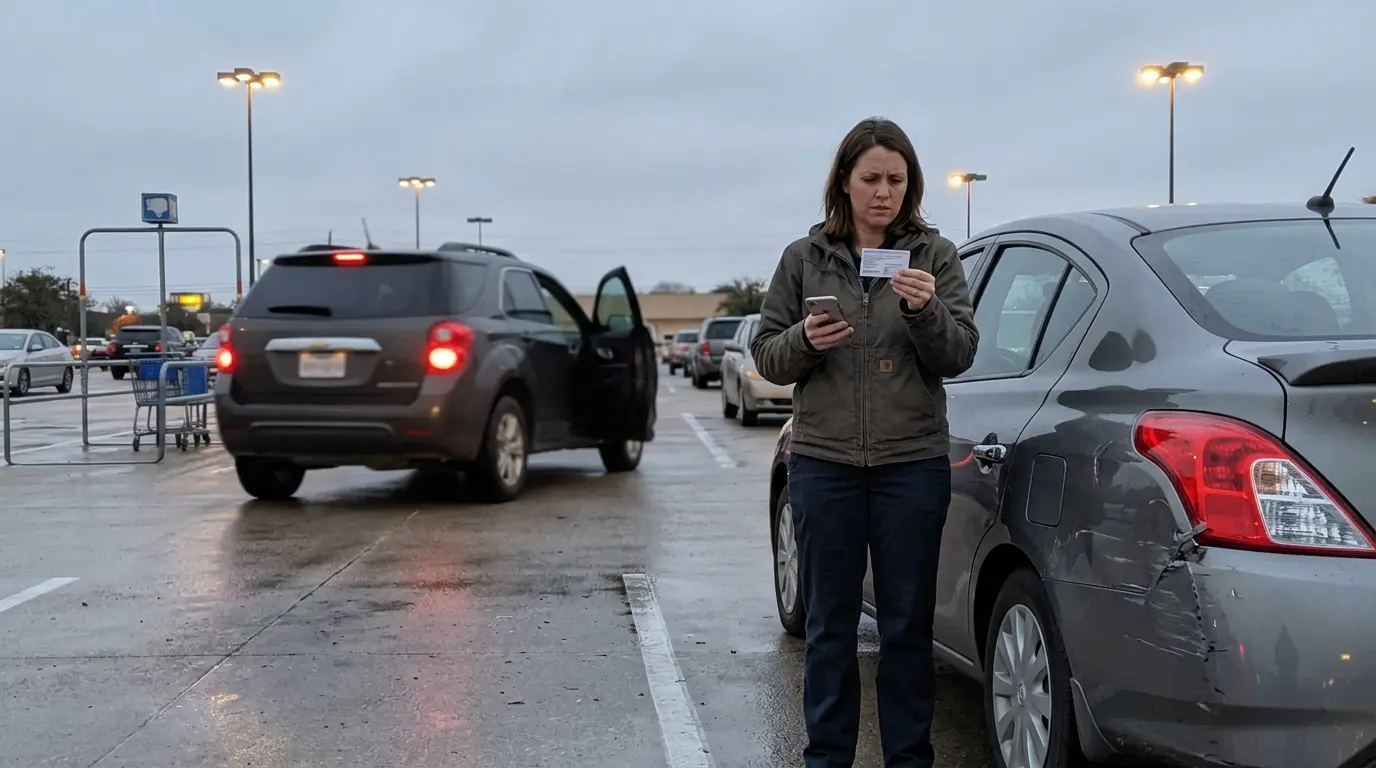
Most collisions end with both drivers exchanging accurate information. The crashes discussed here do not. The other motorist may leave, hand you details that do not match the vehicle or driver, or have no usable insurance at all.
Those circumstances complicate a claim, but they do not necessarily end it. Texas law imposes duties on drivers after a crash, and Texas auto policies commonly contain protections for losses caused by uninsured, underinsured, or unidentified motorists. The outcome depends on the facts, the available evidence, the relevant policy language, and how quickly the claim is reported.

This article was reviewed by Josh Alexander, Attorney. It addresses the situations most frequently raised by callers after a Texas crash: a driver who leaves, inaccurate or mismatched insurance information, and collisions involving an uninsured driver. It also explains the Texas coverages that may be available when third party insurance cannot pay. This is general information, not legal advice. Reading it does not create an attorney client relationship. Every collision presents its own evidence, coverage issues, and deadlines.
The Driver Is Gone or Uninsured. Is the Claim Over?
Usually, no. Texas auto policies can provide a fallback when the at fault driver disappears, lacks insurance, cannot be identified, or has too little coverage. Uninsured/underinsured motorist coverage and personal injury protection are generally included in Texas auto policies unless a named insured rejected them in writing. Medical payments coverage may provide an additional layer if it was purchased. The missing driver is not ordinarily the reason a claim fails. More often, the problem is a missing police report, lost footage, unverified policy information, delayed notice to an insurer, or evidence that was never collected while it was still available.
Your First Moves by Scenario
| What happened | Immediate action | Evidence to secure | Coverage issue to investigate |
|---|---|---|---|
| The driver left the scene | Contact police, report the hit and run, and identify any nearby video source | Plate number, vehicle description, witnesses, cameras, damage photographs | UM coverage and unknown driver requirements if the motorist is never identified |
| The insurance card does not match the driver | Photograph the card, license, plate, and vehicle before anyone leaves | Permission to use the vehicle, owner information, named driver exclusions, policy status | The registered owner’s policy may still insure the driver |
| No license, no paperwork, and a cash offer | Do not resolve the crash privately; request a police response | Exact statements, documents, vehicle photos, plate number, report information | Treat third party coverage as uncertain and check your UM/UIM and PIP |
| The other driver becomes threatening | Get to a safe location, avoid confrontation, and report the conduct | Plate, vehicle description, witnesses, nearby cameras, photos taken safely | The claim can be documented later; do not create a second incident |
| The insurance card is in Spanish or the car has foreign plates | Photograph both sides of the document and write down the insurer and policy number | Policy information, plate jurisdiction, driver details, vehicle information | Determine whether coverage exists and whether it is collectible |
| The driver fled, but you obtained the plate | Give the plate number to police promptly and preserve the source of that information | Plate, direction of travel, video, witnesses, registered owner information | Identify the driver and owner coverage; assess UM if third party coverage is unavailable |
A Quick Texas Coverage Snapshot
- Insurance Research Council, 2022; Texas Department of Insurance, 2025 An estimated 13.8 percent of Texas drivers are uninsured, and TDI reports more than 2.4 million uninsured vehicles statewide.
- Texas Transportation Code §§ 550.021 to 550.026 Drivers have duties to stop, exchange information, render aid where required, and report qualifying crashes.
- Texas Transportation Code § 601.076 An owner’s policy may cover a person operating the insured vehicle with permission.
- Texas Insurance Code §§ 1952.101, 1952.152, and 1952.153 UM/UIM and PIP are generally part of a Texas policy unless rejected in writing.
Coverage, exclusions, claim procedures, and deadlines depend on the facts of the crash and the terms of the relevant policy.
Six Situations We Hear About
These scenarios reflect the calls Texas crash victims make every week. Each one calls for a different response. Several ultimately require the same next step: finding out what coverage is listed on your own declarations page.
1. “You Look Fine,” Then They Leave
Leaving the scene is not excused because another person appears unhurt. Texas Transportation Code §§ 550.021 through 550.023 require a driver involved in a crash to stop, remain at the scene, provide their name, address, registration, and insurance information, show a driver’s license when requested, and provide reasonable assistance when someone is injured.
The severity of the offense depends on the crash. Leaving a property damage collision can be a misdemeanor. Leaving a crash involving injury can carry up to five years of confinement. Serious bodily injury can elevate the offense to a third degree felony, and a death can result in a second degree felony charge.
Do not chase the vehicle. If you can safely capture a plate number, vehicle description, direction of travel, or photograph, do so from where you are. Call 911 or local police, report that the driver left, and document the location, the damage, roadway conditions, and nearby camera sites.
A person may not feel injured in the first minutes after a wreck. Adrenaline can temporarily obscure pain, dizziness, stiffness, headaches, or other symptoms. Seek medical care if you are hurt or begin experiencing symptoms after the collision.
Once the driver leaves, the matter becomes a hit and run claim. Our Texas hit and run accident guide explains how these investigations can develop and what may happen if the driver is identified.
2. The Insurance Card Is Not in the Driver’s Name
A card in someone else’s name is not automatic proof that the driver is uninsured. The person behind the wheel may be using a parent’s car, a roommate’s vehicle, a spouse’s vehicle, or another borrowed car with permission.
Texas Transportation Code § 601.076 provides that an owner’s liability policy covers a person who uses the insured vehicle with the owner’s permission. Insurers generally address that obligation through an omnibus clause in the policy. Put simply, insurance commonly follows the vehicle, but only within the policy’s terms, exclusions, and permission rules.
A driver who is not listed by name is not necessarily uninsured. Photograph the insurance card, driver’s license, license plate, and vehicle. Let the carriers determine whether the driver was a permitted user and whether coverage applies.
The main exceptions include a stolen vehicle, a person specifically excluded by name, or use that went beyond the permission given by the owner. When the owner’s policy does not apply, the driver may be uninsured for purposes of your claim, and your own policy should be reviewed for UM/UIM or other available coverage.
3. No License, No Documents, and an Offer of Cash
Do not accept a roadside cash payment as a replacement for a report and proper information exchange. The payment itself is not necessarily illegal, but it often signals that the driver has no license, no insurance, or both, and wants the crash to disappear before anyone verifies the facts.
Texas Transportation Code § 550.023 still requires the driver to provide their name, address, registration, and insurance information. A private agreement does not eliminate those obligations.
A small amount of cash rarely covers the actual cost of a collision. Repairs may reveal hidden structural damage. Pain or symptoms can emerge later. Medical bills, missed work, rental expenses, and vehicle value loss may be far greater than anything offered in the parking lot or on the roadside.
Contact police while the driver is still present if you can do so safely. Photograph both vehicles, the damage, documents, license plates, and the scene. Record the exact words used about the payment, insurance, license status, or how the crash occurred.
People sometimes call from the scene while the other driver claims they are “pulling up” insurance information. We tell them not to rely on that delay. The safest way to determine whether coverage exists is to involve police and create a record while the person and vehicle are still there.
An insurance card is only a document; it does not establish that coverage is active or that the driver is insured under the policy. An officer may be able to document the discrepancy or verify available information at the roadside. The report and your photographs give the insurers a concrete basis for the coverage investigation. Once police are on the way, the caller can focus on the immediate situation instead of trying to negotiate a claim at the scene.
4. The Driver Is Aggressive and You Cannot Exchange Information
Personal safety takes priority over the normal information exchange. Do not argue, block the other vehicle, chase the driver, or step into an escalating confrontation.
If you feel unsafe, remain in your vehicle if possible. From a safe distance, note the plate number, vehicle type, color, damage, and any distinctive features. Call police and describe the behavior factually when they arrive or when you make the report.
A claim can be reconstructed later through photos, witness information, nearby surveillance cameras, vehicle damage, and a police report. There is no reason to risk another collision or a physical encounter simply to obtain information that may be available from other sources.
If the driver leaves before officers arrive, preserve the details you have and follow the steps for a hit and run report.
5. The Insurance Card Is in Spanish
A Spanish language insurance card can be valid proof of coverage. Texas Department of Insurance rules permit insurers to issue the standard Texas liability card in both English and Spanish. Spanish text on a card from a U.S. insurer is not, by itself, a reason to doubt the policy.
A Mexican insurance policy associated with a Mexican plated vehicle is a different type of document, but it may still reflect real coverage. Whether that policy can be collected depends on the insurer, the policy terms, the location of the collision, and the surrounding facts. If the foreign policy is unavailable or cannot be collected, your own UM coverage may need to be evaluated.
Photograph the front and back of the card. Write down the insurer’s name, policy number, plate number, and driver information. Preserve the information first; let the relevant insurer determine whether the policy applies.
We handle injury claims in English and Spanish every day. Se habla español is part of how our office operates, not an afterthought. Intake coordinator Javier Guel and the intake team take calls in either language 24 hours a day, 7 days a week. A Spanish language insurance card or Mexican policy does not delay an initial evaluation.
6. They Fled, but You Got the Plate
Report the crash promptly. A plate number gives police an actual lead rather than only a general description. Texas Transportation Code § 550.026 requires an immediate report of a crash involving injury, death, or a vehicle damaged to the point that it cannot be safely driven.
A plate identifies the registered owner, not automatically the driver. Police and insurers may need to determine who was operating the vehicle and whether that person had permission to use it. If the driver was a permitted user, the owner’s insurance may be a source of coverage under the same rule discussed above.
Give police the plate, travel direction, time and location, vehicle description, witness details, and any photographs or video. Preserve the original photo, dash camera clip, or written note showing how you obtained the plate number.
If the driver ultimately cannot be identified or no third party policy applies, UM coverage may become relevant. The next section explains the key policy protections and limits to review.
The most important insurance protection after these crashes may already be listed on your own declarations page.
Coverage on Your Policy: UM/UIM, PIP, and MedPay
Three forms of coverage can be particularly important when the other driver cannot pay: uninsured/underinsured motorist coverage, personal injury protection, and medical payments coverage.
UM applies when the at fault driver has no usable insurance. UIM addresses a different problem: the driver has insurance, but their limits are not enough for the injuries and losses involved.
Texas Insurance Code § 1952.101 generally requires insurers to include UM/UIM in an auto policy unless a named insured rejected it in writing. Texas Insurance Code § 1952.152 does the same for PIP. MedPay is optional. The Texas Department of Insurance provides further explanation in its consumer guide to auto insurance.
One point deserves special attention: a written UM/UIM or PIP rejection by any named insured can affect every person protected by that policy. The form may have been signed years earlier by the individual who opened the policy. Review the declarations page and policy documents instead of relying on what anyone recalls selecting.
Before You Call Anyone: Find These Items on the Declarations Page
The declarations page is the short summary near the front of the policy. In a few minutes, it can answer most of the coverage questions that matter after a crash involving a fleeing or uninsured driver.
Look for:
- UM/UIM bodily injury limits, or a notation showing that the coverage was rejected
- UM property damage coverage and its deductible
- PIP coverage amount, or a rejection notation
- MedPay coverage amount, if any
- Collision deductible
- Rental reimbursement coverage
- Any listed excluded driver
- The named insured, meaning the person or people who own the policy
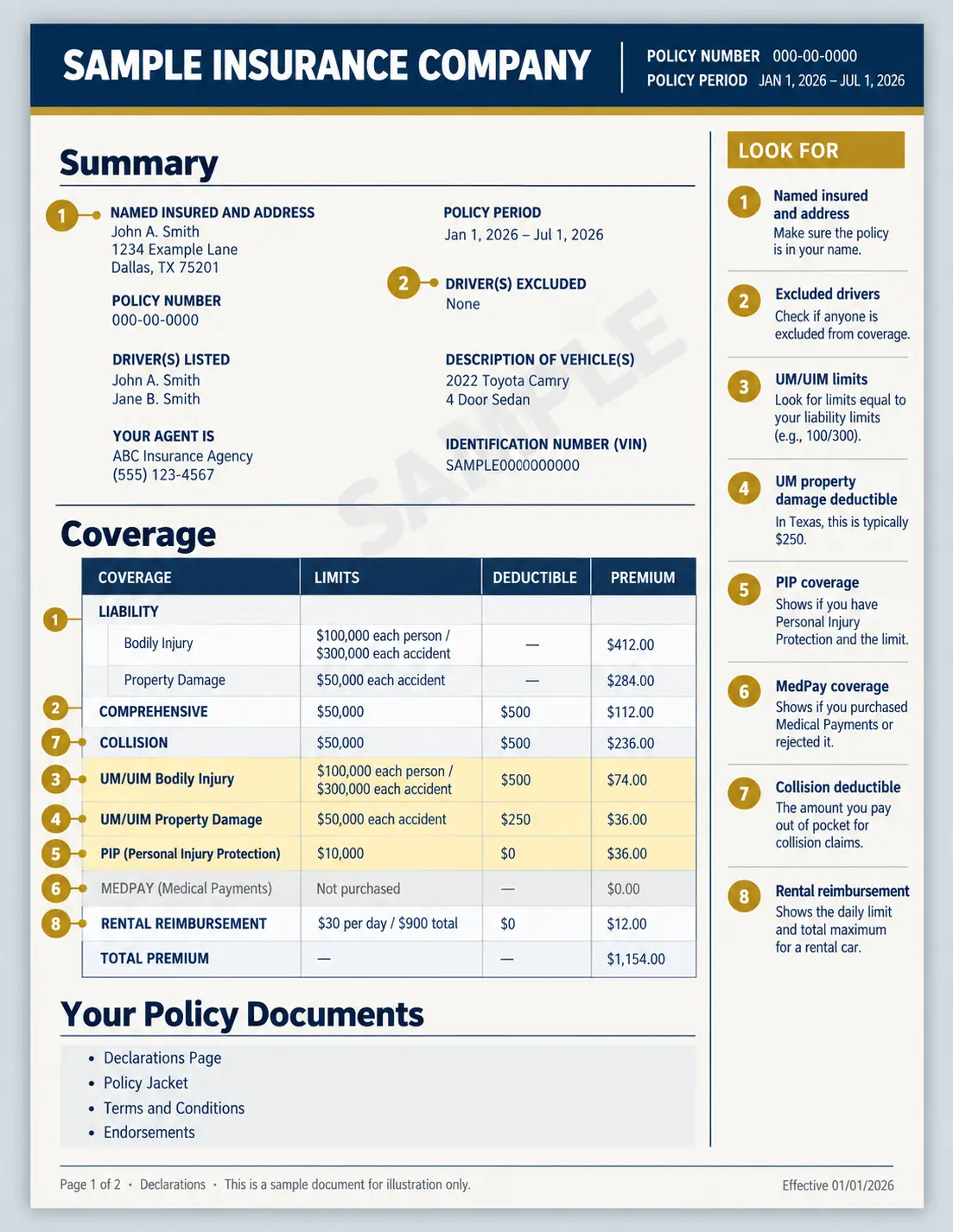
Our intake team walks callers through this page because it often answers the first major coverage question. A UM or PIP line with no dollar amount may indicate that the coverage was declined. Some insurers use “not purchased,” “rejected,” or similar wording instead, and each carrier’s documents can look different.
A written rejection signed years earlier may continue through renewals and later policy changes. Do not assume coverage exists, and do not assume it does not. Read the page.
If the insurer says UM/UIM was rejected, ask for a copy of the signed rejection form. Texas Insurance Code § 1952.101 includes the coverage unless a named insured rejected it in writing. If the carrier cannot support a denial with the form it relies on, have the decision reviewed.
If the policy does not contain UM/UIM today, ask the insurer about adding it for future protection and request written confirmation of the effective date. A coverage change will not apply retroactively to a collision that has already happened.
How the Three Coverages Differ
| Question | UM / UIM | PIP | MedPay |
|---|---|---|---|
| What does it pay? | Injury damages and, in appropriate circumstances, vehicle damage when the at fault driver is uninsured, underinsured, or never identified | Medical expenses and lost income benefits regardless of fault | Medical and funeral expenses regardless of fault |
| Is it included automatically? | Generally yes, unless rejected in writing | Generally yes, unless rejected in writing | No; it is optional |
| Does it cover lost income? | It may be part of the overall injury damages | Yes; standard Texas PIP pays 80 percent of lost income, subject to the policy limit | No |
| What is the basic amount? | Often matches liability limits unless the policyholder chose differently | $2,500 per person, with higher limits such as $5,000 or $10,000 available | The amount selected when the policy was purchased |
| What surprises people? | An unknown driver claim requires actual physical contact, and UM property damage generally has a $250 deductible | It can pay before fault is resolved | The insurer may have reimbursement rights from a later recovery |
The Physical Contact Rule for Unknown Drivers
When the at fault motorist is unknown, Texas Insurance Code § 1952.104 requires actual physical contact between the unknown vehicle and yours for UM coverage to apply.
That rule matters most in a hit and run where no one ever identifies the other driver. A vehicle that strikes yours and leaves may support a UM claim if the other policy requirements are met. A phantom driver who allegedly runs you off the road without touching your vehicle presents a more difficult coverage issue.
In a no contact case, the evidence may determine whether there is any viable claim at all. Witness testimony, traffic camera footage, dash camera video, vehicle damage, roadway evidence, and accident reconstruction can help establish what occurred. That is why photographs, witness names, and camera locations are so important immediately after the crash.
How the Coverage Layers Can Work
The actual order of payment depends on the policy language, the medical providers, available limits, health insurance, and the facts of the claim. Still, a common pattern looks like this:
PIP may pay first. Because fault does not need to be resolved before eligible PIP benefits are paid, it can help with medical expenses and wage loss while the larger claim is investigated. Texas limits the circumstances in which PIP payments can later be recovered from the injured person.
Liability insurance or UM/UIM may provide the main recovery. If the at fault driver has applicable liability coverage, that insurer may be responsible. If not, UM may be the primary path. UIM can become important where the other driver’s limits are too low.
MedPay may be another available payment source. Because MedPay can carry reimbursement rights, the policy and potential settlement should be reviewed before treating it as the first or only medical payment option.
Passengers can also be protected. PIP generally covers people riding in your vehicle, and occupants may have UM coverage under the vehicle policy, their own policy, or another applicable household policy.
Rideshare driving can create an important complication. Personal UM coverage may not apply while a person is working through a rideshare app. Drivers should confirm with their insurer when personal coverage applies, whether rideshare coverage applies, and what happens during each stage of app use.
Health insurance can continue to pay for medical treatment after a crash. Like MedPay, however, health coverage may create a reimbursement claim against a later settlement.
Collision, Rental Coverage, and Vehicle Value
Collision coverage pays for repairs to your vehicle regardless of what the other driver carries. Rental reimbursement coverage may provide a replacement vehicle while yours is in the shop. Each is subject to the deductible, limits, and policy terms you selected.
Those coverages can bypass the immediate uninsured driver problem for property damage, but they do not eliminate every financial loss. Even after a high quality repair, an accident reported on the vehicle’s history can reduce resale value. Texas allows a diminished value claim against the at fault side for that loss when the facts and available coverage support it.
Why UIM Can Matter Even When the Other Driver Is Insured
Texas minimum liability limits are 30/60/25: $30,000 for one injured person, $60,000 for everyone injured in the crash, and $25,000 for property damage. A single hospital visit can exceed $30,000. Serious injuries can exceed that number many times over.
That is the problem UIM coverage is designed to address. It may fill the gap between the at fault driver’s available liability limit and the losses supported by the claim, subject to the UIM policy terms and applicable offsets.
The risk is greater in a multi car crash. One at fault policy may have to be divided among every injured person, leaving each claimant with only a portion of the available limit. Your own UIM coverage can become more important as that shared policy limit shrinks.
With approximately 1 in 7 Texas drivers estimated to be uninsured, UM/UIM protection is not a minor policy detail. It can determine whether there is a meaningful source of recovery after a serious crash. For a detailed example, see who pays after an uninsured driver hits you in Texas.
Managing Litigation Attorney Matthew Graham spent more than a decade trying cases for insurance companies. He also served as Director of Subrogation Litigation for a 10 state region of the nation’s second largest auto insurer. Subrogation, the process by which an insurer seeks repayment after paying a claim, was part of his work.
That experience informs how our firm evaluates coverage disputes, reimbursement issues, claim denials, and insurer arguments designed to reduce payment. We focus on the insurance available to compensate an injured person. We do not pursue people simply because they lack insurance.
Matthew Graham · Managing Litigation Attorney · 25+ years of civil litigation
Fault Determines Responsibility
An uninsured driver is not automatically at fault. A person who lies about insurance does not get to decide responsibility by changing their story. Insurance status and crash fault are separate issues.
Texas assigns fault based on the evidence. That may include photographs, vehicle damage, dash camera footage, surveillance video, witness statements, roadway evidence, medical records, traffic control information, and accident reconstruction.
Your percentage of responsibility can reduce the amount you recover. Under Texas comparative responsibility rules, recovery is generally barred if your share of fault exceeds 50 percent.
A police report can be useful, but it does not conclusively settle fault. The officer’s assessment is one piece of evidence. Insurers do not automatically receive the report, and either side may challenge the report or the fault determination with stronger documentation.
When the other driver’s account changes or the insurance information appears false, your evidence becomes more important. Our guide to gathering evidence after a Texas car accident explains what to save and how quickly it can disappear.
Why Speed Matters More in These Cases
Footage is overwritten. Witnesses become harder to find. A plate lead can go cold. Policy deadlines start running before police finish their work.
Your policy may impose notice requirements for UM, UIM, PIP, MedPay, or collision claims. Those requirements are separate from the deadline for filing a lawsuit. Most Texas personal injury lawsuits are subject to a two year limitations period under Texas Civil Practice and Remedies Code § 16.003. A crash involving a government vehicle can trigger much shorter written notice deadlines, sometimes six months or less.
How To Open a UM or PIP Claim
You make a UM or PIP claim through your own insurer. That surprises many people, but these are first party coverages attached to your policy.
Call the insurer, report the crash, and explain that the other driver fled, may be uninsured, may be underinsured, or may have supplied information that does not appear valid. Give written notice promptly, because the policy’s notice requirement may arise well before the lawsuit deadline.
Provide the available documents:
- The police or hit and run report
- Photographs and videos
- Witness names and contact details
- The other driver’s insurance information, if any
- The plate number and vehicle description
- Medical records and bills
- Vehicle repair documentation
- Your declarations page
One important warning: if you plan to settle with the other driver’s insurer for the liability limits, obtain your UIM carrier’s written consent first. Settling without consent can jeopardize the UIM claim.
A lawyer can also be valuable when the paying carrier is your own UM insurer. Your insurer evaluates the claim as an insurer, not as a personal advocate, and may dispute fault, causation, medical treatment, damages, or coverage. The same comparative fault arguments used by another driver’s insurer can be raised to reduce a UM payment.
Disputed fault, an unidentified driver, a coverage denial, a physical contact dispute, or a limited policy are all issues a Texas personal injury firm addresses regularly. J. Alexander Law handles qualifying injury cases on a contingency fee basis, meaning there is no attorney’s fee unless there is a recovery.
When one of these six situations reaches our intake team, the first questions focus on coverage: Do you have liability only coverage or broader protection? Is UM/UIM listed on the policy? Can you send a screenshot of the declarations page through the insurer’s app or policy portal?
The path of the claim depends on the coverage that is actually in force, not what anyone remembers selecting years ago. We review that information early because finding a fleeing driver or verifying third party coverage can take time.
For qualifying cases, the next steps may include a same day case review, preservation letters to video holders, investigation into the other driver’s available policy, and an immediate review of the client’s own UM/UIM protection. Our systems can sometimes locate insurance information before the carrier completes its search.
If travel is difficult after an injury, we offer home visits and virtual consultations.
Hit by a Driver Who Fits One of These Situations?
Tell us what happened, what information the other driver gave you, whether police responded, and what you were able to photograph or preserve. We can review the potential insurance paths and explain what evidence should be secured first. Se habla español.
Frequently Asked Questions
Is it worth suing someone with no insurance?
Usually, not by itself. You can sue an uninsured driver personally, but a judgment is only as valuable as the person’s ability to pay it. Many uninsured drivers have few collectible assets. That is why UM coverage exists. It can provide a source of payment through your own policy without forcing you to depend entirely on a collection effort against the individual driver. A lawyer can evaluate whether the driver has assets, whether the vehicle owner has coverage, and whether another insurance source should be investigated before you spend money pursuing a lawsuit.
Are uninsured drivers automatically at fault?
No. Driving without insurance may violate the law, but it does not establish that the driver caused the crash. Fault depends on the evidence. An uninsured driver can be completely free of responsibility for a wreck. An insured driver can be entirely at fault. The insurance question affects who may pay; it does not answer who caused the collision.
What happens if someone gives you false insurance information?
Treat the coverage as unverified and report the discrepancy to police. A fabricated, inactive, or invalid card does not create a viable liability claim against the listed insurer. Give police the document itself or a clear photograph of it. Preserve the plate number, driver information, vehicle information, and all communications. The discrepancy may be included in the report and can become relevant to a later coverage or fraud investigation. If the policy does not apply, the claim may need to proceed through the vehicle owner’s coverage, your UM/UIM policy, collision coverage, PIP, or another available source. Presenting false insurance documentation can also be a separate criminal issue in Texas.
What if the other driver lied to their insurance company?
The insurer will investigate both versions of the crash. Adjusters compare the statements with vehicle damage, photographs, witness accounts, surveillance footage, roadway evidence, and other available proof. A story that does not fit the physical damage can be challenged. If the other carrier nevertheless denies liability, your own UM/UIM or collision coverage may provide an alternative path while the dispute is addressed.
What if I let someone drive my car and they cause a crash?
Your policy generally may respond first if you gave the person permission to drive and no exclusion applies. The same principle that can make an owner’s policy relevant when a borrower hits you can also make your policy relevant when someone borrows your vehicle. A friend or family member may be covered even if they have no insurance of their own, provided they were a permitted driver and not excluded by name. If the borrower has a separate policy, it may provide additional or secondary coverage. The exact order depends on both policies and the circumstances.
Do police actually investigate hit and run crashes?
Yes, but the strength of the available lead often determines how far the investigation can go. A plate number, a clear description, a witness, or nearby video can turn a difficult case into an identifiable driver. Injury cases generally receive greater attention, but every agency has limited investigative resources. Report the incident quickly while the lead is still fresh. Do not wait for police to identify the driver before starting the insurance side of the claim; the two processes run independently.
Will my insurance go up if I use uninsured motorist coverage?
A UM claim for a crash you did not cause generally does not raise a Texas premium by itself. However, rating practices vary by insurer, and renewal pricing can change for reasons unrelated to one claim. Ask your agent or carrier how it treats UM claims under your specific policy. Avoiding a valid claim solely out of concern about a possible rate change can cost far more than it saves when injuries or substantial damage are involved.
Does UM coverage apply if the hit and run driver is never found?
It can. Texas treats a never identified driver as uninsured for UM purposes, but the claim must meet the policy and statutory requirements. The key condition is actual physical contact. The unknown vehicle must have made contact with your vehicle. If that requirement is met, UM may cover injury damages and, subject to the usual $250 deductible, property damage. Report the hit and run quickly and provide your insurer notice of a possible UM claim. The policy’s notice duties apply in addition to any lawsuit deadline.
Will an insurance company go after an uninsured driver?
It may. After paying a UM claim, your insurer can pursue the uninsured driver for reimbursement. That process is called subrogation. Whether the carrier actually collects depends on the driver’s assets and ability to pay. That collection effort is the insurer’s responsibility after it pays a covered claim. It does not shift the burden back to you.
Can police tell whether an insurance card is fake?
Often, they can investigate the issue. Texas officers can electronically verify coverage through TexasSure, the state insurance verification database, using the plate number and vehicle identification number. A card that does not match an active policy may be identified quickly. That is one reason to involve police when the card, driver, vehicle, or explanation does not line up.
How long does a hit and run investigation take?
There is no set timeframe. A plate number or clear video can lead to a quick identification. Without a useful lead, the case may remain open for a long time or become inactive unless new evidence appears. Your insurance claim should not wait on that result. Report the crash, preserve the evidence, seek care when needed, and notify your insurer so the insurance process can proceed alongside the investigation.
What happens if one driver has insurance and the other does not?
Fault is handled the same way it would be in any other crash. Insurance status changes the available payment source, not the legal standard for responsibility. If the uninsured driver caused the crash, the insured person may use UM coverage, collision coverage, PIP, MedPay, or another applicable benefit. The insurer may later seek recovery from the uninsured person. Having insurance does not count against the insured driver when fault is being decided.
Should I chase a driver who leaves the scene?
No. Following a fleeing driver can lead to another wreck, an unsafe confrontation, or an argument that you acted unreasonably after the original crash. Remain at the location if safe. Record the plate, vehicle description, travel direction, and distinguishing details. Photograph the scene, note potential cameras, gather witness information, and call police. Law enforcement is better equipped to locate the driver.
Gone, Lying, or Uninsured Does Not Mean Unpaid
A driver leaving the scene, providing false information, or lacking insurance creates immediate problems. It does not necessarily eliminate every source of compensation.
The strongest evidence is usually available right after the crash. Preserve it. The declarations page may reveal coverage you did not know you had. A prompt report can protect both the police investigation and the insurance claim.
“For years, I have asked the same questions in Texas courtrooms: What happened? Who is responsible? And what insurance is available to cover the harm? Insurance companies are built to protect their financial interests and limit claim payments. Our role is to investigate the facts, identify the available coverage, and press for the recovery the evidence supports. You do not pay us unless we win a recovery for you.”
Josh Alexander · Marine Corps Veteran · Super Lawyers Rising Stars, 2022 to 2026 · Multi-Million Dollar Advocates Forum
If you were physically injured by a driver who left, gave false information, or had no insurance, J. Alexander Law can review the crash and explain the available options.
Talk With a Texas Personal Injury Lawyer
J. Alexander Law serves injured clients throughout Texas, including Dallas, Houston, San Antonio, Fort Worth, Arlington, and Canton. Se habla español.