


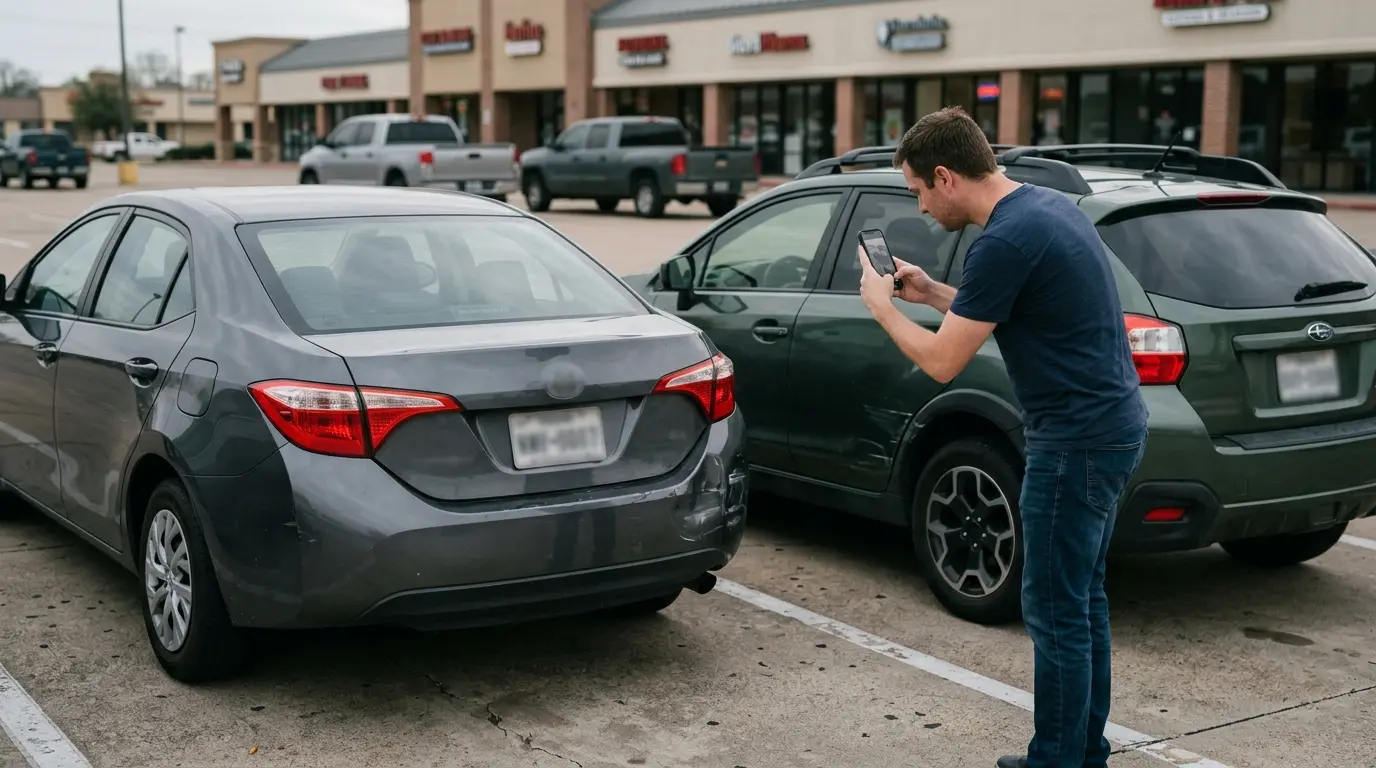
A police report can help after a car accident, but you can still open an insurance claim without one. If police do not respond, do not prepare a report, or give you only an incident number, document the accident yourself as soon as possible.

No police report: can I still make a claim?
Which situation are you in?
Start with what happened with the officer. Each answer ends in one action.
-
NoWhat happened at the scene?
- Parking lot or private property Police response and reporting practices vary by agency. Exchange information, take photos, look for cameras, and report the crash to your insurer.
- No officer at the scene If anyone is injured, the crash blocks traffic, a driver refuses to exchange information, or a driver leaves, call police again. Otherwise, document the crash and report it to your insurer.
-
YesWhat did the officer leave you with?
- A CR-3 crash report Buy a copy from the TxDOT crash records system or the agency records unit once it posts.
- Only an incident number Ask the records unit whether a crash report or incident record exists. The number may show that the agency recorded a response or call. Continue documenting the crash yourself.
Why police may not make a crash report
Police departments may not prepare a crash report for every minor accident. Response and reporting practices can vary by agency, especially when no one appears injured, the vehicles are drivable, or the accident occurred on private property.
That does not mean the accident is unimportant or that you cannot make an insurance claim. If a law enforcement officer investigates a crash that resulted in injury, death, or apparent property damage of at least $1,000 to any one person, Texas law requires the officer to make a written crash report. TxDOT refers to the officer crash report as Form CR-3.
If no officer investigates your accident, or the crash does not meet that threshold, there may be no CR-3 at all. The records you keep then become the primary account of what happened.
The Texas CR-2 blue form is no longer used
In the past, drivers could complete a CR-2 when no officer prepared a crash report. That option no longer exists, and nothing replaced it: no form you fill out creates an official state crash record today.
Instead, protect your claim with your own documentation; the scene checklist below covers what to collect.
What to do at the scene if there is no report
If you are safe and able to do so, collect as much information as possible before leaving. With no official report, these details may carry more weight when an insurer reviews fault, vehicle damage, injuries, and coverage.
- Exchange complete driver and insurance information. Get the other driver’s full name, phone number, address, driver’s license number, license plate number, insurance company, and policy number. Photograph the driver’s license and insurance card if possible. Also photograph the vehicle registration if it is available.
- Photograph the vehicles, damage, and location. Take wide photos of both vehicles, close photos of all visible damage, both license plates, the final positions of the vehicles before they are moved, traffic signs, lane markings, parking lot arrows, road conditions, debris, skid marks, and visible injuries.
- Get witness names and contact information. Ask anyone who saw the accident for their name and phone number. An independent witness may help explain how the crash happened if the drivers later disagree.
- Look for cameras and ask that footage be saved. Check nearby stores, apartments, garages, homes, businesses, and intersections for cameras. Ask the owner or manager to preserve the footage. Many systems automatically record over video after a short period.
- Write down the details while they are fresh. Record the exact location, date, time, weather, traffic conditions, direction each vehicle was traveling, and what each driver said. Note whether the accident happened in a travel lane, parking space, driveway, loading area, or intersection.
- Seek medical care if symptoms appear. Some injuries are not obvious at the scene. Get medical care promptly if you develop neck pain, back pain, headaches, dizziness, numbness, weakness, confusion, or other symptoms.
Photos to take before you leave
- Wide shots of the scene
- Both license plates
- Close photos of all damage
- Final vehicle positions
- Signs and pavement markings
- Road surface, debris, and skid marks
- Visible injuries
- The other driver’s insurance card
- The other driver’s license
If the other driver will not exchange information
Do not argue, threaten the other driver, or try to block the vehicle from leaving. Photograph the vehicle, license plate, driver, damage, and location if you can do so safely. Call police and explain that the other driver is refusing to provide information or is trying to leave.
If the driver leaves without exchanging information, write down the plate number, make, model, color, direction of travel, and anything you remember about the driver. A hit and run report may help your insurer locate the vehicle or evaluate uninsured motorist coverage.
For a more complete evidence checklist, see our guide on how to gather evidence after a Texas car accident.
If an officer came but did not prepare a crash report
Ask for the officer’s name, badge number, agency, and any incident, dispatch, or service number. An incident number is not the same as a CR-3 crash report, but it can help confirm that law enforcement responded. You can also contact the responding agency’s records unit to ask whether any call record, incident record, or crash report is available.
| Question | Incident number | CR-3 crash report |
|---|---|---|
| What it is | A dispatch, call, or incident record number | The standard officer crash report submitted to TxDOT |
| Who creates it | Usually created through the agency’s dispatch or records system | The investigating officer, submitted to TxDOT |
| What it shows | That the agency recorded a call or incident connected to a time and location | The officer’s recorded information about the drivers, vehicles, insurance, crash diagram, and contributing factors |
| Used as the main crash report | No | Yes |
Parking lot accidents: how fault is often reviewed
A parking lot accident can still support an insurance claim even when police do not prepare a report. Fault usually depends on what each driver was doing, where the vehicles were traveling, signs and pavement markings, vehicle damage, witness statements, and available camera footage. Our Texas parking lot accident lawyer page covers the private property fault rules in depth.
Through lanes and parking spaces
In many parking lot crashes, insurers place more responsibility on a driver who pulls out of a parking space into an active travel lane. A driver backing out must watch for approaching vehicles and pedestrians. Fault can still be shared if both drivers were moving, one driver was speeding, visibility was limited, or the evidence shows that both drivers failed to use reasonable care.
Backing collisions
When two vehicles back into each other, insurers often review whether both drivers were moving, how far each vehicle had backed out, the angle of impact, and whether either driver had a clear view. Photos of the vehicle positions, damage, parking space lines, and nearby cameras can be especially important.
Why documentation matters more in a parking lot
Parking lots may have fewer independent witnesses and no police report. If the other driver later gives a different version of events, photographs, video footage, vehicle damage, and witness statements may be the best evidence available. If your vehicle was struck while parked, our guide to getting hit while parked in Texas covers that situation.
Why medical records matter after a delayed injury
It is common for some symptoms to appear after the initial shock of a collision. Neck pain, back pain, headaches, dizziness, numbness, and other symptoms may not be obvious at the scene. If symptoms develop, seek medical care promptly and tell the provider that you were recently involved in a car accident.
Medical records show when you first reported symptoms, what treatment you received, and whether a medical provider connected your symptoms to the crash. They are especially important when symptoms appear days later. Save discharge papers, visit summaries, prescriptions, imaging results, therapy records, work restrictions, medical bills, and receipts.
Vehicle damage does not always show the full effect of a crash on your body. If you have symptoms, let a medical provider evaluate you and follow the provider’s advice. Our free crash injury visualizer shows which injuries each kind of collision commonly causes.
Insurance and fault without a police report
Report the accident promptly
You do not need a police report to notify your insurer or open a claim. Most auto insurance policies require prompt notice of an accident. Report the accident to your insurer as soon as you can, provide accurate basic information, and keep copies of claim numbers, emails, photographs, repair estimates, and medical records.
Insurance companies may still investigate fault
Without a police report, an insurance company may rely more heavily on driver statements, vehicle damage, photographs, witnesses, and the location of the accident. Its initial fault decision is not necessarily final. If you disagree, provide additional evidence and consider speaking with a lawyer before accepting a settlement or signing a release.
Texas uses a modified comparative responsibility rule. In general, an injured person may recover damages if they are 50 percent or less responsible for the accident. Any recovery is reduced by that person’s percentage of responsibility.
Which insurance company to contact
The policy information you collected at the scene tells you and your insurer whose coverage to claim against. If another driver caused the accident, you may make a claim with that driver’s liability insurer. You may also use your own collision coverage, if available, to repair your vehicle sooner.
If you use your own coverage, your insurer may seek repayment from the at fault driver’s insurer. Whether you receive your deductible back depends on the result of that process and the terms of your policy.
If the at fault driver carries no insurance or too little coverage, uninsured or underinsured motorist protection may be available under your own policy. Our guide on who pays when an uninsured driver hits you in Texas explains this coverage in more detail. Our walkthrough of a driver who left, lied about coverage, or carried none shows which policy responds in each situation.
Be careful with recorded statements
The other driver’s insurance company may ask you to give a recorded statement. You can provide basic facts, such as the date, location, and vehicles involved. Do not guess about speed, distance, fault, injuries, or any fact you do not know; an unclear statement may affect how the insurer evaluates fault. If you were injured or fault is disputed, talk with a lawyer before giving one.
Safe to provide
- The date and time of the accident
- The location
- The vehicles and people involved
- Where the vehicles ended up
- Your contact and insurance details
Do not guess or volunteer
- Speed, distance, or timing estimates
- Statements that you are uninjured before you have been medically evaluated
- Opinions about who was at fault
- Predictions about your injuries
- Agreement that the damage “looks minor”
Do not sign a release too early
An insurance company may offer a quick payment for vehicle damage or ask you to sign a release. Read every document carefully. A release may end your right to seek more money for the same crash, including for injuries that become clear after you sign it. If you have pain, ongoing treatment, or questions about what the document covers, consider getting legal advice before signing.
Diminished value after vehicle repairs
Even after proper repairs, a vehicle may sell for less because its vehicle history report shows an accident. This loss in resale value is called diminished value. Whether you can pursue a diminished value claim may depend on the facts, the vehicle, the insurance policy, the type of claim, and the available evidence. Keep repair estimates, photographs, invoices, vehicle history records, and proof of the vehicle’s condition before the accident.
Reporting a crash and your insurance rate
Rating rules vary by insurer and policy, and insurers do not all treat a claim you did not cause the same way. Ask your insurer or agent how reporting this crash may affect your policy.
A missing police report does not automatically prevent an insurance claim. The evidence you collect can still help show what happened.
Why you should act quickly
Evidence can disappear quickly after an accident. Video footage may be deleted, witnesses may become harder to reach, vehicles may be repaired, and memories may fade.
- Day of the accident Photograph the scene, exchange information, and notify your insurer.
- Within days Ask nearby businesses to preserve any camera footage.
- Within weeks Vehicles get repaired and witnesses become harder to reach; save every record.
- Two years The usual filing deadline for a Texas injury lawsuit, with shorter notice rules for some claims.
Save all photographs, repair estimates, medical records, bills, receipts, correspondence, and claim information.
Deadlines after a Texas accident
There is more than one deadline after an accident. The first is your own policy’s prompt notice requirement, covered above. Many Texas personal injury lawsuits must be filed within two years of the accident, but the exact deadline can depend on the type of claim and other facts.
Claims involving a city, county, school district, public transit agency, or other government entity may have much shorter notice requirements. The Texas Tort Claims Act requires written notice within six months, and some city charters set even shorter deadlines of 45 to 90 days. Do not assume the normal two year deadline applies to a claim involving a government vehicle or government property. Speak with a lawyer promptly if a government entity may be involved.
When to call police again or seek help
Call police right away if anyone is injured, a driver leaves the scene, a driver appears impaired, the other driver refuses to exchange information, the crash blocks traffic, or the damage is significant.
Some police departments also accept minor crash reports at a station counter or through an online portal. Ask the department that covers the location whether that option is available. If police do not respond, focus on collecting information, reporting the accident to your insurer, and seeking medical care if symptoms develop.
Injured in an accident with no police report?
Tell us what happened and what evidence you have. We can discuss whether your situation may fall within our personal injury practice and what information may be important to preserve. Se habla español.
Questions about accidents without police reports
Can I file an insurance claim without a police report in Texas?
Yes. You can usually report an accident and open an insurance claim without a police report. The insurance company may use driver statements, vehicle damage, photographs, witnesses, video footage, and other evidence to investigate what happened.
What should I do if police do not make a report?
Document what you still can. At the scene, the checklist above covers it: information, photos, witnesses, cameras. If you have already left, write down your account now, photograph your vehicle damage and any injuries, ask nearby businesses about camera footage before it is recorded over, and report the crash to your insurer.
Why did police not make a crash report?
Often because the accident seemed minor to the responding agency: vehicles were drivable, no one appeared hurt, or it happened on private property. A declined report reflects agency practice, not a judgment about your claim, and you can call the department’s non-emergency line later to ask whether anything was filed.
Can I still use the Texas CR-2 blue form?
No. The blue form was retired on September 1, 2017, and TxDOT will not accept one today, even if you find the old PDF online. Your own records and your insurance claim take its place.
How do I get a copy of a Texas crash report?
You may be able to obtain a report through the TxDOT crash records system or the records unit of the agency that investigated the accident; the state portal itself is at txdot.gov. Have the accident date, location, report number, and names of people involved available when you search or request records.
How long does it take for a Texas crash report to become available?
It depends on the investigating agency and when the officer submits the report. Check back periodically; if the report has not posted yet, you can still open your insurance claim and begin gathering evidence.
Will the insurance company decide who was at fault?
Yes, the insurance company will investigate fault, but its first decision is not necessarily final. You can submit more evidence if you disagree with its assessment. Texas follows a modified comparative responsibility rule: fault above 50 percent generally bars recovery, and any smaller share reduces it.
How long do I have to report an accident?
Tell your insurer right away. Waiting can make an investigation more difficult, and your policy may require prompt notice. Many Texas personal injury lawsuits have a two year filing deadline, but shorter deadlines may apply, especially when a government entity may be involved.
Should I contact the other driver’s insurance company?
Yes, you may need to contact the other driver’s insurer to make a liability claim. Provide accurate basic facts, keep a record of communications, and do not guess about fault or injuries. If you were injured or the insurer asks you to sign a release or give a recorded statement, consider speaking with a lawyer first.
What happens if I never report the accident?
Waiting can make your claim harder to prove. Evidence may disappear, vehicles may be repaired, witnesses may become harder to find, and your insurer may raise questions about delayed notice. Report the accident, save your records, and seek medical care promptly if you develop symptoms.
Is an incident number the same as a crash report?
No. An incident, dispatch, or service number may show that law enforcement responded to a call, but it does not contain the officer’s findings the way a CR-3 crash report does. The agency’s records unit can tell you which records exist for your accident.
Will my insurance go up if someone else hit me?
It depends on your insurer and your policy. Insurers do not all treat a not at fault claim the same way at renewal. Ask your agent how this kind of claim is treated under your policy.
What if the other driver has no insurance or too little?
Your own uninsured or underinsured motorist coverage may pay. It can apply when the at fault driver has no insurance or not enough to cover your losses. Check your declarations page or ask your agent whether you carry it, and report a possible uninsured motorist claim promptly, since these claims have their own notice and filing limits under your policy.
Is a police report the same as an accident report?
Yes; police report, accident report, and crash report are all names for the officer’s CR-3. The report you make to your own insurance company is different: that is your notice that the crash happened. Filing a claim is a separate decision you can make after that notice.
No report does not always mean no case
If you were physically injured in an accident with no police report, the evidence you collected may still support an insurance claim. Contact J. Alexander Law to discuss what happened and the injuries involved.
Talk with a Texas personal injury lawyer.
Reach out about your accident and your injuries. Se habla español.