


How much is a broken arm worth after a car accident in Texas? There is no flat price, but McKinley’s case shows what actually drives the number: two bones broken at once, surgery with a plate and screws, months of hard therapy, and a permanent scar on the arm of an eighteen year old heading to college. This is her story, and the plain answer to what a both-bone forearm fracture means for your recovery and your claim.
The driver pulled across two lanes and stopped. McKinley could not.
McKinley was driving home from the mall after class when an oncoming driver pulled out and stopped across both lanes ahead of her. She was too close to avoid it. She braked hard and struck his driver’s side, and the impact threw her car across the road into cross traffic until it came to rest on a curb on the far side. She was pinned for a moment, then unbuckled, climbed out, and called her dad while bystanders ran over to ask if she was okay.
The adrenaline hid what her body already knew. This is a T-bone crash, also called a side impact collision, and it happened the way many of them do in Texas: not at high speed, but because one driver moved into a path that was not clear.
How she knew her arm was broken before anyone told her
She reached into the back seat for her phone and her hand went limp.
I couldn’t feel anything, but I knew it was broken because I couldn’t lift anything or move it.
That is one of the clearest signs of a serious fracture: not always sharp pain, but a limb that will not obey. After a crash, adrenaline can mask a break for an hour or more, which is why an arm that feels numb, hangs oddly, will not grip, or swells fast needs an X-ray the same day even when it does not hurt yet. The forearm fracture symptoms that should send you in are simple to name:
- An arm that will not work: you cannot lift, grip, or turn the hand, the way McKinley’s went limp.
- Fast swelling or a visible deformity: the arm bulges or looks bent where it should be straight.
- Numbness or a cold hand: a sign the swelling or the broken bone is pressing on a nerve.
- Pain that spikes when you rotate the wrist: the radius and the ulna carry that motion.
Broken forearm symptoms like these do not wait for the adrenaline to fade. McKinley had nine stitches and, under the skin, two broken bones, and getting imaged early is what put her on the path to surgery within a week. If you are sorting out which symptoms need a doctor now, our free Texas injury symptom checker walks through the red flags.
A both-bone forearm fracture: what McKinley actually broke
McKinley shattered her radius and fractured her ulna, an injury orthopedic surgeons call a both-bone forearm fracture. The radius and the ulna are the two bones between the elbow and the wrist, and they work as a pair so the forearm can rotate and turn the palm up and down. It takes real force to break both at once, which is exactly why this injury is more serious than a single clean break: two bones have to be realigned, the rotation of the whole forearm is at stake, and the recovery runs longer.
Is it a fracture or a break?
A fracture and a break are the same thing. In medicine, fracture is simply the word for a broken bone, so a hairline fracture, a crack, and a bone in several pieces are all fractures. What changes the seriousness, and the value of a claim, is the pattern, not the word. The detail that matters is:
| The detail | Why it matters |
|---|---|
| How many bones | One broken bone or, like McKinley’s, both the radius and the ulna at once. |
| Comminuted or clean | A shattered bone that breaks into several pieces is comminuted, and it is harder to repair than a single clean line. |
| Displaced or aligned | When the broken ends move out of line the bone is displaced, and displaced forearm fractures in adults usually go to surgery. |
| Hardware or a cast | Whether a plate and screws were needed to hold the bone is the clearest marker of a serious break. |
| Closed or compound | McKinley’s skin was cut, but the break itself was closed; a compound fracture, where the bone breaks through the skin, is more serious, carries an infection risk, and settles higher. |
So when an adjuster or an intake form calls the injury “a fracture,” that word by itself says nothing about how bad it was. It also sets the broken arm treatment: a hairline fractured arm may heal in a cast, while a displaced both-bone break needs surgery, and the more serious the pattern, the higher the value it drives. Anyone told their injury is only a fracture should read that as the beginning of the question, not the answer.
Surgery, then the harder part: getting the arm to work again
A displaced both-bone forearm fracture in an adult almost always needs surgery, and McKinley had hers about a week and a few days after the wreck. The operation is called open reduction and internal fixation, or ORIF: the surgeon reopens the arm, lines the broken bones back up, and fixes them with a metal plate and screws so they heal straight.
A cast alone cannot hold two shattered bones in the precise alignment the forearm needs to rotate, so surgeons reach for plates to protect that motion, and the hardware often stays in for life. The short gap between the crash and the operation is normal, because the swelling has to settle before a surgeon can safely open the arm.
How long does a broken forearm take to heal?
The healing time for a broken forearm usually runs about three to six months for the bone itself to knit, and closer to six to twelve months to win back real strength and motion. McKinley put it plainly: the surgery was one thing, but “working on the movement was pretty hard.” The typical path looks like this:
- Weeks 0 to 2 Swelling settles, then surgery to set the bones with a plate and screws.
- Weeks 2 to 6 The arm is protected in a cast or brace while the incision and bone begin to heal.
- Months 3 to 6 The bone knits, and physical therapy starts rebuilding the range of motion and grip.
- Months 6 to 12 Real strength and the ability to fully turn the palm return, sometimes not all the way.
For a claim, this long tail is the whole point: the case should not settle until the arm reaches what doctors call maximum medical improvement, the point where a doctor can finally say how much motion and strength will return. That final limit is what the injury is truly worth, and reaching it is also what reveals the future costs, because only then can a doctor say whether the hardware will need to come out or more surgery is coming. Every month of therapy along the way also adds to the recoverable medical bills, so settling before then means guessing low on your own recovery.
Do injections or extra treatment increase your settlement?
Is a broken arm a serious injury?
A broken arm can absolutely be a serious injury, and a both-bone forearm fracture that needs surgery sits on the serious end. Seriousness in a Texas injury claim is not about drama; it is about permanence and function. Did it need surgery? Is there permanent hardware in the arm? Will the range of motion, the grip strength, or the ability to fully rotate the forearm ever return to normal? A displaced fracture repaired with a plate answers yes to most of those, which is why a surgical broken arm is valued very differently from a bruise or a sprain that heals on its own.
The scar, the bills, and what a broken-arm claim is worth
The scar from McKinley’s surgery is a separate, compensable injury, not a footnote to the broken bone. Texas law lets an injured person recover for disfigurement as its own category of damages, apart from medical bills and apart from pain. A surgical scar left by nine stitches and an ORIF incision is permanent and visible, and for an eighteen year old that visibility runs for a lifetime, which multiplies the value because the loss is measured across every one of those years.
Because a permanent scar and any lasting loss of motion never fully resolve, the seriousness of the injury drives the non-economic half of the claim, the part with no receipt. There is no flat price for a broken arm, but the value of a Texas claim is built from a short list of drivers, and a surgical both-bone fracture hits most of them:
| Driver | What it covers |
|---|---|
| Medical bills Economic | The emergency room, imaging, the ORIF surgery and anesthesia, physical therapy, and any future hardware removal. A broken arm treated without insurance can run well into the tens of thousands of dollars, and those bills are recoverable. |
| Lost time and earning capacity Economic | Missed work or school now, plus any lasting limit on the kind of work the arm can do later, which is a recoverable loss of future earning capacity. |
| Pain and impairment Non-economic | The months of limited use and any permanent loss of motion or grip. |
| Disfigurement Non-economic | The permanent forearm scar, documented with photographs over time. |
How is pain and suffering calculated?
Texas has no fixed formula for pain and suffering. Adjusters and juries weigh how severe and permanent the injury is, whether there was surgery, hardware, or a visible scar, and how much daily life changed, and many insurers start from a multiple of the medical bills. A surgical both-bone forearm fracture on a young person carries far more of this non-economic value than a strain that heals in a few weeks. In practice the pain and suffering on a surgical fracture often runs to a multiple of the medical bills and frequently exceeds the bills themselves, which is another way the economic half drives the non-economic half. The full method, including how a fair multiple is set, lives on our guide to what a Texas claim is worth.
How much do insurance companies pay for pain and suffering?
The costs that keep running after the cast comes off
A broken arm claim is not finished when the bone knits. The plate and screws can require a second surgery to remove them, therapy can run for months, and a forearm that heals with stiffness can mean care for years. Those future medical costs are recoverable economic damages, and any future surgery also adds to the pain and impairment that make up the non-economic side. This is the other reason a claim should not settle early: a number that ignores the costs still to come pays for only half the injury.
So what is a broken arm actually worth?
Reported broken arm settlements in Texas commonly run in the tens of thousands, and the pattern of the break is what moves the number:
| Injury path | Commonly reported |
|---|---|
| A minor break that heals in a cast, no surgery | Well below $30,000 |
| A fracture that needed surgery, like McKinley’s ORIF | $30,000 to $100,000 |
| Nerve damage, more than one operation, or a permanent loss of use | Higher |
What you keep is shaped by two first-party pieces most people miss. Many Texas auto policies include PIP or MedPay that pays your first medical bills regardless of who was at fault, and at the end the health insurers and providers who covered your care are repaid out of the settlement through liens and subrogation, which is part of why the net is lower than the gross.
Two other facts can move the final number. If the driver was drunk or grossly reckless, Texas allows punitive damages on top of the compensatory value, and while the injury settlement itself is generally not taxed, those same fees and liens still decide what you keep.
These are general ranges that depend entirely on the facts, not a promise and not McKinley’s result.
Put together, the number comes from one chain
- Seriousness sets the value How serious and permanent the fracture is decides where the claim starts.
- The value splits in two Into the economic bills and the non-economic pain and scar.
- First-party coverage pays early, fees and liens come out late PIP or MedPay pays the early bills, while the contingency fee and any liens come out at the end.
- Comparative fault trims the total If any share of the blame lands on you, the recovery drops by that share.
- The two year deadline ends it Miss it and none of it is recoverable.
That is why the seriousness of the injury and the speed of preserving evidence matter as much as the crash itself.
What is the average settlement for a broken arm in a car accident?
What injury pays the most in a car accident claim?
How much of a $50,000 settlement do you actually keep?
Can you drive with a broken arm, and what you should not do
No Texas law names a broken arm as an automatic bar to driving, but you should not drive until a doctor clears you and you can control the car safely with both hands. In a cast or a sling that usually is not possible, and driving while an injury limits you can shift blame onto you if anything goes wrong. Most people are cleared to drive again several weeks after surgery, once the cast is off, the arm bears normal use, and any pain medication that causes drowsiness has stopped. The rule is simple: ask the surgeon at each visit whether you are cleared, and follow that answer rather than a guess.
What not to do with a broken arm while your claim is open
The worst thing you can do with a broken arm is skip the follow-up care, because gaps in treatment hurt both the bone and the claim. Consistent, documented treatment does double duty: it builds the recoverable medical costs and it proves how serious the injury was. A few quiet mistakes cost people the most:
Who is at fault when a driver pulls out and stops
When a driver pulls out across lanes that are not clear and gets struck, that driver is usually at fault for failing to yield, even though the other car is the one that made contact. Texas law requires a driver entering or crossing a road to yield to traffic that is close enough to be a hazard, and stopping halfway across two lanes does not erase that duty. In McKinley’s crash the oncoming driver moved into a path she was already committed to and left her braking with nowhere to go, and her car struck his driver’s side.
Texas uses a 51 percent rule, so as long as the driver who failed to yield carries most of the blame, the injured driver still recovers. That rule also reaches the dollars: if you are found partly at fault, your recovery drops by your share.
| Your share of the blame | What you recover |
|---|---|
| None of it | $100,000 |
| 20 percent | $80,000 |
| 50 percent | $50,000 |
| 51 percent or more | Nothing |
To see how a side impact drives force into the body, our crash injury visualizer shows it.
Proving a “he pulled out and stopped” crash
A crash that comes down to “he pulled out and stopped” is won with evidence gathered fast, not with memory alone. The strongest proof is physical and independent:
- Point of impact: the damage on the other driver’s door, not just on the front of the car that hit it.
- Final rest positions: where each car ended up, like McKinley’s on a curb across the road.
- Marks and debris: skid or yaw marks and the debris field that show where the collision truly happened.
- Independent witnesses: the bystanders who stopped to ask if she was okay can say what they saw.
A police report, scene photos, and any nearby camera footage lock the account in place before the other driver’s version drifts, and that same evidence is what rebuts any later attempt to shift part of the blame onto McKinley under Texas comparative fault. Our guide on what to do after a car accident in Texas covers how to preserve all of this, even one handed.
When the driver runs: the coverage that still pays
When the at-fault driver leaves the scene, an injured person in Texas can often still be paid through their own uninsured motorist coverage, which exists for hit-and-run crashes and for drivers who cannot cover the harm they cause. The man who hit McKinley was on foot and ran away before coming back, and even a brief flight raises the two questions that decide how a claim gets paid: can the driver be identified, and does he carry insurance?
| The situation | Who pays |
|---|---|
| He is found and insured | His policy pays. |
| He is never identified, or he is uninsured | Uninsured motorist coverage on your own policy steps into his place and pays the same medical bills an at-fault driver’s policy would have. |
So a broken arm does not go unpaid just because the person who caused it ran. An uninsured motorist claim is still your own claim, so Texas comparative fault and the same two year deadline still apply to it, which is why the evidence has to be preserved just as fast. Because the rules for a fleeing or uninsured driver are their own subject, we keep the full explanation on one page: read who pays when the driver who hit you has no insurance.
A teen’s claim, and the clock that runs on it
A young person’s crash claim in Texas runs on the same two year deadline as an adult’s, but with one twist that fit McKinley exactly. For anyone under eighteen, the clock does not start until their eighteenth birthday, so a parent generally brings the claim in the meantime. That is why her dad “did all the handling at the very beginning” and she “took over because I’m eighteen.”
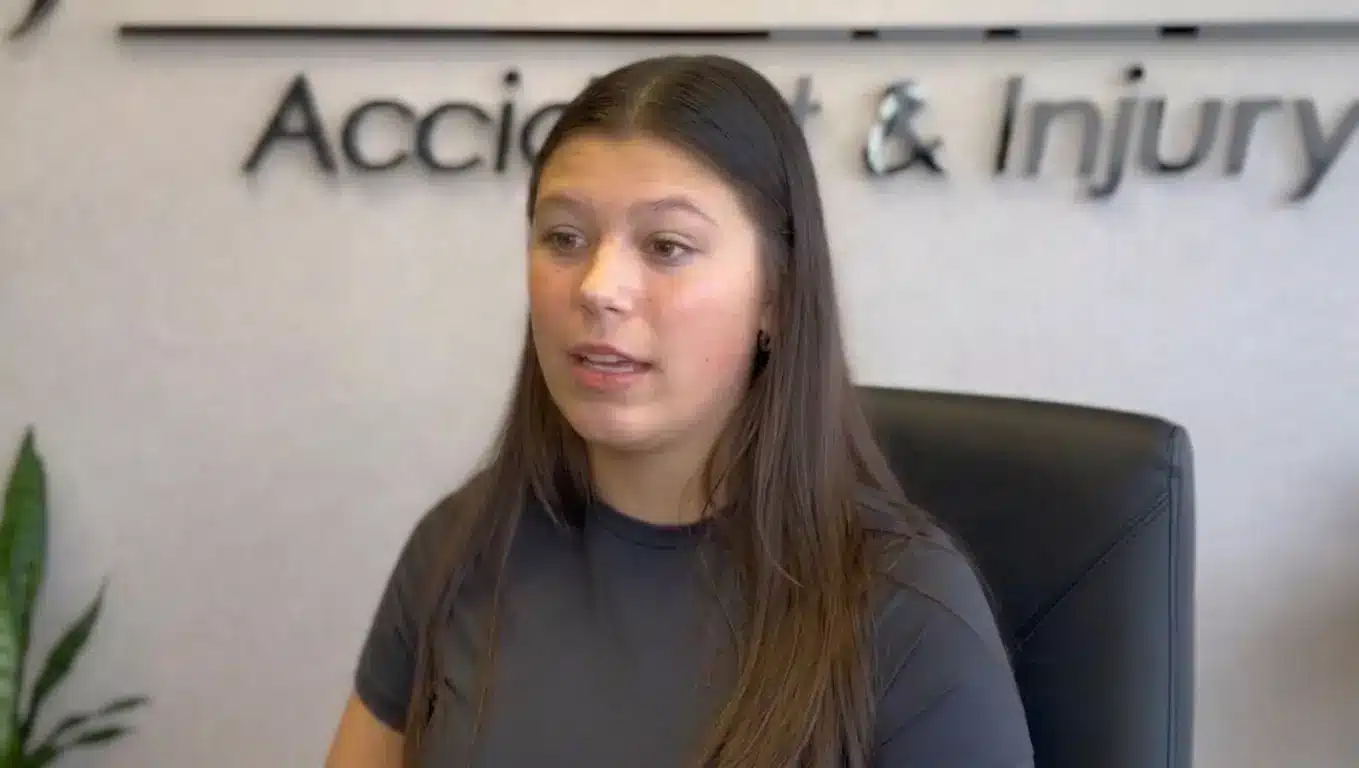
The handoff from parent to young adult is normal, and it is worth getting right, because medical authorizations, paperwork, and any settlement involving a minor follow special rules. The deadline itself is unforgiving: miss the two year window and the claim is gone, no matter how clear the other driver’s fault was. That same tolling applies whether the claim is paid by the other driver’s insurer or by your own uninsured motorist coverage. The exact dates and the minor tolling rule live on our Texas filing deadlines page.
The insurance company, the fee, and why her case felt easy
On a claim like McKinley’s, the insurance adjuster’s job is to close the file quickly and for as little as possible, and a young, polite driver with a clear injury is exactly who they hope will accept an early number. That is why the calls come fast, why the first offer often lands before the arm has finished healing and before you reach maximum medical improvement, so the insurer pays for less than the final injury, and why an adjuster may ask for a recorded statement that sounds routine but is not.
The adjuster’s first target is the part of the claim with no receipt, the permanent impairment and the scar, which are worth real money but easy to argue down when no one pushes back. An offer made before a doctor knows how much motion the forearm will regain is an offer made blind, and it is almost always low. How adjusters build and defend those numbers is its own topic on our page about dealing with insurance companies in Texas.
What should you not tell the insurance company after a car accident?
Should you accept the first settlement offer?
What are the signs of a good settlement offer?
What hiring the firm cost her: nothing up front
McKinley paid nothing out of pocket to have the firm handle her case, because Texas personal injury lawyers work on contingency: the fee is a percentage of the recovery, and it is owed only if the case is won. That is how an eighteen year old and her dad could hand off the insurance calls and the paperwork without ever writing a check, and why she could honestly say “I really didn’t have to do much.” The way the percentage, the case costs, and any medical liens come out of a settlement is spelled out on our page about how contingency fees work in Texas. Waiting to call rarely saves money and usually costs it, since evidence fades and deadlines run while the arm is still healing.
Is it worth suing over a broken arm, and do these cases settle?

The reason McKinley described her case as “really quick” and “really easy” is that almost all of the work happened off her plate while she healed. Her only real job was to get treated and to show up for therapy; the firm handled the insurance company, the medical records, and the fault side of a crash where the other driver had fled.
“Everybody was super nice and really helpful.”
McKinley · Age 18 · Struck leaving school
This review reflects one client’s individual experience. Past results do not guarantee a similar outcome.
She is heading to college with the arm healing and the case behind her. A crash she did not cause took a semester’s worth of normal from her, and the job was to make sure it did not take anything more.
Broke a bone in a Texas crash that was not your fault?
Call 469-807-7480 or contact us online. Se habla español.