

For reporters and editors. Texas. Updated September 2026
Flock Cameras: How They Work,
From the Pole to the Case File
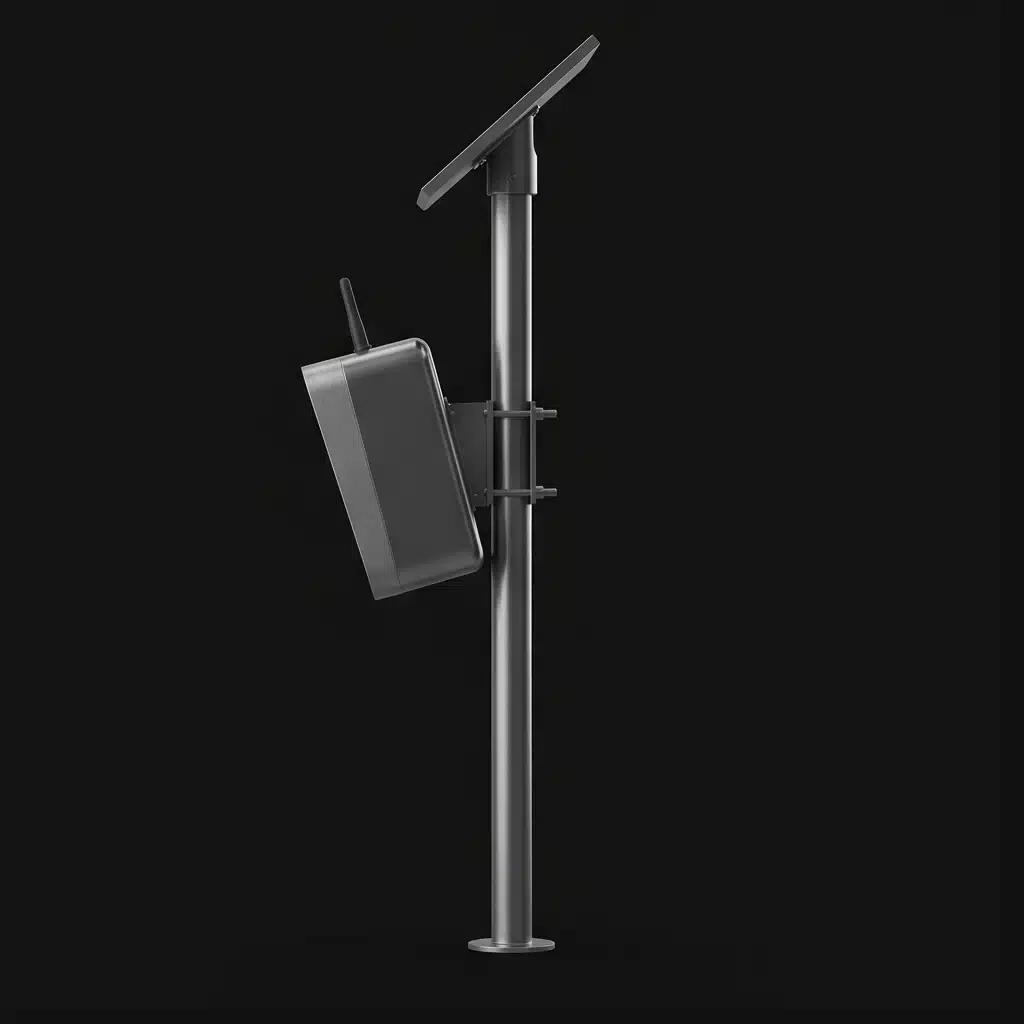
See every part of the camera that captures a plate, in an interactive 360 degree view.

Frame captured (example)2026-09-14 14:32:07TX-EX-014232.781, -96.798passenger sedanillustrative
Render pending.
Every vehicle that crosses the cone is captured, whether or not it is on any list.

LBK8427
L?K?427
Read confidence (example)
0.97
Read confidence (example)
0.58
Partial plate, 5 of 7 characters
Vehicle Fingerprint® attributes
Colour, make, body type and visible features such as a roof rack or a missing hubcap, per Flock’s published search fields.
A probabilistic read is a lead, not proof.
Render pending.
Plates can be stolen, obscured, temporary, altered, or on a car someone else is driving.

Data packet
Plate text, attributes, time and location, image.
Encrypted at rest, KMS keys
GovCloud for CJIS data
Who controls this record
The customer, a city, county, HOA or business, sets access and sharing rules and owns the data. Flock hosts it.
Render pending.
Day 7Flock 2026 default
Day 30older contracts
Selected: 7 days
051015202530
Render pending.
PlatePartial plateTime windowColourMakeBody typeFeatures
LBK8427 (example)2026-09-01, Dallas metro
Partial: L?K84?? (example)2026-08-14, Austin metro
Silver sedan, no plate (example)2026-07-30, Houston metro
0Cameras
0Networks
Hot list match (example)
A plate on an agency hot list matches a camera read.
Alert to officer
Render pending.

T+0Crash
T+hoursPolice search, case code
Preserved
Evidence Mode or a written hold request keeps the record.
Deleted, day 7 or 30
Nobody asks. The record is hard deleted on the default schedule.
Render pending.
Render pending.
Front, 0°Drag to rotate
Check an agency’s real number on its Flock transparency portal.
Choose an example search below.
Default deletion, 7-day rule
–
–
Default deletion, 30-day rule
–
–
Hover a numbered point, or pick a part below the model.
Step 1 of 8
The device on the pole
A Flock camera sits on a pole at a fixed angle over a lane or a driveway. It runs on solar power and a battery, with a cellular modem that sends each capture out over LTE. An independent hardware teardown of a Flock camera found a lithium ion battery pack and an LTE modem inside the housing [4].
The unit is a fixed still camera, not a pan tilt zoom camera, and Flock frames its product around images and vehicle data, not a continuous video feed. Flock states its cameras carry no facial recognition and are built to read vehicle information, not a person’s face [7].
Get it right
Call it a still image camera, not a video camera, and note that Flock says the product does not perform facial recognition [7].
Step 2 of 8
A vehicle passes: the capture
Every vehicle that crosses the camera’s field of view is captured. A vehicle does not need to be on a hot list first. The camera records a still image at that moment, along with a timestamp and the camera’s location.
Flock’s own materials describe the product around images and metadata, not a continuous video stream. The example card shows the kind of fields attached to one capture; the values shown are illustrative, not a real vehicle.
Get it right
Every passing plate is captured. A capture is not the same claim as a search or a match; those come later in this walkthrough.
Step 3 of 8
Detection: reading the plate and the vehicle
A gold box draws around the plate and the system resolves the characters against Flock’s database. The platform classifies the vehicle itself: colour, make, model or body type, and visible features, what Flock calls Vehicle Fingerprint technology [6].
A probabilistic read is a lead, not proof. Plates can be misread, stolen, obscured, temporary, altered, or mounted on a car someone else is driving at the time. The toggle below shows what a harder read looks like next to a clean one.
Get it right
Do not treat a license plate reading as certain if the system is not confident. If the reading is incomplete or has a low confidence score, a person should check it before using it to identify a vehicle.
Sources: [6]
Step 4 of 8
The record leaves the pole
The capture and its metadata travel over the cellular link to cloud storage. Flock says footage and metadata are encrypted through the entire lifecycle, from the device to the cloud, using Amazon Web Services storage and KMS-based encryption, and that CJIS-relevant data stays inside AWS GovCloud, limited to law-enforcement customers [5].
The customer, not Flock, is the party that sets access and sharing rules. A city, a county, an HOA, a school or a business can each be the customer on a given camera, and each can set its own rules for who sees the data and who it is shared with [5].
Get it right
Ask who the customer is on this specific camera before writing “Flock’s data.” A private owner sets different rules than a police department.
Sources: [5]
Step 5 of 8
How long the photo lasts
Flock’s default is now 7 days from the date of capture. Before an August 2026 policy update, the default was 30 days, and data is described as hard deleted from the cloud once the window closes [1][2].
Existing customers can keep a longer period they already had approved, and Evidence Mode lets a detective preserve specific records in cold storage for an active investigation, offered free to agencies on the new default; extended retention beyond that needs approval from an elected official [1][2].
Get it right
To find the actual data-retention period, check the agency’s contract or its public transparency website. Do not rely only on a press release.
For example, Dallas keeps its data for 365 days under its own agreement [10].
Step 6 of 8
Search and hot lists
A Flock search can be narrowed by a full or partial plate number, a date and time range, the vehicle’s color, its make, model or body type, and other visible details such as roof racks, bumper stickers or damage. Flock calls those extra vehicle details “Vehicle Fingerprint” attributes [6].
A hot-list alert is only a possible lead. It does not automatically prove that a vehicle is connected to a crime or give an officer legal grounds to take action. Flock says officers should confirm that the vehicle truly matches before acting on an alert.
Get it right
If an agency says it “searched Flock,” ask who ran the search, for which agency, with what case number or reason, and how many camera networks it reached. One search can reach far beyond one city: in a Texas case EFF reviewed, single searches reached thousands of networks [20].
Step 7 of 8
After a crash
Cameras near the crash may have already captured a plate record, just as they capture every vehicle that passes. To keep that record, send a written preservation request to the agency or private owner that controls the cameras, not Flock. Flock stores the data for its customer, but the customer controls it [1][2][5].
An injured person and the police are working against the same deadline. If no one asks to preserve the record before it is deleted, usually after 7 days under newer contracts or 30 days under older ones, it may be gone for good [1][2].
Get it right
Send a written preservation request during the same week as the crash. Address it to the camera owner, not Flock. Use the date tool below to check the usual deletion dates.
Step 8 of 8
Oversight and Texas
Texas has no statute written for automatic license plate readers. Two 2025 bills, HB 961 and HB 2083, would have created one; both were referred to committee and got no further vote [15][16][17][18].
Governor Greg Abbott barred state agencies from spending further money on Flock cameras starting August 27, 2026, citing misuse concerns, though existing equipment does not have to come down. Texas DPS still runs more than 940 of its own cameras, queried about 615,000 times in June 2026, with 48 percent of those queries coming from outside Texas [9].
Step 1 of 8
Calculator
After a crash: retention dates
Enter the date of the crash to calculate the default deletion date under each published retention policy. The applicable retention period for a specific camera depends on the agency or private owner’s contract, written policy, and any evidence-preservation request. Check the owner’s transparency portal or public records for the local rule.
Default deletion, Flock’s 2026 policy
–
–
Default deletion, 30-day legacy setting
–
–
The real number is in the agency’s contract or transparency portal.
Our Dallas car accident lawyers send the preservation request to the camera owner in the same week as the crash. After a rear-end collision in Dallas, it is the first request we send.
For reporters
Accurate terms
Ten common descriptions that need correction.
| Common wording | More accurate wording | Why it matters |
|---|---|---|
| “Flock records video.” | “Flock captures still images of passing vehicles and stores associated metadata.” | Flock describes its LPR product as capturing vehicle images and metadata at each passage, rather than continuously recording video [2][5]. |
| “Flock uses facial recognition.” | “Flock states that its LPR product does not use facial recognition. It classifies vehicle characteristics through its Vehicle Fingerprint feature.” | Flock says its cameras do not use facial recognition [7]. Vehicle Fingerprint can identify attributes such as color, make, body type, and visible vehicle features [6]. |
| “Flock keeps data for 7 days.” | “Flock’s 2026 default retention period is 7 days, but a local contract or policy may require a different period.” | The company changed its default to 7 days in August 2026 [1][2]. Older contracts may use 30 days. Dallas reportedly retains its own Flock data for 365 days [10]. Evidence Mode may retain records connected to an active investigation. |
| “Flock owns the data.” | “The agency or private customer controls the data. Flock hosts the platform.” | Flock states that its customers set access, sharing, and retention rules for their data [5]. |
| “The camera identified the driver.” | “The camera read a license plate and recorded vehicle information. Investigators must identify the driver separately.” | A license plate identifies a registered vehicle. It does not establish who was driving when the camera captured the image. |
| “An alert means police found a stolen car.” | “A hot-list alert is a possible match that requires officer review.” | An alert results from a match against a list entered or integrated by an agency. Officers must verify the plate, vehicle, and relevant circumstances before taking action. |
| “The city’s cameras.” | “City-funded cameras and state-funded cameras may operate under separate funding and access arrangements.” | In Dallas, police deactivated 321 state-grant-funded cameras after the state funding pause while more than 300 city-funded cameras remained active [11]. |
| “Texas has 13,000 Flock cameras.” | “Texas Tribune reported that Texas had more than 13,000 Flock cameras, based on DPS data. OpenStreetMap counts show only cameras volunteers have mapped.” | The reported statewide number [9] and the crowd-mapped OpenStreetMap count measure different things. OpenStreetMap provides a partial, volunteer-maintained map rather than a statewide inventory [21]. |
| “Flock searched the cameras.” | “A user at a named agency searched data across a specified number of connected networks or cameras.” | A person at an agency initiates a search. Search logs can identify the agency, user, query, date, stated purpose, and network scope. EFF reporting found searches that reached thousands of networks and cameras [20]. |
| “Texas law limits ALPR retention.” | “Texas has no statewide ALPR retention statute.” | In the 2025 legislative session, HB 961 and HB 2083 were referred to committee and did not receive recorded floor votes [15][16][17][18]. Local contracts, agency policies, and public-records practices currently determine many retention rules. |
For reporters
Agency questions
Ten questions for an agency interview or records request.
| Question | Why it matters |
|---|---|
| What retention period does the agency’s current contract with Flock require? | Flock’s default is 7 days, but an agency contract or local policy may retain records longer. The written retention period determines whether crash-related records may still exist. |
| Which employees can run searches? | Role-based access rules determine how many people can view plate-history records. |
| Can outside agencies search the agency’s cameras? | Data-sharing settings determine whether agencies from another city, county, state, or federal jurisdiction can query local vehicle records. |
| Does every search require a case number and written investigative purpose? | A case number and stated purpose link a search to a defined investigation and allow later review. |
| Who reviews search logs, and how frequently? | Audit logs only identify misuse if an agency reviews them and documents follow-up. |
| Does the policy restrict searches connected to protests, medical appointments, religious services, immigration matters, or other protected activity? | Vehicle-location records can reveal where a person traveled and whom they may have visited. |
| Does the agency publish a transparency report or public dashboard? | A public report can identify camera locations, retention periods, searches, alerts, outside-agency access, and misuse investigations. |
| Where should a person submit a complaint, correction request, preservation request, or public-information request? | A crash victim, vehicle owner, or incorrectly identified person needs a named office and written procedure. |
| What written purpose supports each camera location? | Camera placement determines which streets, neighborhoods, entrances, and travel patterns the system captures. |
| Are officers trained to treat a hot-list alert as an investigative lead rather than confirmation of a crime? | A plate match does not confirm the driver’s identity, current vehicle status, or the facts surrounding the alert. |
Timeline
Texas ALPR developments
Recent Texas developments, each linked to the outlet that reported it.
KUT reported that Austin ended its license-plate-reader program in 2025. The report said Austin police later accessed Flock data through cameras operated by neighboring agencies.
The Texas Tribune reported increased use of Flock license-plate-reader cameras among Texas law-enforcement agencies.
Houston police said the department was investigating certain officer use of the Flock system. The report also described scrutiny involving the Pasadena and Baytown police departments.
Governor Greg Abbott barred state agencies from spending additional money on Flock cameras, citing misuse concerns. The reported directive left decisions about existing local equipment to city officials.
Dallas police said that 321 state-funded Flock cameras would be deactivated, with a reported effective date of September 15, 2026.
The Texas Tribune reported that Texas DPS would continue operating more than 940 ALPR cameras. The agency’s network was queried about 615,000 times in June 2026, with 48 percent of the searches coming from outside Texas.
KEDT and Texas Public Radio reported that several Austin-area cities had reduced or ended Flock use, while Round Rock continued operating its cameras.
KERA News reported that Dallas police retain Flock data for 365 days under the department’s agreement, longer than Flock’s new 7-day default.
Sources
Every number on this page, linked
- [1] Flock Safety blog, Flock Guardrails Address LPR Privacy Concerns and Police Transparency
- [2] Flock Safety, Evidence Policy
- [3] The Record, reporting on Flock Safety Audit Assistance
- [4] Center for Human Rights and Privacy, hardware teardown of a Flock Safety camera
- [5] Flock Safety blog, Privacy and Access
- [6] haveibeenflocked.com, search types
- [7] Flock Safety, Myths and Facts
- [8] Flock Safety blog, How Effective Is Flock
- [9] Texas Tribune, DPS will continue its vast Flock camera network in Texas, September 4, 2026
- [10] KERA News, Dallas Flock cameras are here to stay, September 14, 2026
- [11] officer.com, Dallas Police to Deactivate 321 Flock License Plate Cameras After Abbott Funding Pause, September 2, 2026
- [12] KUT, Austin ended its license plate reader program, February 12, 2026
- [13] KEDT and Texas Public Radio, Austin-area cities are abandoning their Flock cameras, September 8, 2026
- [14] Click2Houston, Houston Police Department says it is investigating certain officer usage of Flock system, August 26, 2026
- [15] Texas Legislature, HB 961 bill text, 89th Regular Session
- [16] Texas Legislature, HB 961 bill history, 89th Regular Session
- [17] Texas Legislature, HB 2083 bill text, 89th Regular Session
- [18] Texas Legislature, HB 2083 bill history, 89th Regular Session
- [19] EFF, License Plate Surveillance Logs Reveal Racist Policing Against Romani People, November 3, 2025
- [20] EFF, Flock Safety and Texas Sheriff Claimed License Plate Search Was for a Missing Person, October 7, 2025
- [21] OpenStreetMap wiki, surveillance:type=ALPR tag documentation
- [22] EFF, Atlas of Surveillance ALPR dataset download
- [23] Texas Tribune, Use of Flock license plate reader cameras surges in Texas, August 3, 2026
Questions
Frequently asked questions
Does a Flock camera record video?
Can a Flock camera identify a face?
Flock states that its LPR cameras do not use facial recognition or collect biometric information [7]. The system reads license plates and classifies visible vehicle characteristics, including color, make, body type, and other exterior features [6].
A captured image may contain people incidentally, depending on the camera’s position. The product’s stated search function concerns the vehicle rather than facial identification.
Who can search Flock data in Texas?
The customer that operates or funds the cameras controls access. A police department can authorize particular users under its own policy. A private owner, such as a homeowners association or business, can control access and choose whether to share records with police for a particular investigation or through an ongoing arrangement.
Texas DPS operates a separate statewide ALPR network. Texas Tribune reporting stated that the agency restricted access to agencies with a signed agreement, totaling 206 Texas agencies as of July 2026 [9].
How long does Flock retain data?
Flock’s stated default retention period in 2026 is 7 days from the date of capture [1][2]. The owner’s contract or policy may require another retention period. Older contracts may retain records for 30 days. Dallas police reportedly retain Flock records for 365 days under their own agreement [10].
Flock’s Evidence Mode can preserve specified records in cold storage for an active investigation [1][2]. A preservation request should identify the camera location, date, time range, vehicle description, and reason the record may be relevant.
Can a crash victim request Flock records?
A request should go to the agency or private entity that controls the camera, rather than Flock. Flock hosts the platform, while the customer controls access and disclosure decisions [5].
A written preservation request should identify the crash date, approximate time, location, travel direction, vehicle description, license plate if known, police report number, and the reason the images may relate to the crash. The owner’s retention policy determines how long records remain available [1][2].
Does a plate read prove who caused a crash?
No. A plate read can connect a vehicle to a location and time. It does not identify the driver at that moment or establish fault for a collision.
Investigators should compare the plate record with crash reports, witness statements, vehicle damage, surveillance footage, phone records where lawfully available, and other evidence. License plates can be misread, stolen, obscured, altered, temporary, or attached to a vehicle driven by someone other than the registered owner.
For your site
Embed this walkthrough
Choose the whole walkthrough or one step, then paste the generated snippet on another page. It attributes the data back to this page.
Cite this page: How a Flock Camera Works, From the Pole to the Case File. J. Alexander Law Firm, severeinjurylawyers.com, updated September 2026.
About this page. Facts are drawn from Flock Safety’s own published policy pages, independent hardware review, EFF reporting, Texas news reporting and Texas legislative records, each linked in the sources list above. This page is not legal advice and does not rate any camera, agency or location.
If this touched your case
Hit by a driver who left the scene?
A plate-reader record near a crash can exist for days, not months.
We send the preservation request to the agency or the private owner that controls the cameras.
Call now
(469) 830-7092
Call (469) 830-7092
Free case review
No fee unless we recover. Se habla español.
Attorney advertising. J. Alexander Law Firm, 12801 N Central Expy Ste 1100, Dallas, TX 75251. This page is not legal advice and does not create an attorney-client relationship. Prior results do not guarantee a similar outcome. Facts about Flock Safety and Texas agencies are sourced and linked above; verify current figures with the linked source before publication.
Build 2026-09-15 17:01, without the live data section; inline script hardened for TranslatePress.