


Texas Rear-End Truck Collision Settlement
$100,000 Settlement After a Rear-End Truck Collision Without a Police Report
Our client was rear-ended while driving a truck. No police report was prepared, making early documentation of the vehicles and the collision scene especially important.
The available records reflect emergency care, pain-management treatment, MRI studies, a lumbar brace, cervical facet injections, and chiropractic treatment. The claim resolved before a lawsuit was filed for $100,000.

Case at a Glance
| Case detail | Information |
|---|---|
| Result | $100,000 pre-litigation settlement |
| Crash type | Rear-end collision involving trucks |
| Police report | No police report was prepared |
| Initial complaints | Headache, neck pain, chest pain, and back pain |
| Medical care | Emergency care, pain management, MRI studies, a lumbar brace, cervical facet injections, and chiropractic treatment |
| Key MRI findings | Cervical disc herniation and annular tear; lumbar disc extrusion and annular tear |
| Documented improvement | At Day 90, the pain-management record documented 0/10 neck and back pain and no headaches |
When There Is No Police Report
No police report was prepared for this rear-end collision. Without an officer’s account of vehicle positions, driver statements, witness information, roadway conditions, and visible damage, other evidence becomes especially important.
Here, photographs of both vehicles and the collision scene could help preserve the condition of the vehicles soon after the crash. The client’s truck may not have appeared to have extensive visible damage in every photograph, but the available image of the other vehicle documented damage that also needed to be preserved and evaluated.
Photographs do not independently establish speed, force, fault, or causation. They should be evaluated with the available testimony, repair estimates, vehicle inspections, electronic data, medical records, and any witness information.
When a Texas CR-3 report is prepared, the officer’s contributing-factor codes, injury severity letters, and narrative can be read with the firm’s Texas Crash Report Decoder. None of that coded shorthand existed for this claim, which is one reason the photographs carried so much weight.
The Other Vehicle Helped Complete the Picture
Available photographs show scraping and deformation across the rear tailgate and bumper of the client’s Chevrolet Silverado, and extensive damage to the front of the other driver’s Ford F-150, with debris scattered across the roadway.
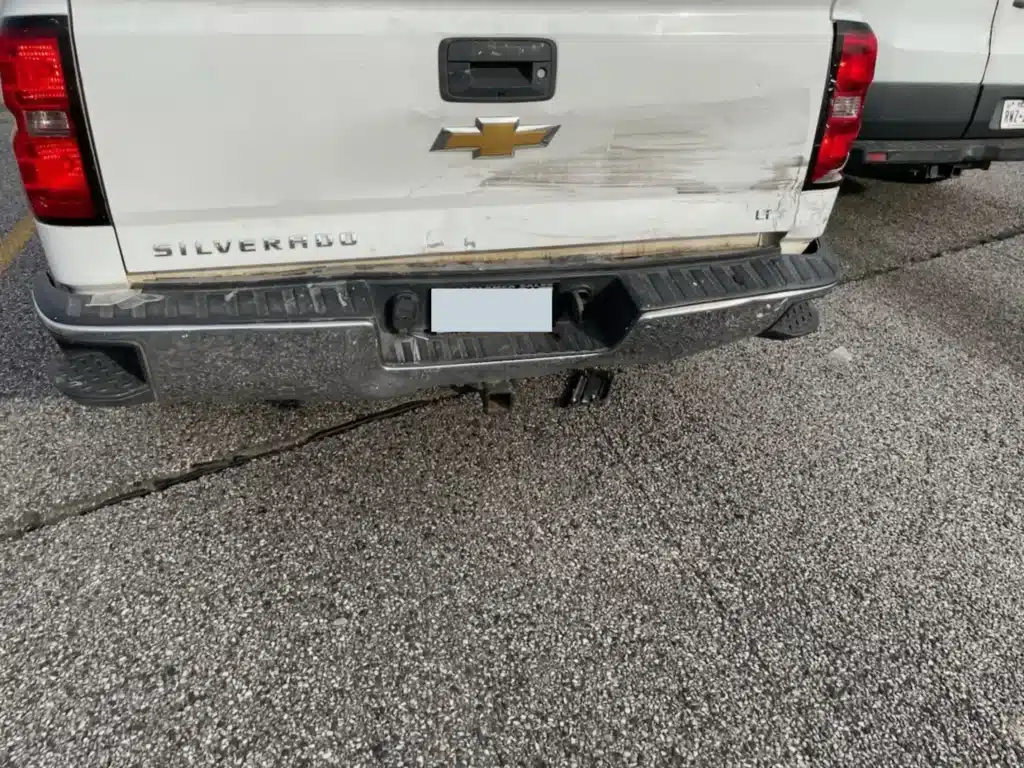
Where one vehicle’s damage appears limited, photographs of every involved vehicle can provide important context. The best practice is to preserve photographs before repairs, towing, sale, dismantling, or disposal make later evaluation more difficult.
The photographs are one part of the evidence. They must be considered together with the available accounts of the collision and the complete property-damage record.
Roughly a quarter of the crashes TxDOT logged in Texas during 2025 were rear-end collisions, the largest single manner of collision group in the state’s records. J. Alexander Law’s Texas Rear End Crash Index tracks that pattern statewide and city by city from 2019 to 2025.
Treatment Documented in the Available Records
The client sought emergency care the day after the rear-end collision. He reported headache, neck pain, chest pain, and back pain. The emergency record documented neck-muscle and chest-wall tenderness, with a normal neurological examination.
CT studies of the head, cervical spine, and chest were reported as normal. The available emergency record states that the lumbar CT was marked abnormal, but the complete lumbar-CT report was not included in the file; the emergency physician documented no acute changes.
The client then treated with a pain-management clinic and a chiropractic clinic. The available records also reflect MRI studies, a lumbar brace, medication, cervical facet injections, and chiropractic treatment.
MRI Findings Were Considered Alongside the Complete Record
MRI studies performed 18 days after the collision documented cervical and lumbar findings. The cervical MRI described a 2 mm disc herniation with an annular tear at C4-5 and mild left-sided narrowing at C5-6 associated with bone spurs.
The lumbar MRI described a 5.5 mm disc extrusion with an annular tear at L4-5. It also described bilateral pars fractures at L5-S1, grade 1 slippage, and mild narrowing of the nerve openings.
The records contain differing descriptions of the L5-S1 condition. The MRI described grade 1 slippage, while later X-rays described grade II slippage and attributed it to a pre-existing pars defect. No orthopedic visit is documented in the available records.
The brain MRI described a small right-frontal white-matter focus that the radiologist considered likely gliosis and was otherwise reported as normal.
Care Progressed Over Approximately Four and a Half Months
- Day 1: Emergency evaluation for reported headache, neck pain, chest pain, and back pain.
- Day 5: Pain-management treatment began. The client reported headaches, neck pain, low-back pain, and right-arm numbness and tingling; medication and therapy were prescribed.
- Day 18: MRI studies of the brain, cervical spine, and lumbar spine were performed.
- Days 33 to 61: The records reflect a lumbar brace, light-duty restrictions, and referrals to orthopedics and neurology.
- Day 69: Right-sided cervical facet injections were performed at C4-5, C5-6, and C6-7.
- Day 90: The pain-management record documented 0/10 neck and back pain and no headaches. The client was released to follow up as needed.
- Day 137: Chiropractic treatment concluded after 25 visits.
Twenty-Five Documented Chiropractic Visits
The client attended 25 chiropractic visits from Day 12 through Day 137. At the initial chiropractic evaluation, he reported headaches; neck pain radiating into both arms; mid-back, low-back, and chest pain; muscle spasm; and reduced range of motion.
The chiropractic records describe electrical stimulation, traction, manual therapy, ultrasound, heat and cold therapy, and exercise. Nerve testing was documented as normal.
X-rays taken during chiropractic care did not identify an acute injury. They described mild arthritic changes and grade II slippage at L5, which the radiologist attributed to a pre-existing pars defect.
The chiropractic discharge record included a future-care estimate. That estimate should be considered alongside the pain-management record documenting 0/10 neck and back pain and no headaches on Day 90.
$100,000 Settlement Before Lawsuit
$100,000
Pre-Litigation Settlement
The claim resolved for $100,000 before a lawsuit was filed.
Every case is different. Past results do not guarantee a similar outcome in another case.
What This Case Shows
- No police report does not mean there is no case, but it increases the importance of prompt evidence preservation.
- Photograph every involved vehicle, including vehicles that appear to have limited visible damage.
- Use wide photographs and close-ups to preserve vehicle positions, roadway conditions, debris, markings, and damage.
- Photographs are important evidence, but they should be evaluated with statements, repair records, vehicle data, and medical documentation.
- Medical records should accurately include improvement, pre-existing findings, conflicting record entries, and the care actually documented.
- A claim can resolve before suit when liability evidence, damages documentation, and case presentation are developed carefully.

Reviewed by: Josh Alexander, Founder and Managing Attorney
Published:
Last reviewed:
More Texas Crash Case Results
- $850,000Pasadena red light crashSettled in litigation
- $600,000Rockwall County five vehicle crashSettled in litigation
- $600,000Mesquite 18 wheeler crashTruck accident settlement
- $325,000Hood County commercial truck crashSettled in litigation
- $175,000Round Rock construction vehicle crashSettled before suit
- $125,000Brownsville armored truck rear endSettled before suit
- $105,000Texas highway unsafe lane changeSettled before suit
- $105,000Three vehicle crash in DallasPolicy limits recovery
- $95,000Midland company truck left turnSettled before suit
- $82,500Plano company truck left turnSettled in litigation
- $50,000Allen rear end crashPolicy limits settlement
- $30,000Houston hit and run recoveryUM policy limits
11Contact
Hit From Behind With
Hit From Behind With
No Police Report?
If another driver hit you from behind and no officer wrote a crash report, J. Alexander Law can help you preserve the photographs, vehicle damage evidence and medical records that carry the claim.
No fee unless we recover · Se habla español · Proudly Serving All of Texas