


Car Accident Case Result
$50,000 Policy Limits Settlement After Allen Rear End Crash
The crash report states that the driver behind our client failed to control speed and struck the rear of her SUV while she was stopped in traffic on northbound U.S. 75 in Allen.
Rear End Car Accident
Northbound U.S. 75 · Allen, Collin County, Texas
The Result
Our client recovered the full $50,000 third party bodily injury policy limit after she was rear ended while stopped in traffic on northbound U.S. 75 in Allen, Texas.
The case resolved before a lawsuit was filed. Although the client did not begin pain management treatment until , the legal team developed the evidence necessary to establish clear liability, document her injuries and treatment, and secure the full available third party policy limit.
Settlement: $50,000 third party policy limit
Resolution: Prelitigation settlement
Case Type: Rear end car accident
Location: Northbound U.S. 75, Allen, Collin County, Texas
Resolution: Prelitigation settlement
Case Type: Rear end car accident
Location: Northbound U.S. 75, Allen, Collin County, Texas
The Rear End Crash
The collision occurred on Thursday, , at approximately 6:03 p.m., in Allen, Collin County, Texas.
The crash occurred on northbound U.S. Highway 75.
- Our client was driving an SUV in northbound traffic.
- Traffic had stopped.
- Our client's vehicle was stopped in the roadway when the driver of a sedan traveling behind her failed to control speed and rear ended her.
- The impact came from directly behind.
- The collision involved two vehicles.
The available crash report information identifies the following driver's failure to control speed as the cause of the rear end collision.
The report did not identify a contributing action by our client.
Read the redacted Allen crash report (PDF)Vehicle Damage and Collision Force
This was not a minor parking lot impact.
The crash caused visible damage to both vehicles.
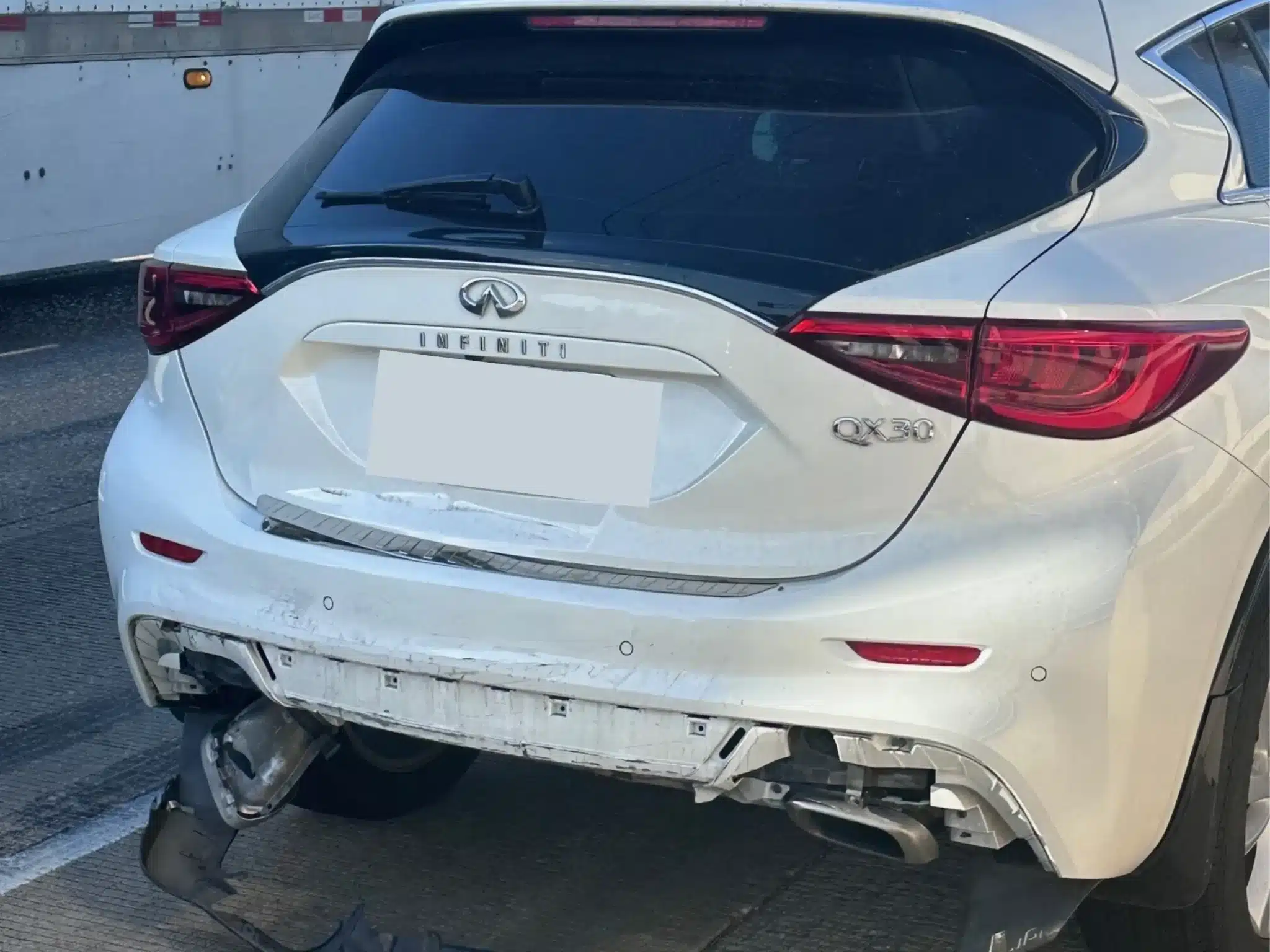
The client's SUV
- The client's SUV sustained rear end damage.
- The rear bumper cover was torn loose and was hanging from the vehicle after impact.
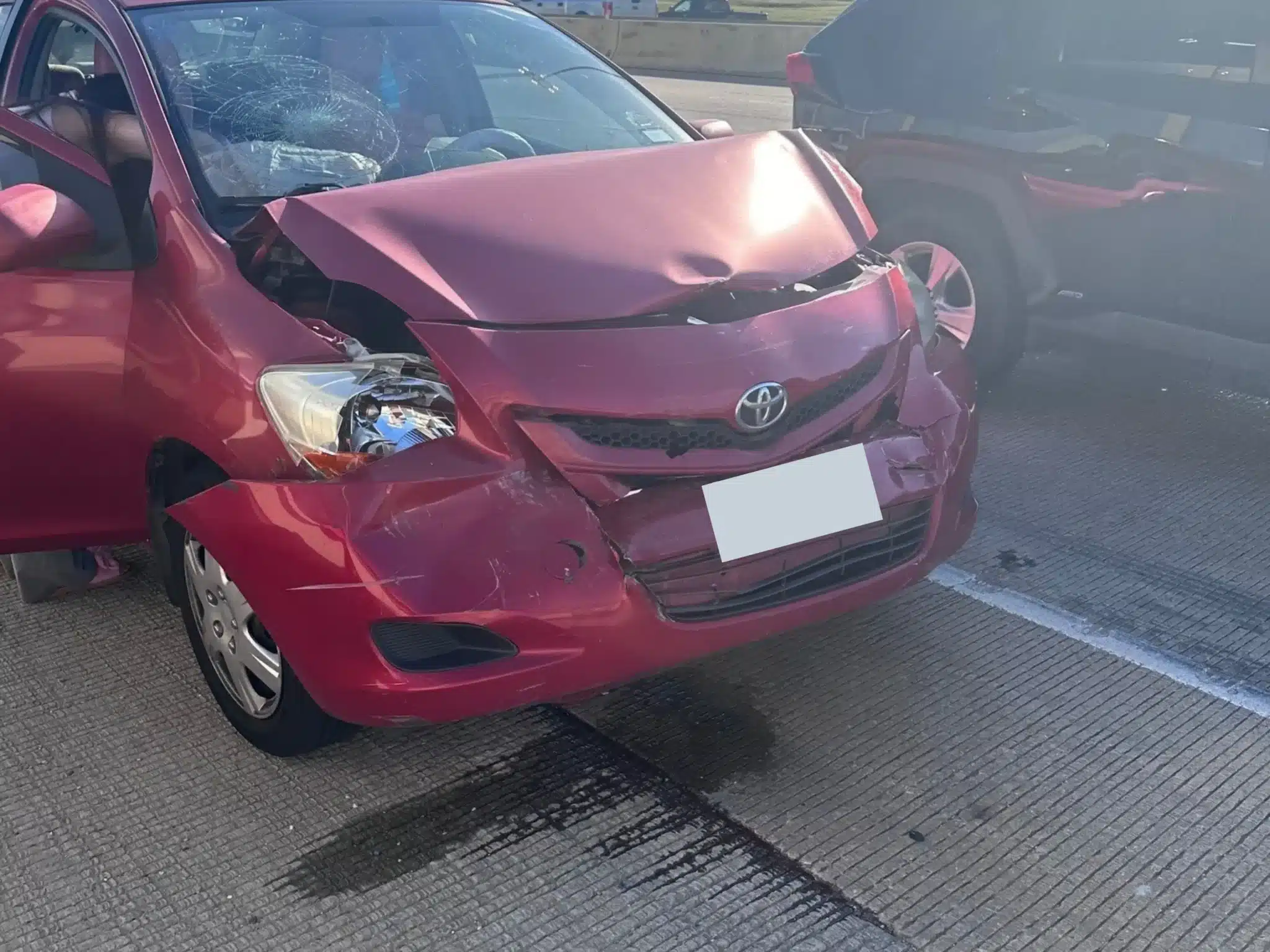
The other driver's sedan
- The other driver's sedan sustained significant front end damage.
- The sedan's hood was visibly crumpled.
- Its front bumper was pushed inward.
- The available photographs also show windshield damage to the striking vehicle.
The damage pattern supports the rear end crash sequence: the following sedan struck the rear of the client's stopped SUV, damaging the SUV's rear and crushing the sedan's front end.
Injuries
The client was a restrained driver.
Her airbags did not deploy.
She did not go to the hospital from the scene.
However, the fact that a person does not leave by ambulance or go directly to an emergency room does not mean the collision caused no injury.
After the crash, the client developed symptoms consistent with whiplash and lower body injury.
Her complaints included:
- 01Whiplash related neck pain.
- 02Lower back pain.
- 03Tailbone pain.
- 04Shooting pain into the right leg.
- 05A sensation of weakness in the right leg.
- 06Muscle spasm.
- 07Pain that affected sleep.
The low back and tailbone pain became more noticeable and worsened in the days after the collision.
Treatment Gap and Pain Management
The client did not begin formal pain management treatment immediately after the August 15 crash.
She began treatment with a pain management provider on .
August 15, 2024Rear end crash
Treatment gap
September 4, 2024Pain management treatment begins
The existence of a treatment gap did not change the core liability evidence: she was stopped in traffic when another driver failed to control speed and rear ended her.
It also did not prevent the legal team from building a complete damages claim.
First Pain Management Examination
At her first pain management examination, the client reported low back pain at an 8 out of 10 level, shooting pain, and a sensation of weakness involving her right leg.
The examination documented muscle spasm, tenderness, and positive back tests.
She was diagnosed with lumbar sprain/strain, muscle spasm, and lumbar radiculopathy.
The treatment provider prescribed ibuprofen 800 mg, ordered a lumbar MRI, and referred her for chiropractic treatment.
Chiropractic Care and Continued Treatment
The client continued with chiropractic care from late September through mid November 2024.
She attended approximately 20 chiropractic visits.
Treatment included:
- Electrical stimulation.
- Mechanical traction.
- Spinal adjustments.
- Massage.
- Therapeutic exercise.
Her chiropractic diagnoses included lumbar sprain, myalgia, and sleep disorder.
- Initial chiropractic examinationAt the initial chiropractic examination, her lumbar range of motion was moderately restricted.
- Mid treatment reevaluationAt a mid treatment reevaluation, her progress was described as slower than expected.
- November reevaluationBy the November reevaluation, her progress was described as improving as expected. Her pain was intermittent, and she did not report numbness, sleep problems, or medication use at that visit.
MRI Findings
A lumbar MRI performed on , documented findings at L4-5 and L5-S1.
At L4-5, the MRI identified:
- 01A 3 mm disc bulge with bone spurs.
- 02A subtle 2 mm central disc herniation.
- 03An annular tear.
- 04Mild to moderate narrowing of the right side nerve opening.
At L5-S1, the MRI identified:
- 01A 3.5 mm disc bulge with bone spurs.
- 02A 3 mm right sided disc herniation.
- 03An annular tear.
- 04Mild narrowing of the spinal canal and right side nerve pathway.
- 05Moderate disc degeneration and endplate changes.
The records describe certain findings (including bone spurs, loss of disc height and hydration, and endplate changes) as degenerative. The client's medical providers nevertheless evaluated the MRI in connection with her post crash low back symptoms and treated her for lumbar disc herniation and radiculopathy.
Spinal Injection
Conservative treatment alone did not immediately resolve the client's symptoms.
As treatment continued, the client elected to proceed with an interventional spinal procedure.
On October 23, 2024, she underwent right sided spinal injections at L4-5, L5-S1, and S1 under IV anesthesia.
The procedure included right sided nerve root blocks and disc nerve blocks.
The procedure diagnosis included lumbar disc herniation and radiculopathy.
Reported low back pain
First pain management examination8 out of 10
November 1 follow up3 out of 10
At the November 1 follow up appointment, the client reported that her pain had greatly improved and was at a 3 out of 10 level, mainly in the morning. She reported that she had not needed medication since the injection.
November 15, 2024No low back pain
At her final pain management appointment on November 15, 2024, she reported no low back pain, planned to stop chiropractic treatment, and was discharged from pain management.
Treatment and Medical Documentation
After the rear end collision, the client's low back and tailbone pain continued and required a structured course of care. She began with pain management treatment, underwent diagnostic imaging, completed chiropractic care, and later proceeded with an interventional spinal procedure after conservative treatment did not immediately resolve her symptoms.
Her records documented evaluation for lumbar sprain and strain, muscle spasm, radiating symptoms, and lumbar disc related findings. The treatment plan included medication, MRI imaging, chiropractic care, follow up appointments, and a spinal injection. After the injection, the client reported substantial improvement. At her final pain management visit, she reported no low back pain and was discharged from pain management.
Overcoming the Treatment Gap
Insurance companies often attempt to use any delay between a crash and the first formal medical appointment to minimize an injured person's claim.
In this case, the client did not start pain management care until , after the August 15 collision.
The attorney did not allow that delay to define the value of the case.
Instead, the legal team focused on the complete evidence:
- 01The client was stopped in northbound U.S. 75 traffic when the following driver failed to control speed.
- 02The collision caused clear rear end damage to the client's SUV and substantial front end damage to the striking sedan.
- 03The client developed lower back and tailbone pain after the crash.
- 04Her pain management examination documented an 8 out of 10 pain level, spasm, tenderness, and radiating symptoms.
- 05Her providers ordered an MRI and diagnosed lumbar sprain/strain, muscle spasm, lumbar radiculopathy, and later lumbar disc herniation.
- 06She completed approximately 20 chiropractic visits.
- 07She required prescription medication and an interventional spinal injection.
- 08The injection provided significant relief, but only after the client underwent continued evaluation and treatment.
By presenting the full timeline, not simply the date of the first appointment, the legal team established the seriousness of the claim and supported a policy limits recovery.
Policy Limits Result
The claim was resolved before litigation became necessary.
The legal team obtained the full available $50,000 third party bodily injury policy limit.
$50,000 Third Party Policy Limits Settlement
Resolved before litigation
Resolved before litigation
This case shows why a treatment gap should not automatically define the outcome of an injury claim. When liability is clear, damage evidence is preserved, medical records support the injury progression, and treatment is properly documented, it is still possible to obtain the full available recovery.
Direct Case Experience
This case summary is based on evidence developed during the firm's representation of the client.
That evidence included the official Texas crash report, vehicle damage photographs, medical records, chiropractic records, pain management records, lumbar MRI findings, procedure documentation, billing records, and settlement documentation.
The case was developed as a complete rear end collision claim, from the stopped traffic impact on northbound U.S. 75 through the client's lower back and tailbone symptoms, treatment gap, chiropractic care, MRI findings, spinal injection, and prelitigation policy limits settlement.
Attorney Review

Reviewed by: Josh Alexander, Founder and Managing Attorney
Published:
Last reviewed:
Case Result Disclaimer
Every case is different. Past results do not guarantee a similar outcome. Recoveries depend on the facts of the collision, liability evidence, available insurance coverage, injuries, medical treatment, medical documentation, damages, and other case specific circumstances.
15Contact
Hurt in a
Hurt in a
Rear End Crash?
If another driver rear ended you and you were injured, J. Alexander Law can review the facts of your situation.