


Round Rock Construction Vehicle Accident Settlement
$175,000 Settlement After Construction Vehicle Ran Stop Sign in Round Rock
Our client had the right of way on Avery Nelson Parkway when a heavy duty construction vehicle entered from Salerno Estates, which was controlled by a stop sign. The other driver slowed as though he would stop, then accelerated into her path.
She braked hard, honked, and steered away, but the crash could not be avoided. The claim resolved before a lawsuit was filed for $175,000.
Case at a Glance
| Case detail | Information |
|---|---|
| Result | $175,000 pre litigation settlement |
| Crash location | Avery Nelson Parkway and Salerno Estates, Round Rock, Texas |
| Crash type | Construction vehicle stop sign collision |
| Client’s right of way | Client was traveling on Avery Nelson Parkway |
| Other driver’s approach | Entered from Salerno Estates, a stop controlled street |
| Documentation issue | Officer provided an information exchange slip, not a narrative crash report |
| Care documented | Emergency treatment, MRI studies, pain management care, cervical epidural injection, and chiropractic treatment |
How the Crash Happened
The collision occurred at the intersection of Avery Nelson Parkway and Salerno Estates in Round Rock. The client was traveling on Avery Nelson Parkway, while the other driver approached from Salerno Estates.
Salerno Estates was controlled by a stop sign. The client had the right of way.
- According to the client, she was traveling approximately 30 to 35 mph, below the 45 mph posted speed limit. She had reduced her speed because it was early in the morning and pedestrians were present in the area.
- The other driver slowed near the stop sign. The client reasonably believed the driver would stop and yield before entering Avery Nelson Parkway.
- Instead, the other driver accelerated into her path.
- The client immediately tried to avoid the crash. She braked hard, sounded her horn, and steered away from the construction vehicle. There was not enough time or space to avoid impact.
- The front right portion of the client’s sedan struck the driver rear area of the other vehicle.
Why the Other Driver Was at Fault
The client had the right of way on Avery Nelson Parkway. The other driver was entering from a stop controlled street and had a duty to stop and yield before proceeding into through traffic.
A driver approaching a stop sign cannot merely slow down and continue into a roadway. The driver must stop, observe traffic, and yield until it is safe to proceed.
The client’s account was that the other driver slowed as though he would stop, but then entered the roadway and accelerated into her path. She was already traveling below the speed limit and took immediate evasive action.
Failure to yield was the factor officers listed most often in the crashes counted by the Texas T Bone Crash Index, 48.8% of them, and stop signs or flashing red lights were the traffic control most often present where those collisions happened. That index counts crashes without assigning fault in any one of them.
A Construction Vehicle Collision
The other vehicle was described as a heavy duty construction vehicle. That detail mattered because commercial or work related vehicles can raise questions beyond the individual driver’s conduct.
Those questions may include:
- 01Who owned the vehicle
- 02Whether the driver was working at the time of the crash
- 03Whether a company employed or controlled the driver
- 04Whether the company had commercial insurance coverage
- 05Whether the vehicle had identifying marks, company materials, equipment, or business cards
- 06Whether the company maintained additional records relevant to the collision
The client reported that the driver was later found to be uninsured and without a valid driver’s license. That did not end the investigation. When a work vehicle is involved, identifying the company connection can be critical.
No Narrative Police Report
Round Rock Police responded to the collision and provided an Accident Information Exchange document. The exchange slip identified the parties, vehicles, insurance information, location, date, and responding officer.
But it was not a narrative crash report.
It did not explain how the collision happened. It did not identify the stop sign. It did not state who had the right of way. It did not include a diagram, witness statements, a fault finding, or a traffic citation determination.
This distinction matters because many people understandably assume that any form provided by an officer is a complete police report. In reality, an information exchange slip may only provide basic identifying and insurance information.
A client should always ask the responding officer:
- Will a formal crash report be prepared?
- What is the report or incident number?
- How can the report be obtained?
- Was a citation issued?
- Were witnesses identified?
- Is there body camera, dash camera, or other video evidence?
- Was the crash photographed or diagrammed by law enforcement?
A formal CR-3 also carries coded fields the exchange slip lacked, including the Box 36 contributing factor codes for each unit and the KABCO injury severity letters. Our Texas Crash Report Decoder translates every one of those codes into plain English.
Why Scene Documentation Mattered
The absence of a narrative crash report made scene evidence especially important.
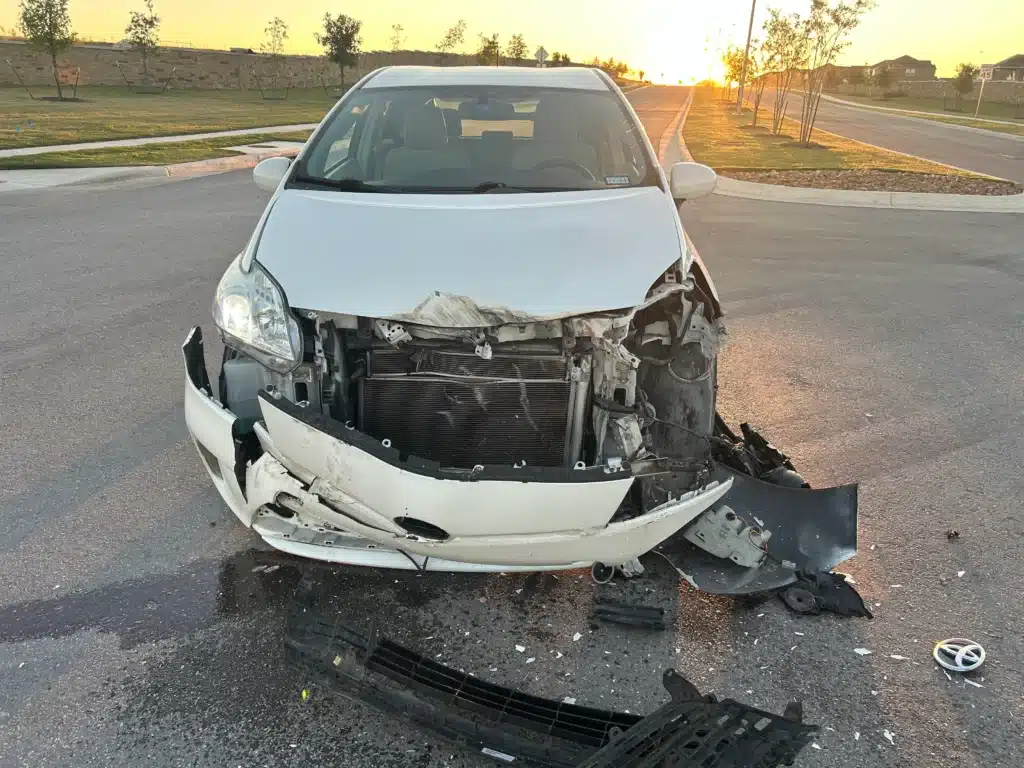
This client took one photograph of the crash and one photograph of a business card from the construction company. She believed a formal police report would later be available and did not realize that the exchange slip was not a full accident report.
The available photographs still mattered. The crash image helped preserve the collision scene, while the business card image helped identify the company connected to the commercial vehicle.
That evidence became particularly important because the individual driver’s insurance and license status created concerns about whether the driver personally carried valid coverage.
What to Document at a Crash Scene
If you are physically able to do so, document as much as possible before vehicles are moved or witnesses leave.
- Photograph each vehicle from all sides
- Photograph license plates and registration stickers
- Photograph company names, logos, business cards, unit numbers, and vehicle markings
- Photograph stop signs, traffic lights, lane markings, crosswalks, road conditions, and sightlines
- Photograph debris, skid marks, broken parts, and the final resting positions of the vehicles
- Record the date, time, weather, lighting conditions, and exact location
- Ask witnesses for their names and phone numbers
- Ask whether nearby homes, businesses, traffic cameras, or doorbell cameras may have captured video
- Get the officer’s name, badge number, incident number, and report information
- Save all photographs, texts, call logs, notes, and communications in their original form
Even one additional photograph can preserve information that may be unavailable later.
Emergency Treatment After the Collision
The client sought emergency medical care on the day of the crash.
She reported headache, mid back pain, lower back pain, and severe pain involving her left thigh and outer left knee. Her pain was recorded as severe.
The emergency examination documented tenderness in the spine, left thigh, and outer left knee. Her neurological examination was normal. She reported no head strike, no loss of consciousness, and no neck pain at that initial visit.
CT imaging of the head, thoracic spine, and lumbar spine did not identify an acute injury. A left knee X ray was also normal.
The emergency diagnoses included:
- Concussion without loss of consciousness
- Thoracic sprain
- Lumbar sprain
- Left thigh contusion
- Left knee contusion
- Left lateral collateral ligament sprain
The client was discharged with pain medication, a muscle relaxant, and instructions to work from home for one week.
Medical Treatment After the Crash
The records reflect approximately four months of follow up treatment across an emergency center, pain management clinic, chiropractic clinic, and MRI facility.
At the pain management clinic, the client reported low back pain, right shoulder pain, right knee pain, and neck pain radiating toward the shoulder.
The examination documented muscle spasm, reduced range of motion, positive facet loading findings, and positive shoulder impingement findings. Strength and sensation were normal.
The provider ordered MRI studies and referred the client for chiropractic treatment.
MRI Findings and Pain Management Care
The cervical MRI identified disc herniations at C5-6 and C6-7. The report described contact with the spinal cord and left nerve rootlets without compression.
The MRI also documented mild canal narrowing at C3-4 and loss of normal cervical curvature, described as consistent with muscle spasm or strain.
The lumbar MRI was normal and did not identify a disc herniation.
The right shoulder MRI described:
- Rotator cuff tendinosis without a tear
- Trace biceps tenosynovitis
- Mild bursitis
- Tiny joint effusion
- Mild AC joint arthritis
The right knee MRI described:
- Findings suggesting a prior ACL sprain without rupture
- Mild meniscal changes without a tear
- Small joint effusion
- Soft tissue swelling
During follow up care, the client was diagnosed with cervical and lumbar radiculopathy and traumatic injury to the right shoulder and knee.
The records reflected improvement in the shoulder and knee symptoms, while neck and lower back symptoms persisted.
Cervical Injection and Recovery
The client initially declined further injections.
At approximately 12 weeks after the collision, she underwent a cervical epidural steroid injection at C7-T1. The records noted no complications.
At the final pain management visit, around four months after the crash, the provider documented more than 70 percent improvement in neck pain. The client reported mild pain in the remaining areas.
She declined further injections and was advised to continue a home exercise program. The provider noted that repeat treatment could be considered if symptoms returned and that future care might be needed.
Chiropractic Treatment
The client attended 23 chiropractic visits beginning approximately one week after the crash and continuing through about week eight.
Her initial complaints included constant neck, mid back, low back, and right knee pain. She also reported symptoms radiating into both shoulders and buttocks, along with difficulty sleeping.
The chiropractic treatment included:
- Spinal manipulation
- Therapeutic exercise
- Manual therapy
- Traction
- Electrical stimulation
At discharge, the records documented moderate improvement and improved range of motion. The client was released with a home exercise program.
The final chiropractic report stated that she was more susceptible to future flare ups and could require additional care.
Medical Record Issues
A complete presentation of the claim required careful attention to the medical records.
The emergency department documented left knee and left thigh complaints. Later records focused more heavily on right knee, right shoulder, neck, and back symptoms.
The crash mechanism was also described in different ways in the records, including right front impact, front impact, and sideswipe.
These issues did not eliminate the claim. They required the facts and treatment to be presented accurately, with a clear explanation of what each record documented.
$175,000 Settlement Before Lawsuit
$175,000
Pre Litigation Settlement
The claim resolved before a lawsuit was filed for $175,000.
The settlement reflected the evidence that the client had the right of way, the other driver entered from a stop controlled street, the client’s attempts to avoid the crash, the commercial connection to the construction vehicle, the limited but important scene documentation, emergency treatment, MRI studies, pain management care, a cervical epidural injection, and chiropractic treatment.
What This Round Rock Case Shows
This case shows why the moments immediately after a crash can matter long after the vehicles leave the scene.
The client reasonably believed that a police officer’s exchange slip meant a complete accident report would be available later. But the document was only an information exchange form. It did not preserve the stop sign, the right of way issue, a crash diagram, witness accounts, or an officer’s conclusion about fault.
The client’s limited photographs became important because they helped preserve the collision and identify the construction company involved.
For anyone involved in a crash with a work vehicle, the lesson is straightforward: do not assume someone else will preserve the evidence for you. Ask questions, take photographs, identify the company, gather witness information, and obtain medical care promptly.
Attorney Case Review
The key liability issue was the stop controlled approach from Salerno Estates. The client was traveling on Avery Nelson Parkway with the right of way when the other driver entered her path.
The limited scene documentation made the investigation more challenging. There was no narrative police report explaining how the crash occurred or assigning fault. The information exchange slip provided important identifying details, but it did not substitute for crash scene evidence.
The commercial connection also mattered. The client reported that the driver was uninsured and unlicensed, requiring attention to the construction company and other possible sources of responsibility or coverage.
The medical presentation required precision. The records documented emergency complaints, follow up pain management care, MRI studies, chiropractic care, a cervical epidural injection, improvement over time, and possible future treatment needs. They also contained differences in the descriptions of injury location and crash mechanism that had to be evaluated honestly.
The claim resolved before litigation for $175,000.
Identifying information has been withheld to protect client privacy. Past results do not guarantee a similar outcome. Every case depends on its own facts, injuries, evidence, insurance coverage, and applicable law.

Reviewed by: Josh Alexander, Founder and Managing Attorney
Published:
Last reviewed:
More Texas Crash Case Results
- $850,000Pasadena red light crashSettled in litigation
- $600,000Rockwall County five vehicle crashSettled in litigation
- $600,000Mesquite 18 wheeler crashTruck accident settlement
- $325,000Hood County commercial truck crashSettled in litigation
- $105,000Texas highway unsafe lane changeSettled before suit
- $105,000Three vehicle crash in DallasPolicy limits recovery
- $100,000Rear end, no police reportSettled before suit
- $95,000Midland company truck left turnSettled before suit
- $82,500Plano company truck left turnSettled in litigation
- $50,000Allen rear end crashPolicy limits settlement
- $30,000Houston hit and run recoveryUM policy limits
18Contact
Hit by a Construction
Hit by a Construction
or Work Vehicle in Texas?
If a construction vehicle, work truck, or company vehicle caused a crash in Round Rock, Austin, or elsewhere in Texas, J. Alexander Law can review the scene evidence, identify the company behind the vehicle, and check every available source of coverage.
No fee unless we recover · Se habla español · Proudly Serving All of Texas