


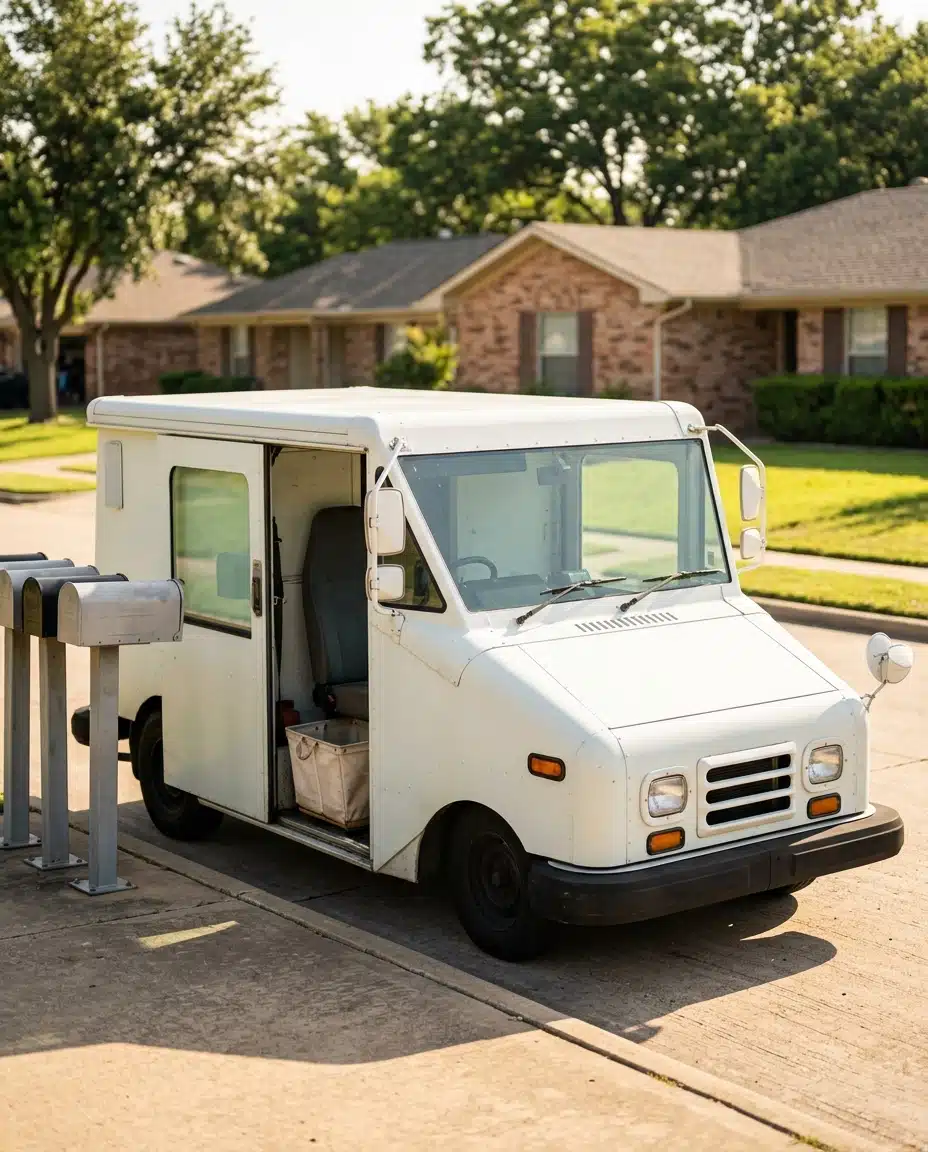
USPS mail truck accident lawyers in Texas.
Reviewed by Josh Alexander, Founder & Managing Attorney | Updated
A mail truck accident claim in Texas goes against the United States government, not against an insurance company. The law behind it is the Federal Tort Claims Act: no adjuster will ever be assigned to you, and you have two years from the crash date to get a written claim to the Postal Service, 28 U.S.C. Sec. 2401(b). Texas negligence rules still decide whether the postal driver was careless.
Rated 4.9 from 568+ client reviews- $100M
Recovered for clients
- 4.9
Average client rating
- 568+
Client reviews
- 5
Years Super Lawyers Rising Stars
 Dallas Stars
 SMU Athletics
 Sporting United
 Super Lawyers Rising Stars
 Multi-Million Dollar Advocates Forum
 Million Dollar Advocates Forum
 Texas Trial Lawyers Association
Reflects total client recoveries across hundreds of resolved matters. Past results do not guarantee a similar outcome.
A USPS accident claim runs against the United States, not an insurance company.
USPS trucks do not carry auto insurance the way private vehicles do; the federal government covers its own vehicles, so there is no insurance company for you to call and no adjuster is ever assigned to your claim. Instead, the Federal Tort Claims Act makes the United States responsible for the crash, and your claim starts only when the Postal Service receives it from you in writing. The Postal Service then reviews and settles the claims it accepts, 28 U.S.C. Sec. 2672.
Your two year deadline to send that written claim starts the day of the crash, 28 U.S.C. Sec. 2401(b), and it keeps counting whether or not anyone contacts you. No adjuster will call, so do not wait for a call before starting your claim.
Texas law still decides what careless driving means here. Federal law borrows the rules of the state where the crash happened, 28 U.S.C. Sec. 1346(b)(1), so Texas traffic and negligence rules measure the postal driver. One exception: a city or county vehicle falls under the Texas Tort Claims Act instead of federal law, and our company vehicle accident guide covers those claims.
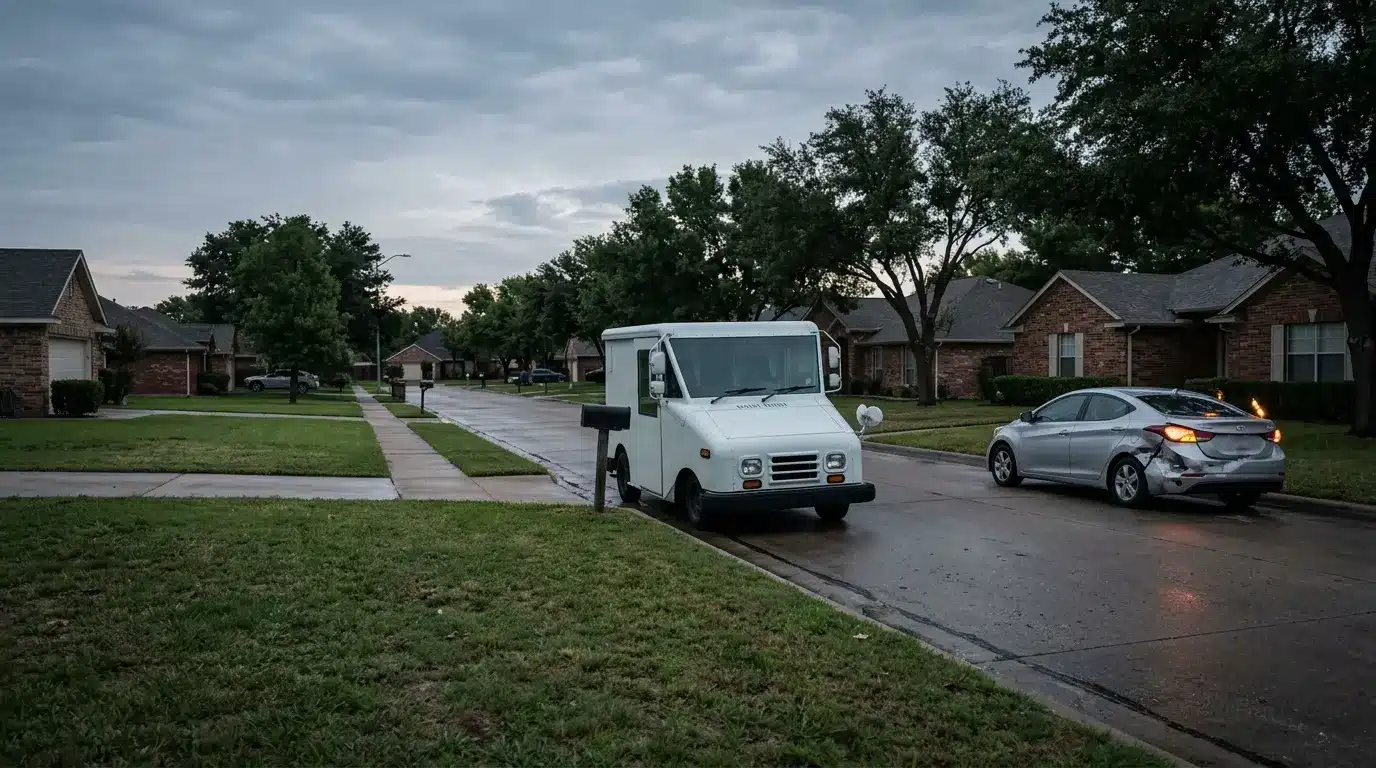
USPS tort claims run on two federal deadlines.
First deadline: you have two years from the crash date to get a written claim to the Postal Service, and the claim only counts on the day the agency receives it, not the day you mail it, 28 U.S.C. Sec. 2401(b). After a USPS truck crash we mark that date the week your file opens. Exceptions are narrow, so confirm your dates with an attorney instead of assuming one covers you.
Second deadline: if the Postal Service denies your claim in writing, you have six months from the date it mails that denial to file your lawsuit, 28 U.S.C. Sec. 2401(b). If six months pass after your claim goes in and the agency has said nothing, you may treat that silence as a denial and file suit, 28 U.S.C. Sec. 2675(a). That choice is yours; silence alone does not end the claim.
One warning: if a private contract carrier was driving instead of a postal employee, neither federal deadline applies. That claim is filed in Texas court within two years of the crash, Tex. Civ. Prac. and Rem. Code Sec. 16.003, and the section below shows you which situation is yours.

Who was driving the mail truck decides your case.
A postal employee on duty makes the claim federal. A contract carrier makes it a regular Texas injury case, the same kind as any other car crash lawsuit, and an Amazon, FedEx, or UPS van was never federal to begin with. We settle this question from the crash report before anything is drafted, because it decides the defendant you name, the form you file, and the deadline you are on.
A postal employee on duty: the United States answers for the crash.
Your claim is against the United States government, not the mail carrier, 28 U.S.C. Sec. 2679. It starts as a written claim sent to the Postal Service on Standard Form 95, and you have two years from the crash to get it there, 28 U.S.C. Sec. 2401(b).
If a lawsuit follows, it goes to federal court and a judge decides it without a jury. The sections below walk through both steps.
1 What this means for your claim
Standard Form 95Two years to presentUnited States is the defendantFederal district court
A contract carrier on the route: a regular Texas injury case against that company.
Some mail routes are driven by private companies the Postal Service hires, called contract carriers. Federal law does not treat those companies as government employees, 28 U.S.C. Sec. 2671, so you sue the company itself in Texas court like any other car crash case, and its commercial auto insurance pays what you recover. The lawsuit is due within two years of the crash, Tex. Civ. Prac. and Rem. Code Sec. 16.003.
There is no Standard Form 95 and no six month waiting period in these cases. Filing the federal form protects nothing when a private company was driving.
2 How we identify the carrier
Owner and employer fields on the CR 3Written request asking who staffed the routeCoverage checked once the company is named
An Amazon, FedEx, or UPS van: a Texas case against a private company, never a federal claim.
An Amazon, FedEx, or UPS van has nothing to do with the federal claim process: no Standard Form 95, no United States defendant, no federal deadline. Each of those companies uses its own contractor setup, which changes who you sue, and Texas fault rules apply from start to finish.
Our Texas delivery vehicle accident page covers each of those companies, and that is the right page for a delivery van claim.
3 What changes
Private company defendantTexas courtNo federal claim step
Not sure who was driving? Call 469-807-7480 and we will read the crash report with you.
How do I file an auto claim against the USPS?
You cannot sue the Postal Service right away. Federal law makes you send a written claim first, and a lawsuit filed before that claim is received gets thrown out of court, 28 U.S.C. Sec. 2675(a). The written claim goes on a government form called Standard Form 95, the USPS tort claim form, following the postal rules at 39 CFR Part 912.
Box 12d of the form asks for one total dollar amount, called the sum certain. Leave it blank, write an estimate, or give a range, and the law treats your claim as never filed, 39 CFR 912.5. Your injuries and your wrecked car go into that same single number; the car does not get its own claim or its own deadline.
The number in box 12d should state your full losses before any fault reduction. If you were partly at fault, Texas law subtracts your percentage from whatever you recover later. That is why we work out the fault question, starting with the crash report, before the form is ever filled in.
How we build your case
- Bills already issued. We start with the medical bills you already have from the hospital, the doctors, and the pharmacy. The Postal Service can verify every one of those charges, which makes them the strongest part of the figure.
- Income already gone. Next we add the pay you lost while you could not work. Your pay stubs and work records prove exactly how much that was.
- Treatment still coming. If you will need more care after the claim goes in, your own treating doctor writes down what that future treatment will cost. That written estimate from your doctor goes into the total, and if the two year deadline arrives before treatment ends, we file with the bills so far plus that estimate instead of missing the date.
What is the address for USPS tort claims?
There is no single USPS tort claim address. Your claim only counts on the day the Postal Service receives your signed Standard Form 95, not the day you mail it, 39 CFR 912.5. The rules name two possible receiving offices, the local District Tort Claims Coordinator and the National Tort Center, and the right one depends on where your crash happened.
Because your two year deadline depends on that received date, we confirm the correct office in writing before mailing anything. Then we ask that office to confirm it received the form, and we keep proof of mailing so the date can be proved either way.
A USPS accident report starts nothing. Only the written claim does.
Telling a postal clerk about the crash, calling it in, or filling out an incident form does not start your claim, 28 U.S.C. Sec. 2675(a). Only the written claim the Postal Service receives starts the six month count, so a report alone never lets you treat silence as a denial.
Already reported it? Good; tell us the date and who you spoke to. We use that report as evidence and send the written claim separately.
You sue the United States, and a federal judge decides the claim.
If your claim ends in a lawsuit, you sue the United States of America. Not the mail carrier, and not the Postal Service. When the driver was working at the time of the crash, federal law makes the government the only defendant, 28 U.S.C. Sec. 2679.
The lawsuit goes to federal court, not a Texas county court, 28 U.S.C. Sec. 1346(b)(1). There is no jury: one federal judge decides who was at fault and how much money you recover, 28 U.S.C. Sec. 2402. That judge reads documents, so we build your file around the crash report, your photographs, and your medical records from week one.
USPS accident claims end one of three ways: the Postal Service pays, it denies, or it never answers. No law forces the agency to respond to your claim. We mark the six month date the day your claim goes in, because after six months of silence you can treat the claim as denied and file suit; the deadlines section above explains that choice.

Proving fault in a mail truck crash
Your own share of fault cuts the recovery
Under Tex. Civ. Prac. and Rem. Code Sec. 33.001, your recovery drops by your percentage of responsibility, and a share above 50 percent bars recovery entirely. Prove 100 dollars of loss at 20 percent fault and you collect 80.
Shared blame does not end a postal vehicle accident claim, but every point assigned to you comes off the amount. So we compare the crash report with your photographs before any number goes on the form; if the report blames you for more than the photos show, we know in week one.
Start your case reviewThe Texas CR 3 crash report
The Texas crash report, called the CR 3, has fields that name who owns the truck and who the driver works for. Those two answers tell us whether your claim is federal or a Texas case, so we read the report in the first week. The officer’s written account of what happened also counts for more in an injury claim than any ticket does.
The fleet number on the truck
A postal vehicle carries a fleet number on its body. Photograph it while the truck is still there, because that number identifies the vehicle months after it is gone.
Your photographs and nearby footage
Your phone photos are stamped with the time, and they show where the vehicles sat and what the damage looked like before anything moved. Save any doorbell clip and every witness phone number the same night, because a neighbor’s camera can record over its footage within days.
What the government holds
Nobody knows whether a postal vehicle had a camera until somebody checks. Once your claim is in, we ask the government for what it holds and send a written request naming the evidence we want preserved. That request cannot force anything, so keep your own copies of every photograph and every document you send.
What you can recover from the United States.
There is no insurance policy limit on a federal claim; the ceiling is what you can prove and the single number you put on the form. One federal rule cuts the other way: 28 U.S.C. Sec. 2674 blocks punitive damages and pre judgment interest, so the government only pays for your actual losses.
Medical care
Treatment already billed, plus future care your own doctor puts a written cost on. A guess written later does not count; the doctor’s estimate does.
Lost income
The pay you missed while you could not work, proved with pay stubs, plus future income lost if the injury changes what work you can do.
Property damage
Your wrecked vehicle goes into the same single number as your injuries, on the same two year deadline. A post office accident gives the car no separate claim.
Losses with no invoice
Pain, lost sleep, and physical limitation never arrive as a bill, so they have to be recorded in your medical chart. Tell the doctor at every visit what you can no longer do; what reaches the chart, we can claim.
Keep every bill, referral, and pay stub in one folder starting tonight. For how a Texas claim is valued, see our guide on average car accident lawsuit value in Texas, and our crash injury visualizer shows what a given diagnosis does inside the body.
Results from Texas motor vehicle claims.
- $716KMotor vehicle accident
Recovered for a driver injured by another motorist’s negligence.
- $350KMotor vehicle accident
Settlement for a client rear ended in Texas traffic.
- $15M18 wheeler, wrongful death
Recovered for a family after a fatal collision with a commercial truck.
- $2.55M18 wheeler crash
Resolved for a client seriously hurt in a wreck with a tractor trailer.
- $1M18 wheeler crash
Recovered after a heavy truck caused a high impact highway collision.
- $750K18 wheeler crash
Settlement for injuries from a commercial truck collision.
Sample results from actual past cases, none of which involved the Postal Service. More recoveries are on our full results page. Past results do not guarantee a similar outcome.
Who handles these claims
You reach an attorney, not a call center. Calls are answered in English and in Spanish.
Josh Alexander
Founder & Managing AttorneyA Texas trial lawyer and Marine Corps veteran, with over ten years in the courtroom and millions recovered for clients across the state. On a postal file he proves fault and sets the figure that goes on Standard Form 95.
Meet Josh Alexander
Matthew Graham
Managing Litigation AttorneyRan insurance defense litigation for over ten years at the country’s second largest auto insurer, so he knows how the other side prices a file. He works for the injured now.
Meet Matthew Graham
Laura Rivas
Senior Associate AttorneyNine years representing injured Texans in vehicle, truck, catastrophic injury, and wrongful death claims, and she takes calls in English and in Spanish.
Meet Laura Rivas


Questions Texans ask after a mail truck wreck.
The form, the deadlines, and the defendant are covered in the sections above. These are the questions that come up on first calls.
Talk to an attorney today
Bring us the crash report and the date it happened. The first thing we mark is your two year deadline to get the written claim to the Postal Service.
Call (469) 807-7480Is hitting a mail truck a federal offense?
No. A traffic collision is not by itself a federal crime, and Texas negligence rules decide who drove carelessly. The money claim is the federal part: it names the United States and follows the FTCA deadlines.
Do mail trucks have to follow traffic laws?
Yes. Federal law borrows the traffic rules of the state where the crash happened, 28 U.S.C. Sec. 1346(b)(1), so Texas rules decide whether the postal driver was negligent.
Can USPS trucks get tickets?
Yes, police can ticket a postal driver, but a ticket is not what wins an injury claim. Fault is proved with the CR 3 crash report, your photographs, and witness statements, so we start with those.
Do USPS cars have cameras?
Some do and some do not, so treat it as unknown until somebody checks. After your claim is in, we ask the government what it holds and send a written request to preserve it. Your own photographs and any doorbell footage usually matter more.
Do mail trucks have insurance?
USPS vehicles do not carry auto insurance the way private vehicles do; the federal government covers its own vehicles. The United States pays valid claims itself, through the written claim process on this page. A contract carrier is different: that private company carries its own commercial auto insurance, and you claim against the company in a Texas case.
How do I contact the USPS Claims Department?
There is no claims department hotline and no adjuster to reach. Everything moves through the written claim and the two federal deadlines, so we handle the letters and track both dates for you.
How long does it take USPS to settle a claim?
No law sets a time, and nothing forces the agency to answer at all. Once six months pass after your claim goes in with no decision, you may treat the silence as a denial and file suit, 28 U.S.C. Sec. 2675(a).
Related reading.
-
Different vehicle
Amazon, FedEx, and UPS van crashes run on Texas rules from day one
Those claims never involve a federal step, and the contractor setup behind each brand is explained on the delivery vehicle page.
Go to delivery vehicle accidents -
Employer responsibility
When a company answers for its driver
Texas employer rules and the Texas Tort Claims Act for city and county vehicles, neither of which governs a federal postal claim.
Read the employer rule -
First steps
What to do in the hours after a Texas crash
Photographing the fleet number is the postal step; this guide covers the rest of the first 48 hours, step by step.
See the first steps -
Deadlines
The Texas deadlines a contract carrier claim runs on
Check your dates -
Case value
What a Texas accident case is worth
See how value is built -
Injury anatomy
Type your diagnosis into the crash injury visualizer
Open the visualizer
From Josh Alexander
“I’ve spent years asking the same question inside Texas courtrooms: what really happened, and who is responsible for it? Insurance companies are built to pay out as little as possible. Trucking companies are built to protect their drivers’ records, not yours. My job is to make sure that changes. You don’t pay me a dollar unless I win. That’s the only way I’ve ever done this.”
Josh Alexander
Founder & Managing Attorney
Marine Corps veteran, Texas trial lawyer
On a postal file that promise works the same way. You bring the crash report and the date of the crash; we prepare the written claim, track both federal deadlines, and answer the letters so you do not have to.
If the driver turns out to be a contract carrier instead, the same file becomes a Texas case, and nothing you gave us gets wasted.
Hit by a mail truck? No fee unless we recover.
Tell us what happened and give us the date it happened. You pay nothing up front, we advance what it costs to build the federal claim, and our fee comes only out of what we recover for you. The first thing we mark is your two year deadline to get the written claim to the Postal Service.
Free consultation, 24/7 · Se habla español · Serving all of Texas
Attorney advertising. Josh Alexander is responsible for the content of this page; principal office 12801 N. Central Expressway, Suite 1100, Dallas, TX 75243. Prior results do not guarantee or predict a similar outcome in any future case. The information on this page is for general purposes only and is not legal advice; contacting the firm or submitting a form does not create an attorney-client relationship. USPS and United States Postal Service are trademarks of the United States Postal Service, named here only to describe the type of claim this firm handles; this firm is not affiliated with, endorsed by, or acting on behalf of the United States Postal Service or the United States government. Se habla español.