




Short answer
What does SIU mean in insurance?
SIU means special investigations unit. An insurer may have its own unit or hire a company to review information about suspected insurance fraud. When an SIU contacts a client about a Texas crash claim, we ask for its instructions in writing. We keep copies. We also talk before the client gives a recorded statement or answers questions under oath.
An SIU referral signals a question, not a finding that you committed fraud. Ask the insurer what prompted the referral.
A special investigations unit can review your Texas car accident claim without proving you did anything wrong. A letter from an investigator can still make you feel like a suspect. When a client gets that letter, we take time to review it before responding. Answer only what you know, and keep copies of what you send. When I respond to the investigator, I put the answer in writing. I use the records, not memory alone.
"Under investigation" does not tell you the whole issue
Sort the message into questions before you answer it.
We are still investigating.
- Are they checking fault?
- Are they checking coverage?
- Does the message identify SIU?
- Does it ask for an examination under oath?
Whatever the issue, identify
- The request, in writing
- Who sent it, and their role
- The issue being reviewed
- The documents requested
- The response date
- And keep your original records
Callers described stalled investigations and missing estimates. These accounts did not show that SIU was involved.
Source: J. Alexander Law Firm intake calls, June 10 to November 18, 2026. We found no reports of a fraud accusation in the calls reviewed. This is not a measure of how often SIU gets involved.
A Texas insurer can investigate a claim for suspected fraud. Anyone who finds insurance fraud or reasonably suspects it must report it in writing within 30 days. Texas Insurance Code section 701.051 requires the fraud unit at the Texas Department of Insurance to receive the report. To report suspected fraud, use the department's online fraud report. A false or padded insurance claim is one example. For a complaint about how an insurer handles your claim, use TDI's complaint process or its Help Line at 800-252-3439. The Help Line is open Monday through Friday, 8 a.m. through 5 p.m. Central time.
I treat a referral as a question to answer with records. A referral is not proof that you did anything wrong. Preserve the original records. If accounts differ, identify the discrepancy and explain it honestly rather than changing records to make them match.
TDI lists padding a claim or filing a claim for a crash that never happened as auto accident fraud. Records can raise questions if they give different dates or describe injuries or damage differently. Those records can also help someone with an honest claim answer questions. We compare the records before anyone responds.
In the video above, Matthew Graham talks about our firm's experience.
What not to say to an insurance investigator?
When an insurance investigator asks about your Texas car accident, skip the guessing. If you do not know an answer or cannot remember, say so rather than offering an estimate.
When records disagree, I first establish what each one actually says. A hospital visit dated Wednesday does not, by itself, prove the crash happened Wednesday. I keep the originals, compare the accounts, and correct a statement only after confirming it was wrong. If the date is still uncertain, the explanation keeps that uncertainty. It does not force the records to match.
If you are unsure of a detail, say so and offer to check your records before answering.
A false claim detail can be insurance fraud under Texas Penal Code section 35.02(a).
An honest mistake is not fraud.
Rather than trying to explain it away in another phone call, tell me what happened. Here is more on why sharing the full story with your lawyer matters.
An adjuster may call soon after the crash. In this video, you can learn what to do if an adjuster asks to record your answers.
Why would my car insurance call me for an EUO?
An examination under oath, or EUO, is an interview under oath that an insurer may request while reviewing a claim. Some policies require the policyholder to attend an EUO to use their own coverage. Before the scheduled date, we talk about what the request covers.
A recorded phone statement can be taken without an oath. An EUO is taken under oath. If the request is unclear, ask the insurer which interview it wants. Bring me the request before agreeing to a date.
If an EUO letter arrives, do not set it aside or go to the examination without advice. We ask the insurer for the date, location and list of requested documents in writing.
Read these numbers as adjacent evidence. They count EUO disputes that reached TDI, not SIU investigations or fraud accusations.
TDI received 30 auto complaints tagged EXAM UNDER OATH in 2024 and 25 in 2025. Each concerned a personal auto policy. The most common listed outcome in both years was Contract Language/Legal Issue. It appeared on 22 complaints received in 2024 and 19 received in 2025.
Company Position Upheld appeared 15 times for 2024 and 13 times for 2025. These labels do not explain why any one complaint closed as it did. Your own policy wording decides what an EUO request can require.
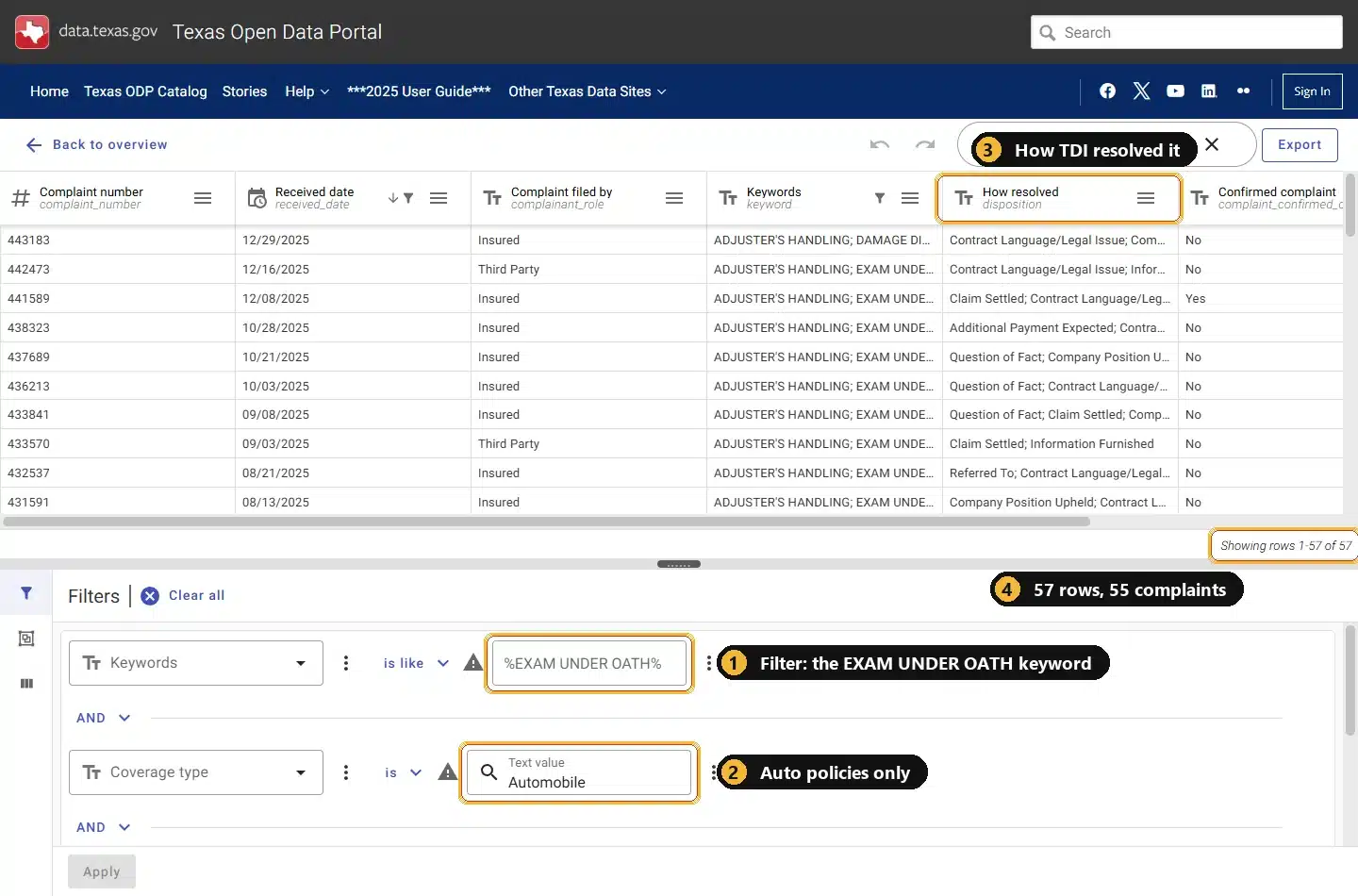
TDI records tagged EXAM UNDER OATH
- The keyword filter: EXAM UNDER OATH.
- Auto coverage only.
- How TDI resolved each complaint.
- 57 rows hold 55 complaints, since one complaint can name several parties.
Screenshot, Nov 19, 2026: TDI's complaint data on the Texas Open Data Portal.
Texas auto complaints TDI tagged EXAM UNDER OATH, by year received | TDI complaint records (data.texas.gov, dataset ubdr-4uff), coverage type Automobile, received 2024 and 2025, pulled Nov 9, 2026. Our count of distinct complaint numbers
| Item | 2024 | 2025 |
|---|---|---|
| Complaints TDI tagged EXAM UNDER OATH | 30 | 25 |
| Filed by: Insured | 27 | 18 |
| Filed by: Third Party | 1 | 5 |
| Confirmed by TDI | 2 | 3 |
| Outcome: Contract Language/Legal Issue | 22 | 19 |
| Outcome: Company Position Upheld | 15 | 13 |
| Outcome: Additional Payment Expected | 8 | 5 |
| Outcome: Claim Settled | 2 | 5 |
| Median days from received to closed | 65.5 | 78 |
Every one of these complaints was about a personal auto policy. A complaint can carry several outcomes, so the outcome rows overlap. A complaint counts as confirmed here when TDI decided an insurer had made an error. We checked that every confirmed finding in these complaints was against an insurer. The counts describe complaints made to TDI, not how often insurers ask for an examination under oath. The tag also does not show that fraud was alleged.
Most of these complaints came from insured people. Third parties filed 1 in 2024 and 5 in 2025, and the records do not say why. If you are not covered by the policy of the insurer asking, ask which policy term it relies on. Before you answer, I review your policy and the letter with you so we can understand what the request covers. We also go through the requested documents before the examination.
A requirement to attend an EUO under your coverage comes from your own policy, not the other driver's insurer. If your policy requires the examination, refusing can put your coverage at risk. I attend the examination with a client whose policy requires it.
Got a letter asking for an examination under oath? Bring it and your policy to me first.
Call 469-807-7480What counts as insurance fraud in Texas?
For insurance fraud involving a claim in Texas, a person must intend to deceive or defraud an insurer. The person must also know that a statement supporting the claim contains important information that is false or misleading. The person may prepare the statement or present it, but it must be presented to the insurer.
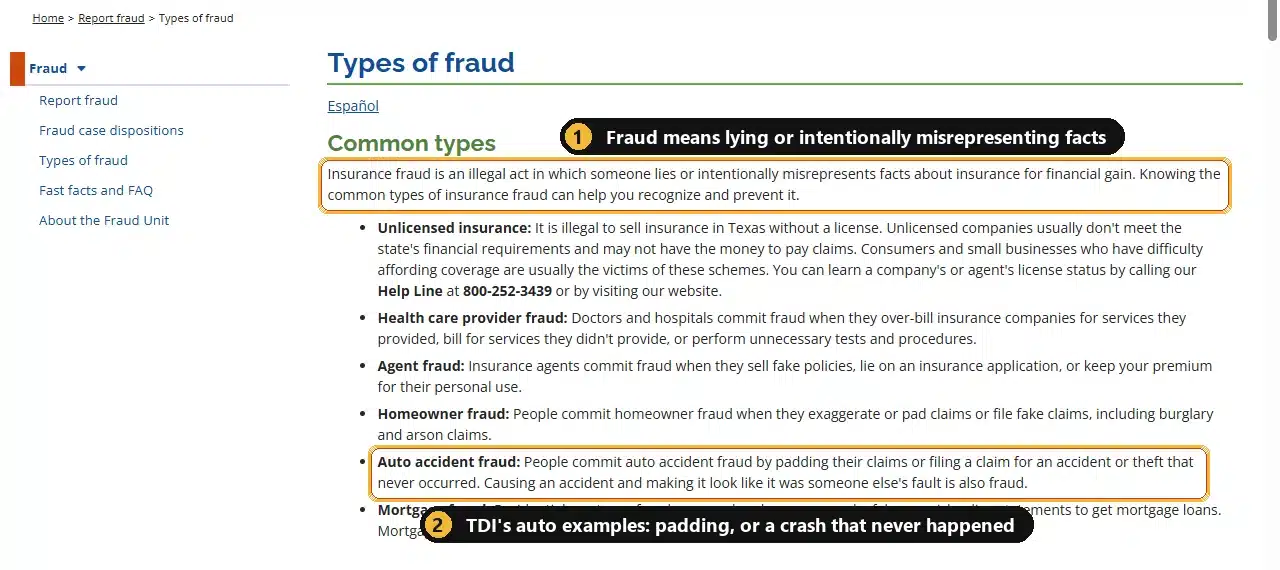
TDI: types of insurance fraud
- TDI describes fraud as lying or intentional misrepresentation for gain.
- TDI's auto examples: padding a claim, or a claim for a crash that never happened.
Screenshot, Nov 19, 2026: TDI's Types of fraud page.
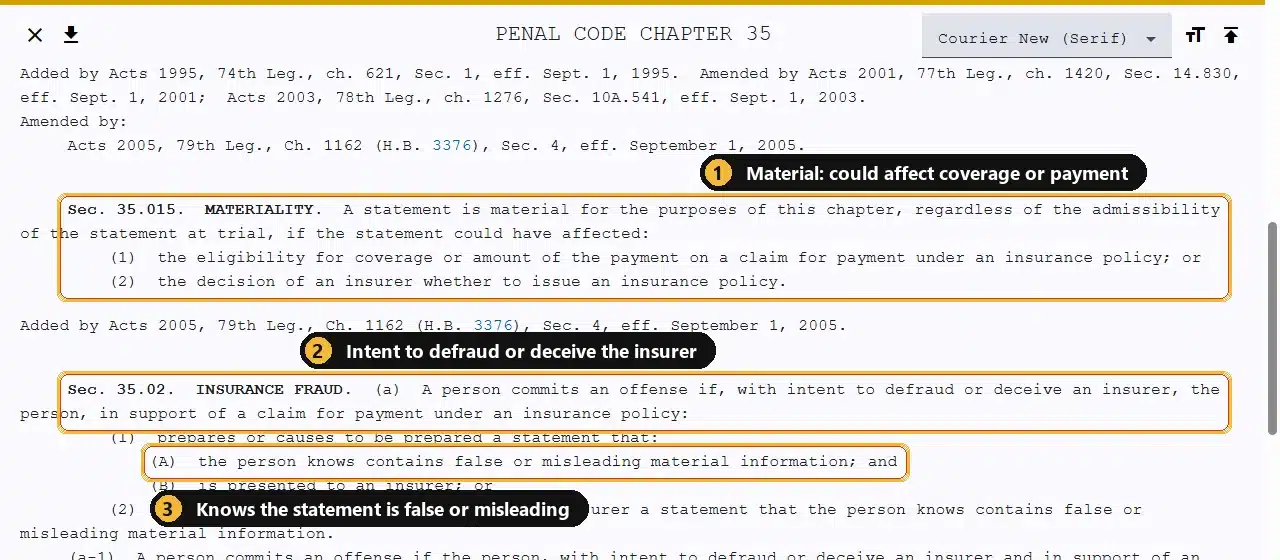
Texas Penal Code section 35.02
- Section 35.015: a detail is material if it could affect coverage or payment.
- Section 35.02(a) requires intent to defraud or deceive an insurer.
- The person must know the statement is false or misleading.
Screenshot, Nov 19, 2026: Penal Code chapter 35.
An adjuster's accusation alone does not establish insurance fraud under Texas law. I look at what you knew when you made the statement. We also look at why you made it and whether the detail mattered to your claim. These answers help us assess the accusation against the legal definition of insurance fraud.
Our firm handles injury claims. If questions come up about police involvement or charges, we refer clients to a criminal defense lawyer. Pause and speak with that lawyer before answering further questions.
How long does an SIU investigation take?
The fraud chapter of the Texas Insurance Code does not set a deadline for an insurer to finish its review. A person who reasonably suspects fraud has 30 days to report it to the state. That reporting period is not a deadline for completing the investigation.
If you file with your own insurer, the deadlines Texas puts on your own insurer cover several steps. Those deadlines cover acknowledging your claim, deciding whether to pay and sending payment if approved.
We keep a dated record of each request and response. That record includes the dates we sent documents. If the insurer denies your claim after its review, I request a written reason. Texas Insurance Code section 541.060(a)(3) calls your insurer's failure to promptly give a reasonable explanation for denial unfair. You can also complain to TDI.
The calls our team reviewed described ordinary claim investigations, missing estimates and uncertainty about what the insurer was doing. None showed an SIU referral or a fraud accusation. Our EUO complaint figures come from TDI records and do not describe our own clients.
What should you keep if your claim is under investigation?
Keep your Texas crash records and everything you sent the insurer. Save the crash report, photographs and medical records. Keep your bills and information about work you missed. Save all paperwork you and the insurer exchanged.
Once you have gathered your records, I put them in date order with you. We can check the details on paper rather than rely on memory when the insurer asks a question. Here is what to keep:
Here is a made up example of a document response. An SIU letter asks for phone records, repair photos and a recorded interview. On a call, you said the crash was Tuesday, but the emergency room chart says Wednesday.
- Ask in writing which policy term supports each request.
- Send the repair photos with a dated cover letter that lists each item.
- Ask why the phone records are needed, and for which dates.
- Compare the records before you change your account.
- If your earlier answer was wrong, correct it in writing.
- If the date is still uncertain, say so in writing.
- Keep a copy of everything you send.
Bring me the investigation letter and the records you have saved when we first talk. We can go through each request together.
An insurer's investigation does not automatically pause your Texas car accident deadlines. We can check those deadlines while the insurer continues its review.
If the insurer denies your claim after review, see the steps in taking a crash claim to court in Texas.
24/7 | Free consultation | No fee unless we win
Got a letter from the insurer's investigators? Bring it to me.
J. Alexander Law serves injured clients throughout Texas: Dallas | Houston | San Antonio | Fort Worth | Arlington | Canton. Se habla español.