



Short answer
What is the difference between a first party and third party insurance claim?
A first party claim is a request for payment under your own policy. A third party claim goes to the other driver’s insurer. Early on, I ask which insurance company will pay, yours or the other driver’s. The answer matters because the rules can differ, including whether you pay a deductible.
After a Texas crash, adjusters may use unfamiliar terms. Unfamiliar terms may also appear in your policy and settlement papers. On a first call, I explain what those words mean for payment and which claims signing may end.
A deductible is the part of a covered loss you pay first. Your policy may have one for collision, comprehensive, or uninsured or underinsured motorist property damage coverage. When your claim goes through the other driver’s insurer, there is no deductible for you to pay.
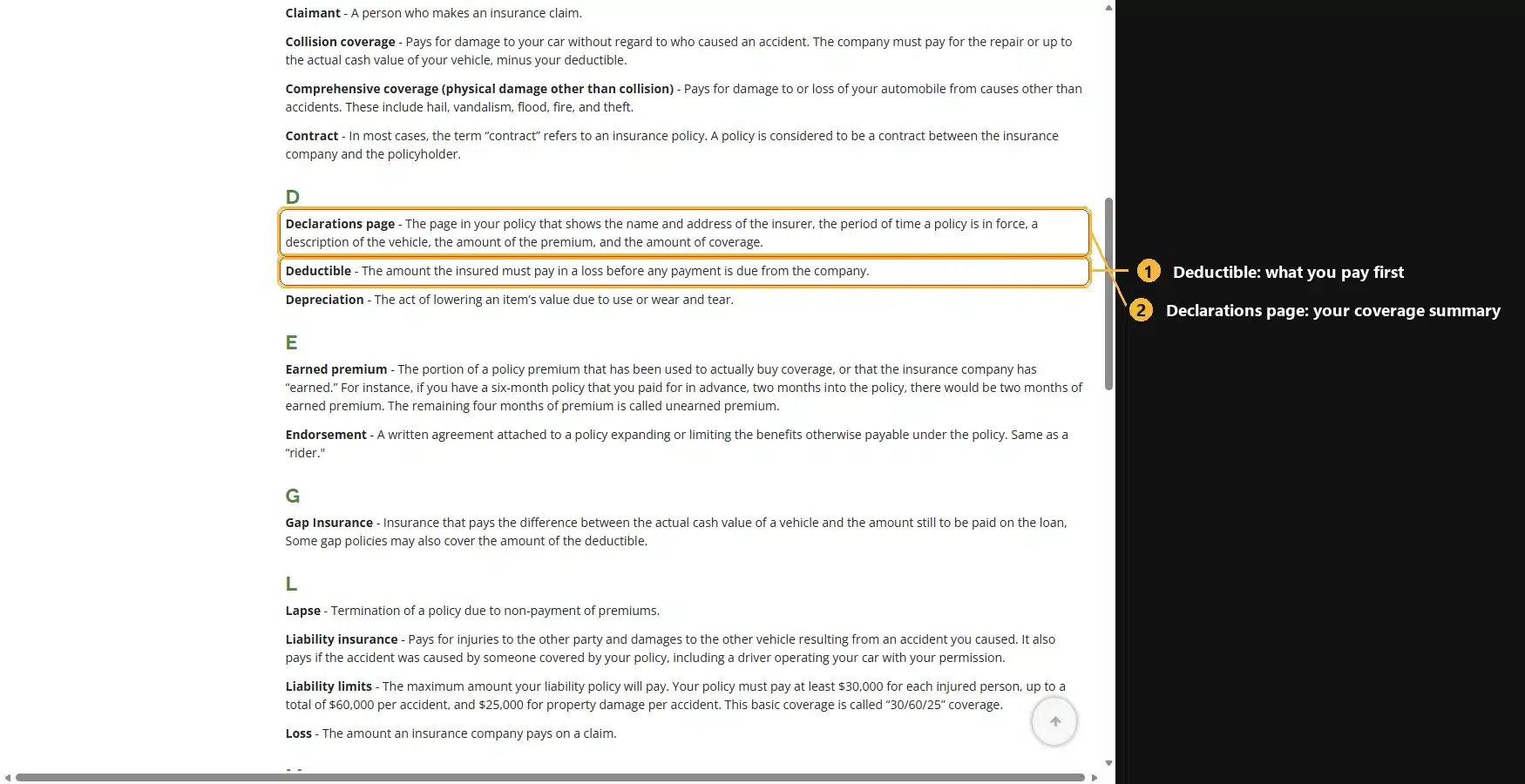
TDI's glossary: deductible
- TDI: the insured pays this amount before the company pays.
- The declarations page summarizes your policy.
Screenshot, Nov 19, 2026: TDI's glossary entry for deductible.
One caller asked us in October whether to pay a deductible after a crash. Ask your insurer which coverage would pay for repairs. Then find that coverage and its deductible on your policy summary, called the declarations page.
If you face a similar choice, check your coverage and read more about dealing with insurers in Texas.
Your declarations page names your insurer, vehicles and policy dates. It lists your coverages, deductibles and limits.
The declarations page shows each coverage you bought, line by line. Those coverages may differ from what you thought full coverage meant.
A blank coverage line alone does not show whether you have that coverage. I ask the insurer to explain the entry and to send any signed rejection.
The calls below show different problems hiding behind the same phrase. So I check the policy dates and the actual coverage entries. I do not rely on the words full coverage. A blank UM line works the same way. The next step is the signed document, not a guess about what the blank means.
What does it mean when an insurance company accepts liability?
The insurer accepts that its driver is responsible for the wreck. It may cover car repairs and injuries, depending on the coverage and its limits. Accepting responsibility does not settle every dispute about injuries, treatment or charges.
An adjuster may call, assign a claim number and ask you for information. We have clients keep that number with their insurance papers so they can identify the claim.
An insurer handles car damage and injuries as separate parts of a claim. If the insurer denies its driver caused the crash, check your next steps for a dispute over fault.
When the company accepts liability, I ask the adjuster to confirm its scope in writing. Does it cover your car damage, your injury claim or both?
For each term: what it means, what it changes in your claim and what to check.
- Claim and claim number. A claim is your request for payment for a loss, and each insurer numbers its own. The number identifies the claim file. Ask which policy it is under and who the current adjuster is. Write down each company’s number and whose policy it belongs to.
- Adjuster. This person handles the claim for the insurer. Some inspect damage, and others review records and decide or recommend what to pay. Your adjuster works for your insurer, and the other driver’s adjuster works for that driver’s insurer. Ask each adjuster which company and policy they handle. An adjuster may phone you before you leave the crash site.
- Claimant. Anyone asking an insurer for payment for a loss. On the other driver’s policy, you are a claimant with no contract with that insurer. Texas claim handling rules still govern how it treats you. Keep your messages to it in writing.
- Added to a claim. The insurer may list you as a claimant on its policyholder’s claim. That listing is not an agreement to pay you. The company can still deny that its driver caused the wreck. Ask for the claim number and keep a written record.
- Policyholder. The person who holds the policy. The policy’s promises run between that person and the insurer. Check whether you are the policyholder, a listed driver or a passenger, because your rights under the policy differ.
- Car damage and injury claims. One crash can create separate claims for the car and for injuries, often with different adjusters. Settling the car part does not close the injury part unless the paper you sign says so. We represent people for their injuries.
- Recorded statement. Questions and answers about the crash that the insurer records. Whether you must give one depends on whose insurer asks. Your own policy may set a duty to cooperate. Read the duties section of your own policy before you agree. We prepare clients before they give a statement under their policy.
- Examination under oath. A separate, formal sworn interview that your own insurer may require under your policy’s duties. It is not the same as a recorded statement. Check your policy and get advice before you attend.
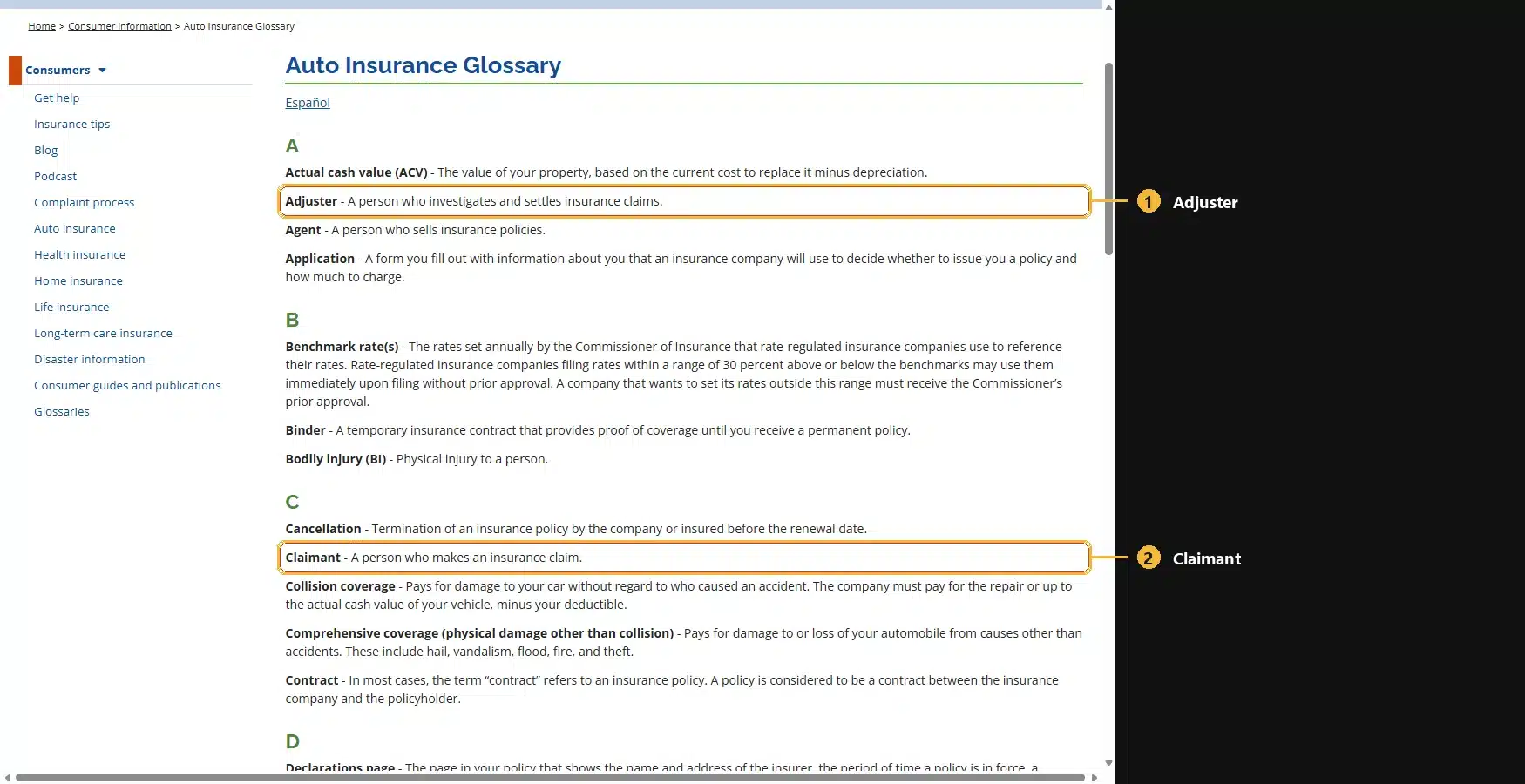
TDI's glossary: adjuster and claimant
- TDI: an adjuster investigates and settles claims.
- TDI: a claimant is a person who makes a claim.
Screenshot, Nov 19, 2026: TDI's auto insurance glossary.

From our attorney
"For a lot of our clients, this is the first interaction they've had with an accident, a claim, maybe the first interaction they've had with their own automobile insurance, using it."
Matthew Graham
Managing Litigation Attorney | On camera, 2026
Did an adjuster say the company accepts liability? Forward me that message so we can check its scope.
Call 469-807-7480What are different types of auto insurance?
People often group liability, collision and comprehensive as the basics of auto insurance. Other coverages can include PIP and medical payments, also called MedPay. Auto insurance can include uninsured motorist (UM) and underinsured motorist (UIM) coverage. Policies can also include uninsured motorist property damage and rental reimbursement.
Liability coverage covers harm you cause others. It does not pay for your own car or injuries. The guide on who pays after a crash involving an uninsured driver explains UM and UIM claims. These claims may apply if the responsible driver has too little insurance or none. Other coverages may pay you, subject to their terms.
Texas Insurance Code section 1952.101(c) says UM coverage does not apply if a named insured rejects UM coverage in writing. Texas Insurance Code section 1952.152(b) says PIP does not apply if any named insured rejects PIP in writing. A full coverage policy can leave out PIP or UM. Ask your insurer for your declarations page and check each coverage.
From our intake calls
"Full coverage" is the start of the question
What to check when someone says they have full coverage.
"I have full coverage"
Illustrative coverage checklist
- Is the policy active?
- Is collision listed?
- Is PIP listed?
- What does the UM and UIM line show?
- Which product are you discussing: auto insurance, gap protection or a service contract?
- 25 calls
- from 24 callers used "full coverage"
- 4 of those 25
- from 4 callers also raised a missing, lapsed or unlisted coverage issue
A blank UM line alone does not settle the question. Request the policy records and any written rejection.
Source: J. Alexander Law Firm intake calls, June 10 to November 18, 2026. Calls, not a population survey. Examples are selected and may not match the coded counts one to one.
We counted only what callers said about their own policies during intake calls to our firm. Because callers chose lawyers, the sample was not random. The sample says nothing about how insurers handle claims.
| What callers raised, in their own words | Calls | Different callers |
|---|---|---|
| Said they had full coverage | 25 | 24 |
| Said they had liability only (or the state minimum) | 15 | 15 |
| Said full coverage, then a missing, lapsed or unlisted part came up | 4 | 4 |
- Collision. Pays to repair or replace your car after a crash, even one you caused, minus your deductible. It can get your car fixed while fault is still argued. Check your collision deductible on the declarations page.
- Comprehensive. Pays for theft, fire, flood, hail, vandalism and hitting a deer, but not a crash with another car. Without collision coverage, it will not pay to fix crash damage. Check that collision is also listed.
- Personal injury protection (PIP). PIP coverage in Texas pays your medical bills and a share of lost income, whoever caused the wreck. It can pay while fault is still disputed. Check the PIP limit, or whether PIP was rejected in writing.
- Medical payments (MedPay). Pays reasonable medical and funeral costs for you and others in your car, regardless of fault. Check whether your policy lists it and at what limit.
- Uninsured motorist (UM). May pay when the at fault driver has no insurance. It makes your own policy the source of payment. Check for a UM amount on the declarations page, or a signed rejection.
- Underinsured motorist (UIM). May pay when the responsible driver’s limit is too low for your losses, up to your policy’s UIM limit. Check your UIM limit as soon as the other driver’s limit is known.
- UM property damage (UMPD). This part of UM pays to repair your car when the at fault driver has no insurance. A deductible may apply, so check the amount.
- Rental reimbursement. Pays a set daily amount for a rental while covered damage is repaired. Check the daily amount and any limit on days or total cost.
- Dealer add ons. If your car is totaled, gap insurance may cover the amount your loan balance exceeds the actual cash value paid. Some gap policies may cover your deductible too. A service contract pays for repairs when parts fail from a defect or normal wear. Neither one pays medical bills or injury claims. If you still owe money on the car, check the gap contract’s terms.
- Newly bought car. Your policy may cover a newly bought car for a set period, often about 20 days. The exact period and coverage depend on your policy. A replacement car usually takes the coverage of the car it replaced. When a client buys a new car, I ask the insurer to confirm the coverage start date in writing.
What is the difference between bodily injury and personal injury after a car accident?
Bodily injury means physical harm to a person. A personal injury claim is the broader claim for harm someone else caused. It can include pain, lost pay and other losses. In insurance papers, the other driver’s bodily injury liability coverage may pay for your injuries. You may also have personal injury protection, called PIP, under your own auto policy. When I look at your declarations page, I note the PIP limit if it appears there. To learn what PIP pays, see our Texas PIP page.
When PIP applies, I pursue a client’s PIP benefits along with a bodily injury claim against the responsible driver. Depending on the Texas policy, bodily injury may also include sickness, disease, death and emotional injury after physical harm.
A person injured while riding in a car crash has their own claim. If the coverage applies, a passenger can look to the responsible driver’s bodily injury coverage. The passenger can also look to PIP on the policy covering the car they rode in, if it applies.
How is bodily injury paid out after a car accident in Texas?
The responsible driver’s liability coverage may pay for medical bills and income lost to injury, up to its limits.
An injury claim in Texas may include payment for physical pain. To see what else your claim may include, read about the types of damages available after a crash.
Your circumstances can affect the Texas deadlines for filing after a car crash. I check for exceptions and earlier notice requirements when I review those deadlines.
If fault comes up, bring me the insurer’s explanation. Then we can discuss how the Texas rules on comparative fault may affect your recovery.
The terms below can help you read the other driver’s policy and understand the coverage available. I ask that driver’s insurer what policy limits apply, so we can see the amount of coverage available.
A policy limit is a coverage ceiling, not a settlement offer. In our Dallas case, our client was hurt after a driver failed to yield. Our client received that driver’s bodily injury limit and a payment under uninsured or underinsured motorist coverage. Ask for the offer and applicable limit in writing so you can compare them.
- Liability coverage. Pays for injuries and property damage when the insured driver, or someone allowed to use the car, causes a crash. It does not pay the insured driver’s own car or injuries. Ask the other driver’s insurer for its limits in writing.
- 30/60/25. Texas minimum insurance requirements include $30,000 for each injured person. The injury limit for 1 wreck is $60,000 total. They also include $25,000 for property damage. Transportation Code section 601.072 sets those amounts. Does 30/60/25 mean full coverage? No. These liability limits do not cover injuries or vehicle damage for the insured driver. Ask whether the other driver carries more than the minimum.
- Policy limits. The most a policy pays for a covered loss. The other driver’s policy may provide more coverage than Texas requires. If your losses pass that limit, your own UIM coverage may matter.
Our Redwater Case: A Liability Limit, Then a UIM Limit
In our Redwater head on case, an SUV drifted across US 67 into our client’s lane, hitting her head on. The SUV driver’s insurer paid its full $100,000 liability limit.
Her injuries included four rib fractures, a fractured sternum and a knee ligament injury. That first limit did not end our coverage review. Her own UIM policy added another $30,000, its full limit. Both claims settled before suit, for a gross total of $130,000.
She received much of her later care through the VA, and that care can carry a federal repayment claim. The gross recovery, the coverage available and the client’s share are separate questions.
What terms will you see when your car accident claim is paid?
When a claim is paid, you may hear terms such as actual cash value, total loss and diminished value. You may also hear about subrogation, a lien, a release or a settlement statement.
You may hear these terms when an insurer decides what your car is worth or prepares a payment. I slow down with clients over release, lien and subrogation. Those words can affect which claims end and how much money you take home.
A release can end the claims it covers, so read its wording first. Our pages on hospital liens and a health insurer asking to be repaid explain how settlements pay those claims.
- Actual cash value (ACV). What your car was worth on the market just before the wreck, after depreciation. It sets a total loss payment. Check the trim, mileage and options of the similar cars the insurer compared.
- Total loss. If repairs would cost too much for the car’s value, the insurer may pay the value instead. Ask how it reached that decision. If you owe more than that payment, see whether gap coverage applies.
- Diminished value. A car can lose market value after repair, even when the repair is good. Ask whether your property damage claim includes that loss.
- Subrogation. An insurer that paid for a loss can seek repayment from the person who caused it or that person’s insurer. If your health insurer paid a crash bill, it may ask for part of your settlement back. Ask for any repayment claim in writing before you settle.
- Lien. A hospital may have a legal claim against your settlement for treatment it has not been paid for. That differs from a health insurer seeking repayment for bills it already paid. Check for lien notices before settlement money is divided.
- Release. You end the claims a release covers by signing it. Check whether a release sent with a car check covers your injuries or only your car.
- Settlement statement. This document shows the total settlement, the fees and bills, and the amount you take home. Check each bill on it against your own records.
Keep in mind
If your release or settlement statement has unfamiliar terms, call me and we can talk about them.
Call 469-807-748024/7 | Free consultation | No fee unless we win
Have a question about your insurance letter? Let's talk about what it means.
J. Alexander Law serves injured clients throughout Texas: Dallas | Houston | San Antonio | Fort Worth | Arlington | Canton. Se habla español.