




Short answer
What Texas car accident laws should I know after a crash?
After an injury crash in Texas, each driver must stop, reasonably help anyone hurt and report it to police. A driver at fault may owe damages, or money for the harm. An injured person assigned 51 percent or more responsibility cannot recover money. For most injury claims, you must file a lawsuit within 2 years.
Texas car accident laws say what drivers must do after a crash, like reporting an injury crash to police. They also affect who may have to pay and how long you have to sue. I check which rules the other driver broke, what the insurer may say you broke, and deadlines and insurance limits. Each rule has its own page in our Texas car accident law guides.
Texas deadlines that start on the crash date
2 years
Deadline to file a lawsuit
I start with the crash date because the two year limit to sue generally runs from that date.
Age 18
When a child's deadline starts
If a child was hurt, we also ask for the child's birth date. The child's 2 year deadline generally starts at age 18.
6 months
Deadline to notify a government unit
If a government vehicle or city road was involved, the deadline to give notice can be much shorter. Notice means telling the government about your claim. Generally, the government unit must get it within 6 months after the crash. A city charter can set a different period.
What Texas drivers must do at the crash scene
A crash may hurt or kill someone. It may also damage a vehicle that someone is driving or has a person with it. The drivers must stop and give reasonable help to anyone hurt. They must also share their names and addresses, each vehicle's registration number and each driver's liability insurer.
Did the other driver stop, help and share that information? We check. Our post wreck checklist covers the other steps, from taking photos to getting the officer's report.
What we ask on the first call
To start, our intake team asks:
- Where and how the wreck happened
- Who saw it
- Whether a dashboard camera recorded it
- What insurance you carry yourself
- Whether a government vehicle or a city road was involved
- What the other driver said right after the crash
We ask early because witnesses and video can get harder to find later. Your own insurance can help pay if the other driver has too little insurance.
How the other driver's words can be used
Rule 801(e)(2) of the Texas evidence rules lets the other side use a driver's words against that driver at trial. A remark like "I never saw you" can help prove fault.
Who is at fault in a car accident in Texas?
Liability insurance usually pays for harm a driver is responsible for causing. Drivers can share fault, and breaking a traffic rule can show fault. As I prepare a claim, I estimate the share of fault a jury might give each driver.
If your case goes to trial, the jury decides each person's percentage of responsibility for the harm. The jury can assign a percentage to you.
Section 33.003 lets the jury assign fault to people bringing claims, people sued and people who settled. It also covers responsible third parties, other people formally named as responsible for the harm. The other side needs enough evidence before it can ask the jury to consider your actions.
I read the crash report for anything the other side could use to blame you. Our team gathers the officer's account, witness statements, photos and video early to answer it. If the report questions your driving, read our 51 percent rule guide.
The traffic rule the insurer looks for
In a fault dispute, the other driver's insurer first asks what traffic rule the injured driver broke.
The insurer reads the crash report for a rule it can use to say both drivers share fault. For example, the report says you changed lanes without signaling. Moments later, your car hit a car whose driver ran a stop sign.
An adjuster, the insurer's claims handler, may put some blame on you. I ask whether your lane change helped cause the crash. Jurors look at every action that played a part in the injuries.
Our client's San Antonio case involved 2 traffic rules. Transportation Code section 545.155 requires a driver entering a highway from a private drive to yield to approaching traffic.
Section 545.062(a) requires enough space behind another car to stop safely. The officer blamed the pickup driver. But the officer's report listed no injury for our client.
His medical records documented injuries that did not appear in the police record.
Stopped at Shopping Center Exit, Hit From Behind
Our client paused at the exit for approaching traffic while the pickup behind him continued forward.
San Antonio, State Highway 151 access road
San Antonio Shopping Center Crash
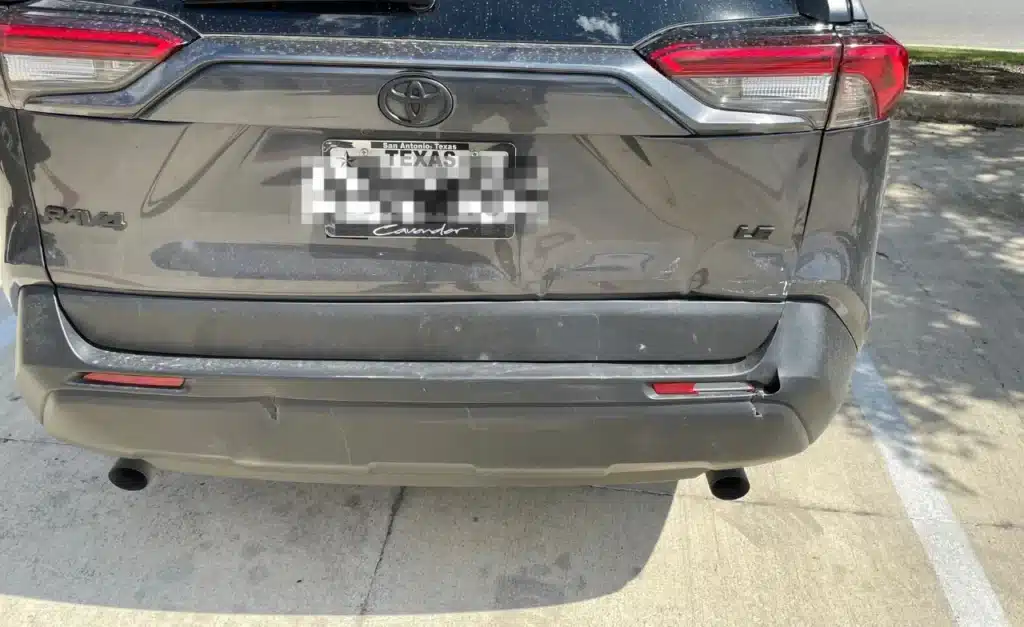
In 2023, our client was easing out of a San Antonio shopping center toward the Highway 151 access road. He stopped for traffic. A pickup struck him from the rear. The report assigned responsibility to the pickup driver.
The pickup driver's insurance paid up to the policy limit. His underinsured motorist policy then paid out to its full limit. The claim was settled without a lawsuit.
When the other side says you are to blame
The police report blames you
If a police report blames you, we can look at it again and challenge it. Our answer for drivers blamed by the other side explains how.
When the insurer points to light damage
Some insurers argue that a car with little damage means the people inside were not badly hurt. Our client's RAV4 had little visible damage. Our team used his medical records to show his symptoms and treatment.
Money, medical bills and other questions
- In a crash claim, you may seek money for treatment costs, pay you missed and pain. You may also seek payment for emotional distress.
- Doctors' bills often arrive before the at fault driver's insurer pays anything. Your own insurance may help with those bills. PIP (personal injury protection) is one part of your policy that can. Our guide to PIP coverage explains it.
- If the other driver sues, see how to respond to a Texas crash lawsuit.
- In October 2026, a caller asked whether a lawyer could help after an officer found the caller at fault. We address that in our answer on legal help after you cause a crash.
- The other driver's adjuster may call before you even leave the crash scene. If that happens, read our answer on adjuster calls.
Is an adjuster putting some of the blame on you? Show me the crash report and the traffic rule the adjuster cites.
Call 469-807-7480Where are Texas car accident laws written?
Texas car accident laws appear in several state codes. Part of my job is finding the rules that apply to your crash.
I research a crash in these 5 Texas codes.
- Transportation Code
The Transportation Code sets traffic rules, duties at a crash scene and the insurance drivers must carry. We use it to check how each driver acted, including whether a driver left the scene unlawfully. Some Texas traffic misdemeanors have no other penalty. A misdemeanor is a less serious crime. For a conviction of those offenses, the fine under section 542.401 is $1 to $200.
- Insurance Code
The Insurance Code sets the coverage your policy must carry and the deadlines insurers have to handle a claim.
- Civil Practice and Remedies Code
The Civil Practice and Remedies Code covers the deadline to sue and how shared fault works. It also sets the steps for a claim against a government unit.
- Property Code
The Property Code covers hospital liens. A hospital lien lets a hospital collect its bill from your settlement. We check for one before a settlement is paid.
- Alcoholic Beverage Code
The Alcoholic Beverage Code's rules can apply when a business served a driver who was already drunk.
Send me any code section that an adjuster or a letter cites. We will read that section ourselves. We check whether it says what the adjuster claims and whether it fits your crash.
When a client says they have no PIP or uninsured motorist coverage, I ask to see the signed rejection. Texas auto liability insurers must provide both coverages unless a named insured rejects them in writing. A policy described as "full coverage" does not necessarily include every optional protection. To check your coverage, our intake team asks:
What our staff tells callers
"They're called underinsured, uninsured motorist coverage as well as personal injury protection. Would you know if you have those by any chance?"
A staff member, 2026
What is the new car accident law in Texas?
No new law raised the Texas minimum insurance amounts for 2026. The minimums are still 30/60/25. Drivers no longer file their own state crash report form. The online claim that adults need booster seats is false.
What changed in Texas crash law and what did not
Still the law
Minimum insurance is still 30/60/25
- $30,000each person hurt
- $60,000all injuries, one crash
- $25,000property damage
A bill must pass to become law, so I check its history before I say a law changed. House Bill 4178 of 2025 proposed 50/100/40 minimums for policies starting or renewing in 2026. The bill stopped in the House Insurance Committee and never passed.
A minimum policy pays up to $30,000 for each person hurt and $60,000 in total per crash. It also pays up to $25,000 for property damage.
Retired in 2017
Drivers no longer file their own crash report
Drivers used to be able to send the state their own crash report on form CR-2. TxDOT, the state transportation agency, has not kept that form since 2017. So keep your own photos and notes. If an officer wrote a report, our litigation paralegals request a copy.
False
The adult booster seat rumor is false
A 2026 rumor about adults needing booster seats is false. I send families to our guide to Texas car seat laws to learn who needs a booster.
When a client asks about a new law they read online, I read the law itself first. Tell me what you read and what happened in your crash.
Read our full list of Texas crash guides for answers about case value or lawsuits.
24/7 | Free consultation | No fee unless we recover
Bring your crash report. I will check it against Texas crash laws.
J. Alexander Law serves injured clients throughout Texas: Dallas | Houston | San Antonio | Fort Worth | Arlington | Canton. Se habla español.