


San Antonio Rear End and UIM Settlement
We Recovered $60,000 From Two Policies at Their Limits for a San Antonio Driver Rear Ended While He Waited to Merge Onto Highway 151
On a Tuesday afternoon in September 2023, our client stopped at the exit of a shopping center on State Highway 151 to let traffic pass, and the pickup in line behind him drove into his back bumper.
The police record proved fault but closed the call as no injury; his medical records proved the rest. The pickup driver’s insurer paid its $30,000 limit, his own underinsured motorist coverage paid another $30,000, and both claims settled in pre litigation, before any lawsuit.
On This Page
Stopped for Traffic at the Shopping Center Exit
Everything known about the crash itself comes from the San Antonio Police Department’s record of the call. In that record, the pickup is Unit 1 and our client’s gray 2022 Toyota RAV4 is Unit 2.
He was leaving the Westover Marketplace shopping center by its private street, heading for the State Highway 151 access road, with the pickup waiting behind him. He eased forward, saw traffic coming along the access road and stopped. The pickup kept coming. The officer typed each driver’s account into the report, and the pickup driver’s reads, word for word:
U1 stated that he was exiting a private dr and U2 was in front of him U1 stated that U2 started to drive forward U1 stated that he assumed that U2 was going to contuine to drive onto the access rd but U2 did not U1 stated that he crashed into the back bumper of U2
Our client’s account follows in the same entry, and the officer’s finding sits on the line after it:
U2 stated that U1 was behind him, and he started to move forward, but stopped due to on coming vehicles U2 stated that U1 crashed into the back bumper of the vehicle
U1 is at fault
The two accounts agree on every point that matters: who was in front, that our client started and then stopped, and that the pickup hit his back bumper. The only difference is the pickup driver’s explanation, that he assumed the RAV4 would keep going.
An Incident Report That Said No Injury
On its face, this record can look like the end of an injury claim.
It was not, and the reason is in what this document is. It is not the TxDOT crash report, the CR-3 that most of our other case results are built around. It is the department’s incident detail report, the record of the call: when it came in, who was sent, what the call taker and the officer typed and how the call was closed. Our investigation obtained this record from the department’s records on October 17, 2023, three weeks after the crash. These are the entries that mattered to his claim:
| Field | Entry, then its meaning |
|---|---|
| Problem | Accident MinorHow the call was classed when it was taken |
| Received by | Non EmergencyCalled in on the department’s non emergency line, not 911 |
| Call taker’s note | refused emsAn ambulance crew was not wanted at the time of the call |
| Officer’s location | 8300 State Hwy 151The block where the officer placed the crash |
| Vehicle check | PVT ST AT WESTOVER MARKETPLACE\STATE HWY 151The shopping center’s private street where it meets the highway |
| Transports | No Transports InformationNo one was taken from the scene by ambulance |
| Disposition | N21-Accident No InjuryThe code the officer closed the call with at 3:24 p.m. |
The police record helped establish fault, but it did not decide whether our client was injured. At the scene, the call taker noted that medical help was declined, and the officer closed the call as an accident with no injury. Those entries describe what happened at the roadside. They are not a diagnosis, and they do not account for symptoms that develop later or the treatment a person may need after leaving the scene.
We did not need to argue that the report was inaccurate. We showed its limits. The medical records documented what the police record could not: the symptoms our client reported after the crash, the care he received, and the treatment his providers found appropriate. Our $89,000 San Antonio case result involved a similar issue: a client was marked as not injured in a TxDOT crash report but received treatment the same morning.
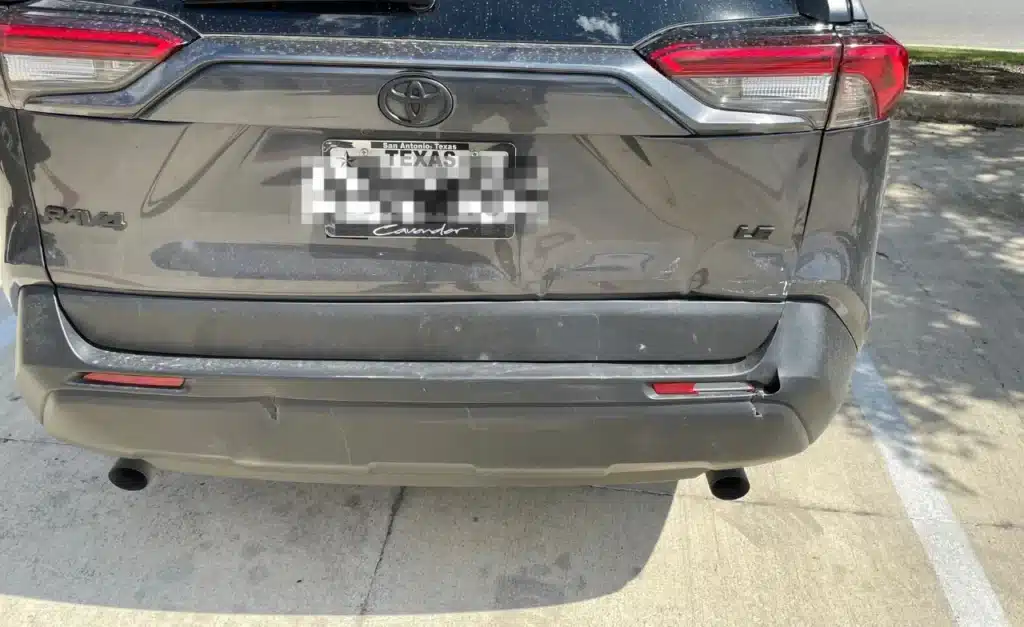
The RAV4 also showed limited visible damage. Insurers sometimes use modest property damage to argue that an occupant could not have been seriously hurt. Vehicle photographs and repair estimates can be relevant, but they do not answer a medical question on their own. We evaluated the claim through the full record: how the collision occurred, the symptoms our client reported, the findings in his medical records, the treatment he received, and the costs tied to that treatment.
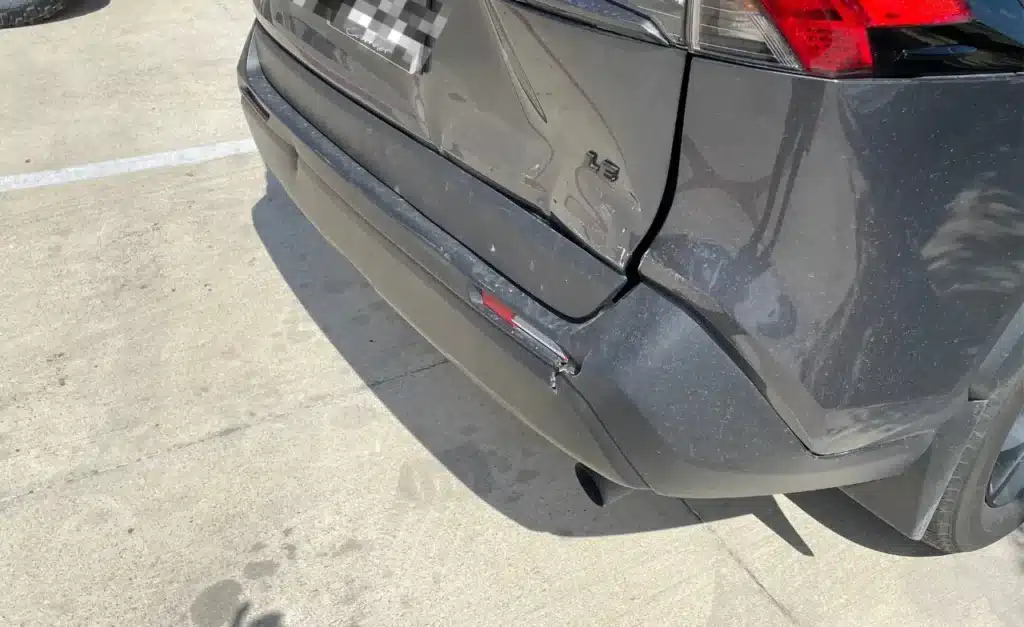
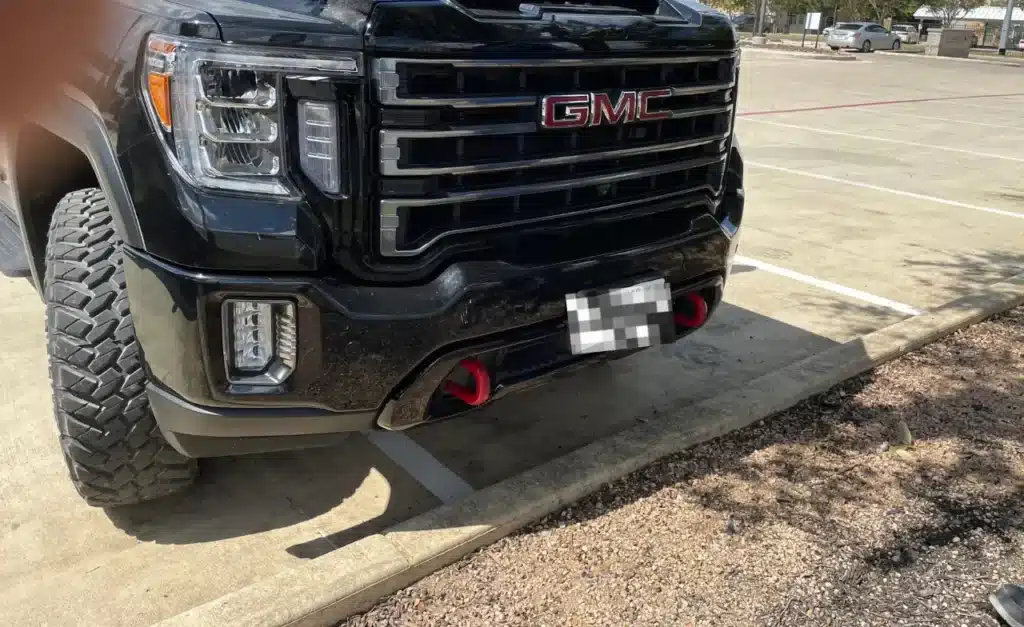
We published a redacted copy of the San Antonio Police Department incident report so readers can see the fault evidence discussed above. The public copy removes personal and identifying information, including names, dates of birth, home addresses, phone numbers, driver license information, license plate and VIN data, insurance details, personnel names and identification numbers, and report numbers.
Open the redacted SAPD incident report (PDF)Room to Stop Is the Following Driver’s Duty
The pickup driver’s explanation was that our client began to pull forward, so he expected the RAV4 to continue onto the Highway 151 access road. But the record shows that our client stopped because traffic was approaching on the highway. That was not unexpected or improper. It was the precaution Texas law required.
Under Texas Transportation Code § 545.155, a driver leaving a private road or driveway must yield to traffic already approaching on the highway. Our client was exiting the shopping center’s private drive. He moved forward, saw approaching vehicles on the access road, and stopped rather than enter their path.
The pickup driver had a separate duty under Texas Transportation Code § 545.062(a). A driver following another vehicle must maintain an assured clear distance: enough space, considering speed, traffic, and roadway conditions, to stop safely without hitting the vehicle ahead. The rule does not allow a following driver to assume that a vehicle ahead will continue moving when that vehicle is approaching highway traffic and may need to yield.
Put simply, our client had to stop for traffic on Highway 151. The pickup driver had to leave enough room to stop if he did. The officer’s finding that the pickup driver was at fault, together with the driver’s own statement that he expected the RAV4 to continue forward, supported that analysis.
Our Texas rear end crash index examines statewide rear end collision patterns and the factors officers record in those crashes. The Highway 151 data below provides local context for the same recurring scenario: a vehicle ahead slows or stops, and the driver behind does not leave enough room to avoid a collision.
How We Built Two Claims From One Crash
The first issue was fault. The police officer identified the pickup driver as responsible, and the driver’s own statement explained why. He said he expected the RAV4 to continue onto the Highway 151 access road. But our client was leaving a private drive and had to yield to approaching traffic. When he stopped, the pickup driver did not leave enough room to stop behind him.
The police report was important because it did more than assign fault. It preserved the pickup driver’s explanation in his own words. An insurer can question an officer’s conclusion. It is more difficult to explain away the at fault driver’s own statement that he assumed the vehicle ahead would keep moving and then struck it from behind.

“Why the crash report does not tell the whole story. Why their injury feels worse now than it did at the scene.”
Josh Alexander, Founder and Managing Attorney, describing questions clients raise after serious crashes on his attorney profile
Fault was not the difficult part of this case. Damages were. No ambulance came to the scene, the call was closed as an accident with no injury, and the RAV4 showed limited visible damage. Those facts gave the insurers a basis to question whether the collision caused a compensable injury or whether the treatment that followed was related to the crash.
We addressed that issue with the medical evidence. The records documented the treatment our client received after the collision, the symptoms reported from one visit to the next, the care his providers recommended, and the bills associated with that care. We presented those records together rather than treating one police code entry or one photograph of the vehicle as the answer to a medical question.
That distinction mattered. The police record documented the collision and supported fault. The medical records documented the effect of the collision on our client. Taken together, the evidence supported damages greater than the $30,000 available under the pickup driver’s bodily injury liability policy.
Why We Pursued UIM Coverage
Once the pickup driver’s $30,000 liability limit was identified, we reviewed our client’s own policy for additional coverage. He carried $30,000 in underinsured motorist coverage, commonly called UIM.
UIM coverage is not an automatic second payment simply because the at fault driver carried minimum insurance. The injured person must establish legally recoverable damages greater than the liability coverage available from the driver who caused the crash. The same evidence therefore had to support both claims:
- The pickup driver’s insurer needed a supported basis to pay its $30,000 liability limit.
- The UIM insurer needed evidence that the client’s legally recoverable damages exceeded that $30,000 payment.
The UIM claim also required coordination with the liability settlement so that the client did not compromise the UIM carrier’s rights before obtaining the required consent.
In this case, the documented damages exceeded the first $30,000. The client’s own insurer then paid its full $30,000 UIM limit.
Who handled the claims
A senior attorney led both claims. The client also had a named case manager with a direct line for calls and texts. The case manager gathered records, tracked bills, coordinated communications with both insurers, and provided an update at least every 14 days.
This matters in a two policy claim because the liability carrier and the client’s UIM carrier are evaluating the same injury through different coverage obligations. Records, bills, settlement communications, consent requirements, and deadlines must be coordinated so that progress on one claim does not create a problem for the other.
Why both claims resolved before suit
Both insurers paid their full policy limits before we filed suit. The liability evidence was strong: the police report identified the pickup driver as at fault, and the driver’s own statement described why he hit the RAV4. The damages evidence came from the medical records documenting treatment, symptoms, provider findings, and the costs of care after the collision.
The combined evidence showed losses beyond the $30,000 available from the pickup driver’s policy and supported the UIM claim under our client’s own coverage.
That result was specific to this collision, the policies available, the medical evidence, and the insurers’ decisions. Another rear end or UIM claim may require a lawsuit, discovery, or trial before it resolves.
The client paid nothing upfront. J. Alexander Law Firm advanced the costs of both claims until they settled.
Two Policies, Two $30,000 Limits
The first payment came from the pickup driver’s insurer: its whole $30,000 limit for bodily injury, the lowest per person amount Transportation Code § 601.072 allows. The second came from his own UIM coverage, which carried the same $30,000 limit; a UIM limit that only matches the other driver’s can still pay, as our guide to underinsured at fault drivers shows with worked examples.
Many Texas UIM policies require the insured to get written consent before signing off on the liability insurer’s payment. The requirement protects the UIM carrier’s potential right to seek reimbursement from the person responsible for the crash, and the same guide covers the request in its section on permission to settle.
Texas law is also why many UIM claims end up in court. A UIM insurer does not have to pay until the injured person’s legal right to those damages is established; the Texas Supreme Court addressed that in Brainard v. Trinity Universal (2006). Our Farmers Branch underinsured motorist result went that route: it settled during discovery.
$60,000, Both Policies at Their Limits
$60,000
Two policy limits, pre litigation
The $60,000 is the combined gross amount both insurers paid. Our fee, the claim costs and any medical balances owed from the recovery were paid from it, and our client received the remainder. Each crash, injury and policy is different, so this result says nothing certain about what another claim is worth.
How Often Drivers Are Rear Ended on State Highway 151
For local context, we ran our own CRIS query on October 5, 2026: every reportable crash TxDOT located on State Highway 151 inside San Antonio, 2021 through 2025, frontage roads included. Reportable means an officer had to file a crash report, which Transportation Code § 550.062 requires when someone is hurt or killed or the property damage to any one person appears to reach $1,000, so collisions handled as a call may never appear in these counts. Rear end covers both CRIS types: both vehicles moving, or the one ahead stopped.
| Year | Reportable crashes on SH 151 | Rear end | Vehicle ahead stopped |
|---|---|---|---|
| 2021 | 563 | 156 | 70 |
| 2022 | 621 | 177 | 84 |
| 2023 | 670 | 217 | 100 |
| 2024 | 768 | 252 | 108 |
| 2025 | 613 | 171 | 73 |
| 2021 to 2025 | 3,235 | 973 | 435 |
Those five years held 973 rear end crashes among 3,235, and in 435 of them the vehicle that was hit had stopped.
The figures do not decide fault in any one case. They show how often the situation in this claim repeats on the same highway: a vehicle stops, and the driver behind has not left enough room to stop.
Attorney Review

Reviewed by: Josh Alexander, Founder and Managing Attorney
Published and reviewed on
More Texas Crash Case Results
- $15,000,000I-45 truck crash wrongful deathSettled in litigation
- $850,000Pasadena red light crashSettled in litigation
- $600,000Rockwall County five vehicle crashSettled in litigation
- $600,000Mesquite 18 wheeler crashTruck accident settlement
- $325,000Hood County commercial truck crashSettled in litigation
- $175,000Round Rock construction vehicle crashSettled before suit
- $125,000Brownsville armored truck rear endSettled before suit
- $105,000Texas highway unsafe lane changeSettled before suit
- $105,000Three vehicle crash in DallasPolicy limits recovery
- $100,000Rear end, no police reportSettled before suit
- $95,000Midland company truck left turnSettled before suit
- $89,000San Antonio 3 car chain reactionSettled before suit
- $85,000Farmers Branch left turn, UIMSettled in litigation
- $82,500Plano company truck left turnSettled in litigation
- $50,000Allen rear end crashPolicy limits settlement
- $30,000San Antonio rotator cuff tearPolicy limit, before suit
- $30,000Houston hit and run recoveryUM policy limits
10Contact
Rear Ended While You Waited
Rear Ended While You Waited
to Pull Out?
If a driver behind you hit you while you were stopped at a driveway, a parking lot exit or a shopping center anywhere in Texas, call us and walk us through it. We will read the police record with you and track down every source of insurance money, your own policy included.
No fee unless we recover · Se habla español · Proudly Serving All of Texas