


Short answer
Do minor settlements require court approval in Texas?
In the child cases our team handles, a judge approves the settlement before payment. Under Texas Rule of Civil Procedure 44, a next friend's settlement binds the child once the court approves it. Some smaller payments can go to the county clerk instead, with no court review.
After a Texas wreck, saying yes to the insurer does not by itself settle your injured child's claim. You can file the lawsuit and sign for your child as a next friend. That is the legal name for the adult who acts for a child in the suit. The judge reviews the agreement. Once the court approves it, the settlement binds your child. Keep the insurance release unsigned until we have talked. From the start, I prepare your child's claim for the hearing.

As a parent or guardian, you act for your child and may have questions about where the money will go. The court may put it in a trust or a restricted account, which needs a court order to withdraw. It may also be paid on a schedule.
Under section 104(a)(2) of the federal tax code, money paid for physical injuries is not taxed as income. That applies whether you receive the money at once or over time.
Punitive damages are money meant to punish and do not get that tax break. Emotional distress alone does not count as a physical injury. The exception is money paid for medical care for that distress. We can go over the payment options with you. Taking money out of a restricted account requires a court order.
The judge on your child's case decides whether your child must attend. Once the hearing is set, I will tell you what that judge expects. Payment follows the judge's approval of the settlement.
In an August call, a lien holder asked about a father's payment. A lien holder has a legal claim on part of the settlement money. Our team explained he could not be paid until his child's prove up hearing ended. At that court hearing, the judge checks whether the agreement benefits your child. The judge also hears from a guardian ad litem if the court appointed one.
Read it as text
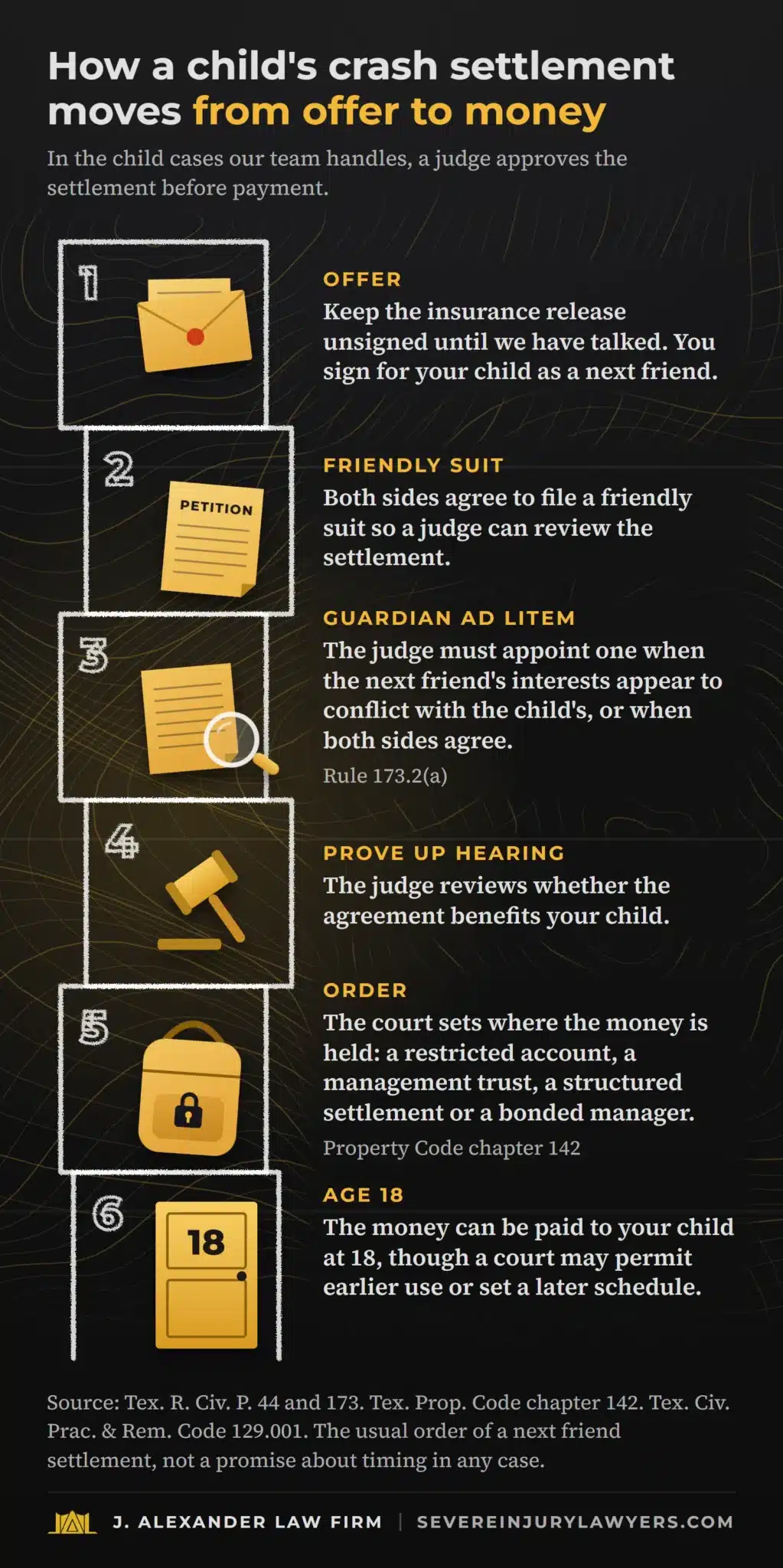
In the child cases our team handles, a judge approves the settlement before payment.
- Offer: Keep the insurance release unsigned until we have talked. You sign for your child as a next friend.
- Friendly suit: Both sides agree to file a friendly suit so a judge can review the settlement.
- Guardian ad litem: This is a person the judge appoints to protect the child's interests. The judge must appoint one when the next friend's interests seem to conflict with the child's. The judge must also appoint one when both sides agree. Rule 173.2(a)
- Prove up hearing: The judge reviews whether the agreement benefits your child.
- Order: The court decides where the money goes. The choices are a restricted account, a management trust, a structured settlement or a bonded manager. Property Code chapter 142
- Age 18: The money can be paid to your child at 18. A court may allow earlier use or set a later schedule.
Tex. R. Civ. P. 44 and 173. Tex. Prop. Code chapter 142. Tex. Civ. Prac. & Rem. Code 129.001.
What is a minor in the state of Texas?
Under section 129.001, Texas sets adulthood at 18. A child younger than 18 cannot make a settlement binding with a signature alone.
If your child has no legal guardian, a next friend can bring the lawsuit for your child. I prepare the claim with that person.
A father hired us to represent him and his son. We had him sign for his son. When parents are divorced or disagree, I sort out who should act for the child before we file.
A father asked Matthew Graham, our managing litigation attorney, about filing for his injured daughter. His answer is below.
If other family members were hurt
If a parent and child are hurt in the same crash, each family member has a separate claim. That includes a child who was a passenger. We review the child's claim apart from the parent's.

From our attorney
"Whether or not you, as a father, can file on behalf of your daughter depends on their age."
Matthew Graham
Managing Litigation Attorney | answering a parent's question, 2026
Is there a dollar limit on a child's settlement in Texas?
Only 1 option has a dollar limit: paying the money to the county clerk. That option is for $250,000 or less. The limit does not apply to other child settlements. To use the clerk, the amount must be fixed and not disputed in a pending lawsuit. Your child also cannot have a court appointed guardian of the estate. That is a person who manages a child's property. I consider the clerk option only when the payment meets those conditions.
Estates Code section 1355.001 covers a qualifying payment owed to a child who lives in Texas. It lets the person who owes the money pay the county clerk. My first question is whether a court has appointed a guardian of the estate for your child.
Once the clerk gives a receipt, the payment binds the child. The child cannot claim that amount again.
The money stays with the clerk with 2 exceptions. A court can order its release (Estates Code section 1355.105). A parent appointed as custodian can also apply to withdraw it for the child (section 1355.102). That parent must post an approved bond for twice the amount (section 1355.103).
A bond is a financial promise that protects the money. If the parent breaks its terms, the bond's backers must cover the money (sections 1355.103 and 1355.104).
Parents ask our team who is handling their child's settlement, where it stands and how long court review takes. In September, one parent called with a question about the judge:
From a parent's call
"they were supposed to been sending my son's settlement to a judge or whatever."
Caller, 2026
What does a guardian ad litem do in a minor settlement in Texas?
The judge may appoint a guardian ad litem, usually a lawyer. That person reviews the proposed agreement and tells the court whether it serves your child. The judge makes that choice, not the parents or the insurer.
Both sides agree to file a friendly suit so a judge can review the settlement. Rule 173.2(a) says when the judge must appoint a guardian ad litem. One case is when the next friend's interests seem to conflict with the child's. The other is when both sides agree to an appointment. The judge must make the appointment in a written order.
A friendly suit does not always need a guardian ad litem. But a parent's interests can conflict with a child's. For example, a parent might want more of the offer for the parent's own claim. That leaves the child with less.
From the start, I keep the parents' claim apart from the child's claim to help avoid a conflict. A guardian ad litem can also alert the court to a conflict.
There is no set timeline for the hearing. The court chooses the date. If it appoints a guardian ad litem, that person reviews the agreement first.
One mother was waiting on her son's hearing. Our team told her 3 papers had arrived and were under review. They were the petition that starts the suit, the request for an ad litem and the appointment order. Our staff said the guardian would call about her son and consider whether the settlement was reasonable. They also said guardians sometimes ask for changes.
Insurers may ask a judge to approve a child's settlement agreement. Without approval, the agreement might not bind the child.
The guardian ad litem may talk with the child, a parent and the family's lawyer. Those talks have the same legal protection as talks between a lawyer and client. Others generally cannot force anyone to reveal them.
A guardian ad litem may receive a reasonable hourly fee and repayment of reasonable expenses. Under Rule 173.6(b), the judge cannot set that fee as a percentage of the settlement or judgment. The judge may include the fee in court costs.
The judge must also approve the attorney fee in your child's settlement. We can review that fee with you using the fee guide. We can also go through the settlement statement showing fees and deductions together, including who pays what.
Where is a minor's settlement money held in Texas?
With you, we present the judge 4 choices: a restricted account, a management trust, scheduled payments or a bonded manager. A qualifying payment may also stay with the county clerk.
In a court approved settlement, no money is paid until the judge approves the agreement. Property Code chapter 142 covers a child who has no legal guardian. It applies when a next friend or guardian ad litem represents that child.
Under section 142.001, the court needs an application and a hearing before it orders an investment. I file that application for your child's money.
One option is a structured settlement after a Texas car accident, which provides payments at set times. The court can consider these arrangements:
- Restricted account (section 142.004). The child's representative may invest in an education savings plan. Or the representative may use qualifying interest paying deposits at a Texas institution. The Federal Deposit Insurance Corporation, or FDIC, must insure the institution. FDIC coverage protects eligible deposits up to insurance limits if the bank fails. The court clerk may invest the funds under a written court order. No bond is needed if withdrawals require a court order.
- Management trust (section 142.005). If a trust serves the child, a court may have a financial institution hold the funds only for the child. The trustee is the person or bank that manages the trust. The trustee may spend its income or funds on the child's health, education, support or maintenance. The court continues to supervise the trust.
- Structured settlement (section 142.008). If both sides ask, a court may approve scheduled payments. A qualifying annuity or an obligation backed by the United States government must fund them. An annuity is an insurance contract that pays on a schedule. The party providing the funding must give the court the funding document. Or that party can give the court an independent financial consultant's sworn statement of present value. Present value means today's value of the future payments.
- Bonded manager (section 142.002). The court may let the child's next friend or ad litem hold the funds after posting a bond. If a surety company backs the bond, it must be at least equal to the amount of money held. Otherwise, it must be at least twice that amount. Ask your lawyer what the bond would cost.
Can I use my child's settlement money in Texas?
Yes. A court order may allow the money to cover an expense that helps your child, such as a car, bill or household cost. The money can be paid to your child at 18. A court may allow earlier use for your child's needs or set a later schedule.
The law treats being under 18 as a legal disability. That term means a condition that limits a person's legal rights. When invested money is taken out, section 142.004(c) lets the court move it to another chapter 142 option.
The court may find the disability has ended, such as when your child turns 18. Then it may order the money paid to the child. A trust under section 142.005 can release money in stages. Some can come at 18 and the rest later.
If your child has an expense, tell me what your child needs and what it costs. With that information, I ask the court for an order to cover the expense. If the court grants the request, you can use your child's settlement money for that expense.
Who owns the claim for a child's medical bills in Texas?
Parents generally hold the claim for their child's medical bills before age 18. The exception is when your child's estate owes those bills. The estate is your child's own money and property. Our team checks how the offer splits your claim from your child's share. We also check for a lien, a legal claim on the money, or an insurer's repayment claim.
Your child's claim can include pain, mental anguish, lost earning ability and care needed after age 18. Say a doctor expects your child to need care after turning 18. The cost of that care belongs in your child's claim. So I ask the doctor for a written assessment before the hearing.
What one mother told us
One mother said her son's doctors and therapist warned the injury might affect him later. He had no symptoms then. She felt her son should receive all the settlement money.
Our team went through the breakdown with her, including the reduced bills, the contract fee and the case expenses. Our team sends letters asking the providers to reduce their bills before the money is divided.
I put the parents' medical bill claim and the child's claim on separate lines in the papers for the judge. Those separate lines show how the offer divides the two claims. The judge can then see that money for your child was not given up to cover your medical bills.
Under Property Code section 55.003, a child is not exempt from a hospital lien. Texas Human Resources Code, at section 32.033(a), assigns part of a Medicaid applicant's or recipient's injury claim to the state. That covers injuries caused by someone else's negligence, meaning carelessness, or wrongdoing.
Section 32.033(e) limits the Health and Human Services Commission's recovery to what it paid for medical care. We can go through your closing paperwork together to check what the paperwork says is owed.
Section 32.033(b) of the Texas Human Resources Code adds a duty to report. A Medicaid recipient must report an injury needing medical care that another person caused. The report is due within 60 days after the recipient learns a claim may exist.

"Made sure my daughter was okay. She stated that she was a little bit in pain. She was scared."
Kevin, a client of J. Alexander Law Firm. Watch Kevin tell it
Does your child's offer combine the injury payment and medical bills? Let's check the breakdown together.
Call 469-807-7480What is the deadline to file a child's injury claim in Texas?
Your child's claim generally has a filing deadline at age 20. Under Section 16.001, the time to file does not start until your child turns 18. Then the usual 2 years begin. Your own claim for medical bills usually has its own deadline, 2 years after the crash.
For example, say a child is hurt on their 7th birthday, March 1, 2026. That child turns 18 on March 1, 2037. The deadline for the parents' medical bill claim would be March 1, 2028. The child's deadline would be March 1, 2039.
I do not wait until your child turns 20. Clinics lose records, and witnesses forget. Your medical bill claim and your child's injury claim can have different deadlines, as the Texas crash filing deadline rules explain. If time has passed since the crash, we can talk about whether a crash claim may be too late.
If your child shares the blame for the crash, your child's payment can drop by that share. Keep that in mind when you weigh your child's offer. The Texas comparative fault guide shows how Texas splits fault in a crash claim.
Bring me your child's offer or release before you sign anything or respond. We can go over the paperwork together. Did an insurance adjuster call you? Sameer Assanie explains when to bring in a lawyer in his answer about an adjuster's first calls after a wreck.
Example
A child's car crash settlement
Say a letter arrives after a Texas car wreck. A mother holds a release for her 9 year old son's injury claim. A release is the paper that ends the claim for good. She calls me to ask if she can sign it and put his money in her checking account.
Her signature alone does not make the agreement binding on her son. I would ask her to leave the release unsigned while we review it.
In a court approved settlement, Rule 44 means the agreement binds her son only after the judge approves it.
A qualifying payment to the county clerk is a separate option.
If we pursue court approval, the mother can act as her son's next friend in a friendly suit. That means she acts for him in the lawsuit.
At a prove up hearing, the judge reviews the proposed settlement. The judge may appoint a guardian ad litem to advise the court about her son's interests.
I would put her claim for his medical bills on a separate line from his injury claim. Then the judge can see how the offer is divided. The court order can place his share in a restricted account or a management trust. It can also set scheduled payments or name a bonded manager. The arrangement may provide for payment at 18 or on a later schedule.
She cannot assume the money can go into her checking account. Say the money is in a restricted account and her son needs some before 18. We can ask the court for an order to withdraw it.
24/7 | Free consultation | No fee unless we recover
Bring me your child's offer. We can explain the friendly suit, the hearing and the court order.
J. Alexander Law serves injured clients throughout Texas: Dallas | Houston | San Antonio | Fort Worth | Arlington | Canton. Se habla español.