




Short answer
What is a tort claim after a car accident in Texas?
A tort claim seeks payment for harm caused by wrongdoing. After a government driver hits you, 3 questions matter. Was the driver on the job? Did the driver's carelessness cause your injury? Would Texas law make the driver personally owe you if the driver were a private person?
If a Texas government vehicle hurt you, you may have a claim under the Texas Tort Claims Act. My first question is which entity owns the vehicle. It could be a school district, transit agency, city, county or state agency. The owner decides 2 things: the notice rules and the damage caps. Notice tells the government about your claim, including your injury or damage, the crash's time and place and what happened. The clock for notice and for a lawsuit generally starts at the crash. Notice is due first.
Section 101.021 covers some injuries and damage caused by using or driving government vehicles or motor driven equipment. My first step is to prove the employee was driving on the job.
Section 101.065 has an exception for some DPS officers. The Act does not cover what a commissioned DPS officer did while off active duty. If the Act covers your claim, section 101.025 permits a lawsuit against the government unit.
Is the government driver blaming you? Read how fault affects a Texas crash claim.
Which government vehicles are covered by the Texas Tort Claims Act?
Did an ambulance, police car, transit bus, school bus, fire truck or government truck hit you? The Act may cover that crash. The Act also covers some claims involving potholes and other defects on public roads.
Section 101.001 includes cities, counties, the state, school districts and other government units in the Act. If a city bus or police car hit you, my first question is who employed the driver. We confirm the employer because damage caps differ by government body. Notice rules may differ too.
- City and county vehicles. These include police cars, public works trucks, garbage trucks and vehicles used by sheriff's departments. You can also read about garbage truck crashes.
- State vehicles. A truck owned by TxDOT, the Texas Department of Transportation, belongs to a state agency. If one hits you, the state's damage caps apply to your claim.
- School buses. The Act protects school districts from most claims. But section 101.051 allows claims involving their motor vehicles, including school buses.
- Fire trucks and ambulances. When a city fire truck is involved, the city's notice rules apply to the claim. You can read about Houston fire truck crash claims. Some volunteer fire departments, rescue squads and emergency medical services count as emergency service organizations. Those have lower caps, so we check whether the provider qualifies.
- Transit buses. You could be hurt as a passenger on a Houston METRO, San Antonio VIA, Austin Capital Metro or Dallas DART bus. The same notice and claim rules apply if a government bus hits your car or hits you on foot.
The Act does not cover assault or other intentional acts
Section 101.057 leaves out claims for intentional wrongs. Those include assault, battery or harmful touching. They also include false imprisonment, which means holding someone against their will. A careless government driver can still be covered if the Act's conditions are met.
How do you give notice of a claim under the Texas Tort Claims Act?
Under Section 101.101(a), the government body must generally receive your notice within 6 months after the crash. Houston sets a 90 day deadline. Other cities may set different deadlines. If the government already knew of your injury or damage, formal notice may not be needed. That is called actual notice, so we check what the government knew.
In the notice, I describe the crash, its time and location, and the injury or damage you claim. To compare the notice periods with the lawsuit deadline, see Texas crash filing deadlines and government notice rules.
The crash report lists the owner. With the vehicle's unit number or markings, that tells me which government body owns it. Once we know the owner, I check its notice rules and send the notice myself.
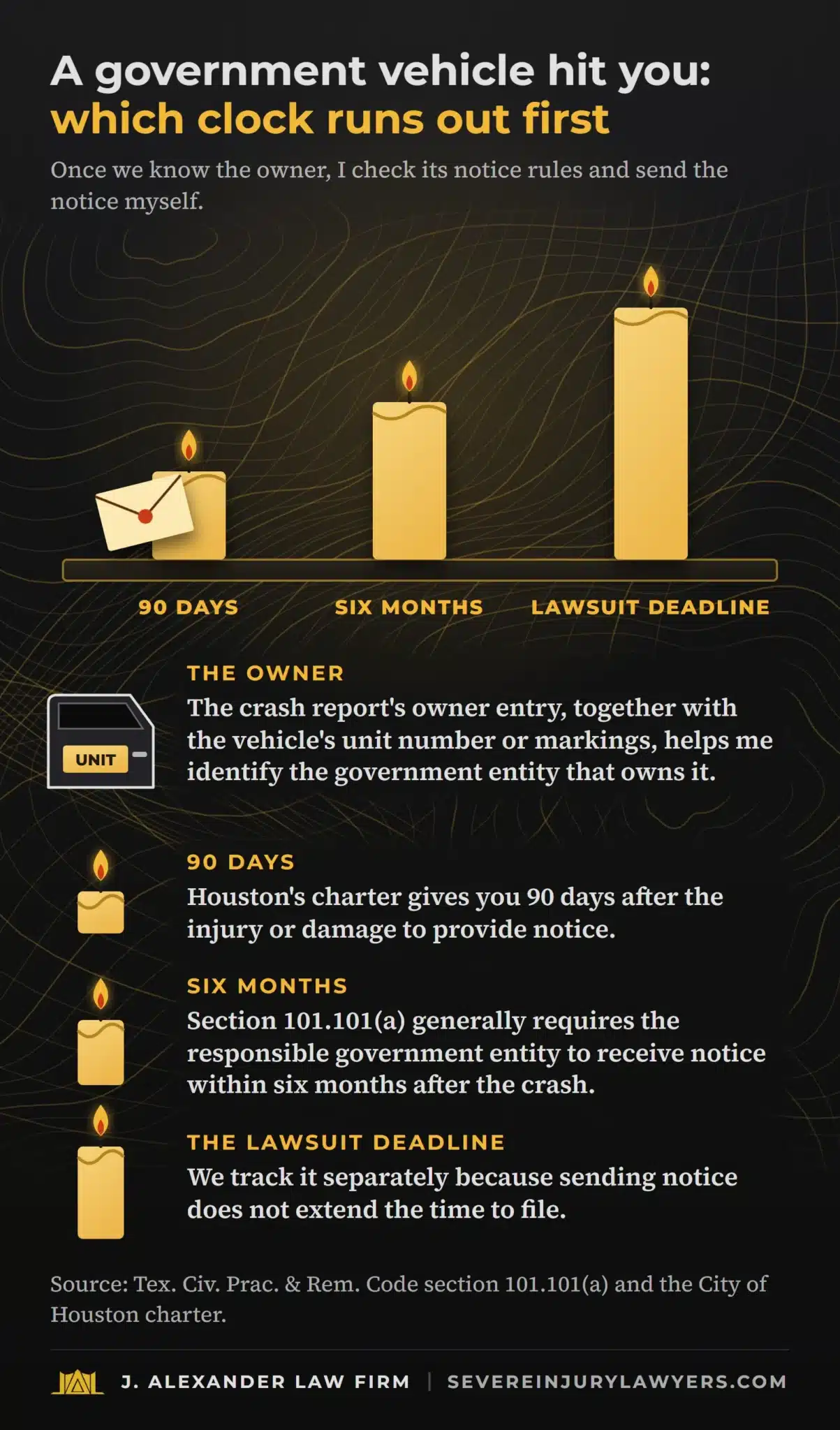
Read it as text
Once we know the owner, I check its notice rules. Then I send the notice myself.
- The owner: The crash report's owner entry and the unit number or markings show which government body owns the vehicle.
- 90 days: Houston's charter gives you 90 days after the injury or damage to provide notice.
- Six months: Under Section 101.101(a), the government body generally must receive notice within 6 months after the crash.
- The lawsuit deadline: We track it separately because sending notice does not extend the time to file.
Tex. Civ. Prac. & Rem. Code section 101.101(a) and the City of Houston charter.
Houston's charter gives you 90 days after the injury or damage to provide notice. Sign it before a notary, then mail it to the City Secretary with a copy to the City Attorney. Attach any medical bills and the accident report if it is available.
Texas courts say actual notice means the government knew 3 things. The government knew someone was hurt or property was damaged. It knew someone said the government was at fault for that harm. It also knew who was involved. A police report may give the government that knowledge. An investigation alone may not.
Say a city work truck turns into your lane. The driver says the city will handle the claim. I would not treat that promise as notice. Instead, I send notice and keep proof the city received it.
A city or agency claims office may call you after the crash. Our adjuster call answer covers its early questions about fault and injuries. Under section 101.027, a city or county may buy insurance. Its insurer can then investigate and settle covered claims.
Under Section 101.104, you cannot ask about or use at trial whether the government has insurance or how much.
We track the lawsuit deadline separately because sending notice does not extend the time to file. Section 101.102 requires filing an Act lawsuit in state court, in the county where the crash happened. The court papers must name the government unit as the defendant, the party being sued.
Not sure which city or agency owns the vehicle? I can look up its notice rules with you.
Call 469-807-7480How much can you recover from a Texas government entity after a crash?
My first question is which government body is responsible for the vehicle. The answer sets the cap on your claim. For a Texas city or the state, section 101.023 caps injury damages at $250,000 for each person. The cap for the whole crash is $500,000. Property damage has a separate limit of $100,000 for the crash.
Section 101.023 sets lower caps for a county, school district or other local unit that is not a city. Injury damages are capped at $100,000 for each person. The combined injury limit for the crash is $300,000. For property damage, the limit on your crash is $100,000. Emergency service organizations generally face these 3 caps too.
For a qualifying injury claim, we consider your treatment bills, the pay you missed and the pain you felt. The cap limits how much the government pays. See the damages available in Texas crash claims for more on those losses.
Example: 3 people hurt by one city truck
A city truck hits a car carrying a driver and two passengers. Each claims $250,000 for injuries. Together that is $750,000. That is more than the $500,000 cap for the crash.
Can you get punitive damages from the government in Texas?
No. Section 101.024 does not allow exemplary (punitive) damages in a Texas Tort Claims Act case.
The Act caps damages against the government. A private contractor or its driver may face different Texas rules. Under section 101.001, an independent contractor and its staff are not government employees.
For example, a private company may run a city's garbage trucks. If its driver hit you, I also look at the company's insurance. The Texas crash lawsuit value guide explains what affects a claim's value.
Does the government pay if a police car or ambulance hits you on an emergency call?
Sometimes. Section 101.055(2) may protect the government when an employee reacts to an emergency situation or responds to an emergency call. The employee's action must follow the laws and ordinances that apply to emergency action. If no emergency law applies, the government can still be protected. The exception is when the employee acted with reckless disregard or conscious indifference for others' safety.
Transportation Code section 546.005 requires a driver of an authorized emergency vehicle to drive with regard for everyone's safety. I ask whether the driver drove with that care. We request dispatch audio and logs to find out whether the vehicle was answering an emergency.
Our TxDOT records cover the first 313 days of 2026, through November 9. They show 2,336 reportable Texas crashes with an emergency responder driving on an emergency. 8 crashes were fatal. 66 involved at least one person with a suspected serious injury.
During the corresponding 313 days of 2025, the records show 2,273 crashes. The early 2026 total works out to about 7 crashes per day. The emergency responder flag on a report does not say who was at fault.
Texas crash reports carrying the CRIS emergency responder flag | TxDOT CRIS public query, statewide reportable crashes, January 1 to November 9 of each year, pulled November 12, 2026 (our own pull), Emergency Responder Flag
| Period | Crashes | Fatal crashes | Suspected serious injury crashes |
|---|---|---|---|
| 2026, January 1 to November 9 | 2,336 | 8 | 66 |
| 2025, January 1 to November 9 | 2,273 | 21 | 62 |
In CRIS, TxDOT's crash records system, the flag marks a crash involving an emergency driver on an emergency. The driver is a peace officer, firefighter or emergency medical services employee. The vehicle is a police, fire or ambulance vehicle. The injury columns count each crash by its worst injury. A flagged crash is not proof of fault. Late reports will likely raise the 2026 numbers.
Can you sue a government employee personally in Texas?
Sometimes. I decide whom to name before filing. Suing the employee can stop you from also suing the government unit.
Under section 101.106, your choice of whom to sue has these effects:
- If you sue the government unit under the Act, you cannot later sue its employee over the same crash.
- If you sue the employee, you cannot sue the government unit over the same crash unless it agrees.
- If you settle a claim under the Act, you cannot sue the unit's employees over the same crash. A court judgment against an employee also stops a suit against the government unit.
- If you sue both the unit and its employees under the Act, the unit can ask the court to drop the employees. The court then dismisses them.
- Say you sue an employee over ordinary job duties, and the Act would have allowed a suit against the unit. The law then treats the employee as sued in an official role. Under section 101.106(f), the employee can ask the court to dismiss the suit. You then have 30 days to change your court papers. You must drop the employee and name the government unit instead. Missing that deadline may leave you without anyone to sue.
Deciding whether to name the driver or the agency? Talk through section 101.106 with me first.
Call 469-807-7480What law applies if a federal or military vehicle hits you in Texas?
If a federal or military vehicle hits you in Texas, the Federal Tort Claims Act may apply. Then we follow that law, not the Texas Act's notice deadline.
We follow the federal process on our mail truck claims page. Similar steps apply to military and other federal vehicles.
Under 28 CFR 14.2(b)(1), send your claim to the federal agency whose work caused the crash. Examples are Border Patrol, ICE or a military branch.
A different federal agency may get your claim by mistake. If it can tell the right agency, it must send the claim there quickly and tell you. If a transfer is impractical, that agency must return the claim to you.
The Attorney General may certify that the federal driver was doing federal work. Then the United States takes the driver's place as the party being sued. Under 28 U.S.C. 2679(d), the government then moves a Texas court case to federal court.
If the Attorney General will not certify that, the employee may ask the court to. The federal court may find the employee was not doing federal work. Then the case goes back to state court.
One day after a postal driver struck her car in October 2026, a woman called our intake team. She had shown officers her dash cam video. She wanted to know why the driver had not received a ticket. Our team asked for the video right away and asked whether anyone got a ticket. We explained that the Postal Service would get its driver's statement and wait for the police report:
From our intake
"I got their insurance because I know that it's not like a regular car accident because it was a USPS driver."
A caller, 2026
How do you get records from a Texas government agency after a crash?
Send a written public information request to the Texas government body that holds the crash records you want.
Anyone can ask a Texas government body for public information about a crash. The government may hold back some of it. Your notice deadline may come before the records do, so do not wait for them.
At the scene, write down the bus or unit number, the route and the driver's name. Only do this if you are safe. Keep those details with the items in the Texas car accident checklist. My concern is timing. In Houston, notice is due within 90 days.
- Crash report, form CR 3. The officer uses this form to document the crash, and you can buy a copy through TxDOT's online system.
- Dispatch audio and logs. If the vehicle was responding to a call, ask the agency that dispatched it for these records.
Example: a truck with a government seal
Who owns the government truck?
Picture a man the night after a white pickup sideswiped his car. He looks at his photos. A seal is on the pickup's door. He cannot tell if it belongs to a city, a county or a state agency.
I would start with the markings on the pickup and compare them with the owner entry on the crash report. A unit number on the truck could help us identify it.
The seal points us to the likely owner and its rules. We still need to confirm who owns the truck.
The owner matters because section 101.023 sets different injury caps for different government units. The limit for a city or the state is higher than the limit that generally applies to a county or another local unit. The applicable limit depends on which government body is responsible, not just what appears on the door.
A city seal does not rule out a private company. The company's driver may have been working for the city. Different Texas rules may then apply.
He can zoom in on the seal and unit number in his photos and send them to us.
Records and notice are separate
A records request is not claim notice.
24/7 | Free consultation | No fee unless we recover
Tell me whose vehicle it was. I will check the notice rules.
J. Alexander Law serves injured clients throughout Texas: Dallas | Houston | San Antonio | Fort Worth | Arlington | Canton. Se habla español.