


On this page
To find out what happened in a Dallas accident today, check three live sources in this order: the TxDOT DriveTexas map, the NTTA traffic map for the Dallas North Tollway, and the Dallas Police active calls feed. Whether you are sitting in the backup or you searched car accident Dallas TX today because you were just in one, the checklist below tells you which source answers which road, why the Dallas North Tollway, US 75, I 30, and I 635 crash where they do, and what to do next.
Old news articles and static pages cannot tell you what is happening on a highway this minute, but the agency feeds below update as crews report from the scene. We at J. Alexander Law Firm built this page around them: a short list of sources that update as the agencies report, and a short list of sources that update as the agencies report them, and a plan for the one reader who needs us most: the person who was in the crash.

The J. Alexander Law Firm team · Dallas, Texas
The five sources that actually update, and which road each one answers
For a Dallas highway right now, the TxDOT DriveTexas map is the fastest statewide source, the NTTA map covers the Tollway, and the Dallas Police active calls feed shows what officers are working this minute. These are the only sources that reflect car wrecks in Dallas today as they happen, because each one is fed by the agency at the scene rather than by a reporter after the fact.
Live Dallas incident sources
Verify links before you rely on them
| Source | What it shows | How current |
|---|---|---|
| DriveTexas.org TxDOT |
Crashes, closures, construction, and live cameras on US 75, I 30, I 635, and downtown | Verified by TxDOT crews, map refreshes every 5 minutes, 24 hours a day |
| NTTA traffic map | Incidents and closures on the Dallas North Tollway and every NTTA toll road | Live tollway conditions, with pushed alerts on the @NTTATravelAlert feed |
| Dallas Police active calls Dallas OpenData |
Active police and major accident calls citywide, with location and beat | Updates continuously from the city dispatch feed |
| TxDOT travel line 1-800-452-9292 |
Statewide road conditions by phone when you cannot look at a screen | Automated 24 hours a day, live counselors 8 a.m. to 6 p.m. |
| WFAA, NBC 5, Fox 4 | DFW traffic maps and on air reports that add context a data feed will not | Continuous during drive times, with Waze powered live maps |
Match the source to the road: use the NTTA map for anything on the Tollway, and use DriveTexas and the Dallas Police active calls feed for US 75, I 30, I 635, and downtown closures. If two sources disagree, the agency working the scene wins, which means DriveTexas for a TxDOT highway and the police feed for an active police scene.
What these feeds can and cannot tell you about last night
These feeds show what is active right now and drop incidents once crews clear them, so a car accident in Dallas today rolls off the maps once the lanes reopen, and a crash from last night usually will not still appear on DriveTexas or the police active calls map this morning. To find out what happened overnight, check the WFAA, NBC 5, or Fox 4 morning traffic recaps, which carry the incidents that closed lanes during the night. For the official record of a specific overnight Dallas car crash, the police crash report is the answer once it posts, usually about two weeks later.
Why downtown Dallas is blocked off today: the four usual reasons
A downtown Dallas closure is almost always one of four things, a major crash, an active police scene, an event closure, or planned construction, and each one has a different fast source.
- A major crash: check DriveTexas and the Dallas Police active calls feed, which show the blocked lanes and the responding units.
- An active police scene: the Dallas Police active calls feed lists it first, and local TV fills in why the street is shut.
- An event closure such as a parade, a marathon, an arena event, or a protest: the City of Dallas and the event organizer post the route, and local TV carries it the morning of.
- Planned construction: DriveTexas and the TxDOT Dallas district notices list the lane and ramp closures in advance.
- Summer heat buckling pavement: extreme Texas heat can buckle concrete panels and pop joints, forcing an emergency lane closure until crews cut out the section, and DriveTexas lists those closures the same way.
How long do Dallas highway closures usually last?
A minor crash often clears within an hour. A wreck with serious injuries, a fatality investigation, or a fuel or chemical spill can hold lanes for several hours.
Where does a Dallas tollway accident tend to happen? Gantries, short merges, and the High Five approach
Dallas North Tollway accidents cluster at the speed differences near the toll gantries, in the short merge lanes at the entrances, on the approach to the High Five interchange where the Tollway meets I 635, and in dense rush hour traffic between downtown and the LBJ merge. A Dallas tollway crash usually starts in that gap where drivers moving at highway speed meet drivers slowing for a gantry or a backup, and that is where the rear end hits begin.
The Dallas North Tollway is a toll road because the North Texas Tollway Authority builds and operates it, which is why the NTTA map, not TxDOT’s, is the live source for anything happening on it, and why it will know before the news does.
Does the Tollway refund tolls during a closure?
No, but you are only charged for the toll points you actually pass. The NTTA bills by gantry, so a closure that reroutes you is billed only for the segments you actually cross. There is no separate refund for sitting in Tollway traffic, and billing questions go to NTTA customer service at 972-818-6882.
Why does US 75 Central Expressway crash so often? Dense exits, the downtown S curves, and rear end chains
US 75, Central Expressway, and what many drivers type as I 75 are all the same road through Dallas. It is signed as US 75, the maps label it Central Expressway, and there is no separate I 75 here, so a live check for any of those names points to the same corridor on DriveTexas.
US 75 crashes come from three things:
- Exits spaced too close together to merge cleanly, forcing late lane changes at speed.
- The S curves near downtown that hide stopped traffic until a driver is on top of it.
- Congestion shockwaves that ripple backward, where each driver brakes a beat later than the one ahead, and near the S curves that beat is the difference between stopping and hitting.
Why does an I 30 accident stop traffic dead? The canyon, the Mixmaster, and the LBJ weaves
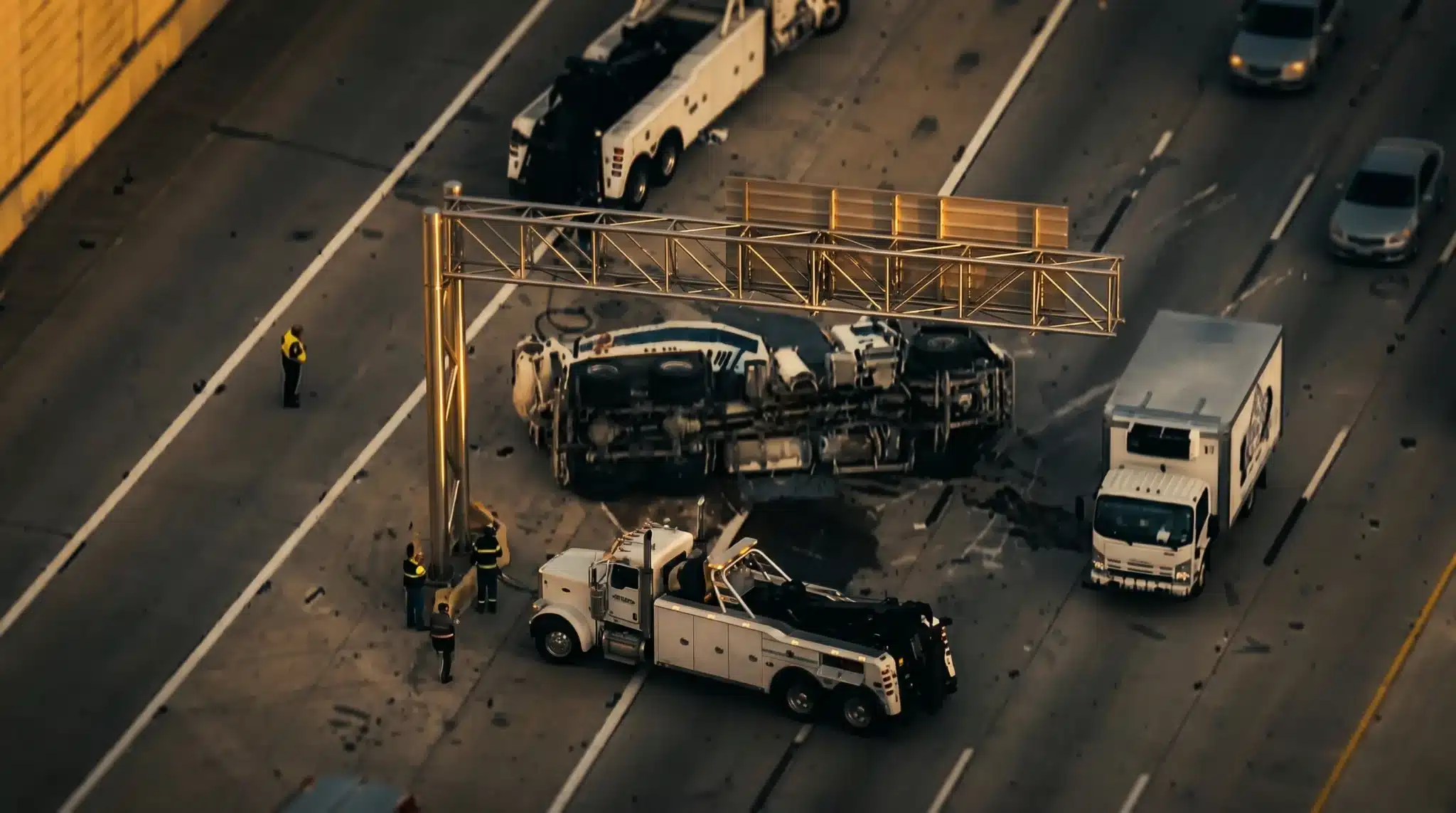
I 30 · the Dallas to Fort Worth run
An I 30 accident stops traffic dead because the corridor gives drivers almost nowhere to divert, and I 635 crashes at its weaves. Three pieces of geometry do the damage:
- The I 30 canyon below downtown boxes traffic in, with no escape once a lane is blocked.
- The Mixmaster, where I 30 crosses I 35E, funnels several freeways through one knot, so one blocked lane backs up all of them until crews clear it.
- The LBJ weaves, where I 635’s main lanes, frontage roads, and LBJ Express toll lanes braid together, force late lane changes at speed near the High Five and the I 35E interchange, and that is where the sideswipes and rear end hits cluster.
When you are stuck on I 30, DriveTexas will show whether the lanes are open again before the backup in front of you does. The DriveTexas map covers I 635 too, and the NTTA map covers the express lanes inside it.
Where do pileups happen most in Dallas?
Where high speed meets a sudden stop. Pileups cluster at the Mixmaster where I 30 and I 35E cross downtown, at the merges near the High Five where US 75 meets I 635, and on the elevated Tollway ramps in fog or ice.
Whose fault is it in a Dallas pileup?
Fault in a Dallas pileup is proportional, decided car by car, and the middle car is not automatically to blame, which is why photographing every vehicle position at the Mixmaster or High Five before the tow trucks clear the chain matters so much; see who actually pays in a chain reaction pileup for the full fault and evidence explainer.
What changes when a semi is in the wreck?
A truck in the crash lengthens two things at once, the closure and the list of who is liable:
- The closure runs hours, not one: a jackknifed tractor trailer or a spilled load forces crews to offload cargo and clean the roadway before reopening, and the same I 635 weaves that produce car sideswipes produce the truck sideswipes that block multiple lanes at once.
- The claim spreads: liability often lands on the carrier, the driver, and the cargo owner together, and our Dallas truck accident lawyers page covers how that is proven.
Do Dallas highways close for ice or fog? The elevated ramps go first
Yes, Dallas highways ice and fog over, and the elevated structures freeze before anything at ground level. Bridges, flyover ramps, and the stacked ramps at the High Five and along the Dallas North Tollway lose heat from below, so they glaze over first in a freeze while the surface streets stay clear, and those iced elevated ramps are exactly where the fog and ice pileups cluster. Morning fog settles worst in the I 30 canyon below downtown and along the low river crossings, cutting sight distance right where traffic already stacks. When a freeze or fog warning is out, DriveTexas shows the ramp and lane closures TxDOT posts, and the elevated ramps are the first ones crews shut.
If you were in the crash everyone is searching about, here are your first three moves
Your first three moves are to get to safety and call 911, to photograph the scene before anything is towed, and to get checked by a doctor even if you feel fine.
- Move to safety and call 911 Get out of live lanes if you can, then call 911 when someone is injured, a driver seems drunk or high, the other car drives off, or the wreck is blocking traffic, so there is an official response and a report number.
- Photograph the scene and the other driver Capture the vehicles, the lanes, the damage, and the other driver’s license, insurance, and plate before anyone leaves, because the scene disappears the moment it is towed.
- Get checked by a doctor today Crash injuries to the neck, back, and chest often surface a day later, so a same day exam protects your health and ties any injury to the crash.

J. Alexander Law Firm · Dallas car accident attorneys
We at J. Alexander Law Firm handle Dallas crash claims on contingency, which means the review is free and there is no fee unless we win. If you were hurt on the Tollway, US 75, I 30, or I 635, our Dallas car accident lawyers can tell you where you stand, and our full what to do after a car accident in Texas guide walks the rest of the checklist.
24/7 · Free consultation · No fee unless we win
Were you in a Dallas crash today?
Call 469-807-7480 or contact us online. Se habla español.
How do you find out what actually happened? The crash report
The police crash report, the CR 3, is the official answer to what happened, and Texas requires an officer to file one whenever a wreck injures someone or leaves apparent damage over 1,000 dollars. It is usually available about two weeks after the crash; the moment it posts, our Texas crash report decoder shows how to pull it and read what the codes and the diagram actually mean.
To check on another person who was in a crash, contact the police agency that worked the scene for the report and, if someone was taken away by ambulance, call the closest hospitals to the crash location, since responders take the injured to the nearest emergency room.
How do you find out if anyone died in a crash today? The maps do not carry casualty counts
Live traffic maps never confirm a death, so a DriveTexas or police feed marker is not a casualty count. The confirmed number moves through a chain you can follow:
- The agency that worked the scene Usually the Dallas Police Department or the Texas Department of Public Safety, which releases fatality information only after next of kin are notified.
- The police media release and the county medical examiner The confirmed number comes from Dallas police media releases and the Dallas County medical examiner, usually within a day of the crash.
- The CR 3 crash report The confirmed count and the injury details appear on the report about two weeks after the crash.
- TxDOT for statewide totals The running Texas road death figures behind any how many died on Texas roads this year answer.
Who was shot and killed in Dallas?
Shooting victims are named by the Dallas Police Department, through its media releases and its open data portal, once next of kin are notified, the same rule that governs every Dallas death. This page tracks crashes, so for a homicide rather than a wreck, those two police sources are the answer.