




Short answer
When does a pedestrian have the right of way in Texas?
You generally may cross when you face a Walk signal. With no pedestrian signal, you may cross on a green light. You may also cross at a crosswalk with no working signal. A driver may have to yield to you there. A green turn arrow by itself does not permit you to cross. Away from a crosswalk, you generally must let cars go first. But the driver still must try to avoid hitting you.
Not always. Texas law determines who must yield based on where you cross. I start by sketching where you were hit. Was it at a corner, a signal or a driveway? Or was it between intersections?
Who had to yield does not decide the whole claim. I also look at what you and the driver each did. You may share some of the blame. See how Texas handles shared fault.
If you were riding a bicycle, different duties apply under the Texas bicycle laws.
Pedestrian right of way in Texas at a glance: who yields, and what it means for a crash claim | Texas Transportation Code chapter 552, Texas Department of Public Safety, Texas Driver Handbook (revised January 2026) and Texas Department of Transportation, read Nov 11, 2026
| Where you were | Who yields | What it means for a claim |
|---|---|---|
| In a crosswalk at a corner with no signal, painted or not | The driver stops and yields (section 552.003(a)) | A driver who did not yield at this crossing may bear fault. |
| In a crosswalk on a Walk signal, or on a green light where there is no pedestrian signal | Walk signal: the driver stops and yields. Green light with no pedestrian signal: you may cross unless the only green is a turn arrow (sections 552.001 and 552.002) | Signal timing and any available camera video may help show what happened. |
| In a crosswalk as a driver makes a right turn against a red light | The driver first comes to a stop, then gives way to you | The question includes whether the driver stopped before turning and yielded to you. |
| In a crosswalk while another vehicle has stopped to let you cross | A driver coming up from behind may not pass the stopped vehicle (section 552.003(c)) | Note which vehicle stopped and which one kept going. |
| Crossing mid block, or anywhere outside a crosswalk at an intersection | The pedestrian yields to vehicles (section 552.005(a)) | Your duty to yield matters, and the driver's duty of care still counts. |
| Crossing an intersection diagonally | Allowed only if a traffic control device authorizes it, and only in the manner it authorizes (section 552.005(c)) | Photograph any signal or sign that controls the diagonal crossing. |
| On a sidewalk crossing the entrance to a driveway, alley or parking area | A driver entering or leaving stops first and gives way to you (section 552.006(c)) | The driver's duty to stop before crossing the sidewalk matters. |
| Walking along a road | Use the sidewalk. If there is none, walk facing traffic along the left edge of the road or on the shoulder | Where you walked in relation to the sidewalk and traffic may matter. |
The table covers the rules that most often matter in injury claims. Texas has other pedestrian laws too.
What is the definition of a crosswalk in Texas?
A crosswalk can be painted on the pavement. It can also be unpainted at an intersection where the sidewalk lines continue across the road. Between intersections, a crossing must be marked to count as a crosswalk.
Say you crossed at an unpainted corner where the sidewalks across the road line up. That spot may count as a crosswalk under section 541.302, even with no paint. An adjuster may call your crossing jaywalking, which means crossing where you should not. Photos of how the sidewalks line up help me answer that.
When no signal is working, section 552.003(a) applies. A driver must stop and yield to someone in the crosswalk on the driver's half of the road.
The driver must also stop for a person crossing from the other half who is close enough to be in danger. Under section 552.004, a pedestrian must walk on the right half of a crosswalk when possible.
A pedestrian cannot suddenly enter the car's path when it is so close that the driver cannot stop and yield. If the insurer says you stepped out suddenly, I check how far away the car was. A car far enough back had time to stop.
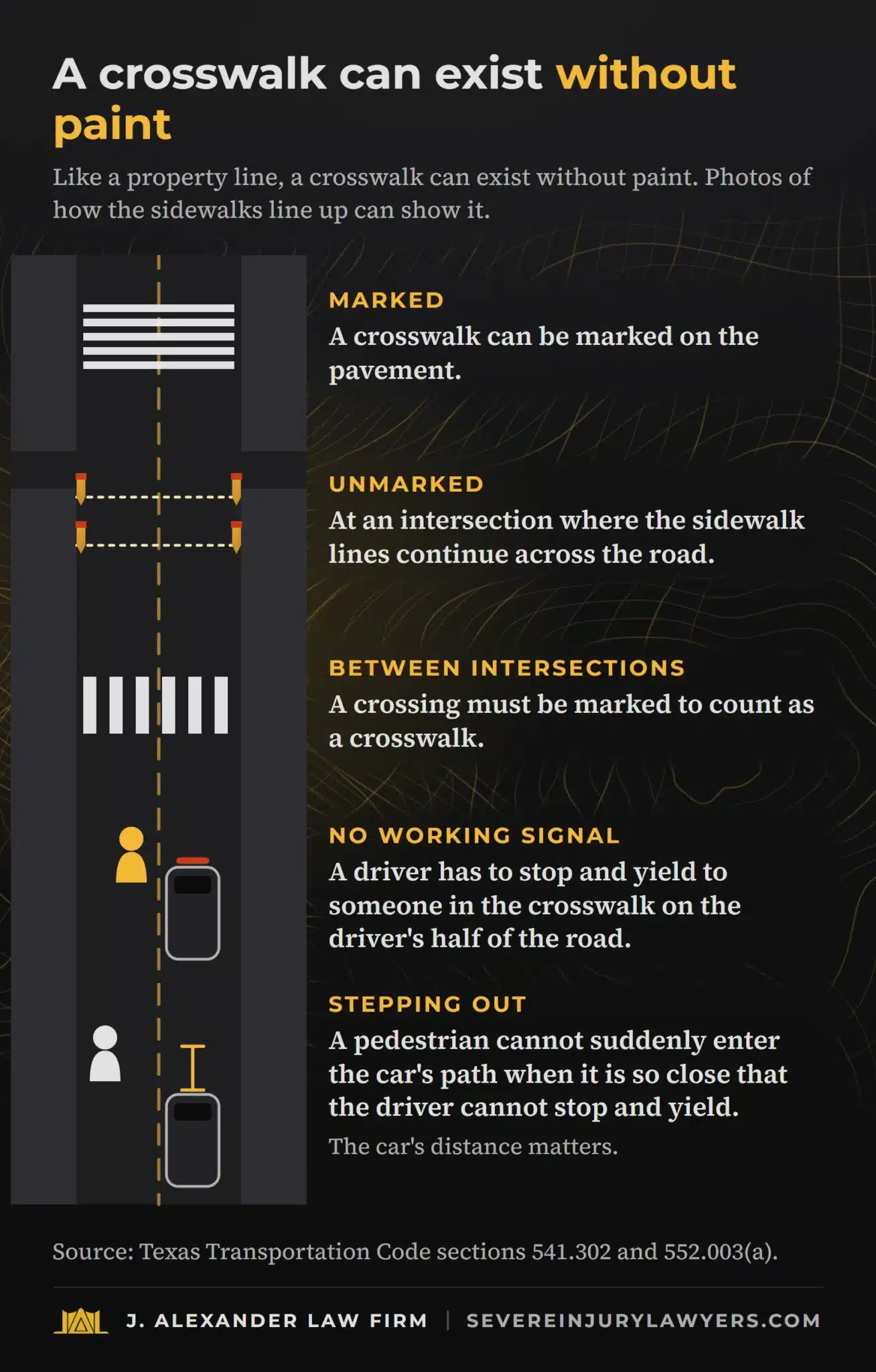
Read it as text
A crosswalk can exist without paint. Photos of how the sidewalks line up can show it.
- Marked: A crosswalk can be marked on the pavement.
- Unmarked: At an intersection where the sidewalk lines continue across the road.
- Between intersections: A crossing must be marked to count as a crosswalk.
- No working signal: A driver must stop for someone in the crosswalk on the driver's half of the road.
- Stepping out: A pedestrian cannot suddenly enter the car's path when it is so close that the driver cannot stop and yield. So how far away the car was matters.
Texas Transportation Code sections 541.302 and 552.003(a).
An insurer reviewing a pedestrian claim first asks where you crossed and whether the driver could see you. Then it asks how fast the driver went and where the driver was looking. Lighting, your clothing, and camera footage help me judge whether the driver could see you.
The Lisa Torry Smith Act took effect in 2021. Under section 545.428, a driver commits a crime by injuring a pedestrian through criminal negligence while driving in a crosswalk. Criminal negligence means missing a serious risk the driver should have seen, showing far less care than an ordinary person. The crime is a Class A misdemeanor. If the injury is serious, it becomes a state jail felony, a low level felony.
The driver has a defense if the pedestrian broke a crossing or road rule. A criminal charge against the driver can support your claim. It does not settle your injury claim.
Sections 550.021 and 550.023 set duties for a driver who hurts a pedestrian. The driver must stop at or near the scene and check if you need help. The driver must share name and insurance information and give reasonable help. Your injury claim still needs its own proof of fault and injury.
Under section 550.023, the driver must arrange a ride to care if you clearly need treatment or ask for it. Under section 550.021, skipping these duties can be a felony if the crash causes serious injury or death.
Who goes first when a driver turns right on green and you are crossing?
When the Walk signal faces you, a driver turning right must stop so you can cross. At a corner with no Walk signal, you may use the crosswalk if you face a green light. That is true for painted and unpainted crosswalks. But if the only green signal is a turn arrow, that arrow does not give you permission to cross.
Even on green, a driver must stop for someone crossing lawfully and let them pass.
Section 552.010 protects a person crossing with a white cane or assistance animal. A driver nearing the intersection or crosswalk must take care to protect that person. The driver must stop fully if that is the only way to prevent injury or danger.
When a turning driver hits someone walking, I start with a question: Which signal did each of you face?
To make a permitted right turn on red, a driver must first stop at the marked line. With no line, the driver must stop before the crosswalk. Then the driver must yield to people crossing lawfully.
A green arrow may show with a red light. The driver must still stop for people lawfully crossing in the crosswalk next to them. The driver must also yield to other traffic lawfully in the intersection.
If the light changed while you were lawfully crossing, the driver must let you finish. A witness or camera footage may help establish when you stepped off the curb. Do not begin crossing against Don't Walk or Wait.
Crashes between 2 drivers follow different rules. See failure to yield crashes between drivers.
When does a pedestrian not have the right of way?
In Texas, you generally must let cars go first if you cross outside a crosswalk, painted or not. You must also yield to vehicles if a pedestrian tunnel or overhead crossing is provided where you cross. Even if you crossed outside a crosswalk, you might still have an injury claim against the driver.
A marked crossing between intersections counts as a crosswalk. If the neighboring intersections both have operating signals, pedestrians may cross between them only at a marked crosswalk. If a crash happened between those intersections, our team measures the distance to the nearest marked crossing.
People often call it jaywalking when someone crosses away from a crosswalk. Chapter 552 does not use that word. It also does not set its own general penalty.
A state traffic misdemeanor is a minor crime. If no other penalty applies, the fine can be $1 to $200 (sections 542.301 and 542.401). Your city may also have its own pedestrian rule, called an ordinance (section 552.009).
If an adjacent sidewalk is accessible, use it instead of walking along the road. If you were on the road, we look at whether an accessible sidewalk was provided. When there is no sidewalk, walk facing traffic on the left side or shoulder unless it is blocked or unsafe.
A ticket alone does not decide fault for the crash. What you did matters. So does what the driver did. I look at the driver's speed and whether the driver was watching for people on foot.
Is it always the driver's fault when a car hits a pedestrian?
No. A driver who hits someone on foot does not automatically have to pay. Even if you crossed away from a crosswalk, the driver can still share fault.
The insurer may say you crossed outside a crosswalk, were difficult to see or stepped out suddenly. You may share some of the blame. Then the Texas shared fault rule decides whether you can get money and how much less you get.
TxDOT crash records show 562 pedestrians killed in Texas in 2026 through November 9. Another 1,073 were seriously injured.
Of the 562 who died, 449 (79.9%) were hit in the dark. That includes 241 where there were no lights. Also, 455 (81.0%) were hit away from an intersection.
The officer's codes describe the light and the location. They do not show whether a crosswalk was there. They also do not show who had to yield or who was to blame.
The 562 deaths are an early count. TxDOT keeps receiving reports for weeks after each crash, so the number will rise. For full year totals from 2023 to 2025, see our yearly Texas counts of people killed and seriously injured.
People on foot killed or seriously injured in Texas crashes, by light condition, 2026 through November 9 | TxDOT CRIS public query, January 1 to November 9, 2026, pulled November 12, 2026
| Light condition at the crash | Pedestrians killed | Pedestrians seriously injured |
|---|---|---|
| Dark, not lighted | 241 | 235 |
| Dark, lighted | 199 | 336 |
| Dark, unknown lighting | 9 | 21 |
| Daylight | 91 | 442 |
| Dusk | 12 | 21 |
| Dawn | 6 | 14 |
| Unknown | 4 | 4 |
| All light conditions | 562 | 1,073 |
These numbers count people on foot, not crashes. Each injury is the pedestrian's own. Seriously injured means the officer marked a suspected serious injury. A death counts only if it happens within 30 days of the crash. So the most recent deaths show up last.
A pedestrian hit in a garage
Here is how our client was hit in a Frisco parking garage.
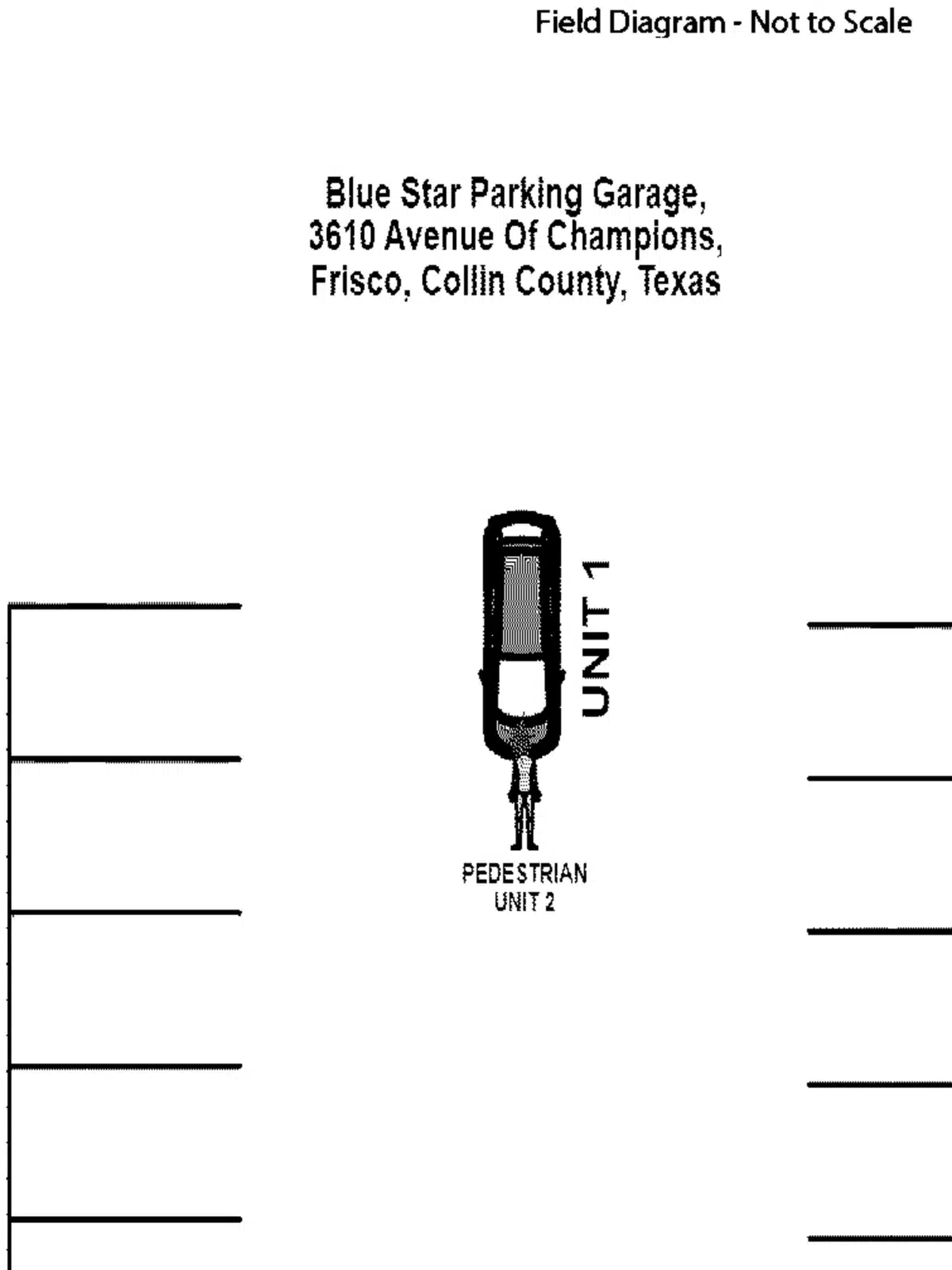
Frisco, a parking garage exit ramp
Frisco garage pedestrian crash
In the early hours of a 2022 morning, our client was on foot in a Frisco parking garage when a car descending the exit ramp struck him.
Witnesses told paramedics our client flipped over the car, which they said was traveling at 12 to 20 mph.
He was confused when paramedics found him on the floor, and they brought him to the emergency room under a trauma alert. He was diagnosed with a concussion.
A later neck MRI showed a disc tear and a small herniation. He kept working and missed therapy because he could not lose the hours.
Frisco police filed a DWI charge against the driver. The crash report did not assign our client any contributing factor. The claim was settled without filing suit.
No court decided fault, and a DWI charge does not establish guilt.
Even away from a crosswalk, a driver must try not to hit you. Under section 552.008, a driver must take extra care on seeing a child in the road. The same goes for a person who is plainly confused or helpless. I check the car's speed and whether the driver watched the road and braked. I also check whether the driver should have honked.
If the driver caused your injuries, your claim can include medical bills, lost pay and your physical pain. Those are some of the losses recoverable after a Texas crash.
Is the adjuster blaming your crossing location? Tell me where you were.
Call 469-807-7480Does a pedestrian have the right of way in a parking lot?
Where a sidewalk crosses a lot entrance, drivers going in or out must stop for a pedestrian and let them pass. Inside a private lot, street yield rules may not apply. So we look at whether the driver was careless.
If the insurer says the driver could not see you, expect questions about darkness. Texas recorded 5,973 traffic crashes involving pedestrians in 2025. In those crashes, 694 people on foot died.
In 2025, 68 percent of pedestrian deaths and injuries occurred in the dark. A driver or walker failing to yield was among the leading factors in pedestrian crashes.
Darkness does not excuse a driver from watching for people. Before reversing from a parking space, the driver should look behind the car for people. In a parking lot claim, I first ask where the driver was looking before the car moved.
The proof and rules for parking lot accident claims differ from those for a crash on a public road.
A Dallas parking lot entrance crash
Here is what happened to our client at a Dallas lot entrance.
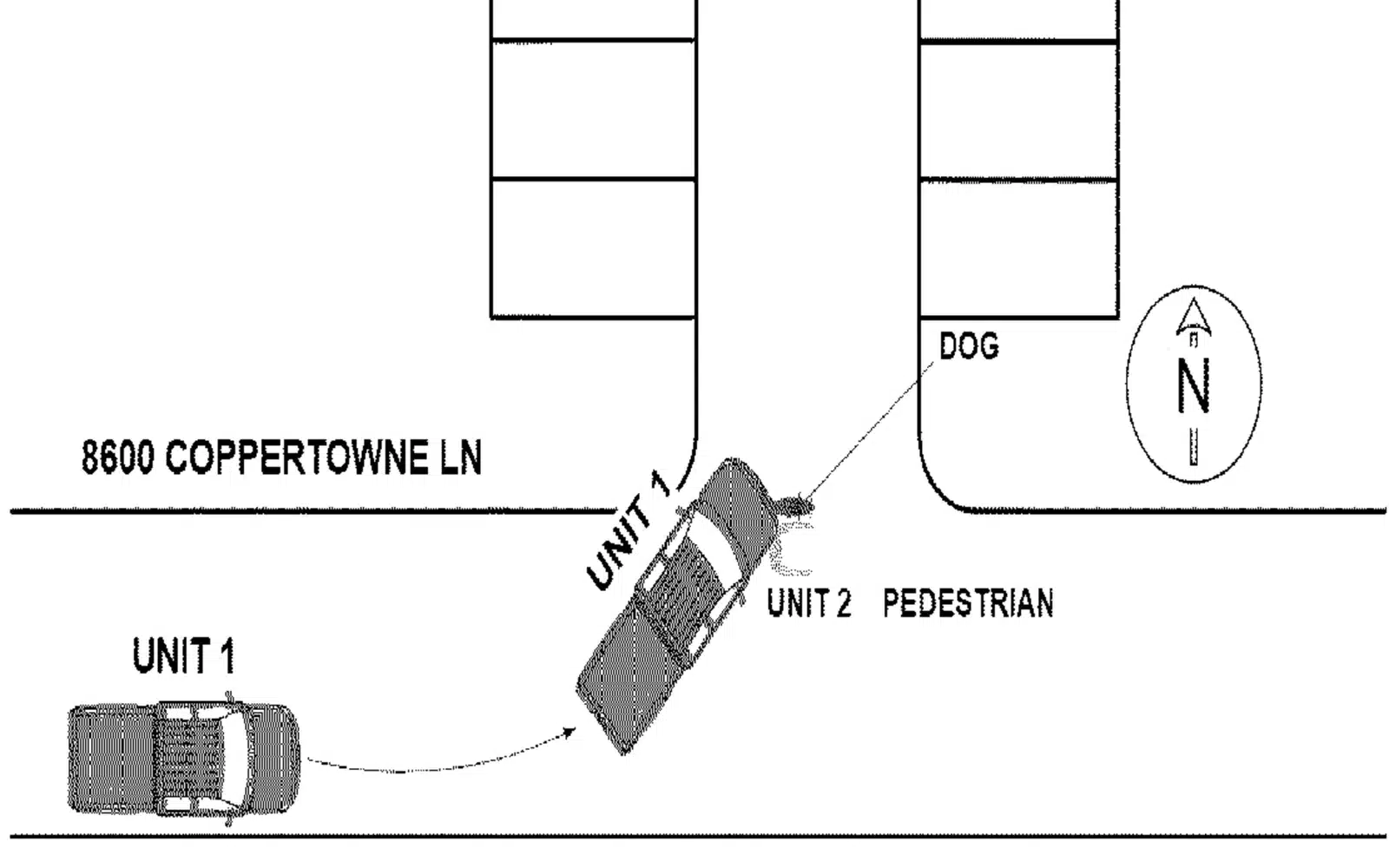
Dallas, a parking lot entrance
Dallas lot entrance crash
On a dark, wet evening, our client and her dog were crossing a parking lot entrance from a Dallas street where the speed limit was 20 mph.
A pickup approaching from the opposite direction turned left into the lot and struck her and her dog. Her dog was killed.
Dallas Fire Rescue checked her at the crash location. The officer noted an evident injury, but she was not transported to a hospital by ambulance.
The report listed no witness or video, and the officer was not dispatched until the next morning, leaving the report as the account of the incident.
The report identified a crosswalk as the traffic control and listed only one contributing factor: the pickup driver failed to yield to the pedestrian.
The report leaves open whether she used a sidewalk. Its codes reflect the officer's opinion and do not decide fault.
She was paid through the pickup driver's liability policy and through underinsured motorist protection on her own policy, without filing a lawsuit, despite being on foot.
What should you do if a car hits you while you are walking?
Get medical care first. When you can, save anything that shows where you crossed and which signal you faced. People may disagree about who had to yield. Photos, video, witnesses and the crash report can settle that. Medical bills usually arrive before your claim settles. Read who pays your medical bills along the way.
Our case managers order the crash report and the officer's diagram. I read both with you. We look at the causes the report lists and any signal or sign it names. When you are able, gather details that show what happened at the crossing:
The deadline to file a Texas pedestrian injury lawsuit does not stop while the insurer reviews your claim. Some exceptions apply. Our team keeps track of that deadline during the review. Check the Texas deadlines for filing a car crash lawsuit rather than waiting for the insurer to finish.
Call me before you sign anything from the driver's insurer. Call me before you agree to a recorded statement about your crossing too. We also cover what to say when an insurance adjuster first calls.
Our Texas pedestrian accident lawyers can explain how we handle your claim. When you call, you will speak with our intake team. You can share the report number and where you crossed with me or anyone else on our team.
Example
Hit in a crosswalk on green
Say a man is walking home from the bus stop. The Walk signal comes on. He steps into the crosswalk.
Halfway across, a car turning right hits him. At the curb, the driver keeps repeating that his light was green.
I would check the signal each person faced. Was Walk lit when the man left the curb? A driver with a green light must stop for someone crossing lawfully. If the pedestrian started on Walk and the signal changed during his crossing, the driver must let him finish.
The driver's green light lets him turn. It does not let him drive through a person already crossing on Walk.
A witness or camera might show when the man stepped off the curb and what the signals displayed.
If fault is disputed, both people's actions count. If the walker shares some blame, he may get less money.
But the driver's green light alone does not end his claim. If this happened to you, write down the corner and the time. Also note the bus stop and who was waiting with you.
Has the driver's insurer asked to record your account? Talk with me about where you stepped off the curb before you give it.
Call 469-807-748024/7 | Free consultation | No fee unless we recover
Tell me where you crossed. We can go through the crash report together.
J. Alexander Law serves injured clients throughout Texas: Dallas | Houston | San Antonio | Fort Worth | Arlington | Canton. Se habla español.