



Short answer
Are electric bikes street legal in Texas?
Yes. An electric bicycle counts as a bicycle under Texas law. Under section 664.001, an e bike must have working pedals, a motor rated under 750 watts and motor assistance that ends at or below 28 mph.
After an e bike or scooter crash, my first question is simple: What were you riding? What you were riding helps us determine which rules apply and which policies to review. In Texas, you can ride an e bike without registering or insuring it. When a car hits you, the driver's liability coverage and a household auto policy may help. Coverage depends on who caused the collision and on the policy terms.
Texas law divides e bikes into three classes. Under Texas Transportation Code section 664.002, makers and sellers must place a permanent, prominent label on an e bike showing its class, maximum assisted speed and motor wattage.
Anyone who changes motor speed capability or engagement must replace the label with accurate details. I first find out which class you were riding because that tells me which rules applied to your ride.
On the road, an e bike rider generally has a driver's rights and duties. Other rules may apply too. See the Texas bicycle rules after a crash.
E bike, electric scooter and moped rules in Texas, side by side | Texas Transportation Code sections 541.201, 551.107, 551.351, 551.352 and 664.001, Texas Department of Transportation, Texas A&M Transportation Institute and Texas Department of Insurance, read Nov 11, 2026
| Rule | E bike (class 1, 2 or 3) | Electric scooter | Moped |
|---|---|---|---|
| What it is | A bicycle with fully operable pedals, an electric motor of fewer than 750 watts and an assisted speed of 28 miles per hour or less (section 664.001). It comes in three classes: 1, 2 and 3. | A self propelled device with at least two wheels, a deck to stand or sit on, a braking system, a gas or electric motor not exceeding 40 cubic centimeters and the ability to be moved by human power alone (section 551.351). | A motor vehicle with a rider's saddle that cannot attain more than 30 miles per hour in one mile, with an engine of no more than five brake horsepower (section 541.201). |
| Where you may ride | Like a bicycle, it may use the road and bike lanes. State law does not bar sidewalk riding, but a city may, and local rules may bar e bikes from some natural surface paths. | On a street or highway posted at 35 miles per hour or less, on a bicycle path or on a sidewalk (section 551.352). A county or city may prohibit scooters on a street or sidewalk for safety. | Ride on the roadway, not on a sidewalk. |
| Title, registration, license and insurance | No title, registration, driver license or liability insurance is required (section 551.107(a)). | Neither registration nor insurance is required. Rules written for motor vehicles do not apply to a motor assisted scooter (section 551.352(e)). | Registration and liability insurance are required. Coverage must be at least 30/60/25, and the rider needs a Class M license. |
| Age and helmet | The rider of a class 3 e bike must be at least 15. A younger person may ride on one as a passenger (section 551.107(c)). The state bicycle chapter has no helmet requirement, though cities may set helmet and age rules. | State law does not require an electric scooter helmet, though a city rule might (see the note below). | License and helmet rules for a moped are covered on our Texas motorcycle laws page. |
| How a crash report lists the rider | The report lists an e bike rider as a pedalcyclist, like a bicycle rider. | The report lists an electric scooter rider as a motorized conveyance. | A moped appears on the report as a motor vehicle. |
Cities may add their own rules on sidewalks, paths, ages, speeds and helmets. Check the local code where the crash happened.
How fast can an e bike go legally in Texas?
On class 1 and 2 bikes, the motor stops helping by 20 mph. Under section 664.001, the class 3 limit is above 20 mph and under 28 mph. The broader definition of an electric bicycle allows assistance up to 28 mph.
If an insurer questions your speed, I look early at how the motor on your e bike worked. On a class 1 or a class 3 bike, the motor helps only when you pedal.
Texas Transportation Code section 664.004 requires makers and sellers to equip class 3 e bikes with a speedometer. A class 2 motor can move the bike even if you are not pedaling.
Under Texas Transportation Code section 551.107(b), you may ride an e bike only if its motor cuts out either when you stop pedaling or when you apply the brakes.
The assisted speed is where the motor stops helping, like a tailwind that fades at its limit. You can still pedal faster, so the assisted speed does not necessarily mark how fast your e bike can travel.
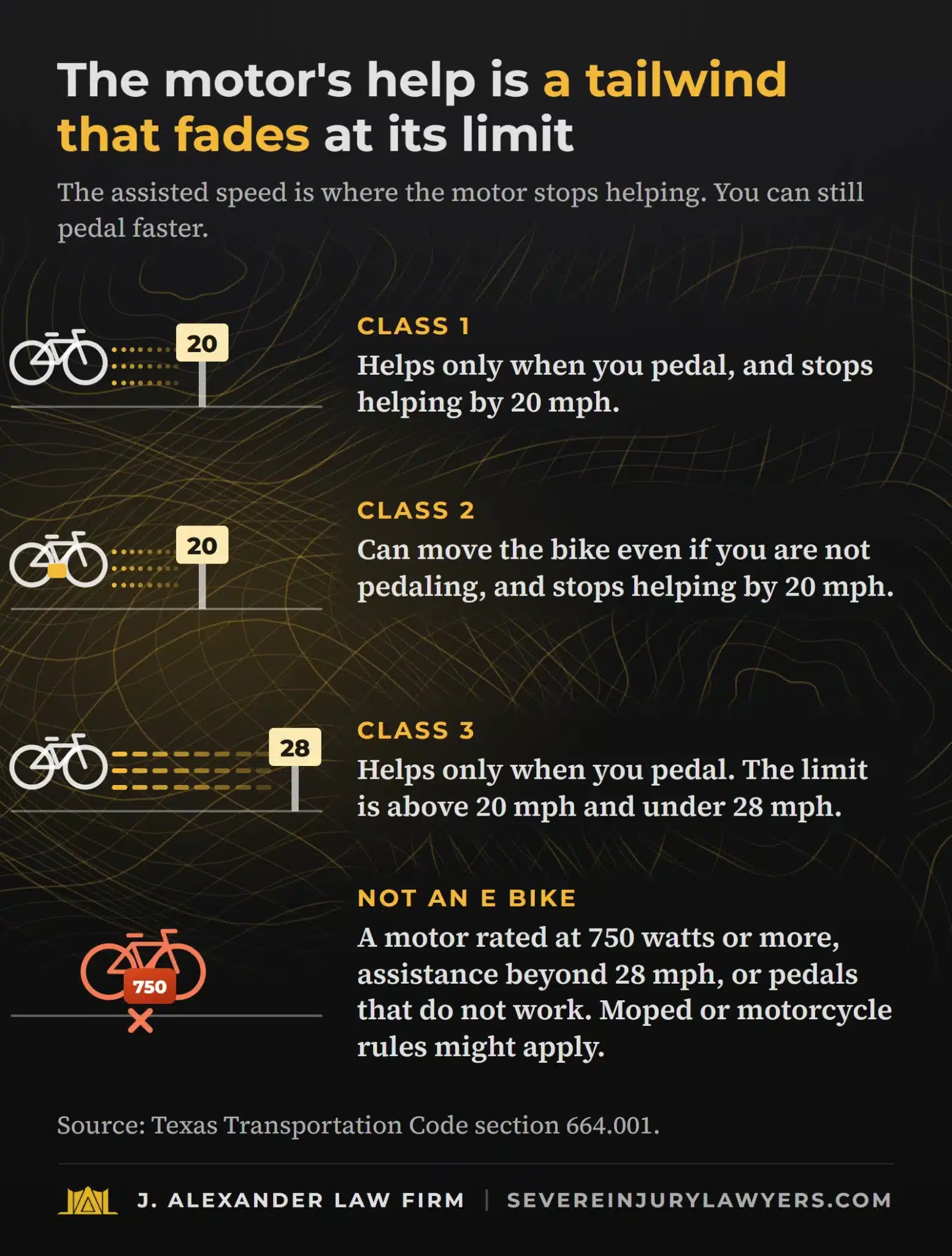
Read it as text
The assisted speed is where the motor stops helping. You can still pedal faster.
- What you were riding: Class 1 Where the motor stops helping: Helps only when you pedal, and stops helping by 20 mph.
- What you were riding: Class 2 Where the motor stops helping: Can move the bike even if you are not pedaling, and stops helping by 20 mph.
- What you were riding: Class 3 Where the motor stops helping: Helps only when you pedal. The limit is above 20 mph and under 28 mph.
- What you were riding: Not an e bike Where the motor stops helping: A motor rated at 750 watts or more, assistance beyond 28 mph, or pedals that do not work. Moped or motorcycle rules might apply.
Texas Transportation Code section 664.001.
A bike falls outside the e bike definition if its motor is rated at 750 watts or more, its assistance goes beyond 28 mph, or its pedals do not work. Moped or motorcycle rules might apply. Our team checks the motor and pedals before accepting how the bike has been classified.
Do you need insurance for an electric bike in Texas?
No. Under section 551.107(a), operating an electric bicycle requires no state title, no registration, no driver license and no liability insurance. Motor assisted scooters do not need registration or insurance either. Mopeds need both.
An adjuster may ask for an insurance card for your e bike, but you may not have one because Texas did not require you to insure it. Having no card does not mean you caused the crash.
After a crash, I check the driver's policy first to see what coverage it offers, rather than looking for a policy on your e bike. For future rides, ask your agent what coverage may be available.
Who pays when a car hits an e bike rider in Texas?
If the driver caused the collision, that driver's liability policy may pay. A household auto policy may also help through PIP, which stands for personal injury protection, or through uninsured and underinsured motorist coverage when the driver lacks enough insurance. The policy terms determine whether these coverages apply to an e bike rider. PIP can help with bills while the claim is pending.
The driver's liability limit caps what that policy pays, as our page on what Texas minimum insurance covers explains.
A claim on the driver's policy may cover your treatment costs, missed income, bike damage and other losses among the damages available for a Texas vehicle collision. What the insurer pays depends on fault and the policy limits.
When a car hits you on a bike, PIP from your auto policy or a relative's policy may apply if that relative lives with you. It pays covered expenses without regard to fault. A named insured can decline PIP in writing. If your family says it was declined, we ask to see that rejection.
If the rider is unrelated to the driver, the rider generally cannot use PIP from the driver's policy. Learn more about personal injury protection in Texas and the coverage to review.
UM stands for uninsured motorist coverage. UIM stands for underinsured motorist coverage. They may help pay for treatment and pain when the driver to blame has no insurance or limits too low for your losses. A policy may also cover a collision with a driver who leaves and is not identified, depending on its terms and requirements.
If a car hits your e bike, report the collision to police, even if the driver leaves. If police never identify the driver, whether your policy pays depends on its terms, and a police report helps show what happened. You can also read how a claim may work when a driver has no insurance.
Our case managers request the declarations page for each household auto policy, and I read each one to see whether it lists PIP and uninsured motorist coverage.
Your health insurance may also cover your injuries, depending on the plan. An auto policy probably will not cover an electric scooter, so I read its terms before relying on that coverage.
Matthew Graham's video addresses crashes involving drivers without insurance or drivers who leave after a collision.
Not sure whether your household auto policy covers your e bike crash? Let me see the declarations page.
Call 469-807-7480Who is at fault when a car hits an e bike in Texas?
What caused the collision matters, including whether a violation of a road rule played a part. E bike riders generally have to obey traffic rules that also apply to drivers.
Matthew Graham handled rider claims for insurers before he worked with us. He told me their first questions about an e bike rider concerned the bike's class, the rider's age on a class 3 bike, and whether its lights were on at night. I check those three things first.
The insurer might ask if a class 3 rider was younger than 15, if the bike lacked required lighting or a reflector at night, or if the rider traveled against traffic. It might also point to a scooter on a street posted above 35 mph. We check whether any violation contributed to the crash.
If any blame for the crash is placed on you, it can affect what you recover. Read how shared blame changes a Texas injury recovery to see how.
The officer's report identifies what you rode, and the rules can differ for bikes, scooters and mopeds. Say your class 2 e bike is listed as a moped. The adjuster would see that entry along with the moped rules on registration and insurance. We send the agency a request to correct the report, along with the receipt or manual.
Not sure what a code on your report means? The decoder on our site, the Texas crash report code decoder, can help.
Did the report get your ride wrong? Let me see the unit description.
Call 469-807-7480Are electric scooters street legal in Texas?
Yes. Section 551.352 allows motor assisted scooters on bicycle paths and sidewalks, and on streets where the posted speed is no higher than 35 miles per hour. A county or city can bar scooters from streets, highways, or sidewalks if it finds a restriction necessary for safety.
Motor assisted scooters generally follow bicycle rules, not motor vehicle rules. A pocket bike or minimotorbike is not a scooter under Texas Transportation Code section 551.351. The scooter rules in section 551.353 do not authorize riding one on roads, highways, streets, sidewalks or paths reserved for bicycles.
You may cross a road with a higher speed limit at an intersection, even though riding along that road is restricted.
Through November 9, TxDOT counted 705 reported crashes in Texas during 2026 involving a unit coded "motorized conveyance," which includes motor assisted scooters. Someone died in 15 of those crashes. The count is incomplete because reports that arrive later are still being added.
Texas crashes with a unit coded motorized conveyance, this year and the same stretch of 2025 (crash dates through November 9) | TxDOT CRIS public query, statewide reportable crashes, January 1 to November 9 of 2026 and of 2025, pulled November 12, 2026
| Period | Crashes | Fatal crashes | Suspected serious injury crashes | Suspected minor injury crashes |
|---|---|---|---|---|
| 2026, January 1 to November 9 | 705 | 15 | 126 | 335 |
| 2025, January 1 to November 9 | 524 | 11 | 66 | 250 |
A crash is counted when any unit in it has the Unit Description 'motorized conveyance'. On the crash report code sheet that value covers motor assisted scooters and other small motorized devices such as pocket bikes, go carts and Segways, so the count is not scooters alone. Under TxDOT's reporting guidance an e bike is coded as a pedalcyclist, so it should not be in this count. Severity is the most severe injury to anyone in the crash. Do not compare the two years: recent 2026 weeks are still incomplete, and on the pull day CRIS held 8 crashes dated November 9 and 266 dated November 8, against 1,098 to 1,871 a day in October. Reportable crashes only.
That category includes more than scooters, and the figures cannot show how many crashes were cars hitting scooter riders.
Many scooter rental agreements make you responsible for damages rather than cover your injuries. Some Texas cities require rental companies to carry insurance, but that coverage mainly addresses damage to public property.
If a car hits your electric scooter in Texas, the driver's auto policy may still be part of your claim. Save your rental agreement and ride receipt right away, before they become hard to find, and send both to me. In a rented scooter claim, I read the agreement before anything else.
A claim against the scooter maker, battery maker, or rental company is separate from a claim under the driver's policy. Say your scooter's brake failed as you came up to an intersection. That points toward the company that built or maintained the scooter, not only the driver.
A moped is different from an e bike or scooter. It must be registered and insured, and our Texas motorcycle laws page covers its license and coverage rules. If a car hits you while you are riding a moped, we may also need to review the moped's own policy.
A car hit you on a rented scooter? Bring me the agreement and we can review its liability terms together.
Call 469-807-7480What should you do after an e bike or scooter accident with a car in Texas?
Seek medical care, notify law enforcement about the crash and leave your e bike or scooter as it is. An operator involved in an injury collision must promptly notify the appropriate law enforcement agency.
Have questions as you gather these items? Our team can help. Try to collect them before repairs start or the record in the rental app disappears:
After a car crashes into your e bike or scooter in Texas, the clock for filing an injury lawsuit keeps running. Exceptions can change your deadline, so our team tracks it from the start. Please review the Texas deadlines for vehicle injury claims promptly.
The car driver's insurer may request a recorded statement or seek your signature on a release. Please talk with me first. For help with the adjuster's call, see how to handle an adjuster call following a wreck.
Example
Car hits e bike at a driveway
Picture a rider wheeling her bent e bike into the garage. Earlier that day, a driver pulled from a driveway and into her path.
Her phone already has a message from the driver's adjuster calling the bike a moped. She wonders whether that name will count against her.
My first question is what the bike actually is. The class label on its frame is a starting point.
Like the care tag inside a shirt, it carries information worth checking before deciding which rules fit. The label lists the class, assisted speed and motor wattage.
If someone changed how the motor works, the label should have been updated.
Under Texas Transportation Code section 664.001, a class 2 bike can use its motor without pedaling and must stop assisting by 20 mph. Class 1 also stops assisting by 20 mph, but its motor helps only while the rider pedals. Class 3 assistance requires pedaling and ends above 20 mph but below 28 mph.
I would check the pedals and motor rating too. An e bike needs working pedals and a motor rated below 750 watts.
A moped is a different kind of vehicle with different rules. The adjuster's name for the bike does not settle which one she rode.
That message can wait while she saves the details. Tonight, she can photograph the label, pedals and handlebar controls before anyone repairs the bike. She can also look for the receipt or manual.
24/7 | Free consultation | No fee unless we win
Tell me about your ride. We can check which policies might apply.
J. Alexander Law serves injured clients throughout Texas: Dallas | Houston | San Antonio | Fort Worth | Arlington | Canton. Se habla español.