




Short answer
Who is responsible when something falls from a vehicle and hits my car?
The driver, owner, or hauling company may be responsible if their actions caused the load to fall. If you can name the driver or company, their insurance may pay for your injuries and car damage. Move out of traffic and call 911. If it is safe, write down the plate and company name. Also note the USDOT number, the federal ID number on the truck's door. Photograph the fallen item and your car. Save any dash cam video. I use those details to find the truck.
My first step is finding the truck that carried the load. The truck leads us to who may have to pay. At the scene, get to a safe place and call 911. Save anything that could identify the truck.
A board through a McKinney windshield
A man called us after a board flew from an uncovered construction dump truck on a McKinney highway. The plywood came through the windshield of the work van he was driving and missed him.
He went to the ER that day and told us the next day that his neck and back had been hurting.
The truck that kept going
The truck kept going, and its driver may not have known what happened. If you find the driver or company responsible for the load, you can claim against their insurance. The table shows possible sources of payment.
Who pays when a load, debris or trailer comes loose | Our summary of Tex. Ins. Code section 1952.104(3), Nationwide Insurance Co. v. Elchehimi (Tex. 2008) and the Texas Department of Insurance auto insurance guide. Coverage depends on the policy you bought.
| What happened | Who pays | What it turns on |
|---|---|---|
| The load hit you and the truck was identified | Liability insurance carried by the hauling driver and the hauling company | Proof that the load came from that truck |
| The load hit you and the truck was never identified | Your own collision or comprehensive coverage for the car. For medical bills: personal injury protection (PIP), medical payments coverage or health insurance | Uninsured motorist coverage usually does not apply, because the object is not the unknown vehicle itself |
| You braked or swerved for debris and another car hit you | The driver who struck your car, plus whoever dropped the debris, if that can be traced | Who dropped the object and how each driver reacted |
| A trailer came unhitched and hit you | The liability insurance on the vehicle that was towing it | The hitch, the safety chains and who hooked up the trailer |
Keep any details you have about the truck, as well as records of your care and car repairs. If the load hurt you, your claim may include medical bills, lost pay and pain. See what a Texas injury claim can recover.
What if the truck that dropped the load is never found in Texas?
If no one finds the truck, your own policy may help. But your uninsured motorist coverage generally requires the unknown vehicle to touch you or your car. A fallen object usually does not count. That is why finding the truck comes first.
The McKinney caller's dash cam
The McKinney caller's employer pulled the van's dash cam video. But the video did not show the truck's plate. Our staff told him we could not take his case without it. He described the moment the board hit:
The caller, on the board hitting the van
"It came through the windshield of my truck."
A caller, 2026
So I first ask whether we can trace the object to one truck.
Uninsured motorist coverage, or UM, is part of your own policy. It may not pay if an unknown truck drops something on your car. Texas Insurance Code section 1952.104(3) requires the unknown vehicle to make physical contact with you or something you own.
A part that separates from a truck before it hits you may not count as contact with the truck. In Nationwide Insurance Co. v. Elchehimi (2008), an axle and wheels came off an unknown 18 wheeler. The Texas Supreme Court said that was not contact.
Our team can read your policy and go over the facts with you before you count on UM.
The court also noted that earlier Texas cases had rejected claims involving fallen cargo. In one, a driver swerved to miss furniture that fell from a vehicle. If the vehicle itself hits you, you then need to prove that contact. Read about proof of contact after a hit and run.
If the truck is never found, I check your declarations page. That page lists the coverages you bought. Collision coverage may pay for crash damage to your car. Comprehensive coverage may pay when gravel hits it. Either one may have a deductible, the amount you pay first. For treatment costs, read what PIP and medical payments coverage can pay.
Did the insurer turn down your claim because the truck was never identified? Show me the denial and the policy.
Call 469-807-7480Who is responsible for road debris damage?
Whoever dropped the debris may have to pay. You must tie the object to them and show they caused the harm. Another driver may also share responsibility for a collision near the debris.
A caller rear ended near debris
One caller was rear ended on a freeway near a large object in the lane. The caller had a police report on the crash. The caller also had the name of the company said to own the object:
The caller, on who owned the object
"I have the information of the company that owns the container or the object that was on the road."
A caller, 2026
A ladder or tire tread left in the road can be harder to trace than a load you watched fall. Look for markings, witnesses and nearby video. Ask about drivers who called 911. Note the time, place, lane and direction.
Say the object that hit your car still has a torn strap or a company name on its side. Clues like those help me trace it to where it came from.
In 2026, Texas reports listed unsecured loads in 1,238 reportable crashes that happened by November 9. Of those crashes, 3 were fatal and 13 involved suspected serious injuries. Texas state and US highways accounted for 464 of the crashes, while 450 happened on interstates.
That entry is the officer's opinion about one vehicle. It does not decide fault. It also does not count crashes an unsecured load caused.
A separate count of 499 covers crashes where a vehicle hit something in the road. That includes an object from another vehicle, a fallen tree, other debris, or rocks from a truck.
Some crashes appear in both counts, so you cannot add the totals together. Neither number is final. TxDOT can take weeks to receive crash reports, so both counts may rise.
Texas crashes where the officer listed 'load not secured', by road class, 2026 through November 9 | TxDOT CRIS public query, January 1 to November 9, 2026, pulled November 11, 2026
| Road class | Crashes | Fatal crashes | Suspected serious injury crashes |
|---|---|---|---|
| US and state highways | 464 | 2 | 3 |
| Interstate | 450 | 0 | 5 |
| City street | 128 | 1 | 1 |
| Farm to market road | 95 | 0 | 4 |
| Tollway | 62 | 0 | 0 |
| County road | 39 | 0 | 0 |
| All road classes | 1,238 | 3 | 13 |
Road class is the type of road where the crash happened. A crash counts as fatal or serious by its worst injury. That injury can be to anyone in the crash, not only people in the truck.
Say you brake for debris and a car behind you hits yours. What you and that driver did can affect your claim.
Texas Transportation Code Section 545.062(a) requires a safe following distance. The driver behind must be able to stop without hitting your car or swerving into something else. That distance depends on speed, traffic and road conditions. That rule alone does not decide fault.
The defense may blame the driver who hit you from behind. So I keep the crash report and video of that impact with the debris proof. Together they show what each driver did. See how Texas comparative negligence, or shared fault, may affect your claim.
Know which company owned the object in your lane? Give me the name and I will look into it with you.
Call 469-807-7480What is the penalty for an unsecured load in Texas?
Breaking the Texas loose material rules in Transportation Code Chapter 725 is a misdemeanor, a minor crime. The fine is $25 to $500 (section 725.003(c)).
The loose material rules cover material that can blow or spill from vehicle movement or weather. Under Section 725.001(2), that includes dirt, sand, gravel, wood chips and trash. It excludes agricultural products in their natural state.
Chapter 725 applies to motor vehicles, trailers and semitrailers on public highways (section 725.002). The chapter does not set general rules for solid cargo such as ladders, lumber or furniture.
Under Section 725.021, a truck bed carrying loose material must be closed in on all 4 sides. It must have no gaps that let material escape. The tailgate must be shut tight.
A cover generally must be fastened at the front and back. An exception applies if the compartment fully encloses the load or the material does not blow or spill out. A commercial vehicle carrying loose material needs a secured cover or a fully enclosed load.
A ticket or an officer's note can be evidence. It does not prove your injuries or the damage to your car. To understand an entry in the report, use the guide to reading Texas collision report codes.
For solid cargo, I look at how the load was secured under other rules, including federal commercial truck rules. For loose material from a dump truck, see dump truck crashes involving rocks and gravel.
Are truck drivers responsible for securing the load?
Yes. Under 49 CFR 392.9, a commercial truck driver cannot drive with cargo that is badly loaded or not tied down well enough. The trucking company cannot allow it either. I hold both to that rule. The driver must also check the cargo within the first 50 miles and again later in the trip. There are exceptions.
When cargo falls from a commercial truck, I ask whether the driver did the checks in the table. I also ask when. The timing of those checks may help establish how long the load was loose.
Federal cargo checks for commercial truck drivers (49 CFR 392.9) | 49 CFR 392.9(b), Code of Federal Regulations, October 1, 2024 edition.
| When | What the driver must do |
|---|---|
| Before driving | Confirm the cargo is spread out properly and tied down well enough |
| Within the first 50 miles of the trip | Inspect the cargo and its securement devices and adjust or add devices as needed |
| At each change of duty status, or after 3 hours or 150 miles of driving, whichever comes first | Recheck the cargo and the devices holding it, adjusting them as needed |
There are exceptions to the inspection rules. One is a sealed trailer the driver was told not to open. Another is a load packed so the driver cannot reach it to check. We also ask who loaded the truck because the loader may share responsibility. Read about who may be responsible after a commercial truck crash.
Federal rule 393.100 requires a commercial truck's load to be held in place. It must not fall off or shift enough to make the truck unstable or hard to steer. So I ask how the load moved, not just whether anything fell.
Cargo that shifts can contribute to a crash even if it never reaches the road.
Weight that shifts in a turn or hard stop can help cause a rollover or a jackknife, where the trailer swings sideways. Texas Transportation Code section 621.101 sets a general limit of 80,000 pounds for the loaded truck. If there is a scale ticket, I compare it with that limit.
Who pays when a trailer comes unhitched in Texas?
The towing driver may have to pay if the driver's actions let the trailer come loose. So may whoever hooked it up. A claim often starts with the towing vehicle's insurance.
Texas Transportation Code section 545.410 generally requires approved safety chains when a car or light truck pulls a trailer. The chains keep the trailer attached if the main hitch fails.
The statute does not apply to agricultural trailers or vehicles operating under federal motor carrier safety regulations. Texas DPS guidance also says fifth wheel and gooseneck trailers do not need safety chains. Those trailers hitch in a truck bed or on a tractor.
Texas safety guidance calls for crossed chains and a connection strong enough to pull the load. I compare the chains in your photos with that guidance. Section 545.410 sets no separate penalty, so section 542.401 provides a general traffic fine of $1 to $200.
If it is safe, photograph the hitch before anyone moves the trailer. Get the hitch ball, the coupler that clamps onto it, the chains and the pin. Our office asks who owns the trailer and who attached it. Those may be different people.
What evidence proves which truck dropped the load?
A plate number, company name or USDOT number may identify the truck. Photos, video, witnesses and a police report can tie that truck and its load to your crash. A Texas injury lawsuit usually must be filed within 2 years. The search for the truck does not pause that deadline.
Why the McKinney video was not enough
As the McKinney call showed, a dash cam may still miss the plate. We look first for the plate, company or USDOT number. Then we look for records of how the load was secured.
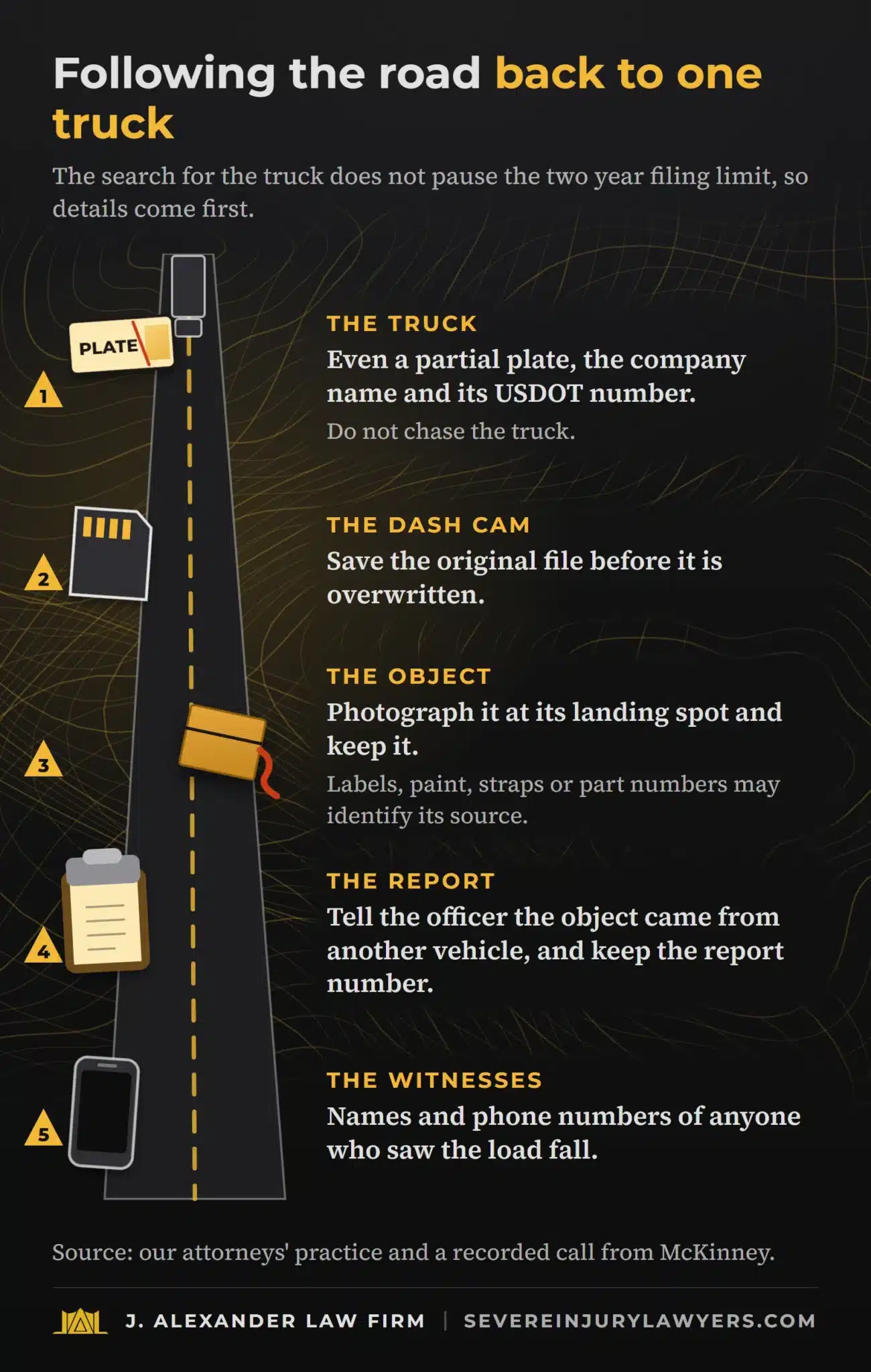
Read it as text
The search for the truck does not pause the 2 year filing limit. So gather these details first.
- The truck: Even a partial plate, the company name and its USDOT number. Do not chase the truck.
- The dash cam: Save the original file before it is overwritten.
- The object: Photograph it at its landing spot and keep it. Labels, paint, straps or part numbers may identify its source.
- The report: Tell the officer the object came from another vehicle, and keep the report number.
- The witnesses: Names and phone numbers of anyone who saw the load fall.
Our attorneys' practice and a recorded call from McKinney.
Once we know the company, our case managers ask it for 4 records. They are loading photos, a scale ticket, inspection reports and the bill of lading, the shipping paper. Those records can show how the cargo was tied down.
The USDOT number on the truck's door points us to the trucking company.
While we look for the truck, our office tracks the lawsuit deadline. Searching does not stop that deadline, though exceptions may apply. For details, read Texas car accident lawsuit time limits.
Call me before the hauling company's insurer records your account or you sign its papers. Our video about an adjuster calling after the crash can help you prepare for that call. Our intake team takes your call first and passes legal questions to an attorney.
Example
Lumber falls from a truck
Say a man stands on the shoulder with his hazard lights blinking. A split piece of lumber lies behind his cracked windshield. The truck that dropped it is already far down the highway.
Finding that truck comes first. I would ask what he remembers about its plate, company name or USDOT number.
A torn strap or printing on the lumber could help us trace it. If he has dash cam video, we would save the original and check it for the truck.
He should stay out of traffic while gathering any details.
If the truck stays unknown, his uninsured motorist coverage may not pay. That coverage requires the unknown vehicle itself to touch him or his car. Lumber that fell off the truck may not count.
In Elchehimi, an axle and wheels came off an unknown truck, and the Texas Supreme Court said that was not contact. I would check whether the truck itself touched him or his car. I would also check what his policy covers.
Once we find the truck, I would look at the straps on the load. I would also check when the driver inspected it. Federal rule 392.9 requires a commercial truck's cargo to be tied down.
The rule generally requires a check within the first 50 miles and more checks later, with exceptions. The truck is gone, but the clues it left can still be found.
He can write down the lane, the time and the truck's direction. He should also note any words printed on the lumber.
Did you get a plate, USDOT number or dash cam clip? Send it over and we can review it together.
Call 469-807-748024/7 | Free consultation | No fee unless we recover
Bring me the plate or dash cam clip. We can look at it together.
J. Alexander Law serves injured clients throughout Texas: Dallas | Houston | San Antonio | Fort Worth | Arlington | Canton. Se habla español.