



Short answer
Are parents liable if their teen crashes a car in the parents' name?
No. A parent is not liable simply because the family car is in the parent's name. A parent can be liable for what the parent did, such as handing the keys to an unsafe driver. If the car's insurance covers the teen, that policy usually pays first.
In Texas, being the teen driver's parent does not by itself make you responsible for the crash. My questions are what the parent did and whether an insurance policy covers the teen.
A mother whose daughter was hit by a teen
A mother who called us in 2026 said a 17 year old had hit her daughter's car.
She said the teen had no license and was not listed on his parents' insurance. The insurer seemed to mix up the teen with his father, the person on the policy.
After a call like hers, we check the policy rather than simply rely on the insurer's account of who was driving. The name on the insurance card does not answer my 2 questions. Is the parent liable? Does the policy cover the teen?
A teen might be covered even when a parent is not liable, depending on any restrictions in the policy.
If a policy covers the crash, it may pay up to its limits, the most it will pay. To find which policy applies, we look at the insurance rules for a borrowed car.
After a Texas teen driver crashes into you, treatment bills and missed income may add up while you recover. Your injury claim may include those losses, as well as physical pain and mental anguish. See what these losses mean in a Texas car crash claim.
When can you hold parents responsible for a teen driver's accident in Texas?
A Texas parent may be responsible if the parent carelessly let the teen drive and that helped cause the wreck. Family Code section 41.001 also makes a parent pay for some property damage. If the teen's insurance falls short, the parent pays personally only with a legal basis, such as the parent's own carelessness. Without that basis, we check your own underinsured motorist coverage. It may cover part of the gap.
A parent may be liable for giving the car to an unsafe or unlicensed teen. The parent must have known, or had reason to know, about the problem. The teen's careless driving must also have caused the crash. What did the parent know? A starting point is whether the teen had a license and whether there had been earlier crashes or tickets.
When a family lets someone drive its car, a claim against the owner depends on 2 things. What did the owner know when handing over the car? What caused the wreck?
In Goodyear v. Mayes, the Texas Supreme Court required proof of who got the car. The driver had no license, was not a competent driver or drove recklessly. The owner must have known, or should have known, of that problem at the time.
The driver's carelessness on the trip must also have caused the crash. We check the license, the owner's knowledge and the cause of the crash.
Who can be made to pay after a teen driver accident in Texas | Texas Family Code sections 41.001 and 41.002 and Texas Transportation Code sections 521.145 and 521.304, read Nov 11, 2026. Negligent entrustment: Goodyear Tire and Rubber Co. v. Mayes, Texas Supreme Court, 2007. Texas Department of Insurance, Auto insurance guide, updated Dec 11, 2025.
| Who | When | What it reaches |
|---|---|---|
| The liability insurance on the car the teen drove | The teen driver caused the crash and the policy covers that driver | Injury and property claims, to the policy's limits |
| A parent or owner who handed over the keys | Negligent entrustment: the teen had no license or was incompetent or reckless, the parent knew it or should have known it, and the teen's careless driving caused the crash | Injuries and property damage |
| A parent, under Family Code section 41.001(1) | The teen's negligent conduct is reasonably attributable to the parent's negligent failure to use control and reasonable discipline | Property damage only |
| A parent, under Family Code section 41.001(2) | Wilful and malicious conduct of a child at least 10 and under 18 | Property damage only, with the limit that section 41.002 sets |
| A parent who only signed the license application | Chapter 521 of the Transportation Code has no section stating a duty to pay for a crash | Not stated in chapter 521 (see sections 521.145 and 521.304(b)) |
In a teen driver claim, the insurer first checks whether the policy names the teen or excludes the teen by name. It also checks whether the teen had permission to drive. Only then does it look at the parents.
A learner license does not let a teen drive alone. Under section 521.222(d), the person beside the learner must have a license. That person must be at least 21 and have at least 1 year of driving experience.
Say a teen with a learner license gets tickets, and her mother knows. Then the teen drives her mother's car to school alone. She needed a licensed adult beside her. So I would ask what the mother knew about the tickets and the solo drive.
A new driver's age alone is not enough for me to base a claim against a parent. In Aboushadid v. Ward, a licensed 16 year old was driving when her vehicle rolled over.
In 2007, the Amarillo appeals court found no evidence her parents had reason to know she was incompetent or reckless. It held that inexperience alone did not make her incompetent.
If the teen's insurer provides coverage, the claim against the teen goes to that insurer first. We add a parent only with a separate legal basis. One is carelessly letting the teen drive. Another is a Family Code rule that applies.
A parent has a duty to control and reasonably discipline a child. If the child carelessly damages property, the parent may have to pay. The child's conduct must be reasonably traceable to the parent's careless failure to do that duty. Family Code section 41.001 applies to property damage, not bodily injury.
Section 41.001 also covers property damage a child aged 10 to 17 causes on purpose and out of spite. The law calls that wilful and malicious conduct. Section 129.001 of the Texas Civil Practice and Remedies Code sets adulthood at 18. That Family Code rule does not cover an 18 year old.
For that conduct, section 41.002 caps actual damages at $25,000 for each incident. Reasonable and necessary court costs, expenses and attorney's fees are added to that. That limit concerns a parent's liability for property damage, not your injury claim against the teen's insurer.
Families often ask whether the name on the car's title decides who pays. A parent does not owe payment for an injury simply because the parent owns the car.
In Wass v. Johnson, a son was driving his parents' car. In 2008, the Fort Worth appeals court said Texas had rejected the family purpose doctrine. That doctrine would make an owner liable just because a family member used the car.
The other driver's insurance may not cover all your injuries. Then we look at the other coverage that may be available after a serious crash.
Is a parent who signs a teen's driver license application liable in Texas?
No. Under Texas Transportation Code section 521.145, signing a teen's license application does not by itself make a parent liable for a later crash. The signature lets the teen apply. It is not a promise to pay for the teen's crashes.
Under Transportation Code section 521.145, a teen under 18 needs a signature to apply for a license. The signer is generally a parent or guardian with custody. It can also be an agent with a power of attorney from that parent. That is a signed form letting someone act for the parent.
Section 521.145 requires the signature. It also has the department give the signer and the teen information on distracted driving and drunk driving laws. It does not say that signing means the signer must pay for a crash.
Under section 521.304, the adult who signed the application can ask DPS to cancel the minor's license. The request must be in writing and signed before a notary. Once the Department of Public Safety receives it, the department must cancel the license.
Once the license is canceled, the law says the cosigner "is released from liability based on the person's signing of the application for any subsequent negligence or wilful misconduct of the minor in operating a motor vehicle".
So once the license is canceled, section 521.304 ends any liability from the signature for the teen's later driving. Neither section makes the signature alone a reason to pay after a crash.
A parent can still face a claim for the parent's own conduct, such as handing the keys to an unsafe driver. Ask me about cancellation, and we can go over what the release covers and what it does not.
Do teens need their own car insurance in Texas?
No. A teen can be covered under a family policy. Adding the teen is usually cheaper than a separate policy. The policy pays only if it covers the driver. If the company says the teen was not listed or was excluded, ask for a written denial and any signed exclusion. An exclusion is a signed form that removes a named driver from coverage. Also check whether your own uninsured motorist coverage might help.
To understand whether the teen was covered, we look at who was driving and what the policy says. Many policies cover the policyholder, relatives and drivers with permission. Exclusions and other terms can change that, so we read the exclusions page.
Some insurers require a policy to list every household member old enough to drive. Tell your insurer when a relative starts driving or turns 16. Read your policy to check its rules.
By law, a teen learning with a permit needs no insurance. But the Texas Department of Insurance urges you to tell your insurer. If you did not report the student driver, the insurer could deny the claim after a wreck. It could also cancel the policy or refuse to renew it.
A son not listed on his father's policy
A caller from our FM 78 result was driving his father's car. The father's insurer refused the crash because the son was not on the policy.
If a company denies payment because a teen was not listed, we ask for the decision in writing. We also ask for any exclusion the policyholder signed. We read both before accepting the decision. A staff member asked a caller about the policy:
Our intake team on unlisted drivers
"Some policies will still accept the claim even though you weren't listed as long as you weren't excluded. But again, there could be underlying written in the policy that says even if you're not written on it, they're not going to accept the claim."
A staff member, 2026
Some policies may cover a teen who is not listed. But a signed exclusion that names the teen can block coverage. We read the policy to see which applies.
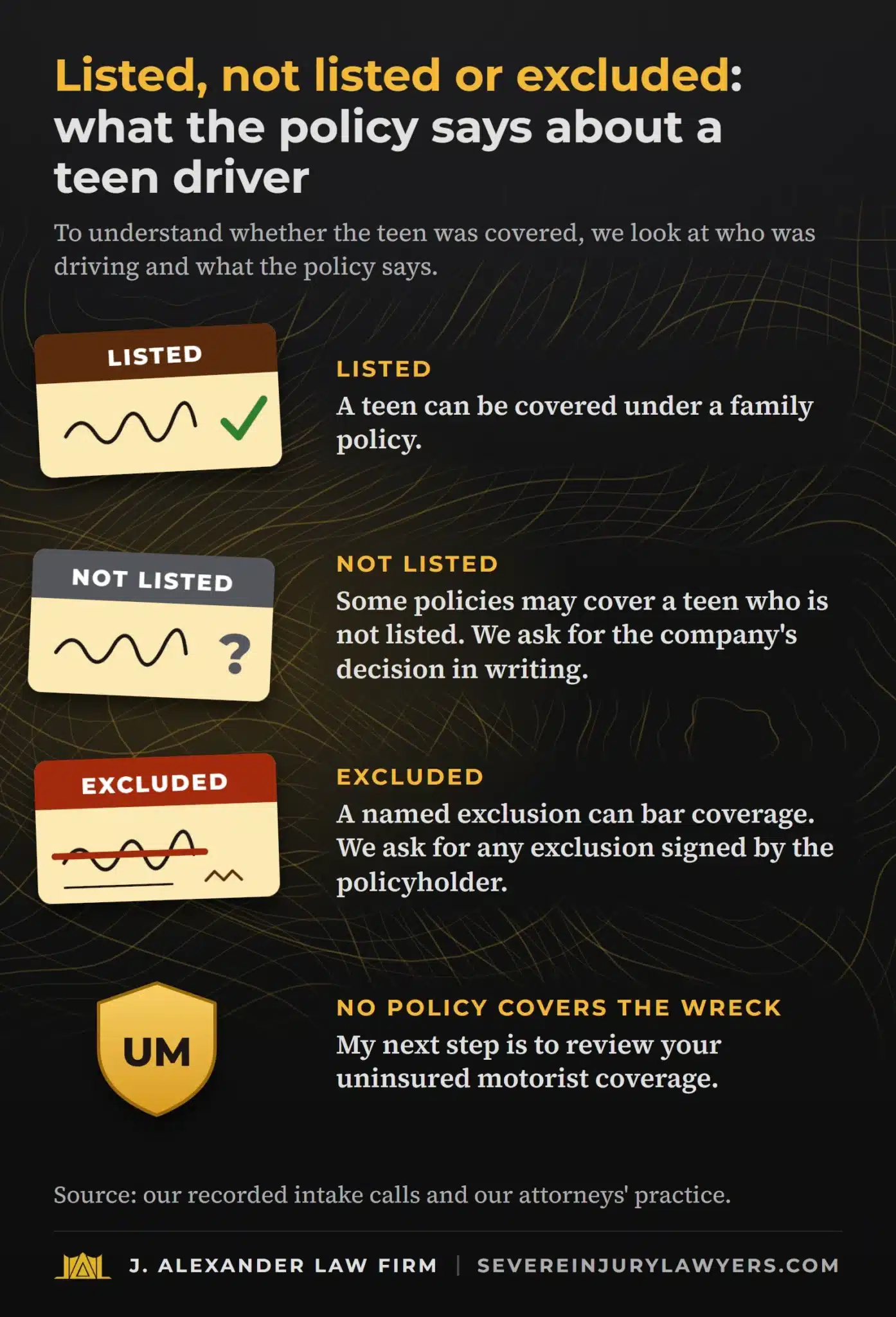
Read it as text
To understand whether the teen was covered, we look at who was driving and what the policy says.
- The teen on the policy: Listed What we read: A teen can be covered under a family policy.
- The teen on the policy: Not listed What we read: Some policies may cover a teen who is not listed. We ask for the company's decision in writing.
- The teen on the policy: Excluded What we read: A named exclusion can bar coverage. We ask for any exclusion signed by the policyholder.
- The teen on the policy: No policy covers the wreck What we read: My next step is to review your uninsured motorist coverage.
Our recorded intake calls and our attorneys' practice.
If no policy covers your Texas wreck, I check your own uninsured motorist coverage. It may pay when the at fault driver has no insurance that applies. A driver's license status and insurance coverage are separate questions.
Did the insurer turn down the claim over an unlisted teen? Please show me the denial before accepting it.
Call 469-807-7480How much will my insurance go up if my teenager has an accident?
There is no fixed increase after a crash. Each insurer sets its own rates, and Texas does not approve them in advance. Crashes and tickets can raise the price. An insurer usually adds an extra charge when you cause a crash.
Ask your insurer for a written explanation of how the wreck will affect your rate. The answer depends on the company and the driving and claims history it looks at.
My first question is which family car your teen drives most often. If your teen mostly drives one car, the insurer prices the teen's coverage on that car. If your teen has no primary car, the insurer uses the family car with the highest insurance rate.
Save the crash report and any letter that identifies who caused the wreck. They may help you address an insurer's mistake about the teen's involvement.
For what to collect at the scene and afterward, see these steps Texans can take following a car crash.
In 2026, a caller said he paid for repairs himself after a wreck he said was not his fault. He worried that using his policy would raise his rate:
A caller worried about his rate
"I didn't want to have my insurance fix it because I didn't want my insurance going up, it not being my fault."
Caller, 2026
What happens if a teenager gets into a car accident in Texas?
The insurer for the car the teen drove handles the claim the same way as for an adult. Payment depends on fault and coverage. Texas limits when and with whom drivers under 18 may drive. So we gather details about the driver and the trip early.
Texas Transportation Code section 545.424 limits how drivers under 18 may use a car. My questions are when the teen drove and who rode along. Our Texas driving age and teen license rules list the limits. We check which ones may matter in your crash.
From January 1 through November 9, 2026, Texas recorded 24,963 reportable crashes involving drivers ages 15 through 17. Of those, 115 were fatal. CRIS, TxDOT's crash records system, counted 43,255 crashes involving a driver aged 18 or 19. That includes 229 fatal crashes.
Drivers ages 15 through 19 were involved in 14.9% of reportable crashes. Those figures do not show who caused each wreck. A crash is counted even when another driver hit the teen. Fatal means someone died, not necessarily the teen.
The public crash counts do not identify the car's owner or establish whether a parent is liable. A crash report alone cannot decide who must pay either. The 2026 counts are incomplete because TxDOT has not received some recent reports yet. Both 24,963 and 43,255 will rise.
Texas crashes with a driver aged 15 to 19 behind the wheel, 2026 to November 9 | TxDOT CRIS public query, January 1 to November 9, 2026, pulled November 11, 2026
| Driver ages in the crash | Crashes | Fatal crashes | Suspected serious injury crashes |
|---|---|---|---|
| At least one driver aged 15 to 17 | 24,963 | 115 | 587 |
| At least one driver aged 18 or 19 | 43,255 | 229 | 1,039 |
| At least one driver aged 15 to 19 | 66,821 | 338 | 1,608 |
| Every reportable crash in Texas | 448,771 | 2,824 | 12,071 |
A crash with both a 16 year old and an 18 year old driving counts in both of the first 2 rows. That is why those rows add up to more than the third row. Drivers whose age is missing from the report are not in any row.
A teen's violation of a driving restriction does not by itself establish who caused a wreck or make a parent liable.
In Aboushadid v. Ward, the court held that the restrictions applied to the teen, not the parents. So they could not support a claim that the parents were negligent for breaking that law. Even so, a broken restriction can help show how the crash happened, so we look at it.
The hour of the wreck helps me understand whether a driving restriction might apply to the teen's trip. Our Texas study of crashes after school shows when those crashes happen across the state.
The mother's call, continued
The mother said her daughter called police after the collision. No officer came, and the drivers were told to exchange information. Later, letters arrived from the other insurer. Our staff told her to send them to her daughter's insurer, not set them aside.
We obtain a crash report when one is available. If the insurer's letters name the wrong driver, I answer in writing. I attach the report and statements about who drove. Send me those letters.
Each injured passenger in the teen's car can bring a separate claim. A parent brings the claim for an injured child. Our passenger claim answer explains the first steps.
The injured passenger may be the teen's relative. Then we read the policy before assuming it pays more than the Texas minimum. Some policies limit what they pay a relative to the minimum the law requires.
Was your child hurt while a teen was driving? Our Texas child injury settlement process explains how the child's claim may be resolved. After a teen driver crash, some claim deadlines may come before the deadline to sue.
The teen's family insurer may call you after the crash. Our answer about a postcrash call from an adjuster covers what the adjuster may ask and how to handle it.
Keep these details together so we can identify who drove, which car was involved and what insurance coverage there is:
Example: a friend's teen crashes with your child inside
Teen crashes dad's SUV
Imagine a mother gets a call at work. Her daughter was riding with a friend, a newly licensed 16 year old. The friend ran a light in her father's SUV.
Her daughter is hurt. The mother asks me if she has to sue the friend's parents. She knows them from school pickup.
I would start with the SUV's insurance. The father's name on its title does not make him responsible for the wreck by itself.
The adjuster might say the teen was not listed on the policy. I would check whether the policy covers her, including whether she was excluded.
The mother can request a written denial and any signed exclusion.
A claim against the father needs its own legal reason. I would ask if he gave his daughter the keys. Did he know then that she was unlicensed, incompetent or reckless? Should he have known?
Her careless driving would also need to have caused the crash. A new license alone does not show she was an unsafe driver.
Handing the keys to a new driver with a clean record is an ordinary choice.
Handing them to a driver you know had 2 recent crashes raises a different question. For the SUV, I would also check the hour and how many passengers under 21 rode along.
A late hour or too many young passengers may break teen driving limits. That alone does not make the father liable.
The mother can bring the injury claim for her daughter. Her claim usually goes to the SUV's insurer, not to the parents' own pockets.
The parents could owe money themselves only with a separate legal reason. One is knowingly handing the keys to an unsafe driver.
Got a letter that names the teen's father or mother as the driver? Send it to me.
Call 469-807-748024/7 | Free consultation | No fee unless we recover
Tell me who owns the car the teen was driving.
J. Alexander Law serves injured clients throughout Texas: Dallas | Houston | San Antonio | Fort Worth | Arlington | Canton. Se habla español.