


On this page
How many people die in car accidents in Texas per year? In 2025 the answer was 3,762, per TxDOT’s crash records as of October 8, 2026, out of 539,118 reportable crashes, and how many people die in car accidents in Texas per day follows from it: about 10, every day, without a single exception in more than 25 years. This page is the verified scoreboard of Texas traffic deaths, what causes them, and the legal path for the families behind the numbers.
The scoreboard: what the latest TxDOT numbers say
Fatal car accidents in Texas land in the numbers below, TxDOT’s fatal crash summaries condensed to one view of the year’s crashes and deaths.
3,762
Texas road deaths in 2025 (TxDOT crash records)
~10/day
Average daily deaths in 2025; 11.4 in 2024
539,118
Reportable crashes statewide in 2025
251,977
People injured in 2024 (TxDOT Crash Facts)
For scale: the 4,161 Texans killed in 2024 were more than a tenth of the 39,254 traffic deaths NHTSA reported nationwide that year, in a state that also posts some of the highest speed limits in the country, including an 85 mph stretch of SH 130 south of Austin, the fastest posted limit in the nation.
The number that lets you compare Texas to any state: deaths per 100 million miles
The car crash rate in Texas was 1.35 deaths per 100 million vehicle miles traveled in 2024, per TxDOT, against a national rate of about 1.20 that NHTSA reported for the same year. Texas’s 4,161 deaths across roughly 31 million residents also works out to about 13 deaths per 100,000 people for the year. That rate, not the raw count, is the fair way to compare Texas to smaller states, because a big population driving 307 billion miles a year pushes the total up even when a road is no more dangerous mile for mile. Measured this way Texas runs above the national average but is not the single worst state, and the rate has fallen alongside the raw total, from 1.52 in 2022 to 1.35 in 2024.
November 7, 2000: the last day nobody died on a Texas road
The last deathless day on Texas roads was November 7, 2000. In the more than 25 years since, TxDOT reports that over 91,000 people have died on Texas roads, at least one every single day. TxDOT marked the streak’s 25th anniversary in November 2025 with a candlelight vigil at the Capitol, and its stated goal remains a single deathless day because, as Deputy Executive Director Brandye Hendrickson put it, one deathless day opens the door to another, and another.
The five year trend: deaths are falling, and the streak still holds
Texas road deaths have declined every year since 2021, from 4,456 that year to 3,762 in 2025, a drop of about 16 percent, with the sharpest single year improvement coming in 2025 at roughly 10 percent below 2024. The direction is real, and so is the floor: even the best year of the five still averaged about 10 deaths every day.
The table and graph below are the raw vehicle crash data, TxDOT’s yearly death totals in one view.
Texas traffic deaths by year
TxDOT CRIS reportable crashes, queried October 8, 2026; figures subject to TxDOT revision
| Year | Deaths | Average per day |
|---|---|---|
| 2021 | 4,456 | 12.2 |
| 2022 | 4,410 | 12.1 |
| 2023 | 4,291 | 11.8 |
| 2024 | 4,161 | 11.4 |
| 2025 | 3,762 | 10.3 |
Texas car accidents graph: deaths per year
Same TxDOT data, drawn to scale
2021
4,456
2022
4,410
2023
4,291
2024
4,161
2025
3,762
What kills on Texas roads: speed, alcohol, and the empty seat belt
Nearly all of it is human error
Roughly 90 percent of car accidents are caused by human error rather than weather, roads, or the vehicle itself, per federal crash causation research that puts the driver-error share at 90 to 94 percent, and Texas fits that pattern. Speeding, alcohol, riding unrestrained, and distraction are all versions of that error, meaning almost every one of these deaths came down to a choice someone made behind the wheel, and a choice that breaks the duty every driver owes is negligence.
Ranked by their share of Texas traffic deaths, the leading causes of vehicle crashes in Texas in order are speeding at about 35 percent of deaths, alcohol impairment at about 25 percent, riding unrestrained, and distraction, and the perennial TxDOT contributing factors of failing to yield and following too closely fill out any longer top causes list. TxDOT’s 2024 Crash Facts put numbers on each:
- Speed: 1,466 deaths in 2024 were speed related, roughly 35 percent of the total, the single largest factor.
- Alcohol: 1,053 people were killed in crashes where a driver was under the influence of alcohol, 25 percent of all deaths, and DUI alcohol crashes peaked between 2:00 and 2:59 a.m.
- No seat belt: 1,170 of the people killed were unrestrained when the crash occurred.
- Distraction: 380 deaths in 2024 involved a distracted driver, with more than 91,000 distraction involved crashes statewide.
These factors are not just statistics; in a claim, each one is evidence of negligence. A speeding, drunk, or texting driver is a driver who breached the duty every Texan on the road is owed, and that breach is what a wrongful death or injury case is built on.
Who dies: the people outside the steel
The deaths are not spread evenly. The people with the least protection carry a share far beyond their numbers, per TxDOT’s 2024 Crash Facts:
- Motorcyclists: 585 riders and passengers were killed in 2024, roughly one every day, and 37 percent of those killed were not wearing helmets, non use that compounds the exposure of the least protected group on the road.
- Pedestrians: 768 people on foot were killed in 2024, about one in five of all Texas road deaths.
- Bicyclists: 78 pedalcyclists were killed in 2024, a 26 percent drop from 2023 and still more than one a week.
Together, people outside a vehicle accounted for roughly a third of everyone killed on Texas roads in 2024, in crashes where the other party was wrapped in a car.
The drivers most likely to kill: what the age data shows
The age that causes the most car accidents is the youngest driving group: drivers 16 to 19 have the highest fatal crash involvement per mile of any age under 80, at 4.8 fatal crashes per 100 million miles against 1.4 for drivers 30 to 59, per IIHS data, with inexperience, speed, and impairment doing the damage. The skew is also male: young male drivers are involved in fatal crashes at more than twice the rate of young female drivers per NHTSA, and males carry higher crash death rates than females at every age, peaking among men 20 to 29. These patterns line up with the leading causes, because the same speeding and impaired driving choices concentrate among younger and male drivers.
Where and when Texas roads kill: rural miles, urban counties, and the 2 a.m. hour
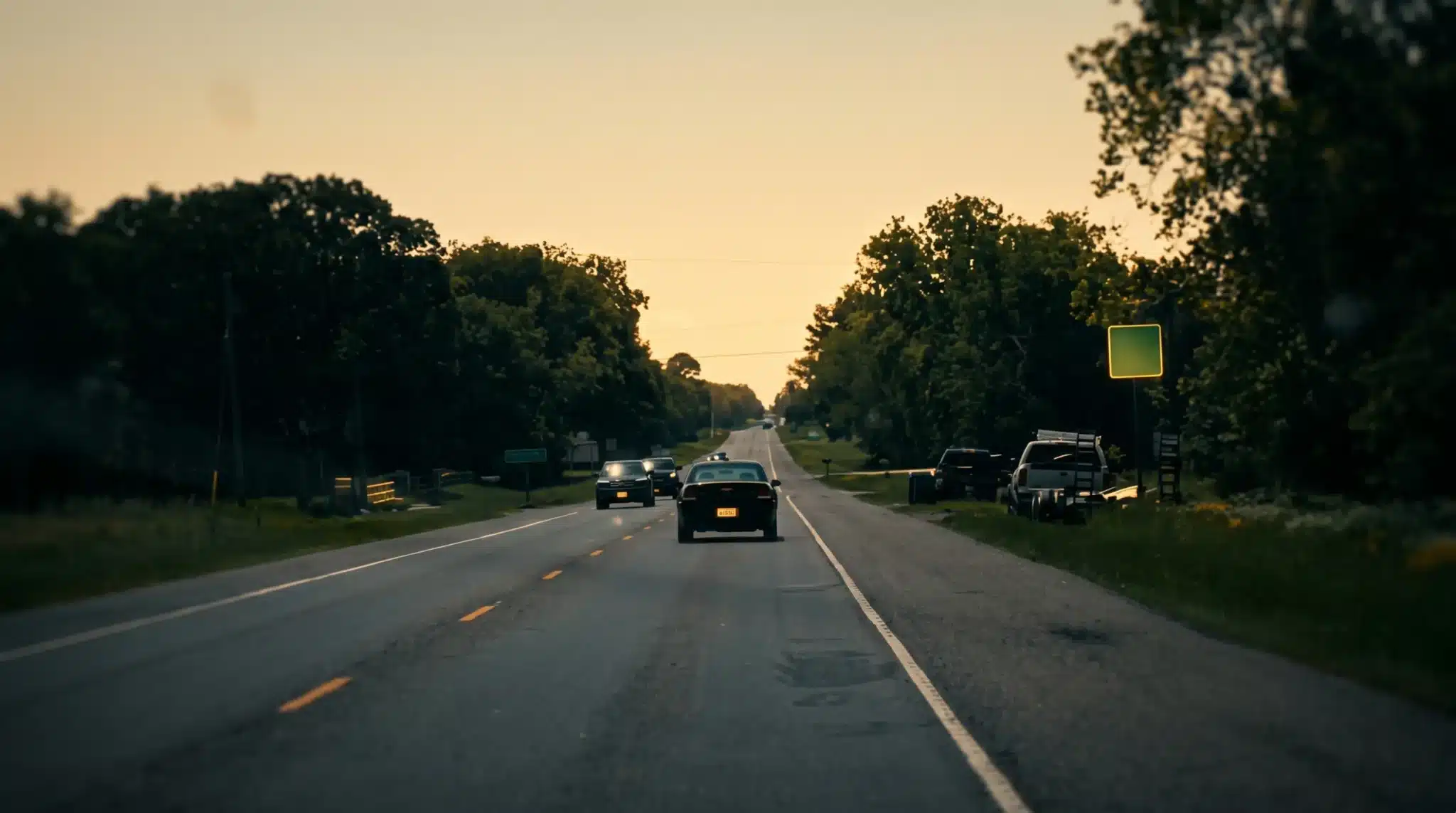
US 64, toward Tyler and Wills Point · rural roads carry over half of Texas road deaths
Geography splits the toll two ways. Rural roads carry a share of deaths far beyond their traffic: just over half of Texas traffic deaths have occurred in rural areas in TxDOT’s recent annual data, on roads with higher speeds, darker miles, and longer ambulance rides. Within cities, the single most common crash point is the intersection: federal crash data attributes roughly 40 percent of all US crashes to intersections, and TxDOT counted 1,030 intersection related deaths in Texas in 2022. The deaths also concentrate where the people are: ranked by raw crashes, Houston is the Texas city with the most, at 66,236 in 2024, ahead of Dallas at 26,109 and Fort Worth at 12,865, and in 2025 the ten most populous counties, led by Harris and Dallas, accounted for 1,601 deaths, 43 percent of the statewide total.
The deadliest freeway in Texas: I 45 by the mile, I 35 by the body count
The deadliest freeway in Texas is I 45, the Dallas to Houston to Galveston corridor, which recorded 0.913 deaths per mile in a national analysis of NHTSA data, second deadliest in the entire country and first among highways in Texas. Measured by raw totals instead of per mile, I 35 has historically carried the heaviest count, with 290 deaths over a recent five year span and more of the state’s deadliest individual stretches than any other highway, 11 of the top 78. Both corridors share the same killers the causes section above ranks: speed, impaired drivers, and heavy traffic meeting them, with I 45’s fatal crashes clustering in Harris County and in the 2 a.m. hour.
Timing repeats too. TxDOT’s 2024 data shows DUI alcohol crashes peaking in the 2 a.m. hour, weekend nights carrying the worst of it, and October standing as the deadliest month of 2024 at 391 deaths. Because these patterns trace to driver choices rather than chance, most of these deaths involved a driver who was legally at fault.
Where Texas ranks against the national average
The deadliest state to drive in is not Texas, but Texas runs above the national average by the fair measure: about 1.35 deaths per 100 million miles driven in 2024 against the national 1.20, which places it among the more dangerous states without making it the worst. The raw tenth-of-the-nation share in the scoreboard above mostly reflects Texas being a big, high mileage state, and the nation high speed limits help explain why speed is the single largest fatality factor here. For what is happening on Dallas roads right now, see our Dallas accident today guide.
If one of these numbers is your family, here is what the law provides
Behind every count on this page is a household that got the worst phone call of its life, and Texas law gives that household a path. A Texas wrongful death claim lets a spouse, child, or parent recover for the loss itself, the lost income, companionship, and support the person provided, and the estate can recover separately for what the person endured. The clock matters: Texas generally allows two years from the death to file, with shorter notice deadlines when a government entity is involved, and the evidence a case runs on, the scene, the vehicles, the witnesses, fades far faster than that.

The J. Alexander Law Firm team · Dallas, Texas
We at J. Alexander Law Firm handle these cases on contingency, which means the review is free, the fee comes only out of what we recover, and a family pays nothing upfront. What a claim is worth depends on the facts, and our guide to what a Texas car accident case is worth explains how these cases are valued. Nothing here undoes a loss; the claim exists so the loss does not also take the family’s future.
24/7 · Free consultation · No fee unless we win
Lost someone on a Texas road?
Call 469-807-7480 or contact us online. Se habla español.