



Short answer
What is a tort claim after a car accident in Texas?
A tort claim seeks payment for harm caused by wrongdoing. After a government driver hits you, three questions may matter. Was the driver working at the time, and did the driver's carelessness cause your injury? We also need to ask whether Texas law would make the driver personally answerable to you.
A Texas government vehicle collision that injures you may give you a claim through the Texas Tort Claims Act. My first question is which entity owns the vehicle. It could be a school district, transit agency, city, county or state agency. The owner determines which notice rules and damage caps apply, so we check when notice is due. The periods for giving notice and filing a lawsuit generally begin when the crash happens. Notice comes due first.
Section 101.021 covers certain injuries and damage caused by the use or operation of vehicles or motor driven equipment. My first step in your driving claim is to work on proving the employee was driving on the job.
Under section 101.065, the Act does not cover a wrongful act, omission or negligence by a Department of Public Safety commissioned officer who was not on active duty at the time. If the Act covers your claim, section 101.025 permits a lawsuit against the government unit.
When a government driver claims your actions contributed to the collision, how fault affects a Texas crash claim shows what that dispute could mean for your claim.
Which government vehicles are covered by the Texas Tort Claims Act?
Did an ambulance, police car, transit bus, school bus, fire truck or government truck hit you? The Act may cover that crash.
Section 101.001 includes cities, counties, the state, school districts and other government units in the Act. If a city bus or police car hit you, my first question is who employed the driver. We confirm the employer because damage caps vary by entity, and notice rules may vary too.
- City and county vehicles. These include police cars, public works trucks, garbage trucks and vehicles used by sheriff's departments. For a closer look at one kind of city or county vehicle, read about garbage truck crashes.
- State vehicles. A truck owned by TxDOT, the Texas Department of Transportation, belongs to a state agency. If one hits you, the state limits are the ones we consider for your claim.
- School buses. School districts have broad protection from claims under the Act, but section 101.051 makes an exception for claims involving their motor vehicles, school buses included.
- Fire trucks and ambulances. When a city fire truck is involved, the city's notice rules apply to the claim. You can read about Houston fire truck crash claims. Some volunteer fire departments, rescue squads and emergency medical service providers qualify as emergency service organizations with lower caps, so we check whether the provider qualifies.
- Transit buses. You could be hurt as a passenger on a Houston METRO, San Antonio VIA, Austin Capital Metro or Dallas DART bus. If a government bus strikes your car or hits you on foot, notice and claim rules apply there too.
Intentional acts are outside the Act
Section 101.057 excludes claims based on intentional wrongs, including assault, battery or harmful touching, and false imprisonment or holding someone against their will. A careless government driver may still be covered when the Act's conditions are met.
What are the requirements for providing a notice of claim under the Texas Tort Claims Act?
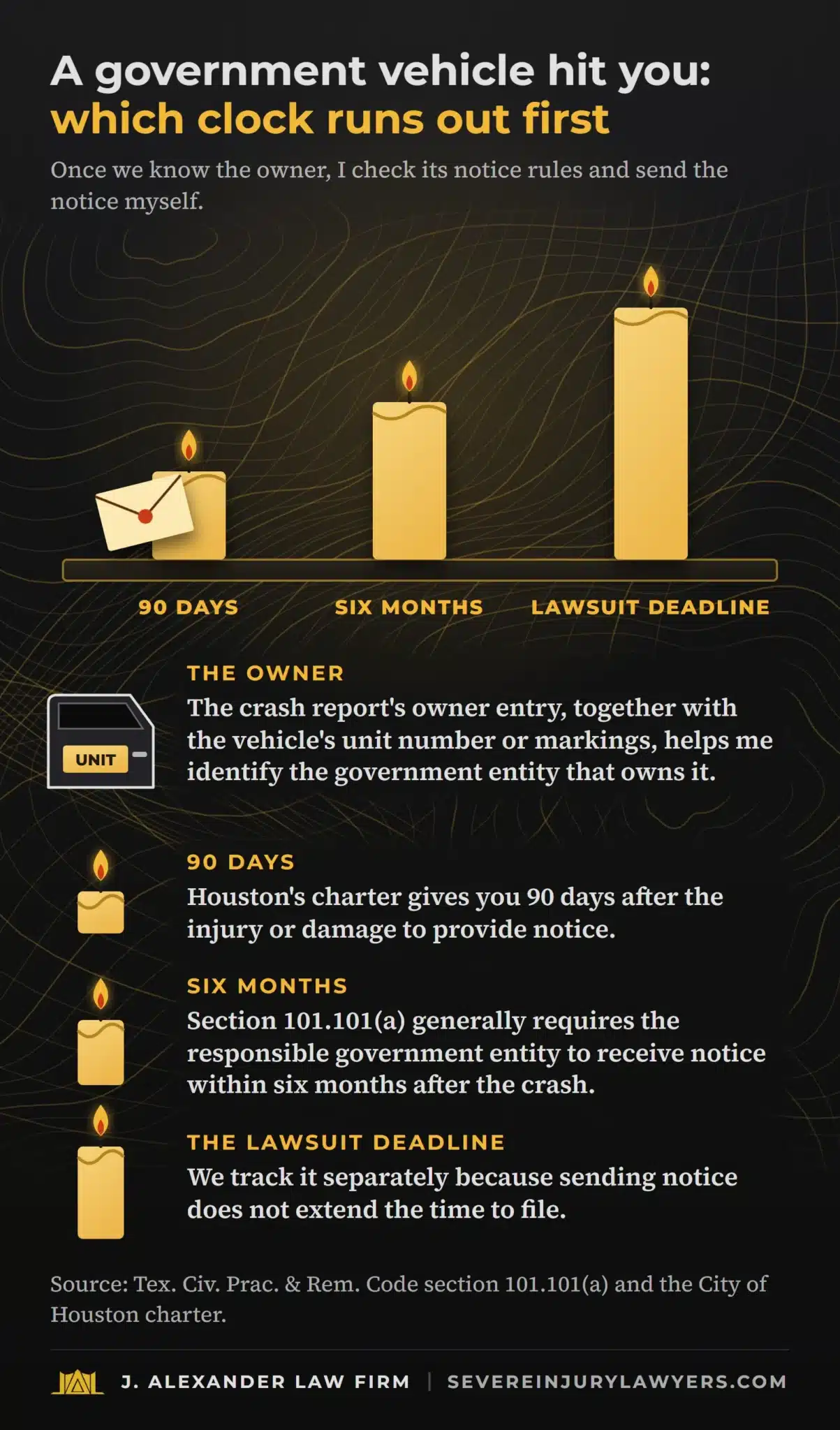
Section 101.101(a) generally requires the responsible government entity to receive notice within six months after the crash. Houston sets a 90 day deadline, and other cities may have different deadlines. Actual notice of your injury or property damage may mean your claim does not require formal notice. We examine what the government unit knew.
In the notice, I describe the crash, its time and location, and the injury or damage you claim. After a government vehicle crash, Texas crash filing deadlines and government notice rules lets you compare notice periods with the lawsuit deadline.
The crash report's owner entry, together with the vehicle's unit number or markings, helps me identify the government entity that owns it. Once we know the owner, I check its notice rules and send the notice myself.
Read it as text
Once we know the owner, I check its notice rules and send the notice myself.
- The owner: The crash report's owner entry, together with the vehicle's unit number or markings, helps me identify the government entity that owns it.
- 90 days: Houston's charter gives you 90 days after the injury or damage to provide notice.
- Six months: Section 101.101(a) generally requires the responsible government entity to receive notice within six months after the crash.
- The lawsuit deadline: We track it separately because sending notice does not extend the time to file.
Tex. Civ. Prac. & Rem. Code section 101.101(a) and the City of Houston charter.
Houston's charter gives you 90 days after the injury or damage to provide notice. Sign it before a notary, then mail it to the City Secretary with a copy to the City Attorney. Attach any medical bills and the accident report if it is available.
Texas courts have read actual notice to mean the entity knew about the harm, its alleged role in causing it and the people involved. A police report may give the entity that knowledge, but an investigation alone may not.
Say a city work truck turns into your lane and the driver says the city will handle the claim. I would not treat that promise as notice. Instead, I send notice and keep proof the city received it.
If a city or agency claims office calls after a collision with its vehicle, our adjuster call answer covers early questions about fault and injuries. Under section 101.027, a city or county may buy insurance that lets its insurer investigate and settle covered claims.
Section 101.104 bars discovery or trial evidence of whether the government has insurance or how much it has.
We track the lawsuit deadline separately because sending notice does not extend the time to file. Section 101.102 requires an Act lawsuit in state court in the county where the claim arose. The court papers must name the government unit as the defendant.
Not sure which city or agency owns the vehicle? I can look up its notice rules with you.
Call 469-807-7480How much can you recover from a Texas government entity after a crash?
My question is which government body is responsible for the vehicle, because the answer matters when we value your claim. If a Texas city or the state is responsible, section 101.023 sets an injury limit of $250,000 for each person and $500,000 for the crash as a whole. Property damage has a separate limit of $100,000 for the crash.
For a county, school district or local unit other than a city, section 101.023 caps injury damages at $100,000 for each person. The combined injury limit for the crash is $300,000. For property damage, the limit on your crash is $100,000. Emergency service organizations face these three limits too, with exceptions.
For a qualifying injury claim, we consider your treatment bills, the pay you missed and the pain you felt. The applicable cap limits what can be paid. The damages available in Texas crash claims include those losses, which can also arise after a government vehicle crash.
Worked example
A city truck hits a car carrying a driver and two passengers. If each claims $250,000 for injuries, their claims exceed the $500,000 crash cap.
Can you get punitive damages in a claim against the government?
No. In a Texas Tort Claims Act case against the government, section 101.024 does not authorize exemplary (punitive) damages.
The Act limits damages against a government defendant, but a private contractor or driver may face different Texas rules. Section 101.001 excludes independent contractors and their agents and employees from the Act's definition of a government employee.
For example, if a company operates a city garbage truck and its driver was driving, I also look at the company's insurance coverage. If a city garbage truck hits you, the Texas crash lawsuit value guide discusses damages and factors that affect a crash claim's value.
Is the government liable if a police car or ambulance hits you on an emergency call?
Sometimes. Section 101.055(2) may protect the government when an employee answers an emergency call or reacts to an emergency and follows the applicable emergency laws. If no emergency law applies, section 101.055(2) can still protect the government unless the employee showed reckless disregard for other people's safety or conscious indifference to it.
Transportation Code section 546.005 requires a driver of an authorized emergency vehicle to drive with regard for everyone's safety. My question is whether the driver met that duty. We request dispatch audio and logs to find out whether the vehicle was answering an emergency.
Our TxDOT records show 2,336 reportable crashes in Texas during the first 313 days of 2026, ending November 9, where an emergency responder was driving on an emergency. Eight crashes were fatal, and 66 involved at least one person with a suspected serious injury.
During the corresponding 313 days of 2025, the records show 2,273 crashes. The preliminary 2026 total works out to about seven crashes per day. The emergency responder flag does not identify who was responsible for a crash.
Texas crash reports carrying the CRIS emergency responder flag | TxDOT CRIS public query, statewide reportable crashes, January 1 to November 9 of each year, pulled November 12, 2026 (our own pull), Emergency Responder Flag
| Period | Crashes | Fatal crashes | Suspected serious injury crashes |
|---|---|---|---|
| 2026, January 1 to November 9 | 2,336 | 8 | 66 |
| 2025, January 1 to November 9 | 2,273 | 21 | 62 |
CRIS defines the flag as a peace officer, firefighter or emergency medical services employee involved in a crash while driving a law enforcement vehicle, fire department vehicle or medical emergency services vehicle while on emergency. The severity columns follow the worst injury anyone in the crash suffered. Being flagged says nothing about fault. Late reports will push the 2026 row higher.
Can you sue a government employee personally in Texas?
Sometimes. My decision about whom to name comes before filing because suing the employee can affect whether you can also pursue the government unit.
Your choice of whom to sue matters under section 101.106:
- If you file an Act suit against the government unit, you cannot later sue or recover from its employee over the same matter.
- Suing an employee bars you from bringing a suit or recovering from the government unit over the same matter, unless the unit consents.
- Settling a claim under the Act bars a suit or recovery against the unit's employees over the same matter. A judgment against an employee also bars a suit or recovery against the government unit.
- If you sue both the government unit and its employees under the Act, the employees are dismissed when the unit files a motion asking the court to dismiss them.
- If a lawsuit concerns an employee's ordinary job duties and the Act would have allowed the suit against the government unit, the law treats the employee as being sued in an official role. Under section 101.106(f), the employee can ask the court to dismiss the suit. You then have 30 days from that filing to amend the court papers, remove the employee and name the government unit instead. Missing that deadline may leave you without anyone to sue.
Deciding whether to name the driver or the agency? Talk through section 101.106 with me first.
Call 469-807-7480What law applies if a federal or military vehicle hits you in Texas?
The Federal Tort Claims Act may apply if a federal or military vehicle hits you in Texas, so we look at your claim under that law rather than the Texas Act's notice deadline.
We use the federal process described on our mail truck claims page for your claim, and similar steps apply if the vehicle belongs to the military or another federal agency.
Under 28 CFR 14.2(b)(1), send your claim to the agency whose activities caused the crash, such as Border Patrol, ICE or a military branch.
If another federal agency receives it and can identify the right one from your claim, it must promptly send the claim there and notify you. If a transfer is impractical, that agency must return the claim to you.
If the Attorney General certifies that the federal driver was acting within the bounds of federal employment, the United States takes the driver's place as the party being sued. Under 28 U.S.C. 2679(d), a case filed in a Texas court is then moved to federal court.
If the Attorney General declines to certify that the employee was acting within the bounds of federal employment, the employee may ask the court to do so. If the federal court decides that request and finds the employee was acting outside those bounds, the removed case returns to state court.
One day after a postal driver struck her car in October 2026, a woman called our intake team. She had shown officers her dash cam video and wanted to know why the driver had not received a citation. Our team asked for the video right away and asked whether anyone had been cited. We explained that the postal side would get its driver's statement and wait for the police report:
From our intake
"I got their insurance because I know that it's not like a regular car accident because it was a USPS driver."
A caller, 2026
How do you get records from a Texas government agency after a crash?
Send a written public information request to the Texas government body that holds the crash records you want.
Anyone can ask a Texas government body for public information about a crash, though some information may be withheld. Keep the shorter notice clock in mind when requesting records.
At the scene, write down the bus or unit number, the route and the driver's name if you can do that without danger. Keep those details with the items in the Texas car accident checklist, which covers what to do after a government vehicle hits you. My concern is timing because notice can be due quickly.
- Crash report, form CR 3. The officer uses this form to document the crash, and you can buy a copy through TxDOT's online system.
- Dispatch audio and logs. If the vehicle was responding to a call, ask the agency that dispatched it for these records.
Example
Who owns the government truck?
Picture a man at his kitchen table the night after a white pickup sideswiped his car. He spreads out his photos under the light. A seal is on the pickup's door, but he cannot tell whether it belongs to a city, a county or a state agency.
I would start with the markings on the pickup and compare them with the owner entry on the crash report. A unit number on the truck could help us identify it.
The seal is like the sender's address printed on an envelope. Reading it can point us toward the right office and the rules that apply, but we still need to confirm who owns the truck.
The identity matters because section 101.023 sets different injury limits for different government units. The limit for a city or the state is higher than the limit that generally applies to a county or another local unit. The applicable limit depends on which government body is responsible, not just what appears on the door.
A city marking also leaves another possibility to check. A private company may have been driving for the city, and different Texas rules may apply to a claim involving that company.
The man does not have to solve that question tonight. He can zoom in on the seal and unit number in his photos and send them to us.
Separate steps
A records request is not claim notice.
24/7 | Free consultation | No fee unless we win
Tell me whose vehicle it was. I will check the notice rules.
J. Alexander Law serves injured clients throughout Texas: Dallas | Houston | San Antonio | Fort Worth | Arlington | Canton. Se habla español.