



Short answer
When does a pedestrian have the right of way in Texas?
You generally may cross when you face a Walk signal or, if there is no pedestrian signal, when the light facing you is green. You may also cross at a crosswalk without a working signal, and a driver may have to yield to you there. A green turn arrow by itself does not permit you to cross. Away from a crosswalk, you generally must yield, but the driver still has to use care to avoid a collision.
Not always. Texas law determines who must yield based on where you cross. I start by sketching where you were hit, whether that was at a corner, signal or driveway, or between intersections.
Who had to yield matters, but it does not decide the whole claim. I also look at what you and the driver each did to see whether responsibility is shared. You can find more detail in our discussion of how Texas handles shared fault.
If you were riding a bicycle, different duties apply under the Texas bicycle laws.
Pedestrian right of way in Texas at a glance: who yields, and what it means for a crash claim | Texas Transportation Code chapter 552, Texas Department of Public Safety, Texas Driver Handbook (revised January 2026) and Texas Department of Transportation, read Nov 11, 2026
| Where you were | Who yields | What it means for a claim |
|---|---|---|
| In a crosswalk at a corner with no signal, painted or not | The driver stops and yields (section 552.003(a)) | A driver who did not yield at this crossing may bear fault. |
| In a crosswalk on a Walk signal, or on a green light where there is no pedestrian signal | Walk signal: the driver stops and yields. Green light with no pedestrian signal: you may cross unless the only green is a turn arrow (sections 552.001 and 552.002) | Signal timing and any available camera video may help show what happened. |
| In a crosswalk as a driver makes a right turn against a red light | The driver first comes to a stop, then gives way to you | The question includes whether the driver stopped before turning and yielded to you. |
| In a crosswalk while another vehicle has stopped to let you cross | A driver coming up from behind may not pass the stopped vehicle (section 552.003(c)) | Note which vehicle stopped and which one kept going. |
| Crossing mid block, or anywhere outside a crosswalk at an intersection | The pedestrian yields to vehicles (section 552.005(a)) | Your duty to yield matters, and the driver's duty of care still counts. |
| Crossing an intersection diagonally | Allowed only if a traffic control device authorizes it, and only in the manner it authorizes (section 552.005(c)) | Photograph any signal or sign that controls the diagonal crossing. |
| On a sidewalk crossing the entrance to a driveway, alley or parking area | A driver entering or leaving stops first and gives way to you (section 552.006(c)) | The driver's duty to stop before crossing the sidewalk matters. |
| Walking along a road | Use the sidewalk. If there is none, walk facing traffic along the left edge of the road or on the shoulder | Where you walked in relation to the sidewalk and traffic may matter. |
The table points to rules that can matter in injury claims, though Texas has other laws governing pedestrians.
What is the definition of a crosswalk in Texas?
A crosswalk can be marked on the pavement or unmarked at an intersection where the sidewalk lines continue across the road. Between intersections, a crossing must be marked to count as a crosswalk.
Say you crossed at an unpainted corner where the sidewalks across the road line up. Depending on the intersection, that spot may count as a crosswalk under section 541.302. It is like a property line, which can exist without paint. I can use photos showing how the sidewalks line up to answer an adjuster who calls your crossing jaywalking.
Under section 552.003(a), when no signal is working, a driver has to stop and yield to someone in the crosswalk on the driver's half of the road.
The driver must also stop and yield when a person crossing from the other half of the road is close enough to be in danger. Under section 552.004, a pedestrian must walk on the right half of a crosswalk when possible.
A pedestrian cannot suddenly enter the car's path when it is so close that the driver cannot stop and yield. If the insurer says you stepped out suddenly, the car's distance matters.
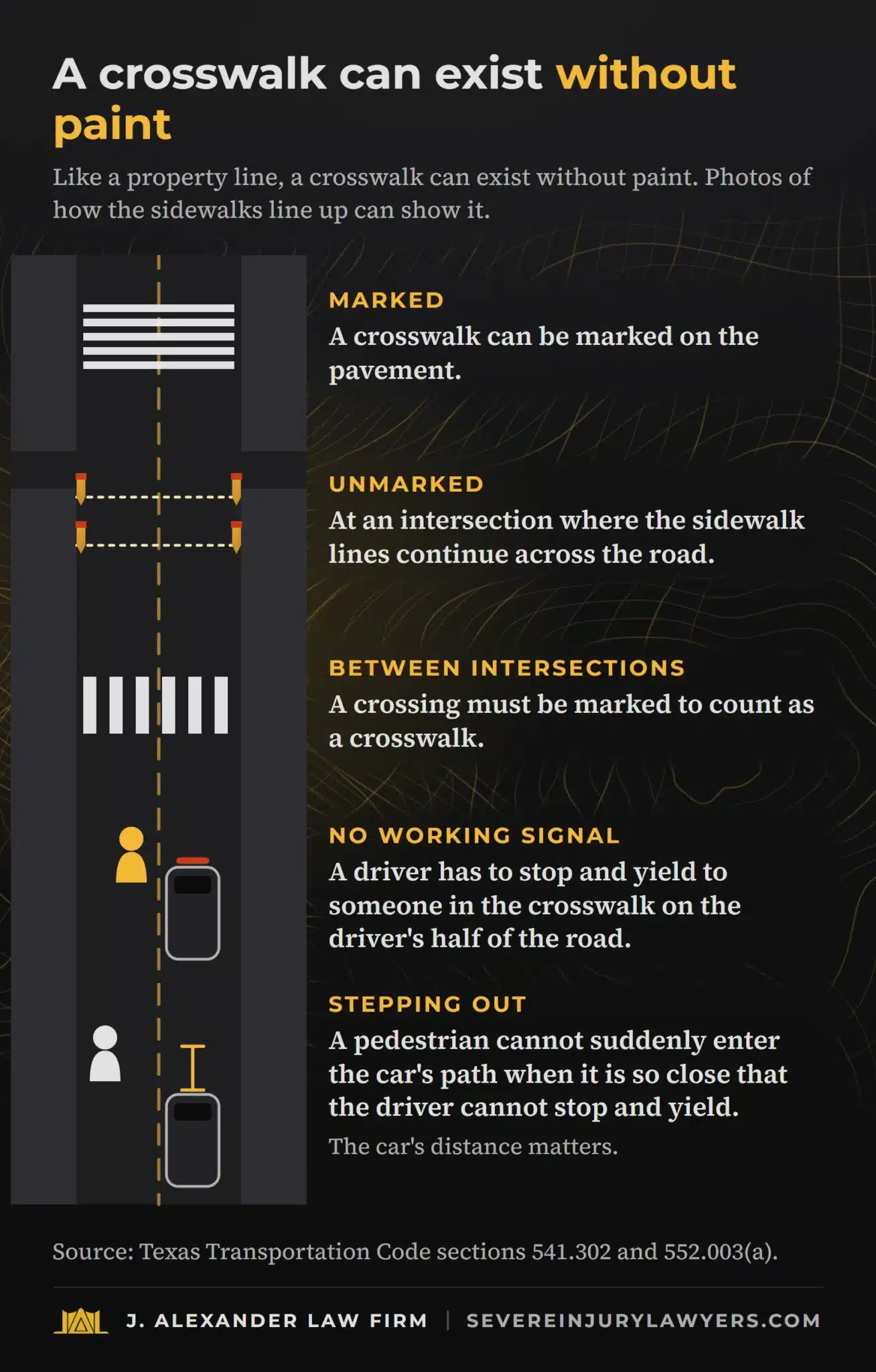
Read it as text
Like a property line, a crosswalk can exist without paint. Photos of how the sidewalks line up can show it.
- Marked: A crosswalk can be marked on the pavement.
- Unmarked: At an intersection where the sidewalk lines continue across the road.
- Between intersections: A crossing must be marked to count as a crosswalk.
- No working signal: A driver has to stop and yield to someone in the crosswalk on the driver's half of the road.
- Stepping out: A pedestrian cannot suddenly enter the car's path when it is so close that the driver cannot stop and yield. The car's distance matters.
Texas Transportation Code sections 541.302 and 552.003(a).
When Matthew Graham defended pedestrian claims for insurance companies, he told me he first asked where the person crossed and whether the driver could see them. He then asked what the driver did behind the wheel. Lighting, your clothing, and camera footage help me judge whether the driver could see you.
The Lisa Torry Smith Act became effective in 2021. Section 545.428 makes it a Class A misdemeanor for a driver to operate a vehicle with criminal negligence in a crosswalk and cause bodily injury to a pedestrian. If the injury is serious, the offense is a state jail felony.
The driver can raise a defense under the law if the pedestrian broke an applicable rule about crossing or using the road. A criminal charge against the driver can help, but it does not resolve your injury claim.
Under sections 550.021 and 550.023, a driver who injures a pedestrian must stop at or near the scene, check for needed aid, share identifying and insurance information, and provide reasonable help. Your claim needs its own proof.
Section 550.023 includes arranging transport when treatment is apparently needed or the injured person requests transport. Under section 550.021, failure to comply can be a felony if the collision causes serious injury or death.
Who has the right of way at a green light turning right?
When the Walk signal faces you, a driver turning right must stop so you can cross. At a corner without a Walk signal, you may use the crosswalk, whether marked or unmarked, if you face a green light. But if the only green signal is a turn arrow, that arrow does not give you permission to cross.
A green light does not erase a driver's duty to stop for someone crossing lawfully and let them pass.
Section 552.010 requires a driver approaching an intersection or crosswalk to protect a person crossing or trying to cross with a white cane or assistance animal, and to stop fully if stopping is the only way to prevent injury or danger.
When a turning driver hits someone walking, I start with a question: Which signal did each of you face?
To make a permitted right turn on red, a driver must first stop at the marked line. If there is no line, the driver must stop before entering the crosswalk and yield to people crossing lawfully.
When a green arrow appears with a red light, the driver must stop for people lawfully crossing in an adjacent crosswalk and yield to other traffic lawfully using the intersection.
If the light changed while you were lawfully crossing, the driver must let you finish. A witness or camera footage may help establish when you stepped off the curb. Do not begin crossing against Don't Walk or Wait.
Different rules govern failure to yield crashes between drivers.
When does a pedestrian not have the right of way?
In Texas, if you cross outside a marked crosswalk or an unmarked crossing at an intersection, you generally must let vehicles go first. You must also yield to vehicles if a pedestrian tunnel or overhead crossing is provided where you cross. Even if you crossed outside a crosswalk, you might still have an injury claim against the driver.
A marked crossing between intersections counts as a crosswalk. If the neighboring intersections both have operating signals, pedestrians may cross between them only at a marked crosswalk. If a crash happened between those intersections, our team measures the distance to the nearest marked crossing.
People often call it jaywalking when someone crosses away from a crosswalk. Chapter 552 does not use that word or set a general penalty of its own.
If someone is convicted of a state traffic misdemeanor and no other penalty applies, the fine can be $1 to $200 (sections 542.301 and 542.401). Your city may also have a pedestrian ordinance (section 552.009).
If an adjacent sidewalk is accessible, use it instead of walking along the road. If you were on the road, we look at whether an accessible sidewalk was provided. When there is no sidewalk, walk facing traffic on the left side or shoulder unless it is blocked or unsafe.
A ticket alone cannot answer every question about the crash. What you did matters, but so does the driver's conduct. I look at the driver's speed and whether the driver was watching for people on foot.
Is it always the driver's fault if you hit a pedestrian?
No. A driver is not automatically liable for hitting someone on foot. Even if you crossed away from a crosswalk, the driver can still share fault.
The insurer may say you crossed outside a crosswalk, were difficult to see or stepped out suddenly. If you share responsibility, the Texas shared fault rule determines whether you can recover money and whether the amount is reduced.
In 2026, up to November 9, Texas reportable crashes claimed 562 pedestrians' lives and left 1,073 seriously injured, according to TxDOT's crash records.
Of the 562 who died, 449 (79.9%) were in crashes coded dark, including 241 in darkness without lighting, and 455 (81.0%) were in crashes coded non intersection.
The light and intersection codes describe the crash scene, but do not show whether a crosswalk was there, which person had to yield or who was to blame.
The 562 deaths are preliminary, and later counts will include deaths not yet counted because TxDOT receives reports for weeks after each crash, while our yearly Texas counts of people killed and seriously injured include full year totals for 2023 to 2025.
People on foot killed or seriously injured in Texas crashes, by light condition, 2026 through November 9 | TxDOT CRIS public query, January 1 to November 9, 2026, pulled November 12, 2026
| Light condition at the crash | Pedestrians killed | Pedestrians seriously injured |
|---|---|---|
| Dark, not lighted | 241 | 235 |
| Dark, lighted | 199 | 336 |
| Dark, unknown lighting | 9 | 21 |
| Daylight | 91 | 442 |
| Dusk | 12 | 21 |
| Dawn | 6 | 14 |
| Unknown | 4 | 4 |
| All light conditions | 562 | 1,073 |
These are people, not crashes, and the injury is the pedestrian's own. Seriously injured is the report's suspected serious injury code. A death is added to the record only if it comes within thirty days, so the latest deaths are the slowest to show up.
A pedestrian hit in a garage
The record in our Frisco garage case describes how a pedestrian was hit.
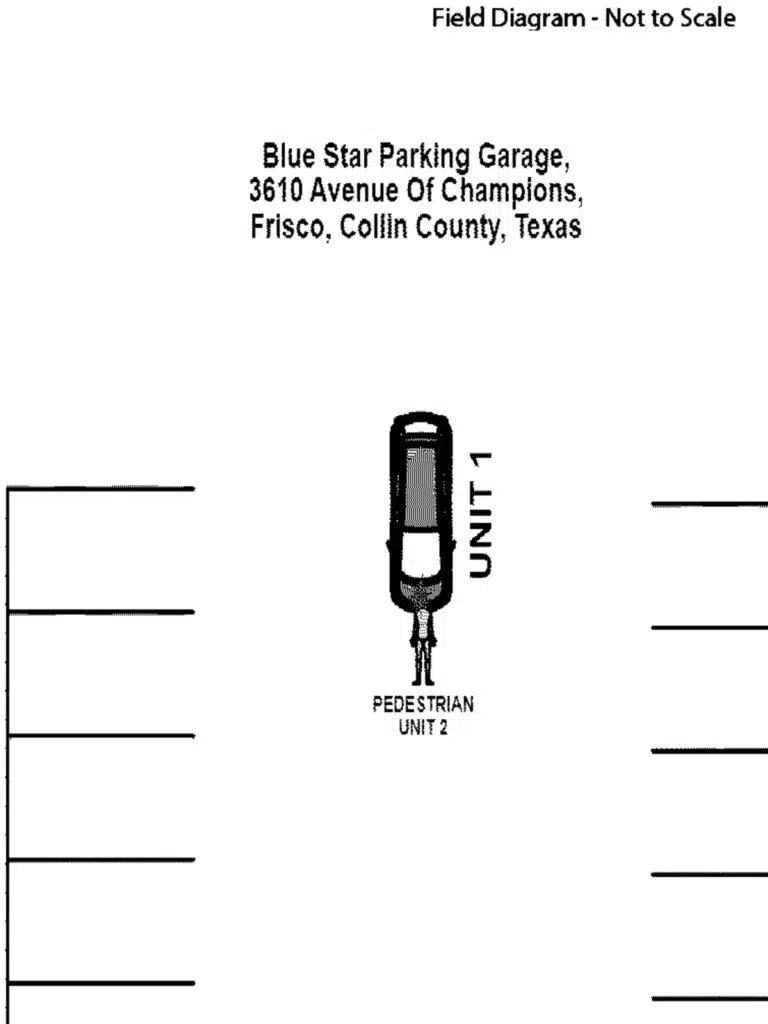
Frisco, a parking garage exit ramp
Frisco garage pedestrian crash
In the early hours of a 2022 morning, our client was on foot in a Frisco parking garage when a car descending the exit ramp struck him.
Witnesses told paramedics our client flipped over the car, which they said was traveling at 12 to 20 mph.
He was confused when paramedics found him on the floor, and they brought him to the emergency room under a trauma alert. He was diagnosed with a concussion.
A later neck MRI showed a disc tear and a small herniation. He kept working and missed therapy because he could not lose the hours.
Frisco police filed a DWI charge against the driver. The crash report did not assign our client any contributing factor. The claim was settled without filing suit.
No court decided fault, and a DWI charge does not establish guilt.
Even away from a crosswalk, a driver still has to take care to keep from hitting you. Under section 552.008, a driver who sees a child or an obviously confused or incapacitated person in the road must take proper precautions. I look at how fast the car was moving, whether the driver kept their eyes on the road and hit the brakes, and whether a horn warning was needed.
If the driver's conduct caused your injuries, your claim can include medical expenses, missed earnings and the physical pain you went through. These are some of the losses recoverable after a Texas crash.
Is the adjuster blaming your crossing location? Tell me where you were.
Call 469-807-7480Does a pedestrian have the right of way in a parking lot?
When a sidewalk crosses a lot entrance, a driver entering or leaving must stop for an approaching pedestrian and let that person pass. Inside a private lot, the rules about yielding on a street do not necessarily apply, so we look at whether someone failed to use care.
If the insurer says the driver could not see you, expect questions about darkness. Texas recorded 5,973 traffic crashes involving pedestrians in 2025, and 694 people died while walking.
In 2025, 68 percent of pedestrian deaths and injuries occurred in the dark. Failure to yield was among the leading factors in pedestrian crashes.
A driver needs to take care even when it is dark. Before reversing from a parking space, the driver should look behind the car for people. That is why, in a parking lot claim, I start by asking where the driver was looking before the car moved.
The rules and evidence for parking lot accident claims can differ from those for a crash on a public road.
A Dallas parking lot entrance crash
The record in our Dallas lot entrance case describes what happened at one crossing.
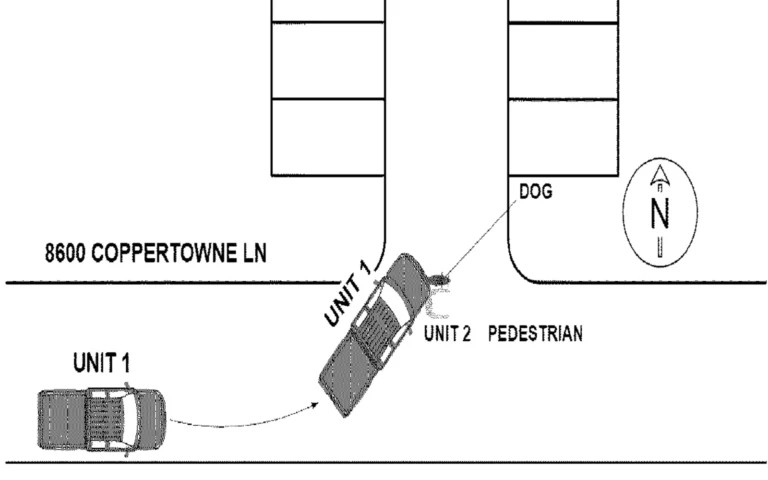
Dallas, a parking lot entrance
Dallas lot entrance crash
On a dark, wet evening, our client and her dog were crossing a parking lot entrance from a Dallas street where the speed limit was 20 mph.
A pickup approaching from the opposite direction turned left into the lot and struck her and her dog. Her dog was killed.
Dallas Fire Rescue checked her at the crash location. The officer noted an evident injury, but she was not transported to a hospital by ambulance.
The report listed no witness or video, and the officer was not dispatched until the next morning, leaving the report as the account of the incident.
The report identified a crosswalk as the traffic control and listed only one contributing factor: the pickup driver failed to yield to the pedestrian.
The report leaves open whether she used a sidewalk. Its codes reflect the officer's opinion and do not decide fault.
She was paid through the pickup driver's liability policy and through underinsured motorist protection on her own policy, without filing a lawsuit, despite being on foot.
What to do if you get hit by a car when walking?
Put your health first and get medical care. When you can, save anything that shows where you crossed and which signal you faced. If people disagree about who had to yield, photos, video, witness accounts, or a crash report can help. Medical bills will arrive before your claim is settled, so read who pays your medical bills along the way.
Our case managers order the crash report and the officer's diagram. I read both with you, looking at the factors the report says contributed to the crash and any traffic signal or sign it lists. When you are able, gather details that show what happened at the crossing:
The deadline to file a Texas pedestrian injury lawsuit keeps running while the driver's insurer reviews your claim, though exceptions can apply. Our team keeps track of that deadline during the review. Check the Texas deadlines for filing a car crash lawsuit rather than waiting for the insurer to finish.
Before you sign anything from the driver's insurer or agree to be recorded describing your crossing, call me. We also cover what to say when an insurance adjuster first calls.
Our Texas pedestrian accident lawyers can explain how we handle your claim. When you call, you will speak with our intake team. You can share the report number and where you crossed with me or anyone else on our team.
Example
Hit in a crosswalk on green
Say a man is walking home from the bus stop. The Walk signal lights, and he steps into the crosswalk.
Halfway across, a car turning right clips him. At the curb, the driver keeps repeating that his light was green.
I would check the signal facing each person and whether Walk was lit when the man left the curb. A driver with a green light must stop for someone crossing lawfully. If the pedestrian started on Walk and the signal changed during his crossing, the driver must let him finish.
Think of the driver's green light as a ticket into a theater. The Walk signal gives the pedestrian a reserved seat.
Getting through the door does not let the driver take a seat someone already occupies. A witness or camera might show when the man stepped off the curb and what the signals displayed.
Both people's actions matter if responsibility is disputed. A finding that the pedestrian contributed could reduce what he recovers.
But the driver's green light alone does not end his claim. If this happened to you, write down the corner, the time, the bus stop and who was waiting with you.
Has the driver's insurer asked to record your account? Talk with me about where you stepped off the curb before you give it.
Call 469-807-748024/7 | Free consultation | No fee unless we win
Tell me where you crossed. We can go through the crash report together.
J. Alexander Law serves injured clients throughout Texas: Dallas | Houston | San Antonio | Fort Worth | Arlington | Canton. Se habla español.