



Short answer
Who is responsible when something falls from a vehicle and hits my car?
The driver, owner, or hauling company may be responsible if their actions caused the load to fall. If you identify the driver or company, its liability insurance may cover your injuries and car damage. Move out of traffic and call 911. If it is safe, write down the license plate, company name, and USDOT number. Take pictures of the fallen item and damage to your car, and save any dash cam video. I use those details to find the truck.
When something falls from a truck and hits your car, I start by identifying the truck that carried it. Knowing which truck it was is the first step in figuring out who may have to pay. At the scene, get to a safe place, call 911, and save any details that could help identify the vehicle.
What callers tell us
A man called us after a board flew from an uncovered construction dump truck on a McKinney highway. The plywood came through the windshield of the work van he was driving and missed him.
He went to the ER that day and told us the next day that his neck and back had been hurting.
What callers tell us
The truck kept going, and its driver may not have known what happened. If you identify a driver or company responsible for the load, you may bring a claim to their liability insurer for the harm. The table shows possible sources of payment.
Who pays when a load, debris or trailer comes loose | Our summary of Tex. Ins. Code section 1952.104(3), Nationwide Insurance Co. v. Elchehimi (Tex. 2008) and the Texas Department of Insurance auto insurance guide. Coverage depends on the policy you bought.
| What happened | Who pays | What it turns on |
|---|---|---|
| The load hit you and the truck was identified | Liability insurance carried by the hauling driver and the hauling company | Proof that the load came from that truck |
| The load hit you and the truck was never identified | Your own collision or comprehensive coverage for the car. For medical bills: personal injury protection (PIP), medical payments coverage or health insurance | Uninsured motorist coverage usually does not apply, because the object is not the unknown vehicle itself |
| You braked or swerved for debris and another car hit you | The driver who struck your car, plus whoever dropped the debris, if that can be traced | Who dropped the object and how each driver reacted |
| A trailer came unhitched and hit you | The liability insurance on the vehicle that was towing it | The hitch, the safety chains and who hooked up the trailer |
Keep any details you have about the truck, as well as records of your care and car repairs. If the falling load hurt you, your injury claim may include medical expenses, earnings you missed and pain from your injuries. Learn more about what a Texas injury claim can recover.
What if the truck that dropped the load is never found in Texas?
If the truck cannot be identified, coverage through your own insurer may help. An object falling from an unknown vehicle generally does not meet the contact requirement for uninsured motorist coverage. That is why finding the truck comes first.
What callers tell us
The McKinney caller's employer pulled the van's dash cam video, but the footage did not give us the truck's plate, and our staff told him we could not take his case without it. He described the moment the board hit:
From our intake
"It came through the windshield of my truck."
A caller, 2026
When trucking insurers hired Matthew Graham to handle fallen load claims, he first asked if the object could be traced to a particular truck. Now I ask that question for the person who was hurt.
If an unknown truck drops something that hits your car, your uninsured motorist coverage, known as UM, may not pay. Texas Insurance Code section 1952.104(3) requires the unknown vehicle to make physical contact with you or something you own.
A part that separates from a truck before it hits you may not count as contact with the truck. In Nationwide Insurance Co. v. Elchehimi (2008), the Texas Supreme Court decided that an axle and wheels from an unidentified 18 wheeler did not meet that contact requirement.
Before relying on UM for a fallen object, our team can read your policy and look at the facts with you.
The court also noted that earlier Texas cases had rejected claims involving fallen cargo. One involved furniture that another driver tried to avoid. If the vehicle itself strikes you, the question becomes how to prove it made contact. Read about proof of contact after a hit and run.
If the truck is never found, I check your insurance declarations page to see what coverage may apply. Collision coverage may help with damage from the crash, while comprehensive coverage may apply when gravel hits your car. Either coverage may come with a deductible. For treatment costs, read what PIP and medical payments coverage can pay.
Did the insurer turn down your claim because the truck was never identified? Show me the denial and the policy.
Call 469-807-7480Who is responsible for road debris damage?
The person or company that dropped the debris may have to pay for the damage if you can connect the object to them and show they caused the harm. Another driver may also share responsibility for a collision near the debris.
What callers tell us
One caller told us a car rear ended the caller on a freeway where a large object was in the lane. The caller had a police report about the rear impact and information identifying the company the caller said owned the object:
From our intake
"I have the information of the company that owns the container or the object that was on the road."
A caller, 2026
A ladder or tire tread left in the road can be harder to trace than a load you watched fall. Check for markings, witnesses, nearby video, and reports from drivers who called 911, then note the time and place, including the lane and direction.
Picture this: the object that struck your car still has a torn strap attached, or a company name stenciled on its side. Those clues work like a return address on a package, giving me a way to trace the debris to where it came from.
In 2026, Texas reports listed unsecured loads in 1,238 reportable crashes that happened by November 9. Of those crashes, 3 were fatal and 13 involved suspected serious injuries. Texas state and US highways accounted for 464 of the crashes, while 450 happened on interstates.
The listing reflects the investigating officer's opinion about one vehicle. It does not establish fault or count crashes caused by unsecured loads.
A separate total of 499 includes crashes in which a vehicle struck an object from another vehicle, a fallen tree or other debris from any source in the road, or rocks that fell or blew from a truck.
Some crashes appear in both counts, so you cannot add the totals together. Neither figure is final because it can take weeks for TxDOT to receive crash reports, and later reports may increase each count.
Texas crashes where the officer listed 'load not secured', by road class, 2026 through November 9 | TxDOT CRIS public query, January 1 to November 9, 2026, pulled November 11, 2026
| Road class | Crashes | Fatal crashes | Suspected serious injury crashes |
|---|---|---|---|
| US and state highways | 464 | 2 | 3 |
| Interstate | 450 | 0 | 5 |
| City street | 128 | 1 | 1 |
| Farm to market road | 95 | 0 | 4 |
| Tollway | 62 | 0 | 0 |
| County road | 39 | 0 | 0 |
| All road classes | 1,238 | 3 | 13 |
Road class is the class of the road the crash is located on. A crash counts as fatal or serious by the worst injury to anyone in it, not only to people in the vehicle the factor was listed for.
When debris makes you react and a car behind you hits yours, what you and the other driver did may affect your claim.
Texas Transportation Code Section 545.062(a) calls for a gap that lets the following driver stop without striking your car or swerving into another vehicle, object or person, accounting for both vehicles' speeds, traffic and highway conditions. That duty alone does not settle fault.
The defense may blame the driver who hit you from behind, so I keep the crash report and any video of that impact in the file with the debris evidence to see what each driver did. Learn how Texas comparative negligence may affect your claim.
Know which company owned the object in your lane? Give me the name and I will look into it with you.
Call 469-807-7480What is the penalty for an unsecured load in Texas?
A violation of the Texas loose material rules in Transportation Code Chapter 725 is a misdemeanor punishable by $25 to $500 (section 725.003(c)).
The loose material rules cover material that can blow or spill from vehicle movement or weather. Section 725.001(2) includes dirt, sand, gravel, wood chips and refuse. It excludes agricultural products in their natural state.
Chapter 725 applies to motor vehicles, trailers and semitrailers on public highways (section 725.002). The chapter does not set general rules for solid cargo such as ladders, lumber or furniture.
Section 725.021 requires a vehicle bed carrying loose material to be enclosed on both sides, at the front and at the rear. It must have no openings that let material escape, and the tailgate must be securely closed.
A cover generally must be fastened at the front and back. An exception applies if the compartment fully encloses the load or the material does not blow or spill out. A commercial vehicle carrying loose material needs a secured cover or a fully enclosed load.
A ticket or an officer's notation can be evidence, but it does not prove every part of an injury or vehicle damage claim. To understand an entry in the report, use the guide to reading Texas collision report codes.
For solid cargo, I look at how the load was secured under other rules, including federal commercial truck rules. For loose material from a dump truck, see dump truck crashes involving rocks and gravel.
Are truck drivers responsible for securing the load?
Yes. Under 49 CFR 392.9, a commercial truck driver cannot drive with cargo that is poorly distributed or not secured well enough. The carrier cannot allow the driver to do so either, and I hold both to that rule. The driver must also inspect the cargo during the first 50 miles and check it again later in the trip, though there are exceptions.
When cargo falls from a commercial truck, I ask whether the driver performed the checks listed in the table and when they took place. The timing of those checks may help establish how long the load was loose.
Federal cargo checks for commercial truck drivers (49 CFR 392.9) | 49 CFR 392.9(b), Code of Federal Regulations, October 1, 2024 edition.
| When | What the driver must do |
|---|---|
| Before driving | Confirm the cargo is spread out properly and tied down well enough |
| Within the first 50 miles of the trip | Inspect the cargo and its securement devices and adjust or add devices as needed |
| At each change of duty status, or after 3 hours or 150 miles of driving, whichever comes first | Recheck the cargo and the devices holding it, adjusting them as needed |
There are exceptions to the inspection rules. They include a sealed vehicle the driver was ordered not to open and a load arranged so that inspection is impracticable. We also ask who loaded the truck because the loader may share responsibility. Read about who may be responsible after a commercial truck crash.
Federal rule 393.100 requires a commercial truck's load to be held in place so it cannot escape or shift enough to make the truck less stable or harder to steer. So I ask, "How did the load move?" rather than looking only at whether anything fell.
Cargo that shifts can contribute to a crash even if it never reaches the road.
Weight that shifts during a turn or hard stop can contribute to a rollover or jackknife. Texas Transportation Code section 621.101 sets a general gross weight limit of 80,000 pounds. When a scale ticket exists, I compare it with that limit to see whether this was an overweight truck.
Who is liable when a trailer comes unhitched in Texas?
The towing driver or another responsible person may be liable if their actions caused the trailer to come loose. A claim may start with the liability insurer for the towing vehicle.
Texas Transportation Code section 545.410 generally requires approved safety chains when a car or light truck pulls a trailer. These flexible connections are meant to keep the vehicles together if the main hitch fails.
The statute does not apply to agricultural trailers or vehicles operating under federal motor carrier safety regulations. DPS guidance also says safety chains are not required for fifth wheel or gooseneck semitrailers.
Texas safety guidance calls for crossed chains and a connection strong enough to pull the load. I compare the chains in your photos with that guidance. Section 545.410 sets no separate penalty, so section 542.401 provides a general traffic fine of $1 to $200.
If conditions permit, photograph the hitch ball, coupler, chains and pin before anyone moves the trailer. Our office asks who owns the trailer and who attached it. Those may be different people.
What evidence proves which truck dropped the load?
A plate number, company name or USDOT number may help identify the truck. Photos, video, witness accounts and a police report may help me connect that truck and its load to your crash. For a Texas injury lawsuit, the filing limit is usually two years. The search for the truck does not pause that deadline.
What callers tell us
As the McKinney call showed, a dash cam may still miss the plate. We look for identifying details first, then for records that show what the load did.
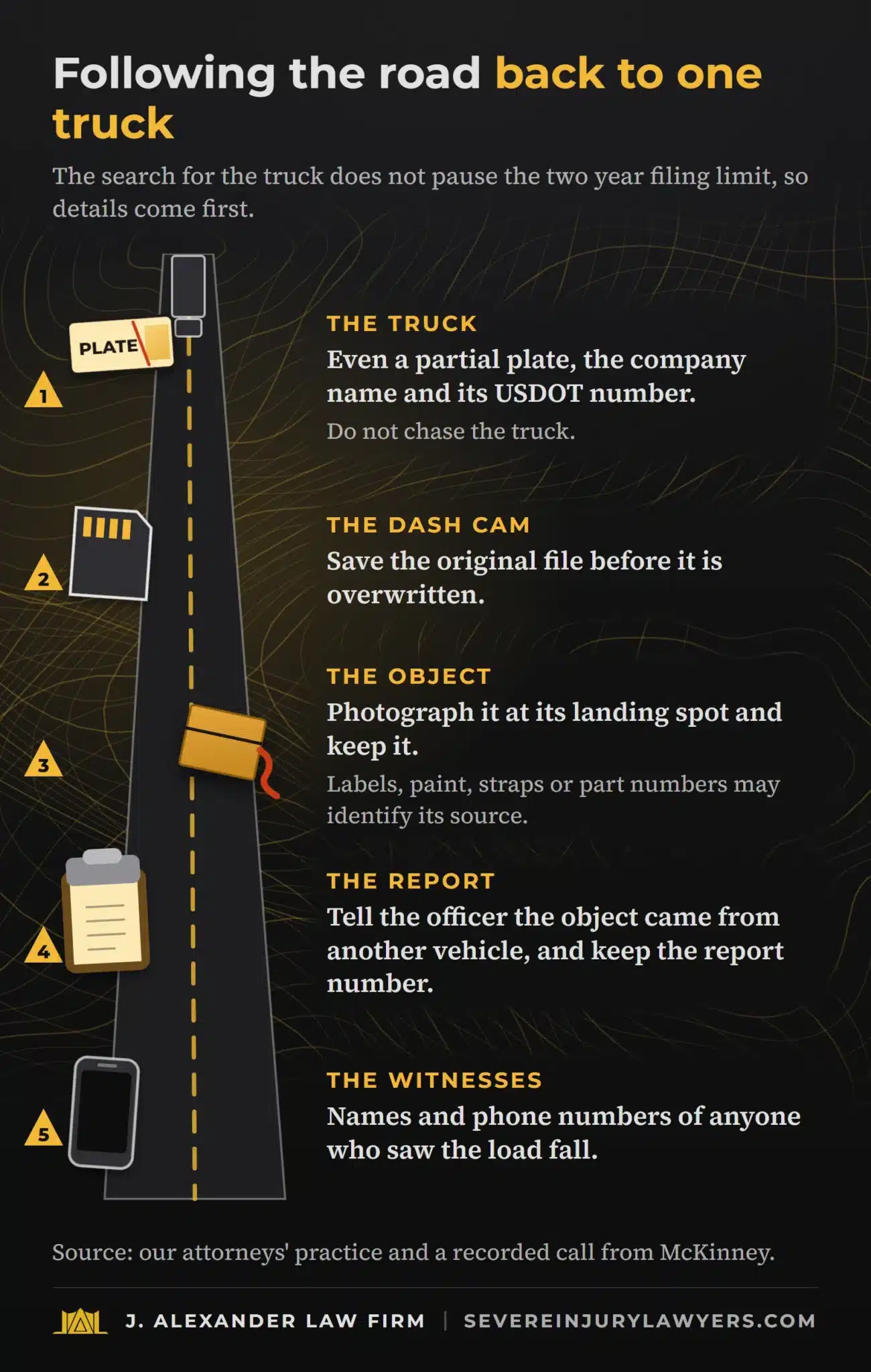
Read it as text
The search for the truck does not pause the two year filing limit, so details come first.
- The truck: Even a partial plate, the company name and its USDOT number. Do not chase the truck.
- The dash cam: Save the original file before it is overwritten.
- The object: Photograph it at its landing spot and keep it. Labels, paint, straps or part numbers may identify its source.
- The report: Tell the officer the object came from another vehicle, and keep the report number.
- The witnesses: Names and phone numbers of anyone who saw the load fall.
Our attorneys' practice and a recorded call from McKinney.
Once you identify a company, our case managers ask the company for loading photos, a scale ticket, inspection reports or a bill of lading. Those records may show how the cargo was handled. The trucking terms used after a Texas truck crash can help you read them.
The USDOT number painted on the truck's door gives you a starting point for finding the carrier. Follow these steps for looking up a trucking company by USDOT number.
As we look for the truck, our office monitors when the lawsuit must be filed. Searching does not stop that deadline, though exceptions may apply. For details, read Texas car accident lawsuit time limits.
Call me before the hauling company's insurer records your account or you sign its papers. Our video about an adjuster calling after the crash can help you prepare for that call. Bring your questions about the fallen load to our team. When you first reach us, our intake team answers and passes any legal questions to an attorney.
Example
Lumber falls from a truck
Say a man stands on the shoulder with his hazard lights blinking. A split piece of lumber lies behind his cracked windshield. Far up the Texas highway, the truck that dropped it is already a small pair of taillights.
Finding that truck comes first. I would ask what he remembers about its plate, company name or USDOT number.
A torn strap or printing on the lumber could help us trace it. If he has dash cam footage, we would check it for the truck and save the original.
He should stay out of traffic while gathering any details.
If the truck remains unknown, the lumber alone may not satisfy the contact rule for uninsured motorist coverage. Think of a game of tag: a thrown ball hitting you does not count as a player's hand tagging you.
In Elchehimi, the Texas Supreme Court decided that an axle and wheels separated from an unknown truck did not meet the contact requirement. I would check whether the truck itself touched the man or his car, as well as what his policy covers.
Once we find the truck, I would examine the load's restraints and the timing of the driver's checks. For a covered commercial truck, federal rule 392.9 requires cargo to be secured.
It generally calls for a check within the first 50 miles and further checks during the trip, with exceptions. The vanished truck may be worrying, but details are still within reach.
He can write down the lane, time, direction and any words printed on the lumber to help us look for it.
Did you get a plate, USDOT number or dash cam clip? Send it over and we can review it together.
Call 469-807-748024/7 | Free consultation | No fee unless we win
Bring me the plate or dash cam clip. We can look at it together.
J. Alexander Law serves injured clients throughout Texas: Dallas | Houston | San Antonio | Fort Worth | Arlington | Canton. Se habla español.