

The short answer
No. Texas does not specifically prohibit eating while driving. But a driver who eats must still control the car and obey traffic laws. I look into the driver's actions leading up to a collision. Food found afterward cannot answer that by itself.
Key points
Eating and phone messaging are covered by different rules.
Field 38 uses code 19 for distraction in vehicle and code 20 for driver inattention. Neither code names food.
The available TxDOT CRIS figures count reported distractions, not crashes involving meals.
Can eating behind the wheel make a driver at fault in Texas?
Meals and phone messages
Driving duties
A meal does not change the duty to drive safely. TxDOT treats eating and drinking as distractions when they draw your attention from driving.
The Texas Department of Insurance recommends pulling off the road to eat. Section 545.351(b)(2) requires enough speed control to prevent a collision with a person or vehicle lawfully traveling on or entering the road, with each person exercising due care.
An officer may cite unsafe driving, such as failure to control speed, even though eating alone is not an offense. Under Texas Transportation Code section 545.401, driving with willful or wanton disregard for people's safety or property can be reckless driving.
For this misdemeanor, a fine can reach $200 and county jail time can reach 30 days, with either penalty or both possible.
Phone messages are separate. Section 545.4251 generally bars reading, composing or sending electronic messages on a phone while operating a moving vehicle, with exceptions. For those rules, see our answer about phone calls while driving.
What the evidence can show
Report factors
In the Texas report, field 38 sits below the heading Factors and Conditions. Code 19 means distraction in vehicle.
Code 20 means driver inattention. Neither code identifies food, though the narrative may provide more detail.
A marked factor gives me a place to start. A single entry does not determine fault.
To understand what the report says, use our crash report decoder.
Before impact
A wrapper in the car may suggest a meal, but it cannot show where the driver's hands or eyes were before impact. I ask what anyone saw before the collision and how the car moved. When there is no such observation, a report factor or video may give us more to examine.
Distraction marked in crash reports
9,242
2026 reports through November 9
The TxDOT CRIS count covers reportable Texas crashes marked distraction in vehicle. It cannot identify how many involved food or drinks without alcohol. Our search found 9,242 such crashes from the start of 2026 through November 9, including 34 fatal crashes.
9,541
2025 equivalent months
The equivalent months of 2025 had 9,541. Wait to compare those years fairly because reports from 2026 continue to come in.
Fault and your claim
Driver conduct
Careless driving during a meal may leave a driver responsible if that conduct helped cause your injuries. Because Texas has no eating ban, negligence per se cannot rest on a violation of such a ban.
Each driver's conduct matters. For how your own actions may affect a claim, see Texas shared responsibility.
Damages and deadlines
Treatment expenses, income you lost and physical pain may be part of the damages an injury claim allows. Under section 16.003, the time limit for most injury lawsuits is two years, with exceptions. If the adjuster for the other car gets in touch and asks to record your account or have you give up a claim, talk that request over with us before you respond.
Read it as text
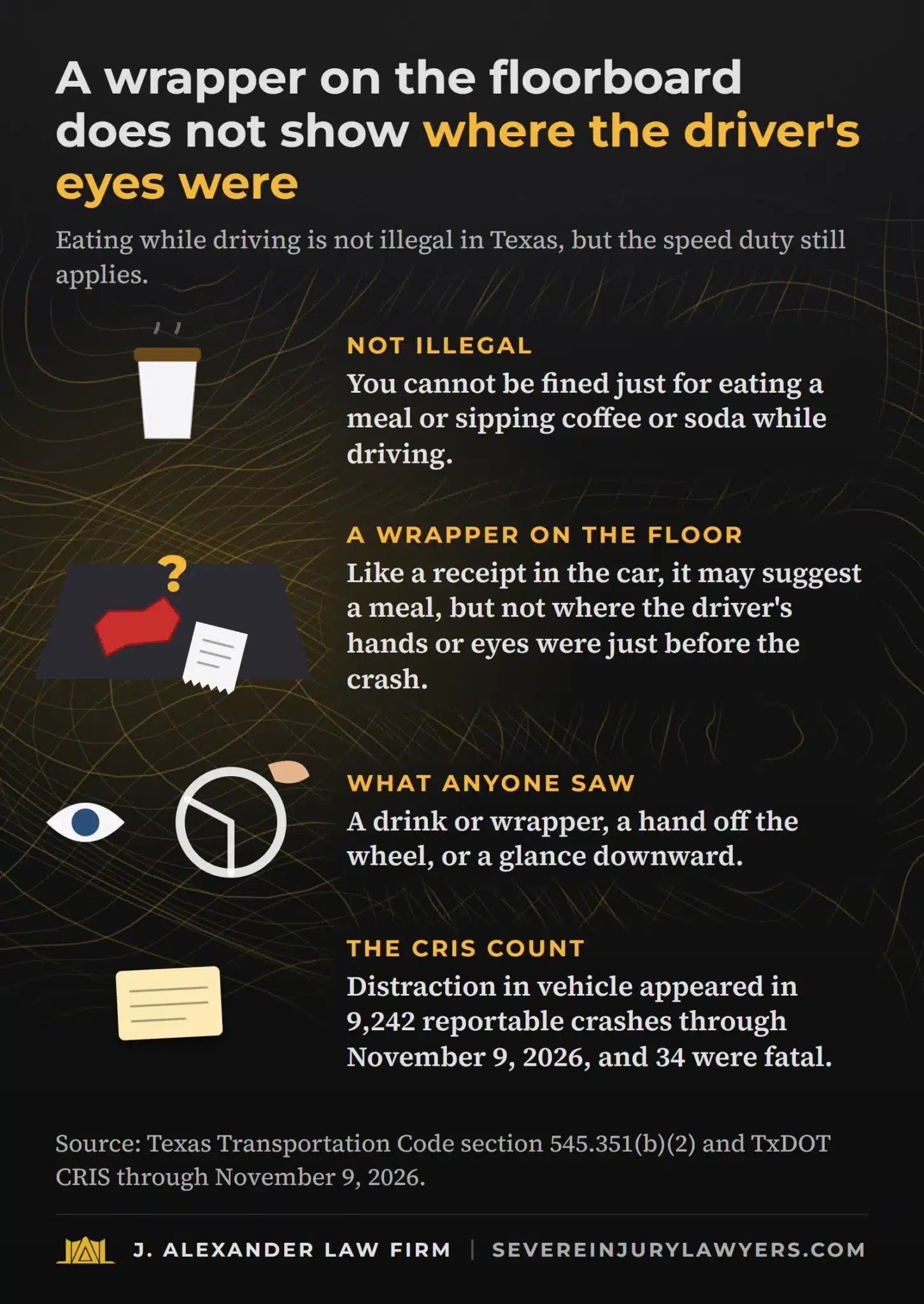
Eating while driving is not illegal in Texas, but the speed duty still applies.
- Not illegal: You cannot be fined just for eating a meal or sipping coffee or soda while driving.
- A wrapper on the floor: Like a receipt in the car, it may suggest a meal, but not where the driver's hands or eyes were just before the crash.
- What anyone saw: A drink or wrapper, a hand off the wheel, or a glance downward.
- The CRIS count: Distraction in vehicle appeared in 9,242 reportable crashes through November 9, 2026, and 34 were fatal.
Texas Transportation Code section 545.351(b)(2) and TxDOT CRIS through November 9, 2026.
Example
Eating before a Texas car crash
Picture eating a sandwich as you drive on a Texas road. A vehicle strikes the rear of your car, and the wrapper drops to the floor. Later, you wonder if lunch will count against you.
The officer might mark code 20, driver inattention, in the report's field 38. That code does not name food.
The narrative may have more detail. I read the entry as a clue to examine, not proof that your meal caused the collision.
The adjuster handling the other driver's claim may suggest your lunch took your attention off traffic. Texas shared responsibility rules allow each driver's conduct to matter. But eating at the wheel is not itself a Texas traffic offense, and a wrapper cannot show where you were looking.
I would first look at how both cars moved before impact. Under Transportation Code section 545.351(b)(2), drivers must control speed as needed to avoid a collision with a road user who is traveling or entering lawfully, with each person using due care.
Note what you remember about the moments before the crash and who saw them. Obtain the report and compare its factor entry with the narrative.
If your driving contributed to the crash, shared responsibility could reduce your claim. The other driver's actions matter too.
Think of the wrapper as a loose puzzle piece: it has a place in the picture, but it cannot show the whole scene. Your lunch alone does not decide your claim.
Read next on our site
Our reading on Texas laws behind a car accident claim covers more of the rules that may affect your claim.