


The short answer
No. An adult can make a phone call without a hands free device on some Texas roads. School crossing zones, certain school grounds and local rules can restrict handheld use. Texas also limits electronic messaging while driving. When I review a crash, I consider where it happened and how closely the driver watched the road.
Key points
A speakerphone can satisfy the school crossing zone rule if the driver uses a hand only to turn a function on or off.
Certain emergency calls can be a defense to a school crossing zone phone charge.
A driver carrying a minor on a school or passenger bus must stop before making an ordinary phone call.
Can talking on a phone while driving decide fault in a Texas crash?
Even when a call is legal, the driver's attention during it can be relevant to a crash claim. Outside a school zone or an area covered by a local phone ordinance, I would focus on whether the driver was attentive to the road.
A call must also have helped cause the crash. When both drivers were on calls, a jury may consider how carefully each watched the road.
Read about phone violations and fault in a crash and shared fault in a phone crash claim.
An adjuster may question whether a driver used a phone or whether the call mattered. A belief alone does not prove phone use.
For a prosecution under section 545.4251(b), the texting must have occurred in a peace officer's presence or within the officer's view, or other evidence must establish it. I can compare the crash time with a call record if the exact minute is known.
An October caller described a chain crash while her car was stopped in traffic: "The guy in the tow truck got out and said, it's my fault. I was.
I was texting". Our office can help when the phone driver's adjuster contacts you.
A phone related crash may support a claim for bills, missed income and what the injuries took from daily life. In most cases, section 16.003 allows two years to file.
Phone rules on Texas roads
School areas and young drivers
The location can change the phone rule. At a school crossing zone, section 545.425 lets a driver use a phone if the vehicle is stopped or the driver uses a hands free device.
A phone attachment or voice control can still qualify when a driver uses a hand just to switch a function on or off. When no other penalty applies, a school zone phone offense can bring a traffic fine.
Section 545.4252 sets a similar limit on public elementary, middle, junior high and high school grounds with a designated crossing zone while the zone's reduced speed limit is active. Section 545.424 bars drivers under 18 from using a phone behind the wheel, including with a hands free device, unless there is an emergency.
Messages and local rules
Texas also restricts messages. Section 545.4251 prohibits reading, writing or sending an electronic message on a phone while driving unless the vehicle is stopped.
Under section 545.4251(e), the fine is $25 to $99. If the driver has a prior conviction under that section, the fine is $100 to $200.
That includes a vehicle stopped at a red light. If a trial shows the texting driver caused someone else's death or serious bodily injury, section 545.4251(f) treats the offense as a Class A misdemeanor.
The fine can reach $4,000, and jail time can reach one year. The statute lists defenses that include hands free use, GPS navigation, seeking emergency help and activating music.
At a texting stop, section 545.4251(i) bars an officer from taking or inspecting the driver's phone unless the Code of Criminal Procedure, the Penal Code or another law permits it. State law replaces local texting ordinances, but a city or county may impose an area wide phone ban and decide whether hands free calls are allowed.
Such a local government must post signs at each entry by state highway, U.S. highway or interstate stating the ban, whether hands free use is allowed and the possibility of a fine. For the messaging rule and how we may seek phone records, see proving the other driver was texting.
Phone use on a crash report
- Report fields and phone codes
A Texas crash report can record phone use in field 38, Factors and Conditions, rather than field 39, Vehicle Defects. The phone codes are code 74, cell or mobile device use talking, code 75, texting, code 76, other, and code 77, unknown.
A report without a phone code does not establish that a phone was not used. Our Managing Litigation Attorney has explained what can happen when someone disputes a report.
Here is how Matthew Graham puts it: "there's nothing to say that we can't get that police officer to come in for a deposition to support the case later on down the road if that's necessary."
271
Crashes with talking listed in 2026
These counts measure reportable crashes where officers listed phone use as a factor. The counts alone cannot tell us whether talking on a call caused any of those crashes.
Our review of TxDOT CRIS data found 271 Texas crashes with talking listed from January 1 through November 9, 2026. Of those, 6 involved a death.
Officers listed talking in 312 crashes over the same dates in 2025. All four phone codes together accounted for 2,427 crashes in the 2026 period, including 9 in an active school zone.
Reports can still arrive, so the 2026 figures do not yet establish a drop from 2025.
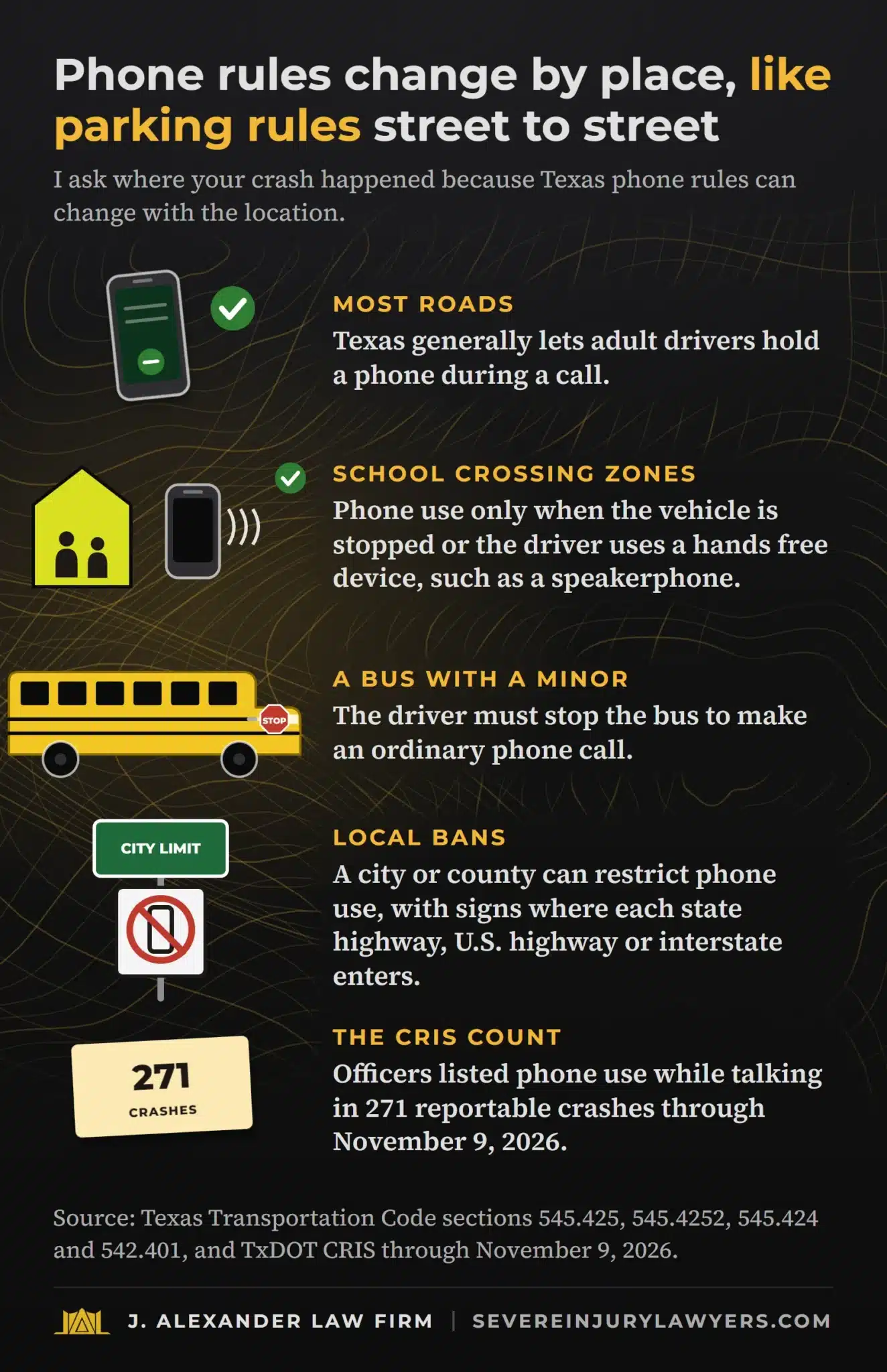
Read it as text
I ask where your crash happened because Texas phone rules can change with the location.
- Most roads: Texas generally lets adult drivers hold a phone during a call.
- School crossing zones: Phone use only when the vehicle is stopped or the driver uses a hands free device, such as a speakerphone.
- A bus with a minor: The driver must stop the bus to make an ordinary phone call.
- Local bans: A city or county can restrict phone use, with signs where each state highway, U.S. highway or interstate enters.
- The CRIS count: Officers listed phone use while talking in 271 reportable crashes through November 9, 2026.
Texas Transportation Code sections 545.425, 545.4252, 545.424 and 542.401, and TxDOT CRIS through November 9, 2026.
Example
Phone use near a school
Take a teen riding home from practice. From the passenger seat, the teen sees the driver ahead holding a phone to her ear.
A moment later, the cars bump at the crosswalk. The teen is hurt and wonders whether the phone mattered.
The same handheld call might be lawful on one block and an offense on the next. Think of a library that permits quiet talk in its lobby but asks for silence in its reading room.
Location comes first. I would check whether the driver was inside the school crossing zone when she used the phone or had already passed it.
Section 545.425 generally restricts phone use while driving through a school crossing zone unless the car is stopped or the device is hands free. Certain emergency calls can be a defense.
A separate rule covers designated public school property while the zone's reduced speed limit is active, so I would check that timing if the car was on school grounds. I would also compare the exact minute of the bump with any available call record.
Seeing a phone at the driver's ear is a detail worth examining. It does not show where she was looking or whether the call helped cause the bump.
Both drivers' actions may matter, and shared fault can affect a claim. The passenger can write down the street, the time, and what they saw in the driver's hand.
Read next on our site
For more on your claim, read about the rules Texas applies after a car accident.