


The short answer
If you witness a Texas car accident, call 911 if someone looks badly hurt or a driver leaves. Share what you observed and how to reach you. The duties in sections 550.021, 550.023 and 550.026 apply to involved drivers, not an uninvolved witness. A separate felony reporting rule can apply to a witness.
In their words
"And I think that's why they were denying liability. But I have a witness statement."
Caller, October 2026
Key points
An officer can speak with you even if you have already left.
Under section 550.021(c), a driver who fails to stop after a collision causing serious bodily injury commits a felony.
Section 74.151 has exceptions for certain paid care and for wilfully or wantonly negligent acts.
Distinguish your own observations from details you heard.
Do you have to stay if you witness a car accident in Texas?
Duties and emergency care
Driver duties
An uninvolved witness does not have the driver duties set out in sections 550.021, 550.023 and 550.026. Those duties can include stopping, checking for injuries, exchanging information, helping and notifying police. Our checklist for drivers after a crash explains what applies to drivers.
Reporting a felony
Penal Code section 38.171 can require a witness to report an observed felony immediately to a peace officer or law enforcement agency. A reasonable person would need to think that someone may have died or been seriously injured and that no one had reported the offense.
The witness must also be able to report without danger of serious injury or death. Section 550.021(c) makes it a felony for an involved driver to leave without stopping after a crash that causes serious injury.
Our guide to a driver leaving the crash scene covers that situation.
Giving emergency care
Section 74.151 can protect someone who gives emergency care in good faith from civil damages for an act during the emergency. The protection does not cover an act that is wilfully or wantonly negligent.
It also excludes care given for pay or in expectation of pay, and care by someone at the scene because they or someone they represent were seeking business or paid work. Subject to an exception, it also excludes a person whose own negligent act or failure to act helped cause the emergency.
A witness can help an officer investigate later. A witness can request a redacted crash report under Texas Transportation Code section 550.065.
That version leaves out the names, phone numbers and addresses, other than ZIP codes, of people listed in the report. One person our office heard about was across the street and called police after hearing a crash, without seeing it happen.
Our article on parking lot crashes and later investigations explains how an officer can complete a report afterward. When accounts conflict, Matthew Graham, J.
Alexander Law Firm's Managing Litigation Attorney, explains: "If there's two people saying different things, they're going to make a credibility assessment."
A caller in October 2026 swerved away from another car and hit a pole. The cars did not touch.
Our intake team explained that the insurer blamed her swerve and denied liability. Her witness statement spoke to why she swerved.
We do not know the outcome.
41
Crash report code
On a Texas crash report, an officer can use code 41 for Faulty Evasive Action in field 38, called Factors and Conditions. Field 39 covers Vehicle Defects instead.
More for bystanders
- A bystander affected by a wreck can also read about when a bystander can claim emotional distress.
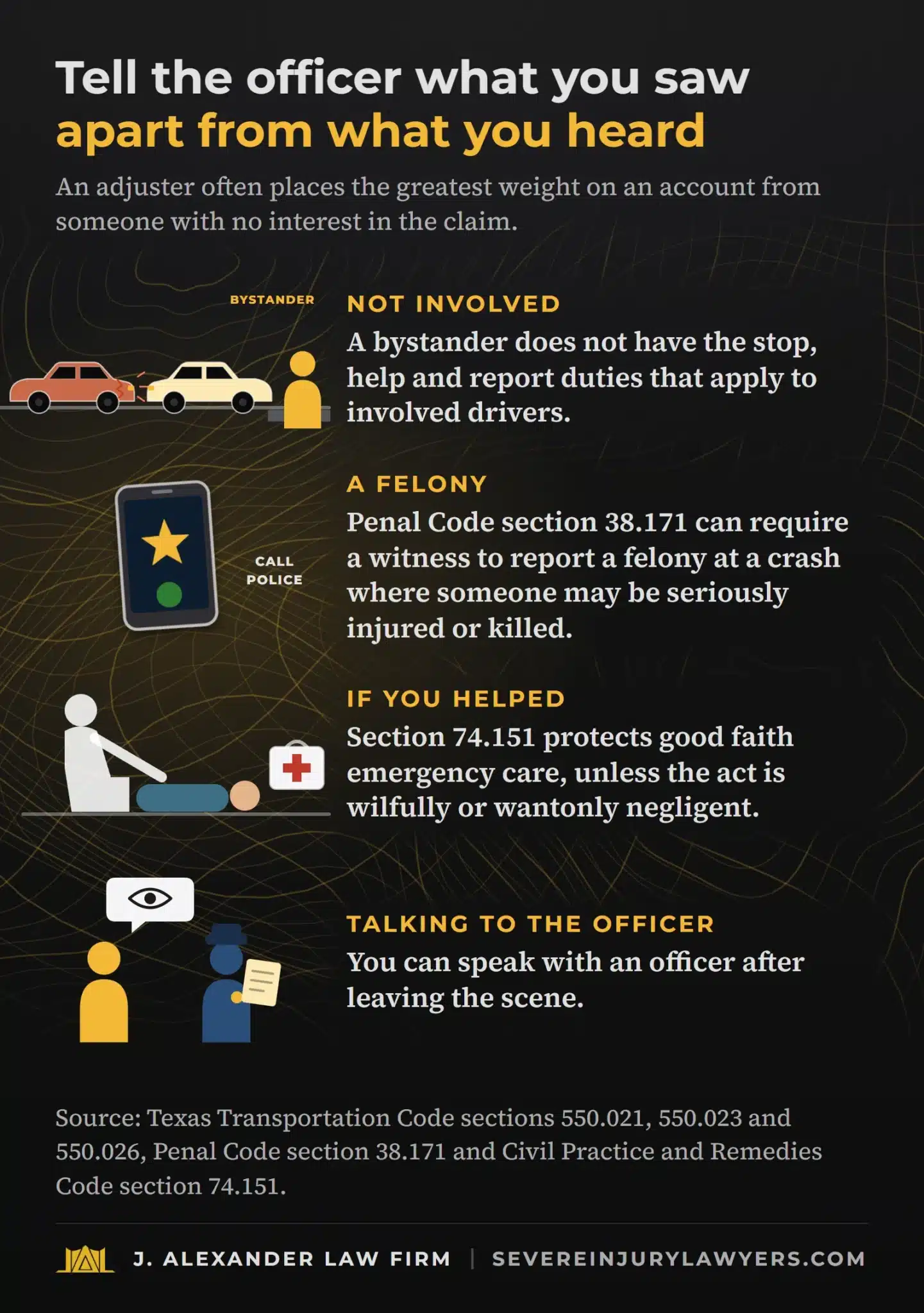
Read it as text
An adjuster often places the greatest weight on an account from someone with no interest in the claim.
- Not involved: A bystander does not have the stop, help and report duties that apply to involved drivers.
- A felony: Penal Code section 38.171 can require a witness to report a felony at a crash where someone may be seriously injured or killed.
- If you helped: Section 74.151 protects good faith emergency care, unless the act is wilfully or wantonly negligent.
- Talking to the officer: You can speak with an officer after leaving the scene.
Texas Transportation Code sections 550.021, 550.023 and 550.026, Penal Code section 38.171 and Civil Practice and Remedies Code section 74.151.
Example
Witness to a Texas car wreck
Say you are standing near a Texas street when tires squeal. A car swerves away from another vehicle and hits a pole.
The driver is hurt. You saw both cars move, and you wonder whether leaving before an officer arrives could be held against you.
The officer might enter code 41 in field 38 to identify a possible faulty evasive action. I would read the narrative as well as the code. The report captures an assessment, while the movements leading to the swerve still need attention.
The insurer might blame the injured driver's swerve and deny liability under Texas rules on shared responsibility. Your account could help explain why the driver turned.
A witness account is like a measuring cup: its value depends on knowing what went into it. Keep what you saw apart from what someone told you.
As an uninvolved witness, you do not have the stopping and information duties that sections 550.021 and 550.023 place on involved drivers. A separate rule, Penal Code section 38.171, can require immediate reporting of a witnessed felony when a reasonable person would believe serious injury or death may have resulted and the offense had not been reported.
The person must also be able to report without danger of serious injury or death. Call police if a driver leaves or someone looks badly hurt.
I want to know where the cars were before the swerve. Write down what you observed and give your contact details to the officer or the people involved.
Responsibility could be shared between drivers, and a share assigned to the injured driver could reduce a recovery. An officer can still speak with you after you leave.
You can be honest about anything you missed.
Read next on our site
If a crash left you hurt, our evidence guide shows how to request help from a witness before that person leaves.