


Hit and run accident lawyer.
Reviewed by Josh Alexander, Founder & Managing Attorney · Updated July 2026
Hit by a driver who took off? You still have a claim. Texas gives you a way to find them. There’s also a criminal case against them. And your own coverage can pay your bills if they’re never caught. Read on to find out how we at J Alexander law fight for those involved in a hit and run case.
Rated 4.9 from 568+ client reviewsRecovered for clients
Average client rating
Client reviews
Years Super Lawyers Rising Stars
Reflects total client recoveries across hundreds of resolved matters. Past results do not guarantee a similar outcome.
A hit and run does not end your case
A hit and run does not end your claim. Even when the driver speeds off, you have three ways to recover. We work all three at the same time, and we start the day you call.
- Find the driver. Cameras, paint transfer, a partial plate, and witnesses often put a name to the car that hit you.
- File a criminal case. Leaving the scene of an accident is a crime in Texas, and the police report starts a case that can strengthen your civil claim.
- Get paid through your own coverage. If the driver is never caught, your hit and run insurance claim runs through your own uninsured motorist coverage. Texas treats a fled, unidentified driver much like an uninsured one. So the driver who hit you is treated as a driver with no insurance and that still covers your medical bills.
What to do in the first hour after a hit and run
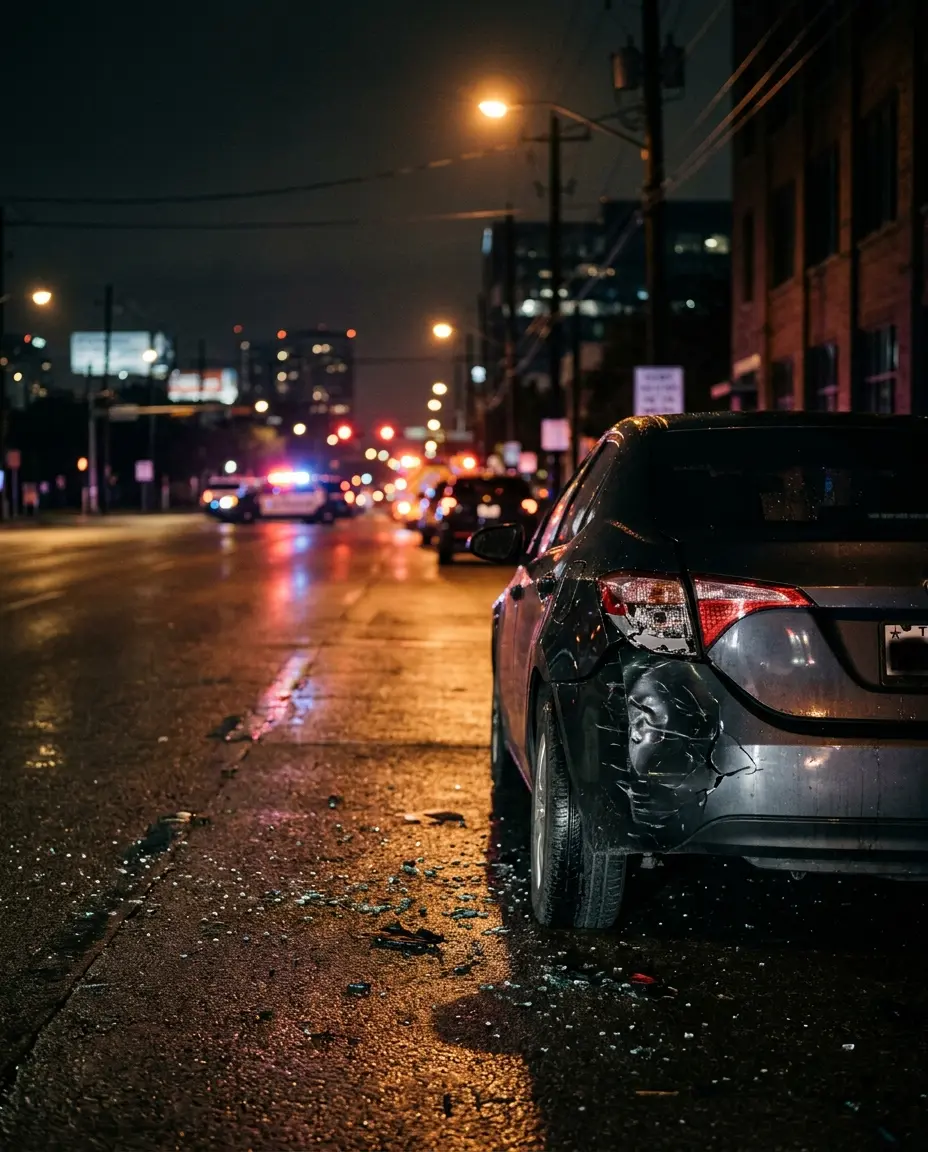
After a hit and run, do not chase the driver, call 911, and photograph the scene before anything moves. Then capture the plate or a description. Get names from witnesses, look for nearby cameras, and see a doctor the same day.
These steps go beyond what Texas law requires at a crash scene. A driver who runs leaves you to protect the evidence yourself. Call us from the scene if you can, and we will tell you what to capture before it disappears.
- Do not chase. Chasing the driver risks a second crash and pulls you away from the evidence. Let the police follow the car.
- Get the plate and a description. A partial plate, the color, the make, and any dents can identify the car later.
- Call 911. Leaving the scene of an accident is a crime, and a police report is often what makes your claim payable later.
- Photograph everything. Snap pics of any damage, any marks on your vehicle, any debris in the scene and exactly where your car stopped.
- Get witness names and numbers. A witness who saw the car flee can back up your claim when there is no other driver to blame.
- Look for cameras. Check for doorbell, business, and traffic cameras nearby, and ask owners to save the footage before it records over.
- See a doctor the same day. A same day medical visit ties your injuries to the crash for the UM insurer, which matters most when the other driver is gone.
Results that speak for themselves.
Recovered for a family after a fatal collision with a commercial truck.
Resolved for a client seriously hurt in a wreck with a tractor trailer.
Recovered after a heavy truck caused a high impact highway collision.
Settlement for injuries from a commercial truck collision.
Recovered for a driver injured by another motorist’s negligence.
Settlement for a client rear ended in Texas traffic.
Sample results from past cases. Past results do not guarantee a similar outcome; every case is different.
Nearby cameras record over within days.
The video that could identify the driver who hit you may be gone within days. Whether it’s footage from a Ring camera of someone’s home or from a gas station these videos have a time limit before they automatically overwrite. Once it’s overwritten, it’s gone for good. Our investigators send preservation letters for all footage the same day and every day you wait reduces your odds of finding the driver.
How we find the driver who hit you and fled
Camera and preservation letters
We map every camera that could have caught the crash and send preservation letters fast.
Physical clues the driver left
A fleeing car leaves proof at the scene. Paint transfer, broken trim, and debris can be matched to a make and model.
Witnesses, tips, and the broadcast
We survey for witnesses and work with police to issue a BOLO (Be On The Lookout Alert), so nearby officers watch for the vehicle. If the accused needs more chasing we bring in private investigators.
of crashes reported to police in 2023 were hit and run
That’s more than 900,000 crashes across the country in a single year. The drivers who fled caused over 240,000 injuries and 2,872 deaths. That is the highest share of all traffic deaths the AAA Foundation for Traffic Safety has ever recorded. It’s why acting fast matters so much.
How we improve the odds of finding the driver
We focus on collecting evidence as fast as possible including any paint trails left on your vehicle, what witnesses can remember, and extractable footage of license plates. The odds of finding the unnamed driver go up fast when evidence is fresh. The longer the wait the more difficult it becomes to find said driver.
What we do while the police file stays open
How long will police investigate a hit and run? There is no set clock, so police may work it for days, weeks, or months, depending on the leads that come in. The work is heaviest in the first days, while camera footage still exists and witnesses remember. Police focus on the crime of leaving the scene. Your injury claim runs on its own track. So we investigate in parallel instead of waiting on the department.
What police will and will not do for a minor hit and run
Police usually don’t investigate minor property damage cases, it’s worth filing the report anyways, the report is what makes your UM or collision claim payable.
Reporting a hit and run in Texas: call 911
How do you report a hit and run in Texas? Call 911, even when nobody is hurt, so an officer makes the reports. Many police departments send ordinary fender benders to an online reporting portal. A hit and run is different. Departments have officers take these reports because the fled driver broke the law. If it is not urgent, ask for your city’s non emergency line. Report it the same day if you can. We then pull your copy and use it to open both claims.
How the fleeing driver shows up on your Texas crash report
On your Texas crash report, the driver who fled is logged as an unknown unit, with the driver and vehicle fields left blank or marked unknown. A police officer still documents the crash, your injuries, the location, and any witness or camera leads on the CR-3 form. That report matters because your uninsured motorist coverage claim usually depends on it. Most insurers want a timely police report before they pay a hit and run insurance claim where no at fault driver exists. If police later identify the driver, an officer files a supplemental report that adds the name. Your claim can then shift toward that driver’s insurance. A hit and run accident attorney uses the report to anchor the whole claim. So pull your copy early. Here’s how to pull your Texas crash report.
The proof that names a fleeing driver fades within hours. Our hit and run lawyers start the camera search the day you call. Ask for a free review before the footage records over.
Free Case EvaluationLeaving the scene of an accident is a crime in Texas
FSRA means failure to stop and render aid
FSRA is the shorthand Texas police and courts use for leaving the scene of an accident. It comes from Texas Transportation Code Section 550.021. That statute tells a driver in an injury crash to stop, stay, share their information, and help anyone who’s hurt. A driver who does none of that and drives off has committed FSRA.
The duties a driver owes you at the scene
Texas Transportation Code Section 550.021 gives every driver in an injury crash four duties: stop, return, check on the people involved, and stay. A driver who does none of these and speeds off has broken the law.
- Stop. The driver has to stop at the scene right away, or as close to it as they safely can.
- Return. If they could not stop at the scene, they have to come back to it.
- Check. They have to find out whether anyone involved needs help.
- Stay. They have to remain there until they give their information and help the injured, as Section 550.023 requires.
Section 550.023 spells out what sharing means. The driver has to give their name, address, vehicle registration number, and car insurer to anyone who was hurt and to the other driver. They have to show their license if asked. And they have to give reasonable help to anyone injured. That includes arranging a ride to a doctor or hospital when it’s clearly needed. A driver who flees does none of this.
Even a fender bender carries a duty. Under Section 550.022, a driver who hits another occupied vehicle still has to stop and trade information before leaving.
How Texas grades a leaving the scene charge
How serious the charge is depends on what the crash caused, whether it’s second degree felony or a small fine.
When someone is killed, fleeing is a second degree felony, not a lighter charge.
-
The crash killed someone2 to 20 years in prison and a fine up to $10,000Second degree felony
-
Serious bodily injuries2 to 10 years in prison and a fine up to $10,000Third degree felony
-
An injury that was not seriousOr up to 1 year in county jail, plus a fine up to $5,000Up to 5 years
-
Vehicle damage of $200 or more, no injuryUp to 180 days in jail and a fine up to $2,000Class B misdemeanor
-
Vehicle damage under $200, no injuryA fine up to $500, no jailClass C misdemeanor
Charge levels come from Texas Transportation Code Sections 550.021 and 550.022. The prison and fine ranges come from Texas Penal Code Sections 12.33, 12.34, 12.22, and 12.23.
Fleeing turns a crash into a crime, and that crime brings the police into your case. Our job is to make sure their work ends up in your claim, not just in a court file.
 Josh AlexanderFounder & Managing Attorney
Marine Corps veteran
The criminal case can order the driver to pay you back
If the driver who fled is caught and convicted, the same court can order them to pay you restitution, on top of any fine.
This comes from Texas Code of Criminal Procedure Article 42.037. It lets the sentencing judge order the driver to make restitution to any victim of the offense. That can cover your property loss and your injury costs. The order is up to the judge, so it’s not automatic. If the judge decides against it, the law makes the judge state the reason on the record. So restitution comes only from a driver who is caught and convicted. It adds to your civil or UM claim but never replaces it. And its criminal timetable runs separately from your two year civil deadline.
How a guilty plea or conviction helps your injury claim
A guilty plea or conviction puts the driver’s name, insurer, and admission into a court record, which gives your injury claim solid ground to stand on.
The criminal case helps you in two ways. First, it forces the driver into the open. Police work, an alert to be on the lookout, and a filed charge can turn an unknown runner into a named defendant. Then you can actually sue and serve them. Second, the plea or judgment creates a record that the driver was there and left. This is where a hit and run accident attorney goes to work. We fold what the criminal case produces into your civil claim.
A driver who broke the duty to stop under Section 550.021 handed your civil case powerful evidence of negligence.
Some drivers who flee turn out to be drunk. That stacks a drunk driving charge on top of the fleeing charge. We explain how those cases work when the fleeing driver was also drunk.
Suing the driver once we put a name to the car
Can I sue someone for a hit and run? Yes, once the driver is identified, the same as any other at fault driver. The catch is finding them, and that is our job.
Texas does not let you win and collect against an unknown John Doe driver. You can’t serve court papers on a name you don’t have. And naming a placeholder defendant doesn’t stop the two year deadline from running against the actual driver. So while the driver stays unknown, the way to get paid is usually your own uninsured motorist coverage. If the police later put a name to the driver, we turn your case into a direct claim against them.
Get paid through your own coverage
We open the uninsured motorist claim and handle every insurer conversation, so you never argue with an adjuster alone.
Who actually pays you when the driver is gone
Who pays for the damage in a hit and run? Your own uninsured motorist coverage usually pays, because the driver who fled is not there to pay you. Texas treats a driver who fled and was never identified the same as an uninsured one. So the uninsured motorist (UM) coverage on your policy steps in. Our uninsured driver page breaks down how you get paid when the driver who hit you has no insurance, and our guide to a driver who left, lied, or was uninsured maps every scenario to the coverage that pays. We line up every source that could pay you and file them in the order that pays fastest.
Your own UM coverage is usually the main source. If the driver is later found and insured, that policy can pay too. When there’s no coverage at all, the state fund covered below is the plan B.
Free Case EvaluationHow we run your UM claim, step by step
What happens in a hit and run with insurance? Your claim runs through your own UM coverage instead of the other driver’s, and it follows a set order. Because there’s no other driver’s insurer to bill, your hit and run insurance claim is a first party claim against your own carrier. Here’s the path we run when the driver is unknown.
Report to police fast
A timely police report is often the one thing that makes your UM claim payable. So call them the day of the crash if possible. If officers never came or declined to write one, our guide to handling a Texas accident with no police report shows what to document in its place.
Notify your insurer promptly
Tell your own insurer right away. Your policy sets its own notice and suit conditions. A late notice can sink a valid claim.
Meet the physical contact rule
Texas law requires actual physical contact with the unknown vehicle. Texas Insurance Code Sec. 1952.104(3) says that when the driver is unknown, “actual physical contact must have occurred between the motor vehicle owned or operated by the unknown person and the person or property of the insured.” Courts read this strictly.
Build corroboration
With no other driver and no far side insurer, you carry the whole burden of proof. Line up the police report, photos of the contact damage and paint transfer, and any independent witness.
Expect first party scrutiny
Your own insurer treats a no witness phantom claim as a possible fraud. So it digs harder than on a normal claim. Know what to say and what to hold back before you give your insurer a recorded statement. Your own insurer can ask for a recorded statement during a UM claim, and what you say shapes its first party scrutiny, so get clear on what to tell your own lawyer, and what never to guess at first.
Push to arbitration or suit
If your carrier lowballs or denies you, most UM policies send the dispute to arbitration. Some even let you sue your own insurer. You still must prove the unknown driver was at fault, just as if you were suing that driver directly.
If the driver is later found
A tip, a camera, or the police work can still name the driver. Once that happens, the physical contact rule stops mattering, because your claim can proceed against that named driver’s insurer. It may even open up restitution through the criminal case.
Getting your car fixed when the driver is gone
Will my insurance fix my car if it was a hit and run? Collision coverage pays to fix your car, and UM property damage coverage can too, each with its own deductible rules. More than one part of your own policy can pay while the driver stays unknown. We read your declarations page with you and tell you which ones you carry.
PIP or MedPay. Pays your medical bills now, with no fault decision needed. Texas insurers must offer PIP, so you have it unless you turned it down in writing.
Your health insurance. Treats you while the claim runs, so your care does not wait on the driver being found.
Collision coverage. Fixes your car even when the driver is never found, minus your deductible.
UM coverage. This is the injury claim, covered in the sequence above.
Contact vs no contact: what your UM claim turns on
The one fact that decides a phantom vehicle UM claim in Texas is whether the unknown car actually touched you or your vehicle. A phantom vehicle is simply the unidentified car that hit you and fled. We build the contact proof from the paint, the dent, and the police report before the adjuster asks for it.
The unknown vehicle hit you or your car, which meets Sec. 1952.104(3). So your UM coverage can pay. A limited chain reaction exception also counts. If the phantom car strikes another car and drives it into you in one unbroken chain, that indirect contact can qualify (see Latham v. Mountain States Mutual Casualty Co., 482 S.W.2d 655 (Tex. Civ. App. 1972)).
A phantom driver forced you off the road but never touched you or your car. A pure no contact claim generally doesn’t meet the statute. And Texas has not adopted a corroborating evidence substitute for contact. It also needs stronger fault proof, since there is no dent or paint to speak for you. Don’t assume this one will pay. Talk to a lawyer about your other options.
How much your UM coverage pays comes down to your limits, and some households can stack policies. We don’t rebuild that math here. Our uninsured driver page walks through how your UM limits and household stacking work.
When suing is worth it, and when it is not
Is it worth suing for a hit and run? Only once that driver is identified, because you cannot collect a judgment against a truly unknown John Doe. Naming a fictitious John Doe does not stop the clock on your deadline to sue the driver who hit you. That clock is the two year window to file your claim. So before the deadline, the claim that actually pays is usually the UM claim against your own insurer. Our hit and run lawyers in Texas protect both tracks at once.
If the driver is found and carries insurance, suing can be well worth it. What your case is worth then depends on the same things as any crash, from your injuries to the coverage available. See how much a Texas car accident claim is worth.
Proving fault when there is no driver to question
Even with the driver gone, you still have to prove the other side caused the crash. With no driver to depose, our hit and run accident lawyers rebuild fault from the physical evidence. That means the point of impact, the paint and debris, camera footage, and any witness accounts. Texas still cuts your recovery by any share of blame placed on you. So pushing that share down matters. See how Texas comparative fault affects your recovery.
When a driver hits your parked car and leaves no note
Came back to a hit and run on your parked car? That is a hit and run, and Texas law told that driver exactly what to do. Under Texas Transportation Code Sec. 550.024, a driver who hits an unattended vehicle must stop. Then they find you to give their name and address. Or they leave a written note in a visible spot on your car with their name, address, and a statement of what happened.
Leaving the scene like this is still a crime, even when the driver only clipped a parked car. It’s a Class C misdemeanor if the damage to all vehicles is under $200. A Class B applies if it is $200 or more. A Class C means a fine up to $500. A Class B can mean up to 180 days in jail and a $2,000 fine.
If the driver instead hit a fence, a wall, or highway landscaping and left, Sec. 550.025 sets the same duty. They have to find and notify the owner, give a name, address, and vehicle registration number, and show a license if asked. The same Class C and Class B tiers apply.
Often no one sees it happen, so we work these like any other hit and run. Photograph the damage and paint transfer, file a police report, and let us canvass the doorbell and business cameras before the footage records over. If the driver did stop and leave their details, your path is different. See what to do if the driver who hit your parked car stayed.
Texas Crime Victims Compensation
The state fund we file when no coverage exists
What if there is no coverage and the driver is never found? Texas Crime Victims Compensation may help pay some of your costs. A hit and run is a crime. So the program covers it for victims who were physically or mentally hurt, and for families after a death. The Office of the Attorney General runs it. An ordinary crash that isn’t a crime does not qualify. A driver who fled the scene does.
Two conditions matter most. You must report the crime to a law enforcement agency. The same police report that anchors your UM claim supports this application, so we file it fast. And you must apply within three years of the date of the crime. The deadline can be extended for good cause, such as the victim’s age or incapacity.
CVC can help pay medical and hospital care, physical therapy or nursing care, counseling, lost wages from your treatment, and funeral and burial costs.
It doesn’t pay for property damage, so it won’t replace your car. And it doesn’t pay for pain and suffering.
CVC is the payer of last resort, so it pays only after everything else does. By law, your health insurance, auto insurance, Medicaid or Medicare, and workers’ compensation all pay first. The fund covers what’s left within its rules. Because it’s a backstop and not a full recovery, we still work every other source first.
Talk to a hit and run accident lawyer today
Find out which coverage pays and what your claim is worth. There’s no fee unless we recover for you.
What we tell every hit and run client on day one
“The first 48 hours decide how much proof we ever get, so we never wait on the police report to start. My team maps the cameras within a block of the crash and gets preservation letters out the same day, because a doorbell clip can loop while you are still at the hospital. We open your uninsured motorist claim at the same time. And when a driver is caught and pleads to leaving the scene, that record changes the tone of the whole negotiation. The adjuster stops treating your account as one side of a story.”

Former insurance defense attorney
The hit and run accident lawyers who handle your claim.
We represent people injured by hit and run drivers and the families of those killed, not the drivers facing charges. When the other driver flees, we take over the search and the fight with the insurer.
Josh Alexander
A Marine Corps veteran and trial lawyer who has recovered millions for injured clients across Texas. On a hit and run he decides where the search starts, from the camera canvass to the Crime Stoppers tip, and he opens your uninsured motorist claim the same week. That way your recovery doesn’t wait on an arrest.
Meet Josh Alexander
Matthew Graham
A former insurance defense litigator who spent over a decade handling claims for one of the country’s largest auto insurers. On a hit and run he builds the physical contact proof and preps you for the recorded statement, so your own insurer cannot turn a phantom driver claim into a fraud file. He uses what he learned on that side to make your uninsured motorist coverage pay.
Meet Matthew Graham
Laura Rivas
Nine years representing injured people in motor vehicle, 18-wheeler, catastrophic injury, and wrongful death claims, in English and Spanish. On a hit and run she runs the witness canvass and ties your medical records to the crash, so the file is built before your own insurer starts questioning it. Texas Bar No. 24096510.
Meet Laura RivasWhat our clients say about working with us.
“They took the time to answer all of my questions and made me feel confident in them. The whole staff has been friendly and professional.”
“After speaking with them, we were put at ease right away. They made sure my physical therapy was covered and have been invaluable to us.”
“Excelente servicio al cliente, son muy atentos con sus clientes. La comunicacion es muy buena; te ayudan a cualquier hora.”
Reviews from actual clients. Past results do not guarantee a similar outcome.

No fee unless we win your hit and run case.
You pay nothing up front. We advance the cost of finding the driver and building your hit and run insurance claim. Our fee comes out of the recovery, never out of your pocket.
Hit and run questions, answered.
What victims ask us most after a driver leaves the scene.
Not sure where your case stands?
The fastest answer comes from a free call with an attorney who can hear exactly what happened to you.
Call 469-807-7480Can I sue someone for a hit and run?
What happens in a hit and run with insurance?
Who pays for the damage in a hit and run?
What percent of hit and run cases get solved?
Is it worth suing for a hit and run?
How long will police investigate a hit and run?
Six offices. The same standard of care.
From DFW to the Gulf Coast to South Texas, an attorney is never far. Find your nearest office and the services we handle there. And if you cannot come to us, we come to you.
Canton
TXCanton, TX 75103 (903) 385-8500
Explore services in Canton
Arlington, TX 76012 (817) 856-0580
Explore services in Arlington
Hit by a driver who took off anywhere in Texas? Every office runs the same camera canvass and opens the same uninsured motorist claim.
View all locationsRead these before you talk to an adjuster.
The guides people ask us for most after a crash in Texas. What to do in the first hours, how long you actually have to file, what the insurer is doing while you wait, and what a claim is worth before anyone offers you a number.
Injury symptom checker: what needs a doctor now
Free toolThe Texas crash map: where these wrecks happen
Injury valueWhat a whiplash and neck injury claim is worth
Case valueWhat a Texas accident claim is actually worth
Hiring a lawyerWhen a lawyer changes the number, and when it does not
Legal feesWhat no fee unless we win actually costs you
Talk to a hit and run accident lawyer in Texas. No fee unless we recover.
Tell us what happened and we will tell you where your hit and run claim stands, at no cost. We work every path at once, and you pay nothing unless we recover for you.
Free consultation, 24/7 · Spanish speaking staff available · Serving all of Texas
Attorney advertising. Josh Alexander is responsible for the content of this page. Principal office 12801 N. Central Expressway, Suite 1100, Dallas, TX 75243. This page is a hit and run accident lawyer resource for injured victims and their families, not for drivers facing charges. Past results do not guarantee or predict a similar outcome in any future case. The information on this page is general and is not legal advice. Contacting the firm or sending a form does not create an attorney client relationship. Spanish speaking staff available.