


The short answer
Under 49 CFR sections 392.80 and 392.82, covered truck drivers in Texas cannot text or hold a phone for a call while driving, unless contacting police or emergency services is necessary. The rules also limit other handheld phone use and forbid carriers from allowing or requiring texting or prohibited phone use. A hands free call is permitted under those federal rules, so I look at how the driver used the phone. For your crash claim, we also need to learn whether a call or text in the cab contributed to the crash.
Key points
Under federal phone rules, a covered truck stopped at a traffic light can still be driving.
A truck safely stopped at the roadside is not driving under the federal phone rules.
The federal phone restrictions extend to school bus operations as well.
A mounted work device can provide a defense to a Texas messaging charge in some circumstances.
Can truck drivers text and drive?
No. Section 392.80 prohibits a covered commercial truck driver from texting while driving, unless texting is necessary to reach police or emergency services. Texting includes reading or typing text in messages, email and web pages. Using a navigation system does not count as texting, nor does pressing one button to start or end a call. A device with several functions, such as a dispatch device, also falls outside the texting definition when used for a purpose federal rules do not otherwise prohibit. For your claim, I want to know how the driver used the device. Picture a covered truck driver typing a reply to dispatch at a red light, with the engine running. Under section 392.80, waiting at the light still counts as driving.
Section 392.82 does not allow a covered truck driver to use a handheld phone while operating the truck. That includes holding the phone for a voice call, dialing or answering with more than one button press, or reaching so far that the driver leaves the belted driving position. Like a radio control on the dash, the phone should be reachable from the seat for a single press to start a call, rather than picked up and held for the conversation. A hands free call is allowed under federal rules when the driver follows those limits. A driver may text or use a handheld phone if needed to communicate with police or emergency services, but a carrier cannot otherwise permit or require either while a driver is driving. 49 CFR 383.51(c), Table 2, treats state or local commercial vehicle texting and handheld phone convictions as serious violations. A second qualifying conviction from separate incidents within 3 years disqualifies commercial driving for 60 days. A third or later brings 120 days. What did you see the truck driver's hands doing when you noticed the truck?
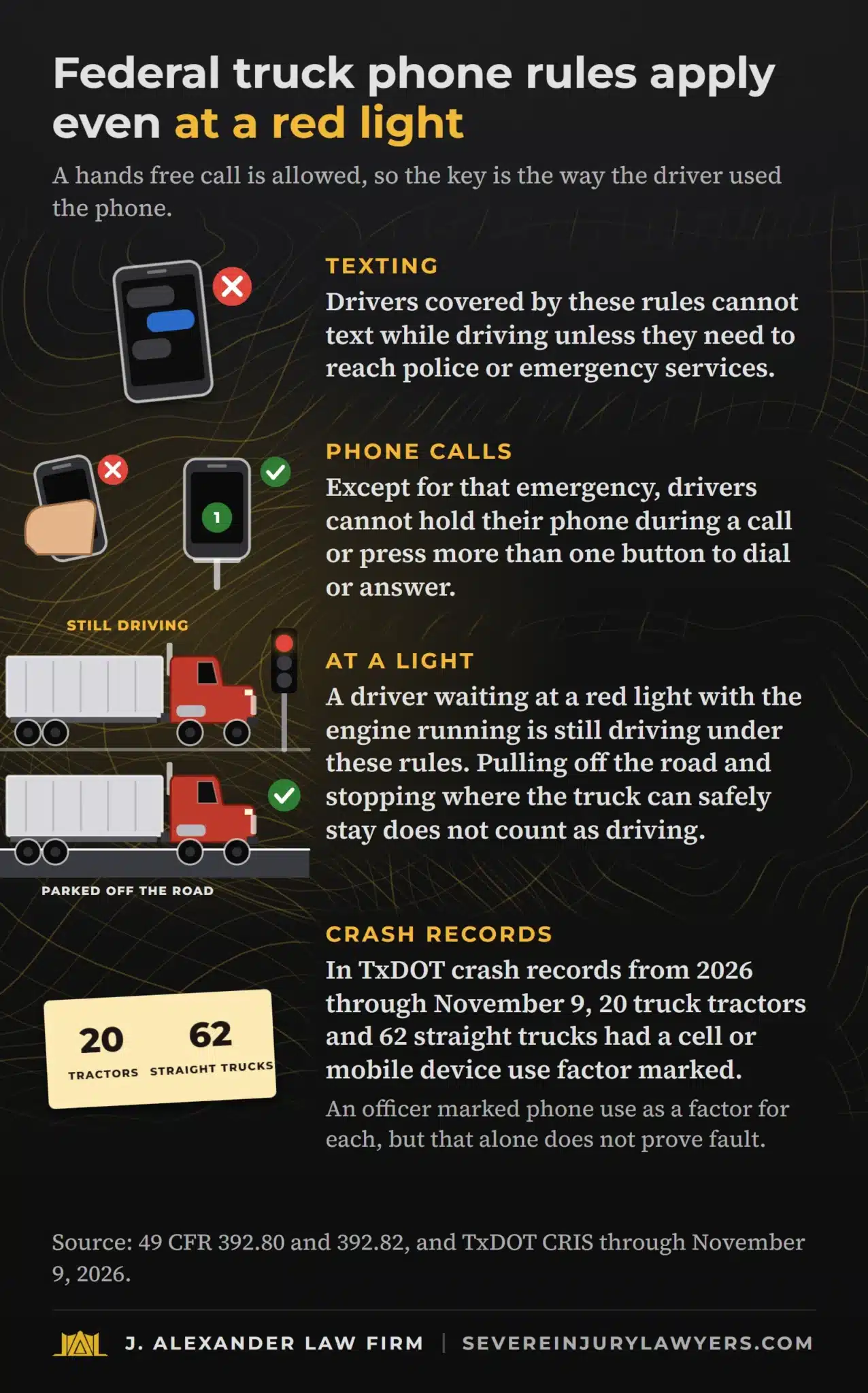
Read it as text
A hands free call is allowed, so the key is the way the driver used the phone.
- Texting: Drivers covered by these rules cannot text while driving unless they need to reach police or emergency services.
- Phone calls: Except for that emergency, drivers cannot hold their phone during a call or press more than one button to dial or answer.
- At a light: A driver waiting at a red light with the engine running is still driving under these rules. Pulling off the road and stopping where the truck can safely stay does not count as driving.
- Crash records: In TxDOT crash records from 2026 through November 9, 20 truck tractors and 62 straight trucks had a cell or mobile device use factor marked. An officer marked phone use as a factor for each, but that alone does not prove fault.
49 CFR 392.80 and 392.82, and TxDOT CRIS through November 9, 2026.
Both federal phone rules apply to commercial vehicles in interstate commerce and to school bus operations, even though most federal motor carrier rules exclude school bus operations. Texas also restricts reading or sending messages behind the wheel unless the vehicle is stopped, with exceptions. For a Texas messaging charge, section 545.4251(c)(5) provides an affirmative defense when a truck driver uses a portable wireless device mounted temporarily or permanently in the vehicle to relay work information between the driver and a dispatcher, a digital network or a software application service. Texas Transportation Code section 545.425(b) generally bars a truck driver from using a wireless device in a school crossing zone unless stopped or using it hands free. Section 545.425(d) provides an affirmative defense for an emergency call or, in some circumstances, a missing required sign.
For the 2026 period starting January 1 and ending November 9, our TxDOT CRIS pull showed 20 truck tractors alongside 62 straight trucks with the "cell/mobile device use" factor listed. CRIS reports call straight trucks "truck", and the four phone factors are talking, texting, other and unknown. A death occurred in crashes involving 3 of those 20 truck tractors. For the 2025 period starting January 1 and ending November 9, CRIS listed 26 truck tractors as well as 41 trucks. The listed factor does not decide fault, and crash severity records the worst injury anywhere in a crash. Late 2026 reports are still arriving, so do not set the 2026 counts against the 2025 counts or read a trend into them.
When phone distraction may have played a part in a truck crash, we look at both the driver's phone and the dispatch device mounted in the cab. Work messages can arrive on the dispatch screen. Federal regulations, like statutes, can support negligence per se. For the claim, I still need to connect the rule violation to how the crash and injuries happened.
Example
Truck driver on phone at light
Suppose a woman is riding in her sister's car at a red light. In the next lane, a screen in a truck driver's lap lights his face.
The light changes, and the tractor trailer drifts into their car. She is left wondering whether the screen played a part.
I would check whether the truck's engine was running while it waited. Under the federal texting rule, a covered truck at a red light is like a runner jogging in place at a water table: paused for a moment, but still in the race. A truck moved off the road and safely stopped is treated differently.
The driver's hands matter too. Did he hold a phone for a call, or press one button to start or end it?
Federal rules permit a hands free call within certain limits. They also allow phone use when needed to reach police or emergency services.
I would check whether the screen belonged to a personal phone or a mounted dispatch device. A qualifying work device can support a defense to a Texas messaging charge.
Ask our team about the carrier's dispatch messages before records are lost. We would still need to connect any phone use to the crash.
You may be worried about what you missed from the passenger seat. Write down the lane, what you saw in the driver's hands or lap, and where any screen sat in the cab. A glow by itself cannot show what appeared on the screen, so stick to what you remember.
Read next on our site
See how Texas hands free rules apply to other drivers, including the limits in school zones.