


The short answer
No. A cracked windshield is not automatically illegal in Texas. Section 547.004(a)(1) makes it a misdemeanor to drive a vehicle that is unsafe enough to endanger someone. The law does not set a prohibited crack length. A conviction for unsafe equipment can bring a fine.
Key points
A crack alone is not an object attached to the windshield under section 547.613(a)(1).
Windshield wipers must work properly and be under the driver's control.
Replacement windshield glass must use safety glazing material.
An officer might note a windshield crack in the narrative of a Texas crash report.
Can a cracked windshield affect fault in a Texas car accident?
When can a crack matter?
A crack can matter after a wreck if it affected the driver's view and contributed to the crash. If gravel from a truck hits your windshield, identifying the truck matters for a claim.
Under Transportation Code section 725.021, loose gravel loads need a sound bed, a secured tailgate and a secured cover, with exceptions based on the vehicle and load. I would ask where the crack was on the glass, how much the driver could see, and how light and weather affected that view.
An August caller said a board from a dump truck came through his windshield. "They didn't have the net of the rollout net that they're supposed to have, the coverage." We requested damage photos and asked whether his dash camera caught the plate.
Section 547.004(a)(1) concerns a vehicle condition that endangers a person, rather than a particular crack length.
How might a crash report describe it?
TxDOT's crash report code sheet has no entry for a cracked windshield defect. Vehicle Defects appears as field 39, where code 98, other, calls for a narrative explanation.
Under Factors and Conditions, field 38 uses 48 for impaired visibility. That entry also directs the officer to explain the condition in the narrative.
The narrative could identify a crack, glare or a failed wiper. To make sense of the entries, use our crash report decoder.
Impaired visibility in crash reports
3,327
Reportable crashes
The count measures reports marked for impaired visibility, not crashes caused by cracked windshields. Our search of TxDOT CRIS found that entry in 3,327 reportable Texas crashes in 2026, including 57 fatal crashes. All were reported by November 9.
2,517
Reports listing clear weather
Of those reports, 2,517 listed clear weather, 339 rain and 133 fog. That code cannot show what blocked the driver's view or which person caused the wreck. More 2026 reports continue to arrive.
Other windshield rules
Wipers
Rain makes the condition of the wipers relevant to the windshield question. Section 547.603 requires a working device that clears moisture and can be operated or controlled by the driver.
Texas DPS says noncommercial vehicles have not needed a safety inspection for registration since January 2025, though some still need emissions tests. Commercial vehicles still need safety inspections, where windshield damage and wiper contact can matter.
Replacement glass
Section 547.608(c) requires safety glazing material when glass in a door, window or windshield is replaced.
Objects on glass
With exceptions, section 547.613(a)(1) addresses objects or material placed on or attached to glass that reduce the driver's clear view. A crack alone is part of the glass, rather than something attached to it.
How can fault affect a claim?
A violation involving the windshield may bring negligence per se into the claim. Where a driver with cracked glass shares blame, the Texas fault rules matter to the claim.
What about damages and deadlines?
A claim's possible damages in a claim can include medical bills and pay you missed while recovering. For an injury claim, section 16.003 usually allows two years to bring a lawsuit, starting when the claim accrues.
What if an adjuster calls?
If an adjuster pushes for the crack's location and also requests a recording of your account or a release bearing your signature, speak with us before you agree.
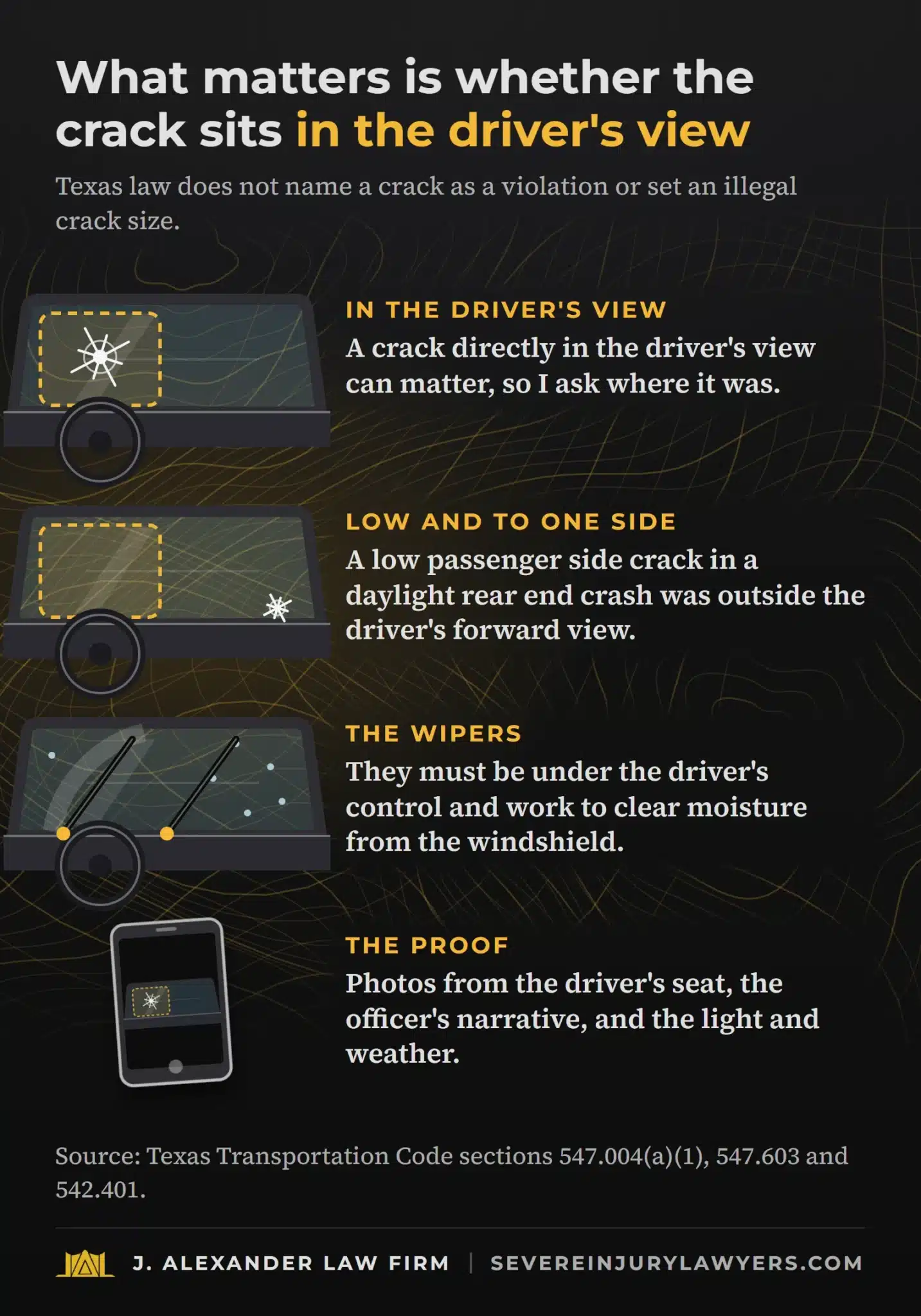
Read it as text
Texas law does not name a crack as a violation or set an illegal crack size.
- In the driver's view: A crack directly in the driver's view can matter, so I ask where it was.
- Low and to one side: A low passenger side crack in a daylight rear end crash was outside the driver's forward view.
- The wipers: They must be under the driver's control and work to clear moisture from the windshield.
- The proof: Photos from the driver's seat, the officer's narrative, and the light and weather.
Texas Transportation Code sections 547.004(a)(1), 547.603 and 542.401.
Example
Cracked windshield after a Texas wreck
Picture rain on your windshield as you drive in Texas. A crack crosses the glass, and another vehicle hits yours. Later, you worry the crack will be used against you.
The officer might describe the crack in the report and mark impaired visibility as a factor. A report can work like a map with details left blank. The officer's account matters, but mentioning a crack does not resolve what caused the collision.
An adjuster for the other driver could claim that the damaged glass made you partly responsible. The adjuster might point to the Texas rule on unsafe vehicles or argue that a violation supports a negligence claim. Neither argument settles whether the crack affected your view or played a part in the wreck.
I would examine the crack's location in relation to your line of sight, along with the rain and light. Section 547.004(a)(1) asks whether a vehicle's condition makes it unsafe in a way that endangers someone.
It sets no crack length. Before repair, take pictures from inside and outside the car, including the view from your seat.
Keep any estimate dated before the wreck.
If the crack limited your view and helped cause the collision, your share of responsibility could reduce your claim. If the crack did not play a part, its presence alone does not put the blame on you. A crack on your windshield can raise a question, but the details of your view matter.
Read next on our site
Texas crash laws also cover personal injury protection, with $2,500 per person required unless a named insured declines the coverage in writing.