


The short answer
Yes. Driving a car with one headlight out can violate Texas law, particularly when lights are required. Section 547.321 requires two headlamps, one on each side of the front. Section 547.004 makes certain equipment violations a misdemeanor that can bring a fine. Daylight changes when lights must be on, but it does not remove the equipment requirement.
Key points
Section 547.302 does not require headlights to be lit in clear daylight.
A headlamp defect may be recorded as a contributing factor after a crash.
A headlight violation can be proved without a ticket.
Can a headlight out make a driver at fault in a Texas crash?
Headlights must be lit at night. Section 541.401 defines nighttime as starting half an hour after sunset and ending half an hour before sunrise. Section 547.302 also requires them when dim light or atmospheric conditions prevent a clear view of a person or vehicle 1,000 feet ahead. A completely dark front side falls short when lights are required. Under sections 547.004 and 542.401, the misdemeanor carries a $1 to $200 fine when no other penalty applies. Section 547.004 allows dismissal if you fix the defect before your first appearance and pay a fee up to $10, except for commercial motor vehicle offenses. For a lifted truck, I also check lamp height. Section 547.321 sets a range of 24 to 54 inches. Rain may raise separate questions covered in our guide to bad weather crashes in Texas. Different rules govern when drivers must dim high beams.
The April 1, 2023 Texas crash report form gives officers different codes for a defect and for driving without lights. Field 39, Vehicle Defects, includes code 5, defective or no headlamps. Field 38, Factors and Conditions, includes code 21, drove without headlights. Code 21 does not establish that a lamp was defective. Poor visibility has its own entry, 48, in field 38, while 98 covers other factors. Both codes require an explanation in the officer's narrative.
The TxDOT counts measure reportable crashes with an officer recorded headlamp defect or a factor for driving without headlights. These numbers cannot tell us who was at fault or whether a particular crash involved just one unlit headlight. In the CRIS data we pulled through November 9, 2026, officers recorded defective or no headlamps in 229 crashes. Of those, 185 happened in darkness, 32 in daylight and 10 were fatal. Drove without headlights appeared in 551 crashes, including 469 in darkness. Reports for 2026 are still being filed.
An unlit headlight can matter to fault if it contributes to a wreck. For example, a turning driver might mistake a car's single light for a motorcycle at night and misjudge the car's width or position. When a broken headlight rule played a part in both the wreck and the injuries, I consider negligence per se. The turning driver's actions may matter too. Texas fault rules address shared responsibility.
After a wreck involving a headlight, you may seek money for medical bills, income you missed and pain. Once an injury claim accrues, most people seeking money for it must bring a lawsuit within two years. Exceptions apply under section 16.003.
Read it as text
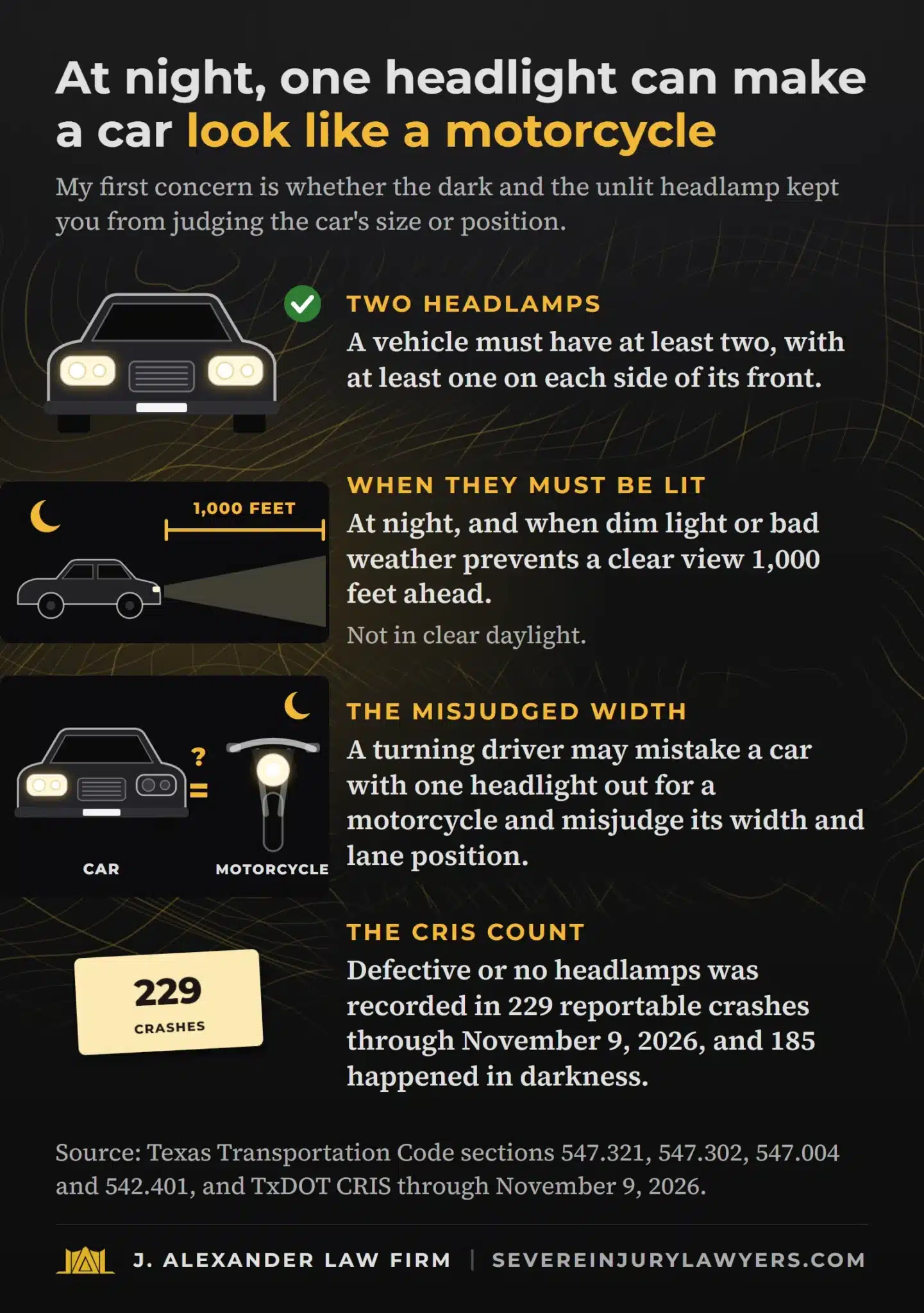
My first concern is whether the dark and the unlit headlamp kept you from judging the car's size or position.
- Two headlamps: A vehicle must have at least two, with at least one on each side of its front.
- When they must be lit: At night, and when dim light or bad weather prevents a clear view 1,000 feet ahead. Not in clear daylight.
- The misjudged width: A turning driver may mistake a car with one headlight out for a motorcycle and misjudge its width and lane position.
- The CRIS count: Defective or no headlamps was recorded in 229 reportable crashes through November 9, 2026, and 185 happened in darkness.
Texas Transportation Code sections 547.321, 547.302, 547.004 and 542.401, and TxDOT CRIS through November 9, 2026.
A daylight crash can still prompt questions from an insurer about your headlight, so the time and conditions matter. I would also want to know whether the lamp worked before impact. Bring us into the conversation before answering questions from an adjuster asking about your lights.
Example
One Headlight Before a Texas Crash
Say a passenger notices your left headlight looks dark in a store window reflection. You plan to change the bulb that weekend. A few evenings later, after sunset, a driver pulls out from a side street and turns into your car.
The turning driver's adjuster might argue that the dark lamp made your car harder to judge and that you share responsibility. I would want to know what the turning driver could see and whether the lamp made a difference.
The crash time matters. Section 547.302 requires the lamps to be lit at nighttime.
Under section 541.401, that period starts half an hour after sunset. Even before then, poor light or weather can make lamps necessary.
Section 547.321 also requires headlamps on both sides of the front.
Think of the two lamps as the ends of a tape measure. Seeing both can help another driver judge the car's width and position.
A single light might be mistaken for a motorcycle. Your passenger saw the dark lamp before the wreck.
When safe, photograph the front with the lights switched on before any repair, and ask the passenger what they remember.
If the lamp contributed to the collision, a share of responsibility could reduce a recovery. The turning driver's choices matter too. I understand why the dark lamp worries you, but Texas fault rules leave room to examine both drivers' actions.
Read next on our site
You can find the crosswalk rules for when drivers stop and yield in car accident laws for Texas drivers.