


The short answer
No. Texas law allows you to drive barefoot or in flip flops. You still need to use reasonable care and manage your speed. When an adjuster blames your footwear, I would ask for evidence showing how it affected what happened at the pedals.
Key points
Bare feet alone do not make you responsible for a Texas crash.
A claim that your flip flop contributed to a crash needs supporting evidence.
Driving barefoot alone cannot bring a footwear ticket in Texas.
Can driving barefoot make you at fault in a Texas crash?
Can bare feet put blame on me?
Even though barefoot driving is legal, careless driving that contributes to a crash can put some blame on the driver. A bare foot slipping could lead to a reckless driving ticket under section 545.401 if the driving shows wilful or wanton indifference to risks to people or property.
I would look at when and how your foot used the pedal, rather than assume your footwear caused the wreck. The rule also covers a store's customer parking area under section 545.401(c), with exceptions for private residential property and garages or lots charging to park or store vehicles.
What does the speed rule say?
Drivers must adjust their speed as needed to avoid striking people or vehicles that are legally on or entering a highway, under section 545.351(b)(2). The rule also accounts for each person's duty to use reasonable care.
How might a crash report address footwear?
Neither field 38, Factors and Conditions, nor field 39, Vehicle Defects, assigns a code to footwear. For a factor absent from the list, field 38 uses code 98, Other, and the officer explains it in the narrative.
An unlisted vehicle defect goes under code 98, Other, in field 39, and the officer explains it in the narrative. I would read the officer's narrative to see whether it mentions footwear or pedal use.
What if my car has a braking record?
If your car has a braking record, I would look at it alongside your account.
What is my deadline for filing suit?
Under section 16.003, you normally have two years after an injury claim accrues to bring a lawsuit. Exceptions can apply.
Reported pedal slip crashes
230
Crashes reported in 2026
The TxDOT CRIS count records reported crashes involving a foot slipping off a brake or clutch. It cannot tell us whether the driver wore shoes or was barefoot, and the code does not establish fault. From January 1 through November 9, 2026, we found 230 reportable Texas crashes with that other factor, including 1 fatal crash.
256
Crashes reported in 2025
For the same period in 2025, officers recorded it in 256 crashes. A comparison must wait because the 2026 reports were still coming in.
More on claims and evidence
- Section 547.615 and ways to preserve recorder data are covered in our speeding crash evidence guide.
- For more records worth looking at, visit our crash evidence guide.
- Your bare feet alone cannot establish negligence per se.
- See how a claim may change when blame is divided under Texas shared fault.
- Footwear does not change the losses an injury claim in Texas includes.
- See the Texas injury filing deadline.
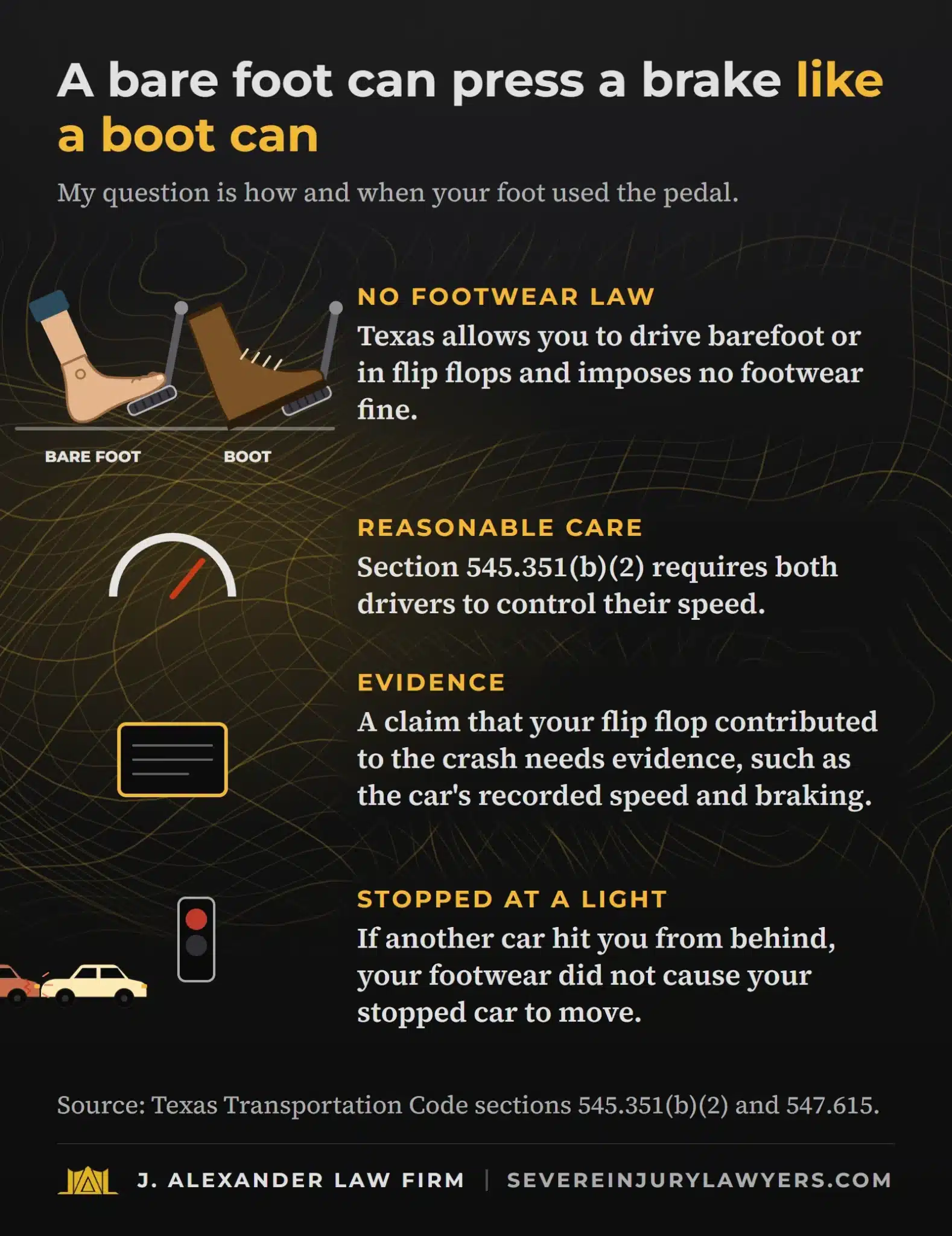
Read it as text
My question is how and when your foot used the pedal.
- No footwear law: Texas allows you to drive barefoot or in flip flops and imposes no footwear fine.
- Reasonable care: Section 545.351(b)(2) requires both drivers to control their speed.
- Evidence: A claim that your flip flop contributed to the crash needs evidence, such as the car's recorded speed and braking.
- Stopped at a light: If another car hit you from behind, your footwear did not cause your stopped car to move.
Texas Transportation Code sections 545.351(b)(2) and 547.615.
Example
Barefoot in a Texas car wreck
Picture driving barefoot on a Texas road. The car ahead slows, you press the brake, and the cars collide.
Afterward, an adjuster asks if your foot slipped. You are hurt and worried that driving without shoes will count against you.
An officer might mention your feet in the crash report. If the officer identifies an unlisted contributing factor, field 38 can use code 98, with an explanation in the narrative. I read that entry for the officer's account, but it does not decide responsibility.
The adjuster could argue that your bare foot affected your braking and point to Texas shared responsibility rules. Being barefoot is legal, though.
Knowing what was on your foot without knowing how you used the pedal is like hearing a brake squeal without seeing when the driver pressed it. The timing matters.
My first question is how your foot moved and when you slowed. Section 545.351(b)(2) requires drivers to control speed to avoid hitting people or vehicles lawfully on or entering the highway, taking account of each person's duty of care.
Write down your speed and what you remember about the pedals. If your car has a braking record, that record may help us examine your account.
Your driving and the other driver's actions could both matter if responsibility is shared. A share assigned to you could reduce a recovery. You may feel uneasy about the adjuster's question, but bare feet alone do not establish that you caused the wreck.
Read next on our site
Our office keeps a list of Texas car accident laws, including the 30/60/25 liability insurance minimums.