


The short answer
No. You can drive with an ordinary interior light on in Texas, and using a dome light by itself is not a reason for a ticket. Someone may still claim the light affected what you saw or how well you paid attention when a crash happened. My question would be whether the light helped cause the collision.
Key points
Using a dome light alone is not a Texas traffic violation.
Section 547.302 says to switch on certain outside lamps after dark. Bad weather or dim light triggers the rule too if people or vehicles 1,000 feet ahead cannot be seen clearly.
A crash report may mention a cabin light in the officer's narrative, but there is no separate code for it.
Can a dome light on at night affect fault in a Texas crash?
Can an insurer blame the cabin light?
If an insurer blames your cabin light, the question is whether the light contributed to the crash. As Managing Litigation Attorney Matthew Graham puts it in one of our videos: "Anybody can blame anybody, right?" I would ask why you used the light, what was visible ahead through your windshield and how the road was lit.
What might the crash report say?
Check the narrative on your Texas crash report for a mention of the cabin light. Field 38, Factors and Conditions, has no code for a dome light.
The officer may use code 19, Distraction in Vehicle, or code 48, Impaired Visibility. For code 48, the officer must explain the visibility issue in the narrative.
The officer must describe the factor in the narrative when using code 98, Other, too. An officer's entry does not decide fault.
Crashes reported after dark
2,480
2026 count
Our TxDOT CRIS count measures reportable Texas crashes after dark with code 19, Distraction in Vehicle. It cannot show how many involved dome lights because there is no cabin light field.
The count through November 9, 2026 was 2,480. Of those, 914 were marked "dark, not lighted", 1,484 "dark, lighted" and 82 "dark, unknown lighting".
2,635
2025 count
The equivalent period in 2025 had 2,635. The 2026 count is not ready for comparison because some reports have yet to arrive.
What about outside lights?
Your required outside lights are a separate question from your dome light. Chapter 547 of the Texas Transportation Code does not specifically address colored interior LED lights.
Section 547.305 generally bars driving with a red light visible from directly in front of the vehicle's center, unless the law permits it or the vehicle is a police vehicle. At night, section 547.302 requires drivers to use their required lamps.
They must also use them when poor light or weather makes it impossible to see people or vehicles clearly on the road at a distance of 1,000 feet in front of them. The status of those lamps can be important in a crash claim.
Section 547.305 also restricts red, white or blue flashing lights, with legal exceptions, even when the light is temporary or switched off.
Does the dome light establish negligence per se?
Just having the dome light on is not enough for negligence per se. The driver's care and the part the light may have played in the collision can still matter.
Read more about your claim
- Our guide to gathering evidence following a crash can help you preserve information about the scene.
- If a driver shares blame, our fault rules explain how that can affect a claim.
- The cabin light does not change what your injury claim can cover, which may include treatment, missed earnings and pain.
- It also does not change the two years most suits get under section 16.003.
- Different rules apply to outside lights, including high beams.
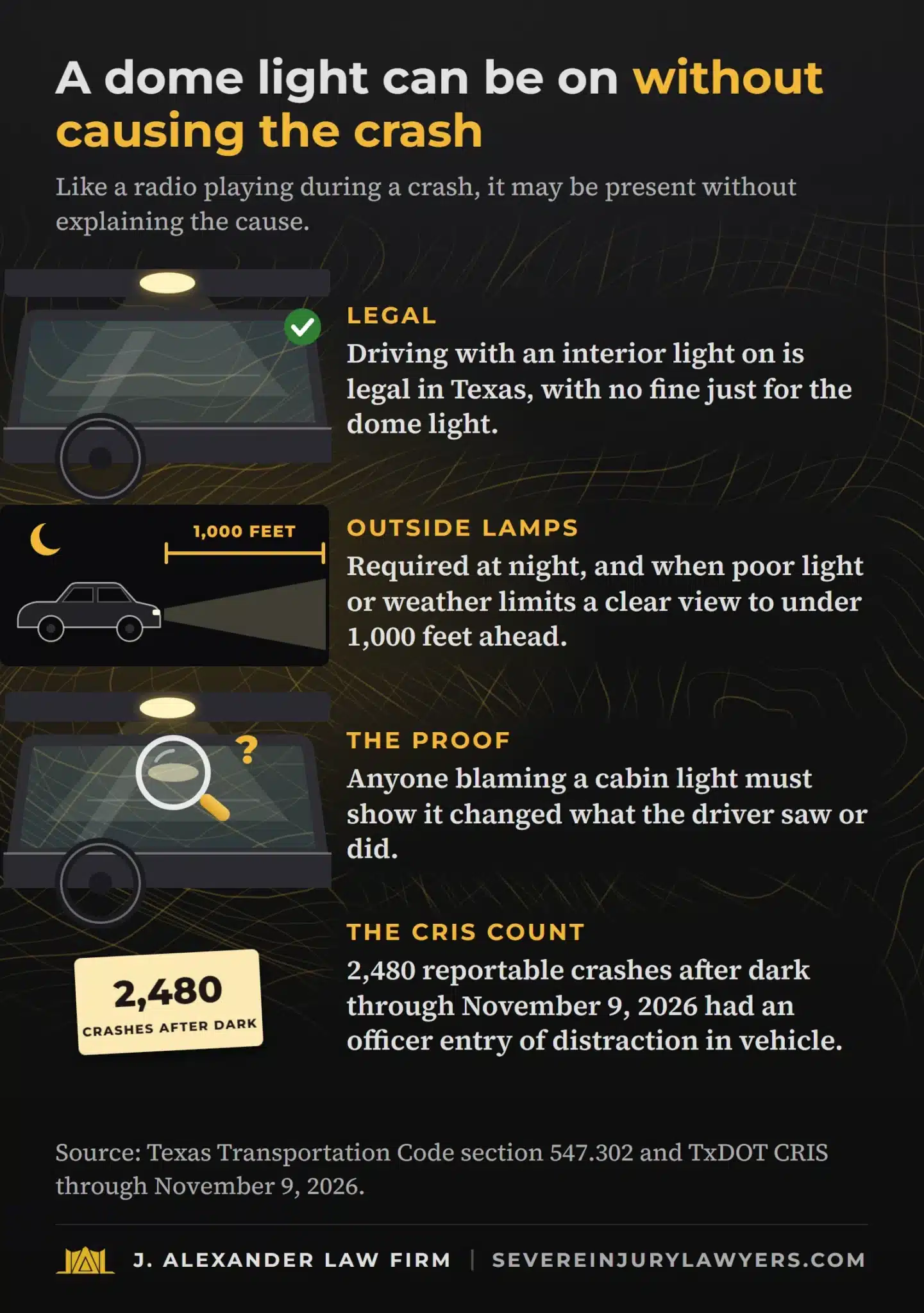
Read it as text
Like a radio playing during a crash, it may be present without explaining the cause.
- Legal: Driving with an interior light on is legal in Texas, with no fine just for the dome light.
- Outside lamps: Required at night, and when poor light or weather limits a clear view to under 1,000 feet ahead.
- The proof: Anyone blaming a cabin light must show it changed what the driver saw or did.
- The CRIS count: 2,480 reportable crashes after dark through November 9, 2026 had an officer entry of distraction in vehicle.
Texas Transportation Code section 547.302 and TxDOT CRIS through November 9, 2026.
Example
Dome light on during a crash
Picture a Texas street at night. You switch on the dome light to find something inside your car. Another vehicle strikes you, and the glow in your cabin becomes a question after the wreck.
An officer might mention the cabin light in the report narrative and mark code 48 for impaired visibility. The code is shorthand for an officer's assessment. It cannot measure what you could see through the windshield, and the report does not make the final fault decision.
The adjuster for the other driver's insurer could say the light distracted you or made the road harder to see. The adjuster might use Texas shared responsibility rules to argue for a reduction in your claim. That argument still leaves a question: did the light play a part in the collision?
I would want to know why the light was on, what you could see ahead and how the street was lit. Section 547.302 requires certain vehicle lamps at night.
It does not prohibit an ordinary dome light. Note when you used the light and what you remember seeing.
Keep any dash camera video of the road.
Both drivers' actions matter. If your conduct contributed to the crash, your recovery could be reduced.
The other driver's conduct matters too. A mention of your dome light can feel worrying, but that detail by itself does not resolve your claim.
Read next on our site
For the seat belt rule, see car crash laws in Texas.