


The short answer
No. Driving below the posted limit alone does not make your driving illegal in Texas. Section 545.363 prohibits driving slowly enough to impede normal, reasonable traffic, unless the reduced speed is needed for safe operation or to obey the law. A posted minimum can also apply. I look at why the car slowed and the gap available to the driver behind it.
Key points
A TxDOT CRIS count of swerves around stopped or slow vehicles does not measure illegal slow driving.
Rain, road work or a wreck ahead can make a lower speed necessary.
Speed, traffic and road conditions affect how much room the driver behind needs to stop safely.
Is a slow driver at fault if they get rear ended in Texas?
A minimum speed sign can matter when we assess a slow driver's conduct. State, toll, county or city authorities may set a minimum speed within their jurisdiction under section 545.363 when an engineering and traffic investigation finds slow speeds consistently hold up normal, reasonable highway traffic. Once signs give notice, a driver may go below that minimum only when safe operation or compliance with law requires it. Texas Transportation Code section 545.351 requires an appropriate reduced speed at intersections, railroad crossings, curves, hill crests and narrow or winding roads. Special hazards involving traffic, pedestrians, weather or road conditions also call for a reduced speed. A conviction for unlawful traffic obstruction or driving below a posted minimum can bring a fine. Section 545.157 requires moving over for a stopped emergency vehicle with lights on when two or more lanes go your way, or slowing to 20 mph below limits of 25 or more, or to five mph for lower limits, unless police direct otherwise. If the slower car was in the left lane, our answer on driving in the left lane covers the keep right rule.
In September 2026, a caller who hit another car from behind on a blind corner spoke with our intake team. He said the other car was moving about 20 miles per hour below the limit. He accepted some fault, but not all of it. Our intake team asked whether a dash camera or another source could help establish the car's speed. The team told him the following driver would most likely be found at fault and that we could not take the case. Section 545.062 requires enough space for the following driver to stop safely, considering the road, traffic and how fast both vehicles are moving. Our explanation of rear end car accidents in Texas covers that driver's role.
Field 38 lists crash factors and conditions in the Texas report. Simply driving below the limit has no separate code. Field 39 covers vehicle defects. In field 38, code 48 means impaired visibility and code 98 means other. The officer must explain either code in the written account. At our firm, the Managing Litigation Attorney is Matthew Graham. He explains that "we can sometimes keep a bad police report out of evidence altogether if it just conflicts with the other facts that are easy to prove and obvious."
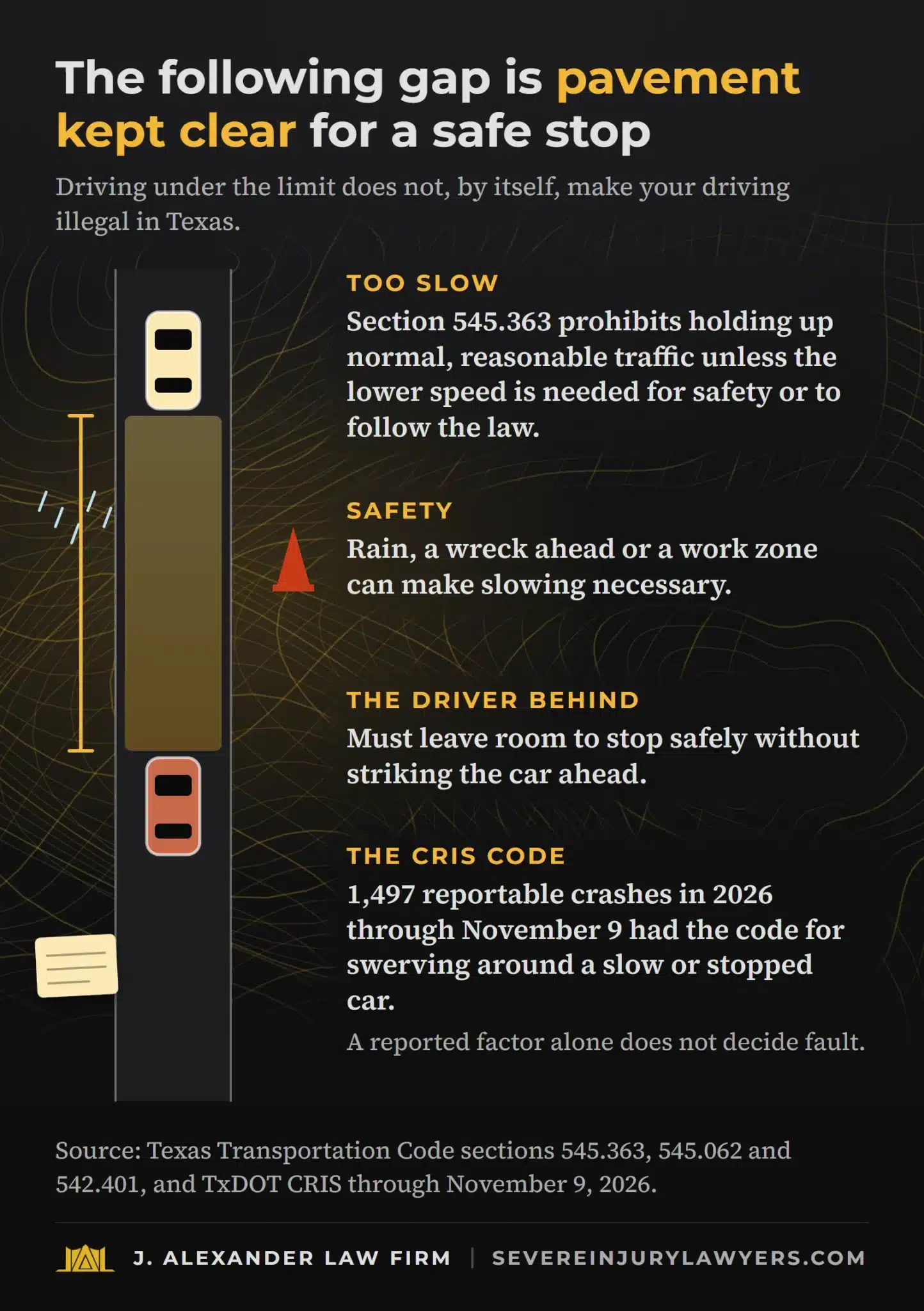
Read it as text
Driving under the limit does not, by itself, make your driving illegal in Texas.
- Too slow: Section 545.363 bars driving so slowly that normal, reasonable traffic is held up, unless safety or the law calls for the lower speed.
- Safety: A work zone, rain or a wreck ahead can make slowing necessary.
- The driver behind: Must leave room to stop safely without striking the car ahead.
- The CRIS code: 1,497 reportable crashes in 2026 through November 9 had the code for swerving around a slow or stopped car. A reported factor alone does not decide fault.
Texas Transportation Code sections 545.363, 545.062 and 542.401, and TxDOT CRIS through November 9, 2026.
The swerving count measures reportable crashes where an officer listed a maneuver around a stopped or slow vehicle. It cannot tell us how many involved unlawful slow driving, distinguish stopped vehicles from slow ones, or establish whether either driver broke a rule. Our review of TxDOT CRIS found 1,497 such crashes in the period ending November 9, 2026. Of those, 9 were fatal. The matching months of 2025 had 1,605 crashes with that factor. More 2026 reports are needed for a fair comparison. A recorded factor by itself does not settle who was at fault.
A slow driver may share responsibility if an unsafe reduction in speed contributed to a crash. The speed alone does not prove fault. For how a broken traffic rule can matter when a crash causes harm, see negligence per se. To learn how a share of the blame can affect your claim, read about Texas fault.
If an adjuster calls about speed, you can speak with us before giving the insurer a recorded account or signing paperwork that waives a claim. Medical care, missed earnings and pain may count toward an injury claim. Our explanation of the time to sue covers the deadline and its exceptions.
Example
Driving slowly before a Texas crash
Picture rain tapping your windshield as you slow for road work on a Texas highway. A following car strikes your rear bumper, and you are hurt. Later, the insurer denies your claim and points to your speed.
The officer might list a factor under field 38 and describe the circumstances in the written account. I would compare those entries. The report gives us the officer's assessment, but responsibility remains open to examination.
The adjuster may argue that you held up traffic in violation of section 545.363. That rule restricts driving slowly enough to obstruct normal, reasonable traffic, with an exception when a lower speed is necessary for safety. A speed number is like a thermometer reading: it tells us a condition, not what caused it.
My first question is whether road work and rain made your slower speed necessary. I would also check for a posted minimum and look at the distance between the cars.
Save any dash camera video and make a note of the conditions you recall. Section 545.062 also requires the following driver to maintain a distance that allows a safe stop, considering both speeds, traffic and road conditions.
Texas can assign responsibility to either driver or divide it between them. If your conduct contributed, your portion could reduce a recovery.
The following driver's distance and speed matter too. A denial is unsettling, but traveling under the limit alone does not answer why this crash happened.
Read next on our site
Texas car accident laws you should know include the basic speed rule, which calls for a speed suited to your driving conditions.