


The short answer
No. Passing on the right is legal in Texas in limited circumstances. Section 545.057 requires a safe pass, a vehicle ahead that is turning left or about to turn, and qualifying road conditions. Section 545.058 permits certain necessary and safe uses of an improved shoulder. If no different penalty applies, a conviction for an illegal right pass can carry a fine.
In their words
"And she went on the shoulder and once she realized there was a barrier there that she couldn't go forward, she came into the drivable lanes and caused the whole accident."
Caller, October 2026
Key points
A qualifying highway needs space for two moving lines of traffic in each direction, without obstructions or parked vehicles.
A driver may use the right shoulder to avoid a collision when necessary and safe.
An officer's passing entry reflects an opinion. It does not settle who caused the wreck.
Who is at fault when a driver passing on the right causes a crash?
Where the pass happens
On the main road
- For a pass on the main road, I check both the left turn condition and the road itself. On a street restricted to one direction, section 545.057 requires an unobstructed roadway with space for at least two moving lines of vehicles. The pass also has to be safe. Section 545.053 says a driver being passed must not speed up until the other vehicle is completely past and, when signaled audibly, must move or stay right. Those duties do not apply when a right pass is permitted.
On the right shoulder
- Section 545.058 allows most drivers onto an improved right shoulder only when necessary, safe and for a listed purpose. Section 545.057(b) bars passing on the right by driving off the main traveled roadway, including onto grass, except as section 545.058 permits. A driver may pass a disabled vehicle there, get around one that is preparing for a left turn, or pass one slowing or stopped in the main highway lanes. Other listed uses include stopping or parking, gaining speed to enter traffic, slowing for a right turn, letting a faster vehicle pass, obeying a traffic sign or signal, and avoiding a collision. The reason for the move matters. For guidance on keeping right, see the rules for using the left lane.
Questions after a crash
A return to the travel lanes
A caller in October 2026 described a driver coming back from the shoulder into the travel lanes. On that call, our intake team asked about video.
She said her car records video, and the team requested a copy to review. Matthew Graham serves J.
Alexander Law Firm as its Managing Litigation Attorney. For a quick decision at the scene, he looks at "who changed lanes when they shouldn't have".
That question can still be disputed after the report. A lane change can also put fault in dispute.
Factors on the report
Look at field 38, Factors and Conditions, on the Texas crash report. For the passing driver, an officer may choose code 27 for an unsafe pass on the right, code 58 for passing on the shoulder, or code 79 for driving on an improved shoulder.
For a conviction for an unlawful right pass, section 542.401 sets the fine between $1 and $200 when no other penalty is provided. Code 4, changed lane when unsafe, could appear for the driver ahead.
These are factor entries, not entries in field 39, Vehicle Defects. Which driver has which entry matters.
The crash report decoder can help you read the report.
What the numbers show
Texas crash counts
The TxDOT counts measure crashes with an officer marked factor. They do not count every right pass or establish final fault.
Records through November 9 show 1,740 reportable Texas crashes in 2026 with an unsafe right pass marked for one or more vehicles, including 730 on city streets. Officers marked passing on either shoulder in 645 crashes, including 229 on U.S. and state highways and 175 on interstates.
Each crash is counted once per factor, even if several vehicles have it. The figures remain incomplete because reports are still arriving.
More about your claim
- See how negligence per se may apply when a traffic violation helps cause a wreck.
- Read how Texas weighs each driver's share for the effect on a claim.
- Depending on the facts, an injury claim can seek payment for treatment bills, missed earnings and pain.
- For filing a lawsuit, section 16.003 normally allows two years to sue, though exceptions can apply.
- If the passing driver's adjuster contacts you, talk to us before agreeing to record your account or sign a release.
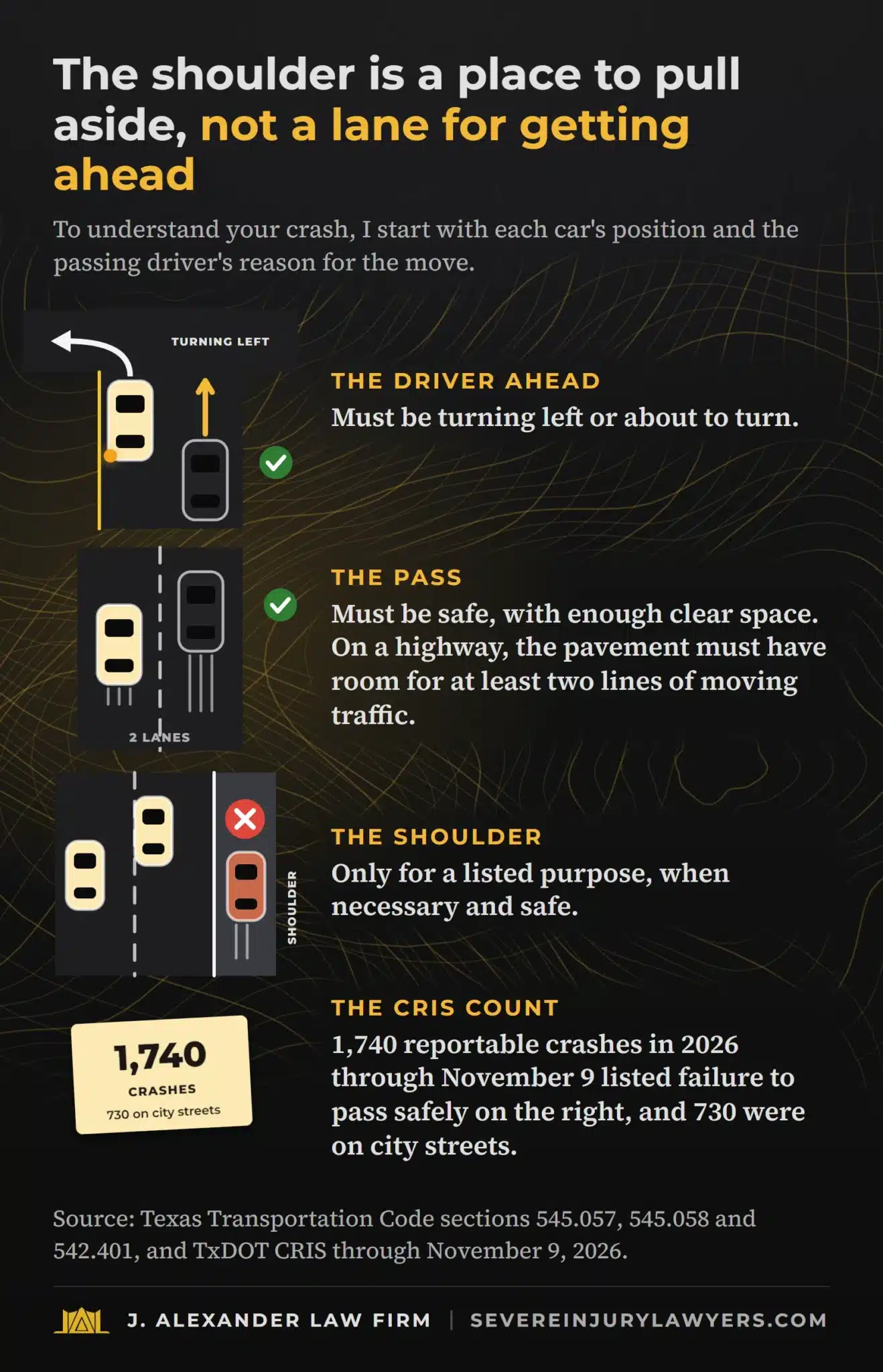
Read it as text
To understand your crash, I start with each car's position and the passing driver's reason for the move.
- The driver ahead: Must be turning left or about to turn.
- The pass: Must be safe, with enough clear space. On a highway, the pavement must have room for at least two rows of vehicles moving side by side.
- The shoulder: Only for a listed purpose, when necessary and safe.
- The CRIS count: 1,740 reportable crashes in 2026 through November 9 listed failure to pass safely on the right, and 730 were on city streets.
Texas Transportation Code sections 545.057, 545.058 and 542.401, and TxDOT CRIS through November 9, 2026.
Example
Passing on the right before a crash
Picture a car slowing ahead of you on a Texas highway. You move onto the paved right shoulder to pass.
As you return to the travel lane, the other car moves right and the vehicles collide. Your injury claim is later denied, with your pass cited as the reason.
The officer might enter code 58 for your vehicle in field 38, indicating an improper shoulder pass. I take that assessment seriously, but the entry alone does not decide responsibility. Check which vehicle the report identifies and read the narrative too.
The other driver's insurer may point to the rule restricting shoulder use and argue that your pass caused the wreck. I would want to know whether the shoulder move was necessary and whether it could be made safely. A slowing car makes the maneuver one of the uses section 545.058 permits when those conditions are met.
The stripe between the lane and shoulder is like a border between two sets of rules. Under section 545.057, a pass on the main road has different conditions, including a left turn by the vehicle ahead.
Write down where each car was when contact occurred. If you have video, keep the original unchanged.
Photograph tire marks if you can safely reach them.
Both the pass and the other driver's movement could matter to a shared responsibility decision. A finding that you contributed could mean less payment on your claim. I understand why the denial worries you, but passing on the right does not automatically make you responsible for the crash.
Read next on our site
Frontage road traffic must yield under the ramp rule, which is also explained among Texas car accident laws.