


The short answer
In Texas, the windshield strip and front side windows generally must let at least 25 percent of light through the glass and film together. The windshield strip must end at the AS1 line or five inches from the upper edge, whichever is closer to the edge. A tint conviction can carry a fine. For a wreck claim, I look at whether the film affected a driver's view.
Key points
The windshield strip must stay near the upper edge.
Front side windows have limits on light transmission and reflection.
A medical need for direct sun protection may be a defense in a tint prosecution.
A tint business can face a separate penalty for a missing label.
Can dark window tint affect who is at fault in a Texas crash?
A dispute over dark glass turns on which window carried the film and whether it affected the view at the time of the wreck.
Tint rules and crash reports
- Front glass
Section 547.613 sets the 25 percent light limit for the windshield strip, front side windows and wing vents beside the driver. Film and glass together must also reflect no more than 25 percent of light.
Texas Transportation Code Section 547.613(d) lets DPS treat a front side window or wing vent as exempt if its light transmission or reflectance varies from the standard by up to three percent. A lower light transmission number means darker tint.
A 5 percent reading lets through one fifth as much light as a 25 percent reading and falls below the limit unless an exemption applies. Red, blue and amber are prohibited on the windshield strip.
Texas DPS permits clear UV film without tint anywhere on the windshield without a medical exemption. For tinted film, DPS requires placement above the AS1 line.
- Rear glass and exemptions
Side windows behind the driver do not have to meet the 25 percent light limit. Rear glass is also exempt from that light limit when outside mirrors on both sides show the road at least 200 feet behind the vehicle.
Factory tinted glass that meets federal standards is exempt, as is a vehicle registered outside Texas. Dark rear glass alone does not establish the driver's view ahead through the windshield.
- Offenses and labels
Section 547.613 treats driving with material that obstructs or reduces the driver's clear view as a misdemeanor unless an exemption applies. Applying material that changes color or reduces light transmission can also be an offense unless exempt.
A defendant or passenger who needed protection from direct sun for a medical reason may raise that need as a defense. I ask clients to keep their doctor's paperwork.
For darker front windows due to a medical condition, Texas DPS requires a statement signed by a licensed physician or optometrist, kept in the vehicle and shown to an officer at a traffic stop. DPS stopped issuing tint exemption certificates in 2019.
Section 547.609 requires a label between the film and glass. A tint business that omits the required label can face a fine up to $1,000.
The label may not give a numerical tint reading. Our crash evidence guide covers other records to keep.
- Code 48
Texas crash reports do not have a separate code for window tint. Field 38 lists code 48, impaired visibility, which calls for an explanation in the narrative.
Tint could be described there, but the code alone identifies neither the obstruction nor the person responsible. I check the narrative when tint may have affected visibility.
A count of reportable crashes after dark with impaired visibility does not measure tint related crashes or establish fault. The count in our TxDOT CRIS search reached 772 such crashes by November 9, 2026.
Of those, officers listed 484 in darkness without lighting, 260 in darkness with lighting, and 28 in darkness with lighting unknown. Reports for 2026 were still arriving, so the counts are partial.
Before repairs or removal
Keep evidence of the tint
Broken glass or removed film can take tint evidence away. I want pictures of the windows and any label before repairs or removal.
In Brookshire Brothers v. Aldridge, decided in 2014, the Texas Supreme Court generally required intentional destruction before a jury could receive an instruction about missing evidence. A narrow exception can apply when negligent loss irreparably deprives the other side of a meaningful chance to present its case.
The crash evidence guide also addresses records after a wreck.
More about your crash claim
- A tint ticket raises questions about how a citation fits into a crash claim.
- If both drivers' actions are disputed, the rules for Texas shared fault may matter.
- Talk with us before replying if a claims adjuster wants details about your windows or wants to make a recording of your account.
- A claim can address crash costs and the harm done to you.
Read it as text
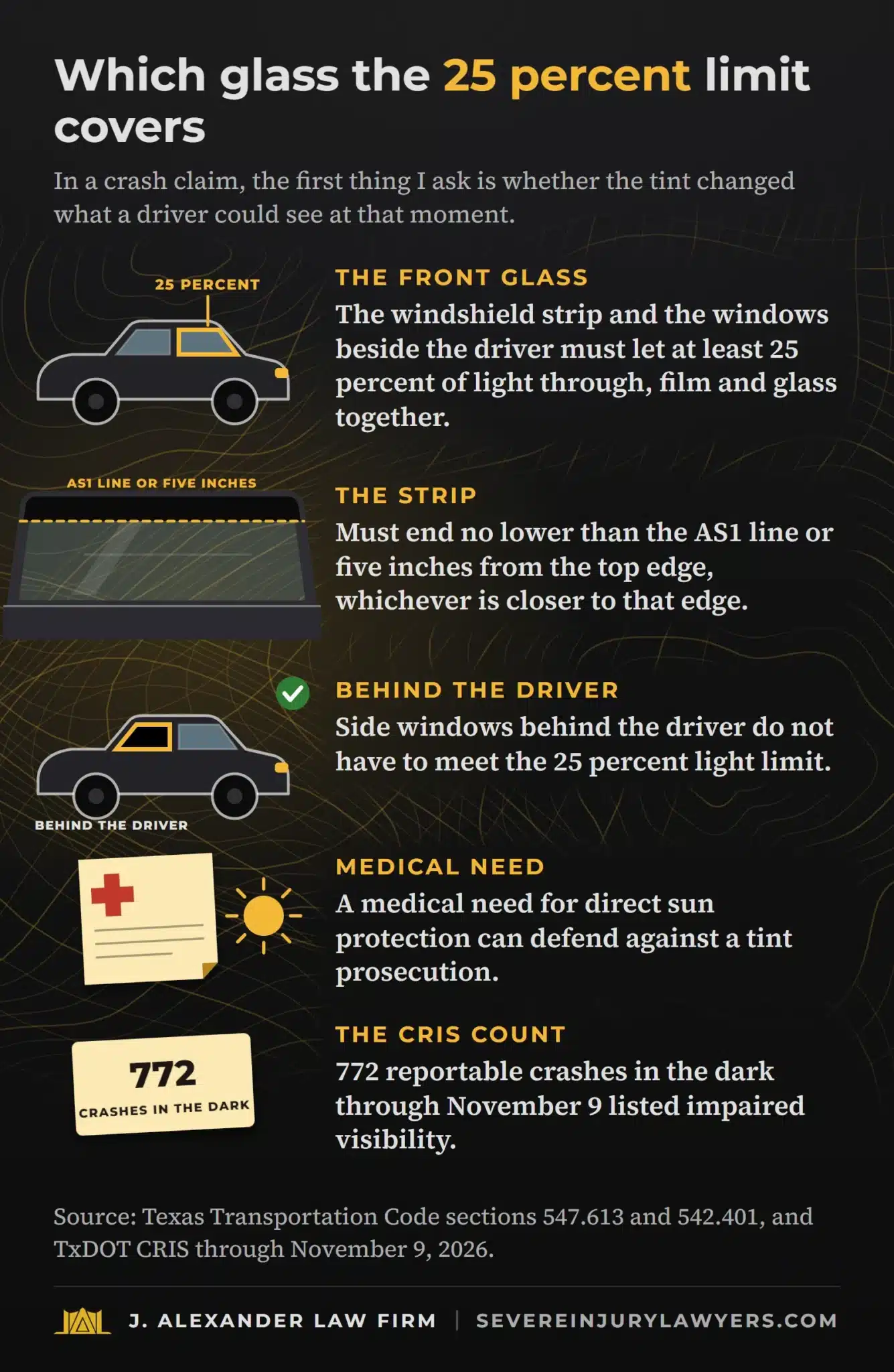
I start by asking if the film affected the driver's view when the crash happened.
- The front glass: The windshield strip and the front side windows must let at least 25 percent of light through, film and glass together.
- The strip: Must end no lower than the AS1 line or five inches from the top edge, whichever is closer to that edge.
- Behind the driver: Side windows behind the driver do not have to meet the 25 percent light limit.
- Medical need: In a tint prosecution, needing protection from direct sunlight for medical reasons may be a defense.
- The CRIS count: 772 reportable crashes in the dark through November 9 listed impaired visibility.
Texas Transportation Code sections 547.613 and 542.401, and TxDOT CRIS through November 9, 2026.
Example
Dark tint after a car wreck
Picture driving home at dusk with tinted front windows. Another car hits yours, and you are hurt. Later, an adjuster asks whether your windows were too dark to see through.
The officer might put code 48 for impaired visibility on the Texas crash report and explain it in the narrative. That code is like a bookmark: it points me toward a question, but it does not identify what blocked anyone's view or who caused the wreck.
The other driver's adjuster might point to your tint and argue that you share responsibility. Texas rules on shared responsibility can matter when both drivers' actions are disputed. The adjuster's question alone does not settle whether your windows affected your view.
I would look first at which window had film and what you could see through it. Under Section 547.613, the front side glass and film together generally must let at least 25 percent of light through, though an exemption may apply.
Take photos of the windows and any label before repairs or removal. Note the light conditions, and don't guess at a percentage.
The same questions can matter if the other driver had dark tint. Shared responsibility could affect a claim in either direction, depending on the drivers' actions and the facts. If you are worried that tint will be held against you, start with the window involved and what the view was like when the crash happened.
Read next on our site
Our team tracks the usual 2 year deadline to sue under section 16.003, along with other Texas rules for car crash claims.