



Short answer
How does a third party claim work in Texas?
You send a third party insurance claim to the liability insurer for the driver at fault. Its adjuster reviews coverage, who caused the crash and your losses before the company takes a position.
You can open a third party claim with the other driver’s insurance company after a Texas crash. That company works for the driver it covers. An adjuster is the person who handles the claim for the insurance company. You have no contract with that company, but Texas rules still govern how it handles your claim. The Texas Department of Insurance (TDI) enforces those rules.
If its driver caused the crash, the other driver’s insurer may owe for your treatment, car repairs and rental. It pays only up to the policy limits. It can dispute fault or the amount, and it can refuse your claim. You may have other losses to claim as well. See every kind of loss you can claim after a Texas wreck.
We send the adjuster the photos, witness contact details, police report and repair estimates ourselves. The adjuster then has those items to help decide fault. We keep a record of what we sent and when, then ask the adjuster to identify any additional information needed.
Call the other driver’s insurance company to open a claim. Have these ready:
- The at fault driver’s name and policy number, if you have them
- Your photos and the police report number
- The crash location and time
Write down the claim number and your adjuster’s name.
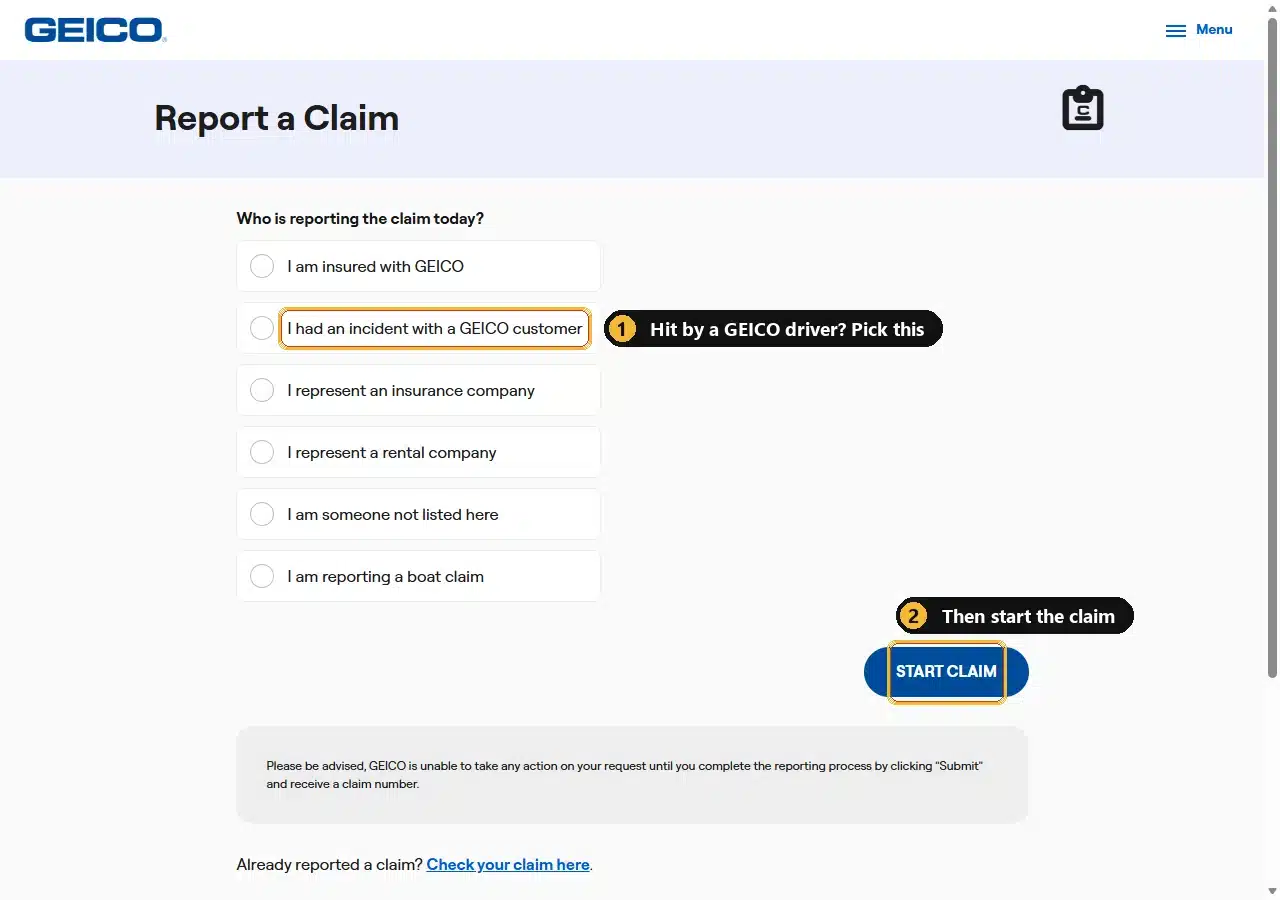
Example: GEICO asks who is reporting
- Not the insurer's customer? There is a choice for people its driver hit.
- The report starts after that choice.
Screenshot, Nov 19, 2026: the GEICO claim form.
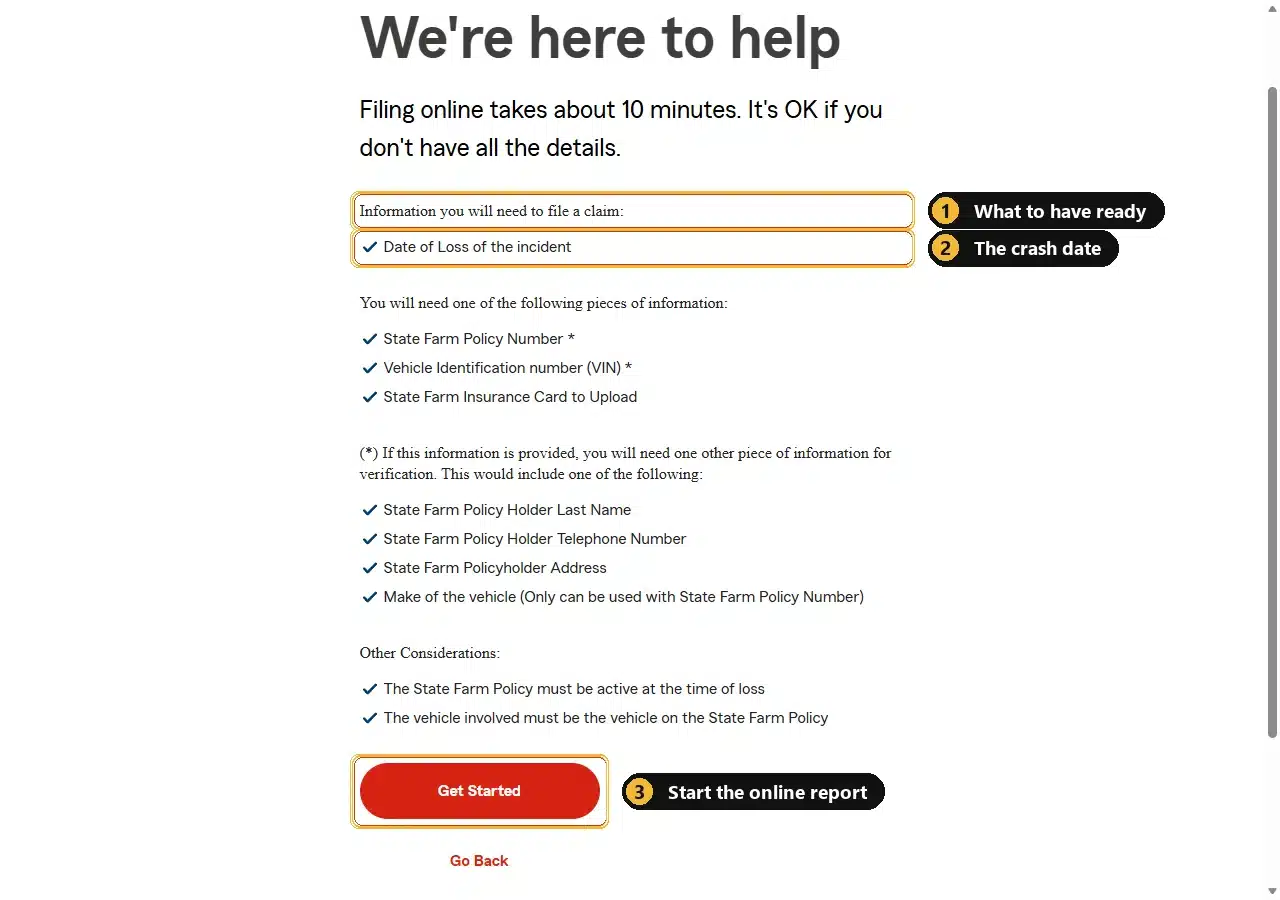
Example: State Farm's claimant page
- What to gather before you open the claim.
- The date of the crash.
- The online report starts here.
Screenshot, Nov 19, 2026: the State Farm page for claimants.
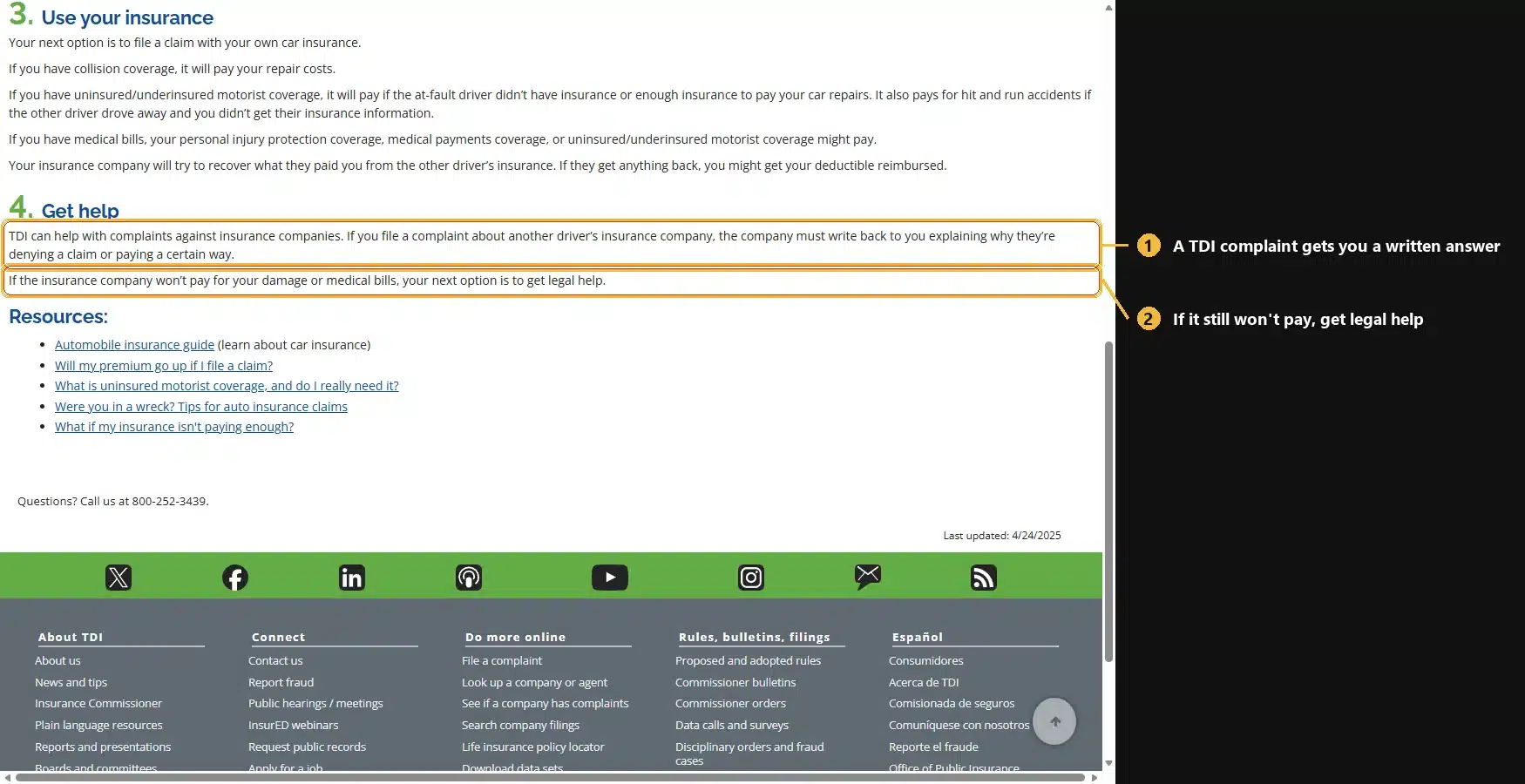
TDI: dealing with the other driver's insurer
- A complaint gets a written explanation from the company.
- If it still will not pay, TDI points to legal help.
Screenshot, Nov 19, 2026: TDI's tip page on the other driver's insurance.
The other driver’s policy stops paying at its limit. Texas sets required minimums of $30,000 for one person’s injuries and $60,000 for all injuries in one crash. It also requires $25,000 for property damage. Ask the adjuster in writing for the declarations page, which the insurer may not send right away. The page shows the other driver’s policy limits.
You may have remaining injury losses when coverage from the at fault driver is not enough. If your policy has underinsured motorist (UIM) coverage, it can help pay those remaining losses, up to its limit. Personal injury protection (PIP) on your policy pays reasonable medical expenses and lost income from the crash, regardless of fault. Sections 1952.151 and 1952.155 of the Texas Insurance Code cover what PIP pays after a Texas crash. A Texas policy includes PIP if no named insured rejected PIP in writing. Uninsured and underinsured motorist insurance comes with the policy if no named insured rejected that coverage in writing.
Texas rules still apply when the other driver’s insurer handles your claim. While that insurer weighs fault, see Sameer Assanie’s filmed answer about adjusters who phone right after a wreck. If you need to bring an injury lawsuit, you sue the driver rather than the driver’s insurer.
On camera, Matthew Graham explained why the kind of vehicle matters:

From our attorney
"The law requires certain coverages for certain kinds of vehicles doing certain kinds of things…"
Matthew Graham
Managing Litigation Attorney | answering a question about insurance coverage for different vehicles, recorded in 2026
From our intake calls
What callers needed help sorting out
Selected topics raised in 25 calls naming the other driver's insurer.
| Topic | Calls | Bring this |
|---|---|---|
| Car repairs, rental, total loss or car value | 7 calls | Repair estimate, valuation report or rental letters, as they apply |
| Blame, disputed fault or a denial | 6 calls | Written fault decision and crash evidence |
| An offer the caller called too low | 4 calls | The offer and any proposed release |
| Medical bills or other costs not paid in full | 3 calls | Bills and payment records |
| Coverage limits unknown, too low or uninsured | 3 calls | Insurance information and any coverage or denial letters |
Counts are calls, not different callers. Topics can overlap, so one call can count in more than one row. Some callers reported accepted fault or named no problem.
Source: J. Alexander Law Firm intake calls, June 10 to November 18, 2026. Selected topics, not a study of how insurers perform.
From our intake calls
What callers already had from an insurer when they called
What callers said an insurer had already given them, decided or offered. Requests, such as for a recorded statement, came up in fewer than three calls. Not mentioned does not mean not received.
| What the caller had | Type | Calls | Different callers |
|---|---|---|---|
| A claim number | Given | 16 calls | 15 |
| A denial, or the insurer putting the fault on them | Decision | 7 calls | 6 |
| A total loss decision on the car | Decision | 5 calls | 5 |
| An injury offer: an amount offered for the injury claim | Offer | 4 calls | 4 |
Other categories came up in fewer than three calls each and are not shown.
Source: J. Alexander Law Firm intake calls, June 10 to November 18, 2026. Base: 36 calls from 34 different callers, out of 1,190 transcribed calls. A call can count in more than one row.
Our Spring Valley Road Case: The Other Insurer Paid Its Limit During the Lawsuit
In our Spring Valley Road case, a left turning driver cut across our client’s path. At the scene, the officer coded her as not injured.
Her records over the next months showed more. Pain management, MRIs, therapy and two injections came first. In May 2024, a spine surgeon found weakness in her arm and grip and reduced feeling in a hand. She later had neck fusion surgery. Once surgery was recommended, we gathered written estimates for it.
The other driver’s insurer did not pay its $50,000 limit before suit. We filed, and it paid that full limit during discovery. Her own UIM claim then settled for $35,000. The $85,000 total is gross, and neither claim went to trial.
What does Texas law require of the other driver's insurance company?
Texas bars insurers from using unfair practices to settle claims. The first rule protects anyone making a claim, not just the insurer’s customer. Other rules cover how insurers communicate, investigate claims, share coverage information and settle claims.
The other driver’s insurer: what it must do, what it can dispute and what you can do | Texas Insurance Code sections 542.003 and 542.004, and 28 Texas Administrative Code section 21.203
| What the insurer must do | What it can dispute | What you can do about it |
|---|---|---|
| Acknowledge your claim messages with reasonable promptness. Within 15 business days is presumed prompt. That is not a deadline to decide or pay. | Whether a message needed an answer, and when it arrived | Send messages in writing and keep the dates |
| Use reasonable standards to investigate claims promptly | Who caused the crash, and what your losses are worth | Send photos, witness names, the police report and repair estimates |
| Try in good faith to settle once liability is reasonably clear | Whether liability is reasonably clear | Ask for its fault decision and its reasons in writing |
| Not give you false information about relevant facts or policy terms | Which facts and policy terms matter to your claim | Ask for the declarations page and policy limits in writing |
| Not require your federal tax returns to settle, unless an exception applies | Whether the lost income exception applies | Ask the adjuster to name the exception before you send them |
The detailed rules and our reading of them follow below. Each row is a summary, not a promise about how a claim will end.
Texas Insurance Code section 542.003 bars insurers from using unfair practices to settle claims. You are not the insurer’s customer, so which protections reach you? Item (1) speaks of a claimant, the person making a claim, not only a policyholder. Items (2) and (3) speak of claims arising under the insurer’s policy. Item (4) covers any claim submitted to the insurer. The listed practices include:
- 542.003(b)(1): Knowingly giving a claimant false information about relevant facts or policy terms related to the coverage in question.
- 542.003(b)(2): Failing to acknowledge relevant claim communications with reasonable promptness.
- 542.003(b)(3): Failing to adopt and use reasonable standards for promptly investigating claims.
- 542.003(b)(4): Not trying in good faith to settle promptly, fairly and equitably once liability has become reasonably clear.
TDI’s rule at 28 Texas Administrative Code section 21.203 carries out these standards. The other driver’s insurer is still expected to work toward a fast and fair settlement of your claim. A separate provision applies when an insurer forces someone to file a lawsuit by offering too little. It applies to a policyholder, so you cannot rely on it against the other driver’s insurer.
A Stowers demand is not a claim against the insurer. It is a written offer to settle your claim against its driver within the policy limits, for a full release. If the insurer rejects an offer a reasonably careful insurer would accept, it can later owe the whole judgment. A judgment is the amount the court orders. Strict conditions apply, so a lawyer should prepare one.
Under item (4), liability means responsibility for the crash. The question is whether responsibility has become reasonably clear. Our intake team asks whether the insurer has accepted responsibility or is still investigating. If the adjuster has answered you, tell me the exact words. An answer of “we accept liability” differs from “we are still looking into it”. Section 33.001 of the Texas Civil Practice and Remedies Code covers your share of responsibility in Texas. You cannot recover damages when your share exceeds 50 percent. Section 33.012(a) reduces your damages by your share of responsibility. That reduction is one part of Texas law on shared fault.
How long does the other driver's insurance company have to respond in Texas?
The Texas prompt payment deadlines to decide and pay a claim are not binding on the other driver’s carrier. Under TDI’s rule, a carrier that confirms receipt of your claim messages inside 15 business days is presumed reasonably prompt.
The prompt payment rules set deadlines your own insurer has to meet, but not for the other driver’s insurer.
Item (2) of the TDI rule, 21.203(2), calls those messages pertinent communications. It applies to claims arising under the insurer’s policies.
I read rule 21.203(2) to cover a claim like yours against the other motorist’s liability policy. That is a presumption, not a deadline to finish or pay the claim. The rule excludes written answers to specific questions the insurer asked after the initial report.
Say you email your repair estimate to the adjuster on a Monday, without answering a specific question. If the insurer confirms receipt within 15 business days, rule 21.203(2) presumes that response was prompt. The rule does not say when the insurer must decide or pay.
One caller told our team an inspector had already looked at the damaged car. The adjuster still had not provided an estimate. The caller did not know whether the inspector’s report had reached the adjuster. That is where I start. What has been inspected, what has been delivered, and what is the adjuster waiting for? “We are investigating” does not answer those questions. I ask for the missing step in writing. I do not assume the inspection and the adjuster’s review are the same thing.
Some people call our team after the other driver’s insurer stops returning their calls. The company may be waiting for its own driver to respond. That driver may not respond at all. Keep your messages and their dates so I can show the adjuster where the replies stopped. I can show the same record to TDI or a court later.
In most injury cases, you have two years to sue the motorist who hit you. That clock keeps running while the carrier sits on your file. Other deadlines can be shorter. So I check the Texas deadline to file a crash lawsuit instead of counting on the insurer to finish first.
Our $195,000 Case: A Limits Demand Before the Insurer Disclosed Its Limit
In our $195,000 commercial vehicle case, our client’s car was sitting still in traffic. A vehicle a business had insured struck the car from behind. There was no police report. The insurer still had not told us its limit when we drafted the demand.
So we worked with what we had. Our client’s account and the rear damage photos supported fault. About nine months of care went into the demand one provider at a time.
We then demanded the insured’s policy limits by name, with about two weeks to respond. Waiting for the number would have meant no response deadline on the demand.
The business vehicle’s insurer agreed to $195,000. That amount is gross. We cannot say whether that equaled the limit. We also do not credit the demand alone for the result.
Can the other driver's insurance company ask for your tax returns?
It can ask, but it can require them to settle only in limited cases. Texas bars an insurer from requiring your federal tax returns to settle unless an exception applies. The exceptions are a court order to produce them, a fire loss, or a claim for lost profits or income.
The insurer may ask for your federal tax returns. Insurance Code section 542.004(a) sets the limits on requiring them to settle.
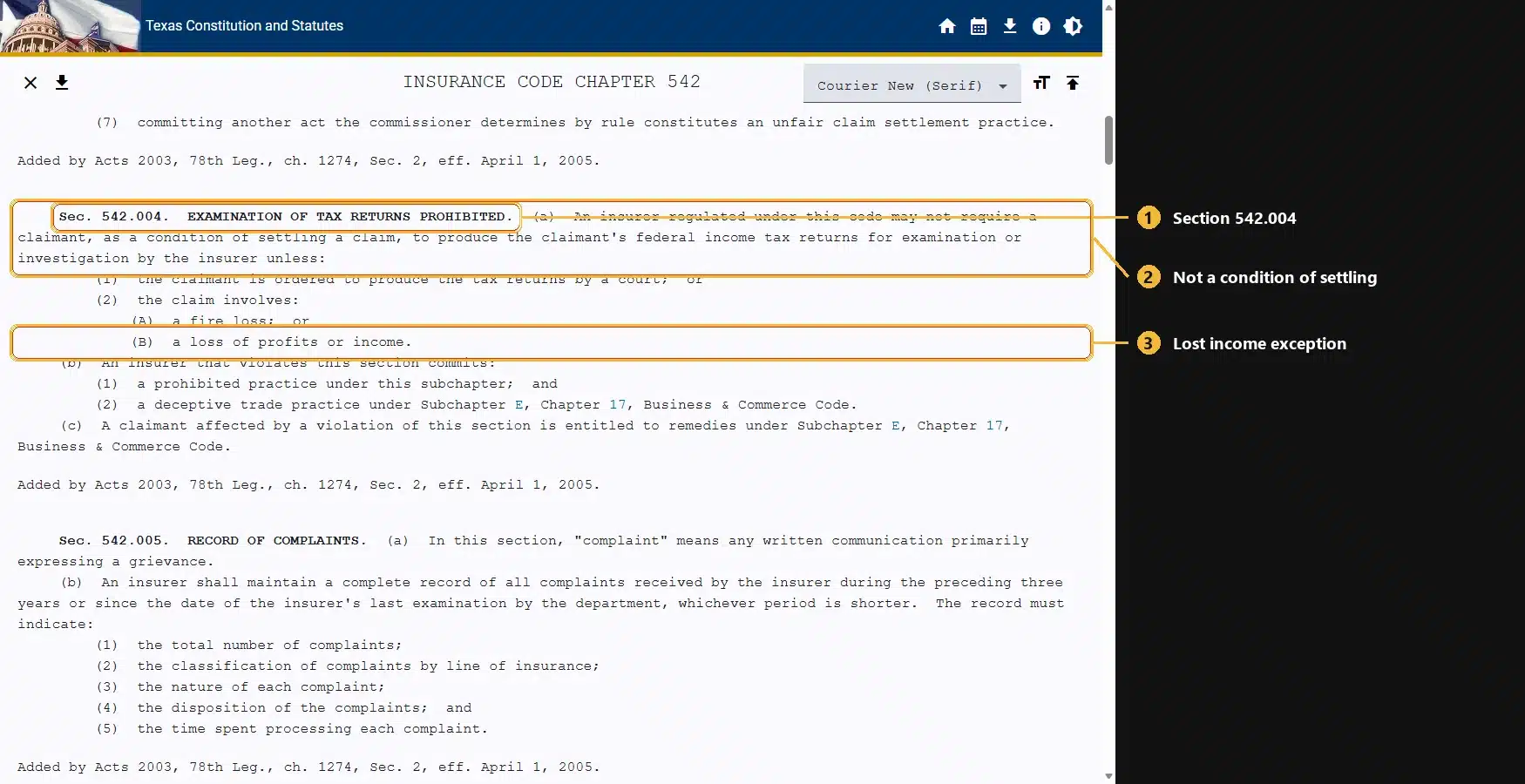
Texas Insurance Code section 542.004
- The section that limits tax return requests.
- Returns cannot be a condition of settling unless an exception applies.
- One exception: a claim for lost profits or income.
Screenshot, Nov 19, 2026: Insurance Code section 542.004.
For a crash claim involving lost pay, that income exception may apply. If you claim no lost income or profits, the insurer cannot require your returns to settle unless another exception applies. If an adjuster asks for them, ask whether it is a condition to settle and which exception applies.
Pay stubs and other documents may be among the records that prove lost pay after a Texas crash.
If an adjuster wants your tax returns, I separate two questions. What information does the company need, and is it making the returns a condition of settlement? A return can show far more than the income loss you claim. If your claim has no income loss in it, I ask the adjuster to name the reason. If income is disputed, I ask whether narrower records, such as pay stubs, would answer it first.
Section 542.004(b) treats a violation as a prohibited practice and a deceptive trade practice. Under section 542.004(c), “a claimant affected by a violation” can seek remedies under the Business and Commerce Code.
Got a tax return request from the at fault driver's adjuster? We will check it against Insurance Code 542.004 with you.
Call 469-807-7480What can TDI do if the other driver's insurance company breaks the rules?
TDI receives complaints and can investigate an insurer’s practices. A finding of a violation can lead to an order to stop the conduct. Further action can follow if the company does not comply.
TDI must maintain a system to receive and process individual complaints about violations of the claim settlement subchapter.
Insurance Code section 542.008 also requires an investigation in certain cases. The number and type of complaints may show an insurer falls below the minimum performance standard. They may also be out of proportion to complaints against comparable insurers. Under section 542.009(g), complaint numbers and types alone cannot establish a violation.
If TDI finds a violation, section 542.010 requires a cease and desist order. If the insurer does not comply, TDI may suspend or revoke its certificate of authority or limit its business.
TDI does not decide fault. It usually cannot step in when the other driver’s insurer will not accept responsibility. Apart from the tax return rule in section 542.004, you cannot sue that insurer under the unfair settlement rules. Insurance Code section 541.060(a) lists unfair settlement practices “with respect to a claim by an insured or beneficiary”. Subsection (b) limits who can sue under subsection (a). It gives no right to sue to a third party claiming against someone covered under a liability insurance policy.
You cannot directly sue the other driver’s insurer for unfair claim settlement practices under the rule the court considered. The Texas Supreme Court reached that result in Allstate Insurance Co. v. Watson, 876 S.W.2d 145 (Tex. 1994). A driver hurt in a crash with an Allstate insured sued Allstate directly. The court held she lacked standing to bring that unfair settlement claim.
The court explained that a third party claimant has no contract and no special relationship with the insurer. Those rights could conflict with the insurer’s duties to its own insured.
Our filmed answer about contacting the insurer for the driver at fault can help you decide whether to call. You can check the driver’s policy limits. TDI keeps complaint records for each insurer.
OPIC, short for Office of Public Insurance Counsel, is an independent state agency that speaks for Texas insurance consumers. OPIC sends insurance complaints and questions to TDI at 800-252-3439. OPIC also accepts general questions.
If you tell our team the other driver’s insurer denied your claim, we first ask one thing. Is the denial official and in writing? Has the company stopped responding, turned down your claim or asked for documents you are unsure about?
Let me look at its message before you reply. A complaint cannot force the insurer to accept fault. So I build the case against the driver.
Did the other driver’s insurer stop answering? Tell me when its replies stopped.
Call 469-807-748024/7 | Free consultation | No fee unless we win
Call me so we can read the other insurer's request together.
J. Alexander Law serves injured clients throughout Texas: Dallas | Houston | San Antonio | Fort Worth | Arlington | Canton. Se habla español.