


Farmers Branch Underinsured Motorist Settlement
$85,000 Underinsured Motorist Settlement After a Left Turn Crash on Spring Valley Road in Farmers Branch
A left turning driver headed for a furniture store parking lot cut across Spring Valley Road into the path of our client’s Tesla. The other driver’s insurer paid its full $50,000 limit, and the underinsured motorist coverage on her own policy added $35,000.
She later had fusion surgery on her neck. Both claims settled in February 2026, after we filed suit.
On This Page
The Case at a Glance
| Case detail | Information |
|---|---|
| Result | $85,000 in total: the at fault driver’s full $50,000 liability limit, then $35,000 in UIM benefits from our client’s own insurer |
| How it resolved | Lawsuit filed; both claims settled during discovery, in February 2026 |
| Who worked it | Our intake team, an assigned case manager and the senior attorney who filed suit and settled both claims |
| Date and time | |
| Location | 4800 block of Spring Valley Road, Farmers Branch, Dallas County, about 400 feet west of Inwood Road |
| Vehicles | 2016 Ford Edge turning left; 2021 Tesla Model 3, driven by our client |
| Crash report | Farmers Branch Police Department CR-3, completed that morning, with factor 37 listed for the Edge’s driver |
| Injuries | Disc tears on MRI, followed in 2024 by a diagnosis of spinal cord compression at neck level |
| Treatment | Pain management, physical therapy, two epidural steroid injections, then neck fusion surgery |
A Left Turn Through a Gap in Stopped Traffic
We rebuilt this crash from two sources, the officer’s report and the scene photos, and they line up.
Spring Valley Road is divided here by a protected median and posted at 40 mph. At 8:30 on a cloudy Thursday morning, eastbound traffic in the lane closest to the median had backed up, while the center lane kept moving. Our client was in that center lane in her Tesla Model 3. A westbound Ford Edge turned left through the median, crossed in front of the stopped cars and pulled into her lane on its way to a parking lot on the south side.
The officer’s account on page 2, copied exactly:
Unit 1 was traveling WB in the 4800 block of Spring Valley Rd. Unit 1 was turning south to pull into the parking lot of Weirs Furniture located at 4800 Spring Valley Rd. Unit 2 was traveling EB in the 4800 block of Spring Valley in the center lane. Traffic in the left lane was backed up but the center lane was free. Unit 1 turned in front of Unit 2 and failed to yield right of way. Unit 2 attempt to use evasive action to avoid collision but was unsuccessful. The front right of Unit 2 struck the back right of Unit 1.
Unit 1 is the Edge and Unit 2 is our client’s Tesla. The narrative records three things that mattered: the Edge turned in front of her, its driver failed to yield, and she tried to avoid it before her front right corner met the back of the Edge’s right side.
- Ford Edge. Westbound, then turning left across the eastbound lanes toward a furniture store lot.
- Tesla Model 3, our client. Eastbound in the center lane, the one lane still moving.
- Stopped cars. The backed up eastbound lane nearest the median, with a gap the Edge turned through.
A line of stopped cars can hide the next lane from a driver turning across it, and it can hide the turning car from drivers in that next lane. A Dallas caller hit in a similar crash described the maneuver to us in July 2026: drivers on the far side of the road who “make that left turn and come all the way across oncoming traffic, like to get in those businesses.”
Who Had to Yield
A gap in a stopped lane is not permission to cross the next one. Transportation Code § 545.152 covers a turn “into an alley or private road or driveway” as well as a turn at an intersection: the turning driver has to give way to oncoming vehicles near enough to be an immediate hazard. The Edge was turning left into a business driveway, and our client’s Tesla was oncoming in the open lane.
The officer’s contributing factor for the Edge was 37, which TxDOT’s CR-3 code sheet uses for a left turn made without yielding. The same list has a separate entry, 34, for failing to yield at a private drive; this report uses 37. No factor appears for our client.
Left turns across oncoming traffic are a steady share of Farmers Branch crash reports. In 2025, CRIS, TxDOT’s crash records database, put 85 of the city’s 919 reportable crashes in the category for one vehicle going straight and an opposite direction vehicle turning left, about 9%. Officers listed factor 37 as a contributing factor for at least one driver in 72 of those 919 crashes. In 2023 the counts were 104 and 96 out of 815. Each crash counts once, the city is the one named on the report, and a contributing factor is the investigating officer’s opinion. Our statewide left turn crash study tracks how serious these crashes tend to be, and our guide to failure to yield crashes walks through who yields in other situations.
The Farmers Branch Report, Line by Line
The two page report packs most of the facts into numbered codes. These are the ones this claim turned on; for every other box, see our guide to Texas crash report codes.
The copy in our file is the certified one. TxDOT’s custodian of crash records signed its certification on September 22, 2023, eight days after the crash, stating that it is a true and correct copy of the report the officer filed. From it we took what every claim like this starts with: the officer’s account of the crash, a contributing factor for the Edge’s driver and none for our client, and the insurance listed for each vehicle, which named the company standing behind the Edge.
| Field | Entry, then its meaning |
|---|---|
| Road | Spring Valley Rd, block 4800, roadway part 1Main travel lanes of Spring Valley Road |
| Reference point | 400 FT W of 14000 Inwood RdNot at an intersection; 400 feet west of the Inwood Road crossing |
| Road type | Roadway type 3, speed limit 40Two way road divided by a protected median; posted 40 mph |
| Entering roads | 98Other, explained in the narrative: the turn into a parking lot |
| Traffic control | 96None at that spot: no signal or sign governing the turn |
| Factor, Edge | 37Turned left without yielding |
| Factor, Tesla | NoneNothing listed for our client |
| Charges | BlankNo citation listed; the factor above is the officer’s opinion of the cause |
| Conditions | Light 1, weather 2, surface 1Daylight under an overcast sky; dry road |
| Restraints and airbags | Restraint 1, airbag 1 for both driversShoulder and lap belts worn; no airbag deployed |
| Injury code | N for both driversNot injured, as the officer saw it at the scene |
| Towing | Unit 2 towedThe Tesla left on a tow truck; the Edge did not |
| Response | Notified 08:32, arrived 08:43, scene cleared 09:00An officer reached the scene 13 minutes after the 8:30 crash and cleared it by 9:00 a.m. |
Crushed Corner, Scraped Quarter
Each damage rating on a CR-3 gives the clock direction of the force, a short code for the area struck, and a severity digit from 0 to 7.
| Vehicle | Rating, decoded |
|---|---|
| Ford Edge, Unit 1 | 3-RBQ-2Force from the 3 o’clock side into the right back quarter, severity 2 |
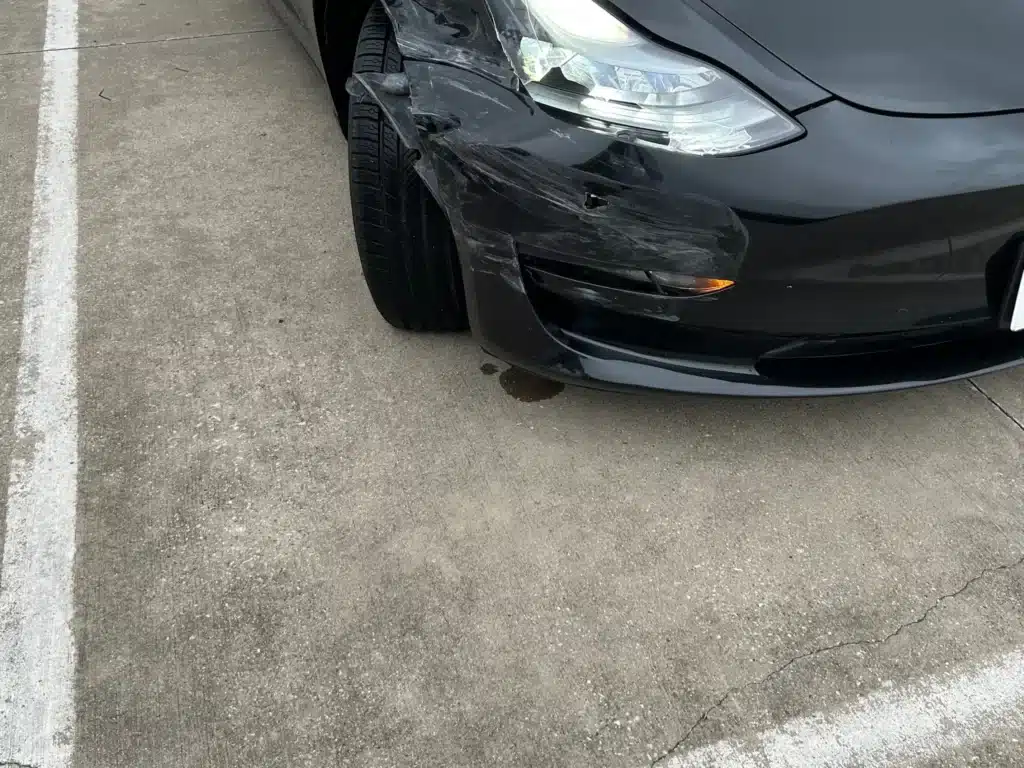
| Tesla Model 3, Unit 2 (our client) | 1-FR-3Force from 1 o’clock into the front right, severity 3 |
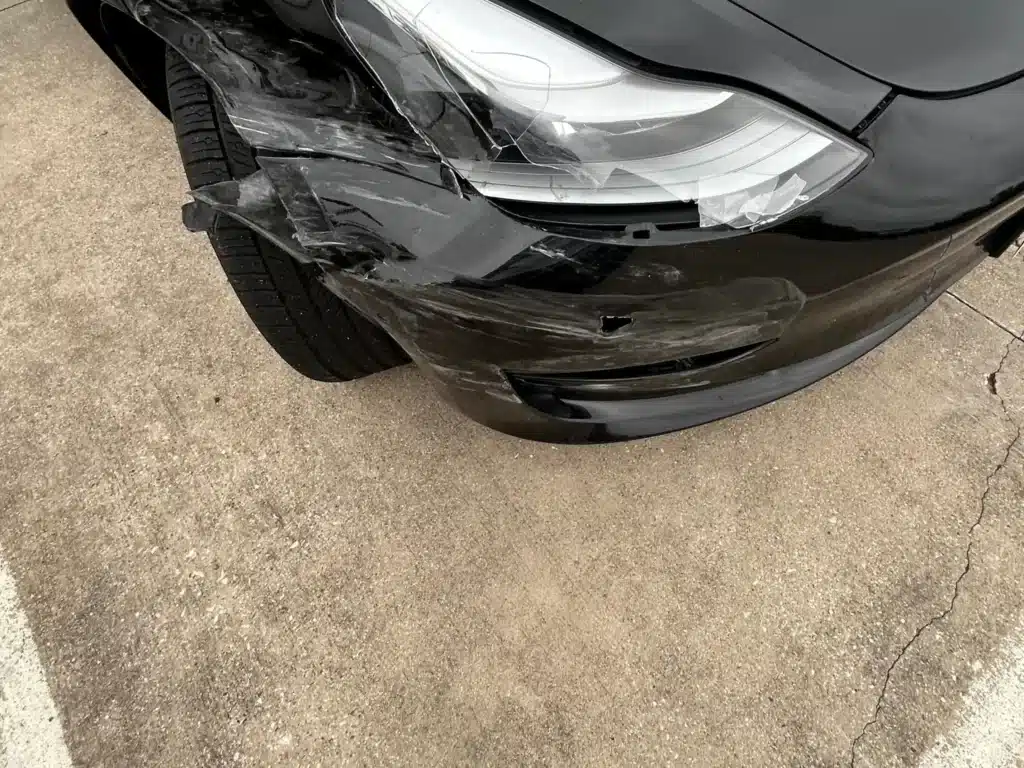
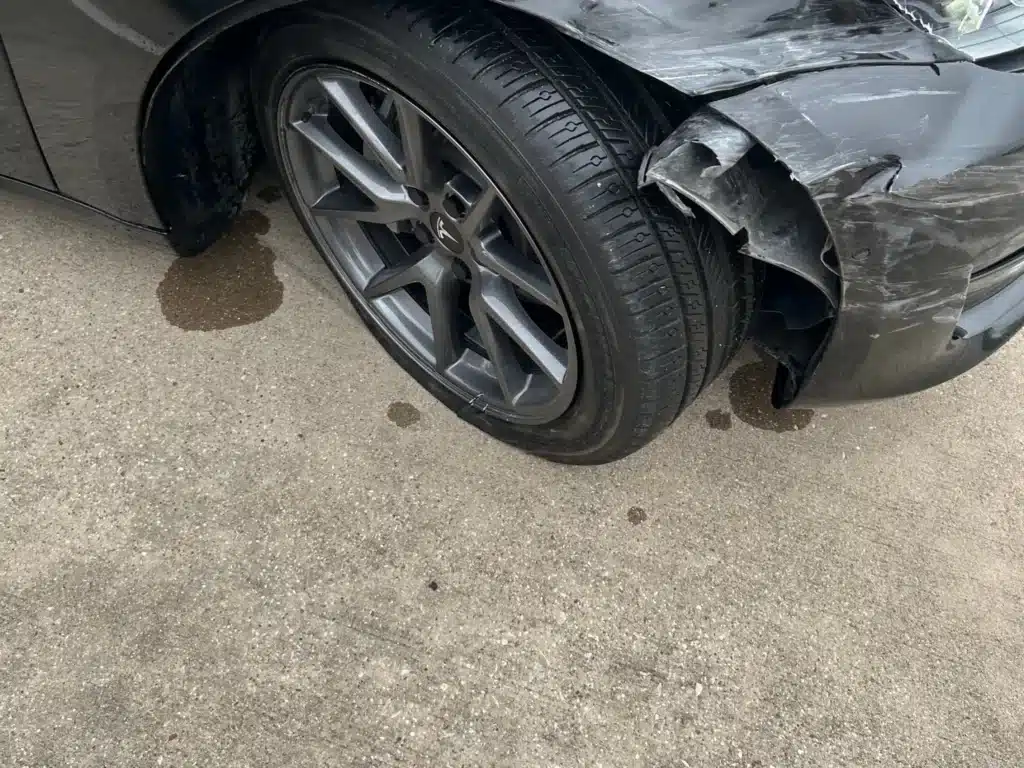
Five photos in our file were taken at the scene that morning, all before the officer arrived at 8:43: three of the Tesla and two of the Edge. We checked each one against the ratings above, and they match. The Tesla’s front right corner took the hit: the bumper cover split and peeled back around the wheel, the headlamp cracked and the fender creased, and the car was towed from Spring Valley Road. The Edge’s right rear corner came away scraped, with its bumper cover pulled loose, and the Edge was not towed.
From Injections to Neck Fusion
The officer coded our client N, not injured, and no ambulance took her anywhere. There was no emergency room visit. On October 10, 2023, she saw a pain management physician for pain in her neck, her mid back and her lower back, along with tension headaches. The exam found reduced range of motion through the neck and lower spine and pain over the facet joints, the small joints along the back of the spine; her neurological exam was normal. X rays showed her neck had lost its normal curve. The physician ordered MRIs and physical therapy and prescribed acetaminophen and methocarbamol, a muscle relaxant.
What the MRIs showed
The October 28 MRIs found disc bulges and protrusions in her neck, with tears through the tough outer ring of several discs, tears the radiologist described as “acute.” The spinal cord itself showed no abnormal signal. In her lower back, a disc protrusion with a similar tear and a bulge above it narrowed the openings where nerves leave the spine.
Therapy and injections
Physical therapy started in December: exercise, hands on manual therapy, traction, electrical stimulation, and heat and cold. In January 2024 she had two epidural steroid injections, which place anti inflammatory medicine near irritated spinal nerves, one in her lower back on January 9 and one in her neck on January 23. On February 20 she reported “near complete relief” from both, her headaches had become rare, and no further injections were recommended.
The spine surgeon
On May 1, 2024, a spine surgeon examined her and found brisk reflexes, including an inverted brachioradialis reflex, a reflex sign that points to pressure on the spinal cord at neck level; weakness in her right triceps and her left grip; reduced feeling in her left hand; and slow, uncoordinated opening and closing of her right hand. The diagnosis was cervical myelopathy, compression of the spinal cord in the neck, along with narrowing in her lower spine. At her June 28 visit she described trouble opening jars and numbness in her hands that was getting worse, and the exam found new numbness in her right forearm and weakness in both hands. The surgeon recommended an anterior cervical discectomy and fusion, an operation that removes damaged disc material through the front of the neck and fuses the bones on either side. She went ahead with the fusion surgery.
The $50,000 Limit, Then Her Own UIM
The Edge’s liability policy capped what it would pay for our client’s injuries at $50,000, more than the $30,000 Texas minimum explained in our guide to the 30/60/25 rule, but still a ceiling. Once that insurer paid every dollar of it, the rest of the recovery had to come from our client’s own policy.
That coverage is underinsured motorist coverage, or UIM. Insurance Code § 1952.101 makes it part of every Texas auto liability policy unless an insured on the policy declines it in writing. A vehicle counts as underinsured when its liability limits are lower than the UIM limit on the injured person’s own policy (§ 1952.103), and UIM then covers the rest of what the driver at fault is legally responsible for, up to the UIM limit (§ 1952.106). In August 2026 a staff member reminded a caller that it is “always good to just know the coverages,” and of UIM in particular: “That’s just the extra coverage that you can tap into as well.”
Our guide to claims that outgrow the other driver’s coverage explains these rules in depth, and our $105,000 Dallas result shows another case where UIM added to a policy limit recovery. What we did with all of it on her file comes next.
How We Built Her Claim
Every file at our firm passes through the same three sets of hands: our intake team, a case manager and a senior attorney. Here is what each of them does on a claim like hers, and what that looked like on her file, which went into a lawsuit.
Intake: the first conversation
Someone on our intake team picks up at any hour, and the call can happen in English or Spanish. The first conversation after a crash like this one gathers what everything else is built on: when and where it happened, whether an officer came, any photos from the scene, the insurance on both vehicles, what hurts, and what care has started. Intake then opens the file and hands it to a case manager.
Her case manager: records and updates
Each client gets one assigned case manager, a phone line straight to that person for calls and texts, and an update from our office at least every 14 days. The case manager follows the treatment as it happens. Hers ran from a pain clinic to an MRI center, through physical therapy and two injections, and on to a spine surgeon, and we requested the records and bills from each of those providers and read every page. By the end, her records ran to 224 pages.
When fusion was recommended
The surgeon’s recommendation in June 2024 changed the size of this claim. We gathered written estimates for the operation itself: the surgeon’s fees, the hospital’s charges and the implants. Those figures stay off this page, like every other medical number in her file.
Her attorney: the demand
A senior attorney leads every file. That attorney reviews the report and the insurance on both sides, signs off on the demand, leads the talks with the insurers and takes the client’s questions directly. On paper, fault pointed one way from the start: factor 37 for the Edge’s driver, nothing listed for our client, and a statute that makes the turning driver yield to oncoming traffic. Her demand to the Edge’s insurer drew on the whole file, along with a summary from an outside records reviewer, prepared for the demand, that projected the care still ahead of her. The insurer did not pay its limit.
Into a lawsuit
When the other side’s insurer refuses to pay a limit that a client’s injuries outrun, we file suit, and we did here. A lawsuit puts the claim on a court’s schedule. In discovery, each side must disclose what it knows, answer written questions under oath and turn over documents, and witnesses can be questioned under oath in depositions. For a client, discovery usually means sworn written answers about the crash, the treatment and daily life since, prepared with us, and sometimes a deposition.
We have walked this road before. On our $82,500 Plano result, another left turn crash, the truck’s commercial insurer said no to a policy limits demand before suit, and that case resolved in litigation in June 2026.
A fight for the full $50,000
Her case was in discovery when the Edge’s insurer agreed to pay its full $50,000, the most its policy would cover for her injuries. It took a fight to get there, and our attorney stayed on it until that limit was paid.
Then her own policy
With the Edge’s policy paid out, the at fault side of her claim was finished, but her losses ran past that limit. Her own auto policy carried underinsured motorist coverage, and that claim settled for $35,000 in February 2026, while the lawsuit was still pending.
September 2023 to February 2026
- September 14, 2023: The Edge turns across Spring Valley Road at 8:30 a.m.; the officer arrives at 8:43 and the scene clears by 9:00.
- September 22, 2023: TxDOT certifies the copy of the crash report we work from.
- October 10, 2023: First visit with a pain management physician; MRIs and physical therapy ordered.
- October 28, 2023: MRIs find torn discs in her neck and lower spine.
- December 2023: Physical therapy begins.
- January 9 and 23, 2024: Epidural steroid injections, lower back first, then neck.
- February 20, 2024: She reports near complete relief; no more injections recommended.
- May 1, 2024: The spine surgeon’s exam turns up signs of cord compression.
- June 28, 2024: Fusion surgery recommended, and she chooses to have it.
- Afterward: The neck fusion is performed.
- In suit: We file the lawsuit, and the case moves into discovery.
- In discovery: After a fight, the Edge’s insurer pays its full $50,000.
- February 2026: The UIM claim on her own policy settles at $35,000; the total is $85,000.
$85,000, Settled During Discovery
$85,000
Policy limit plus UIM, settled in litigation
| Source | Amount |
|---|---|
| The Edge’s liability insurer, its full policy limit | $50,000 |
| Underinsured motorist coverage on our client’s policy | $35,000 |
| Total recovery | $85,000 |
Both claims resolved while our lawsuit was in discovery, so the case ended without a trial. Our page on suing after a Texas car accident lays out each stage of a Texas lawsuit.
We keep our client’s identity private. These are gross figures; the firm’s fee, case expenses and medical liens are deducted before she receives her share. Every case has its own injuries, records, fault picture and coverage, so this result is not an estimate for anyone else’s claim.
Lessons From Spring Valley Road
- Turning left into a driveway, a driver must give way to oncoming cars, even when the nearest lane has stopped and left a gap.
- A policy limit is a ceiling, not a valuation. When one is paid in full, check the injured person’s own policy for UIM.
- Factor 37 on a CR-3 records the officer’s view of the cause even when the charges section is blank.
- Her spine surgeon’s notes, down to her trouble opening jars, put her daily limits on the record.
- Damage photos of both vehicles matched the officer’s ratings and the narrative’s point of impact.
- Written estimates turn a recommended surgery into a documented cost instead of a guess.
- A lawsuit is not a trial: this one ended in discovery, with both claims paid.
Attorney Review

Reviewed by: Josh Alexander, Founder and Managing Attorney
First published , reviewed the same day
More Texas Crash Case Results
- $850,000Pasadena red light crashSettled in litigation
- $600,000Rockwall County five vehicle crashSettled in litigation
- $600,000Mesquite 18 wheeler crashTruck accident settlement
- $325,000Hood County commercial truck crashSettled in litigation
- $175,000Round Rock construction vehicle crashSettled before suit
- $125,000Brownsville armored truck rear endSettled before suit
- $105,000Texas highway unsafe lane changeSettled before suit
- $105,000Three vehicle crash in DallasPolicy limits recovery
- $100,000Rear end, no police reportSettled before suit
- $95,000Midland company truck left turnSettled before suit
- $89,000San Antonio 3 car chain reactionSettled before suit
- $82,500Plano company truck left turnSettled in litigation
- $50,000Allen rear end crashPolicy limits settlement
- $30,000Houston hit and run recoveryUM policy limits
14Contact
Hit by a Driver
Hit by a Driver
Turning Left?
If the driver at fault carried too little coverage for your injuries, your own policy’s underinsured motorist coverage may make up part of the difference. We get the CR-3, find every policy that applies and press each one for what it owes.
No fee unless we recover · Se habla español · Proudly Serving All of Texas